Flame Test Lab Results and Solution Breakdown
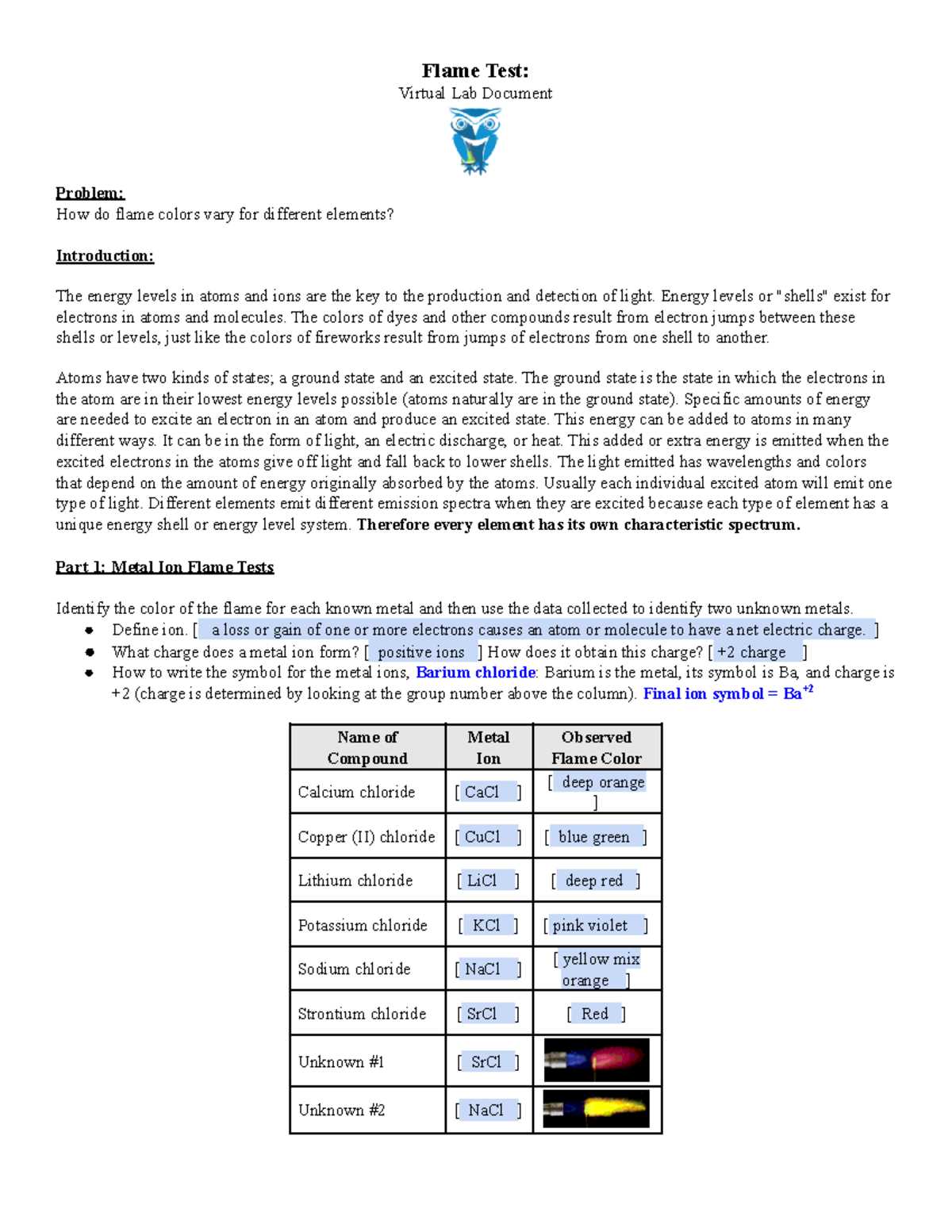
To accurately interpret the results from a metal ion detection experiment, it’s important to understand how specific elements react when exposed to heat. Different metals emit distinct colors when burned, and these color changes can be used to identify the presence of particular ions. This process requires careful observation and precise handling of materials to avoid errors and ensure reliable results.
One key to mastering this experiment is recognizing the common patterns in flame color reactions. For example, sodium typically produces a bright yellow flame, while copper can yield a green or blue hue. Understanding these patterns allows for quicker identification of unknown samples and aids in confirming your findings.
Reviewing solutions alongside your own results helps to identify where your methodology may need adjustment. For those new to the experiment, comparing the steps and observing where discrepancies occur can prevent misunderstandings in technique or misinterpretation of results. With practice, you will become more skilled at matching the observed colors with the corresponding ions, leading to more accurate conclusions.
Flame Test Lab Answer Key
When performing a metal ion identification experiment, observe the following reactions based on the type of metal being tested. Here’s a quick guide to interpreting the common colors produced:
- Sodium: Bright yellow flame
- Potassium: Light violet flame
- Calcium: Orange-red flame
- Barium: Green flame
- Copper: Green or blue flame
- Strontium: Red flame
Compare your observed results to this list to confirm the presence of these elements. If the color is different, check the purity of your sample or ensure proper heat application. Accurate identification requires consistent technique and careful attention to the flame color.
If your results do not match the expected colors, revisit the experiment steps, focusing on sample handling and flame exposure time. Small adjustments can help achieve accurate results and confirm the identification of the metal ions.
Understanding Flame Colors and Their Significance
Each metal ion produces a unique color when exposed to heat, which is due to the excitation of electrons in the atoms. The colors emitted are specific to the energy levels of the electrons in the metal atoms. Here’s a guide to interpreting the common colors produced in this experiment:
- Sodium (Na): Bright yellow – indicates the presence of sodium ions.
- Potassium (K): Light violet – signals potassium ions.
- Calcium (Ca): Orange-red – associated with calcium ions.
- Barium (Ba): Green – a sign of barium ions in the sample.
- Copper (Cu): Green or blue – often seen with copper compounds.
- Strontium (Sr): Red – characteristic of strontium ions.
Understanding these colors allows for the identification of different elements in a sample. The distinct hues arise from the specific wavelengths of light emitted as the electrons drop back to their original energy levels. Accurate identification depends on careful observation and consistent application of heat. If the observed color does not match the expected one, consider the sample purity and the flame temperature.
In some cases, additional factors like the presence of other chemicals may alter the flame color. Therefore, it is important to conduct multiple trials and compare results to ensure accurate identification.
How to Properly Perform the Flame Test Experiment
To conduct the experiment correctly, follow these key steps:
- Prepare your materials: Gather a Bunsen burner, metal salts or compounds to test, a clean wire loop, a heat-resistant mat, and safety equipment such as goggles and gloves.
- Clean the wire loop: Before each use, dip the wire loop into hydrochloric acid and heat it in the flame until no color is present. This ensures that the loop is free of contaminants.
- Dip the loop in the sample: Take a small amount of the metal compound with the wire loop. Make sure the sample is dry to avoid unexpected reactions.
- Heat the sample: Hold the loop with the sample in the Bunsen burner’s flame. Observe the color emitted as the metal ions are heated. Record the color change carefully.
- Repeat for different samples: For each new sample, clean the wire loop before testing to avoid cross-contamination. Repeat the procedure for all the substances you wish to test.
It’s crucial to keep the flame temperature constant and to use only small amounts of the sample to avoid any dangerous reactions. Always perform the experiment in a well-ventilated area and under supervision if you are unfamiliar with handling chemicals or heat sources.
For more detailed instructions and safety precautions, refer to authoritative resources like the American Chemical Society.
Common Metals Used in Flame Test and Their Results
Several metals are commonly used in the heating experiment to observe their characteristic colors. Each metal ion emits a distinct color when heated in a flame, which can be used to identify the substance. Here are some of the most common metals and the colors they produce:
- Lithium salts: Produces a bright red flame.
- Sodium salts: Emits a yellow flame.
- Potassium salts: Gives off a lilac or light purple flame.
- Calcium salts: Creates an orange-red flame.
- Barium salts: Produces a green flame.
- Copper salts: Results in a blue-green flame.
- Strontium salts: Emits a bright red flame similar to lithium.
These metals are typically tested using small amounts of their salts, which are heated in a flame to produce their characteristic colors. This method is useful in qualitative analysis and can help in identifying metals in unknown compounds.
How to Interpret Flame Colors for Different Ions
The colors produced by various ions when heated in a flame are a result of their characteristic emission spectra. Each metal ion emits light at specific wavelengths, which correspond to particular colors. To interpret flame colors correctly, it’s important to match the observed color with the known emission spectra of the ion being tested.
- Lithium (Li+): Bright red flame. Indicates the presence of lithium salts.
- Sodium (Na+): Intense yellow flame. This is a distinctive feature of sodium ions, often masking other colors in mixed samples.
- Potassium (K+): Light purple or lilac flame. Often observed as a faint, pale color.
- Calcium (Ca2+): Orange-red flame. A characteristic color for calcium ions.
- Barium (Ba2+): Green flame. Strong green color helps identify barium compounds.
- Copper (Cu2+): Blue-green flame. Copper compounds tend to produce a distinctive greenish-blue hue.
- Strontium (Sr2+): Red flame. Similar to lithium but typically more intense and vibrant.
By observing these colors and comparing them with known standards, it’s possible to identify specific metal ions in unknown compounds. Ensure proper cleaning of equipment between tests to avoid contamination that may alter results.
Identifying Errors in the Flame Test and How to Avoid Them
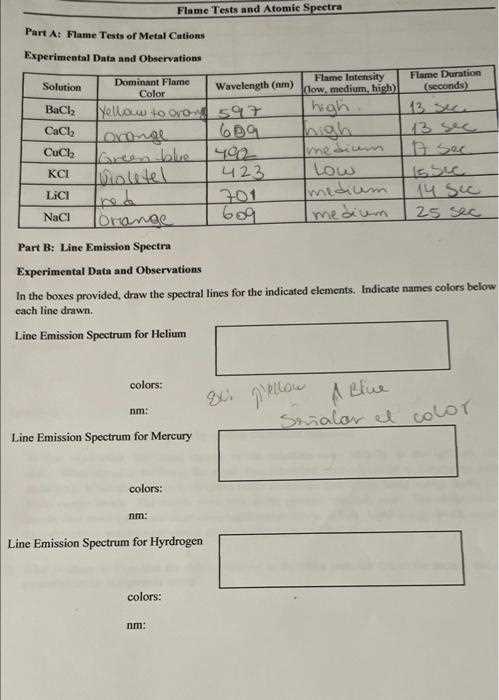
Errors during the procedure can lead to inaccurate results. Here are common mistakes and tips on how to prevent them:
| Error | How to Avoid |
|---|---|
| Contamination of the wire loop | Ensure the wire is cleaned thoroughly between tests using hydrochloric acid and a flame. This prevents previous samples from affecting the results. |
| Incorrect flame color identification | Ensure proper lighting conditions when observing the flame. Use a white background to better distinguish the flame color, and allow the flame to stabilize before recording observations. |
| Failure to use proper sample size | Use a small, manageable amount of the substance for accurate results. Too much material can overwhelm the flame and obscure the color. |
| Overheating the sample | Avoid exposing the substance to excessive heat. Overheating can alter the color of the flame, making it difficult to determine the correct metal ion. |
| Misinterpretation of colors | Familiarize yourself with the common flame colors of different ions. Practice using samples of known compounds to gain experience before identifying unknown substances. |
| Using a contaminated burner | Clean the burner thoroughly before starting the experiment to avoid contamination of the flame. This ensures the flame color is not altered by residual chemicals. |
By following these precautions, you can minimize errors and improve the accuracy of your observations during the procedure.
Using the Solution Set to Verify Flame Test Results
Compare the observed colors with a known solution set to confirm your findings. This allows you to match the flame color to specific metal ions. Here’s how to do it:
- Before beginning, review the solution set that corresponds to the expected flame colors for common metal ions.
- After observing the flame color, check it against the solution set to verify which ion produced the observed result.
- For accuracy, use a white background to view the flame color clearly and make sure the flame is stable before recording your result.
- If the observed color does not match any ion in the solution set, double-check the sample size and the wire cleanliness. Contamination can alter the color.
- Take note of the intensity and consistency of the color. A weak or inconsistent flame could indicate an error in procedure or sample preparation.
- If you’re unsure, repeat the process with a new sample to verify your observation against the solution set.
This method helps reduce mistakes and ensures that your results are reliable and match known data.
Analyzing the Chemistry Behind Flame Colors in the Test
Different metals emit specific colors when heated due to the excitation of their electrons. The heat provides energy that causes the metal atoms to excite and jump to higher energy levels. When they return to their ground state, they release energy in the form of light. The wavelength of this light corresponds to a specific color. Here’s how it works:
- Sodium: Produces a bright yellow color due to electron transitions between energy levels that emit light at 589 nm.
- Potassium: Emits a pale lilac or light purple color, with the emission peak around 404 nm.
- Copper: Can create a greenish-blue hue, primarily due to the emission of light at wavelengths between 480 nm and 510 nm.
- Calcium: Shows a brick red flame as a result of the release of light around 622 nm.
- Barium: Produces a green flame, typically around 510 nm, because of its unique electron transitions.
These color patterns are not random. The wavelength of light emitted is specific to the energy levels of the electrons in the metal atoms, and these levels vary from one element to another. By carefully observing these colors, one can identify the metal based on known spectral data.
Preparing for a Flame Test Lab Exam or Quiz
To succeed in an exam or quiz based on this experiment, start by familiarizing yourself with the various metal salts and their characteristic colors when exposed to high heat. Understanding the specific wavelengths emitted by each metal is key to identifying them correctly. Review the common metal ions tested, such as sodium, potassium, calcium, and copper, and their associated flame colors.
Practice interpreting the results from different chemical reactions. Create flashcards with the metal names on one side and their corresponding flame colors on the other. This helps reinforce the association between each ion and the observed color. Additionally, focus on understanding why certain metals produce specific colors, paying attention to their electron configurations and energy transitions.
Before the exam, review the experimental procedure carefully. Know the steps for preparing samples, heating them properly, and recording observations. Make sure to understand safety protocols, such as handling chemicals and using appropriate protective equipment, as this may be tested in practical assessments.
Lastly, take practice quizzes or tests, if available, to gauge your understanding of the material. This will help you feel more confident and identify areas where you need additional study.