30 60 90 Triangle Worksheet Solutions and Step by Step Guide
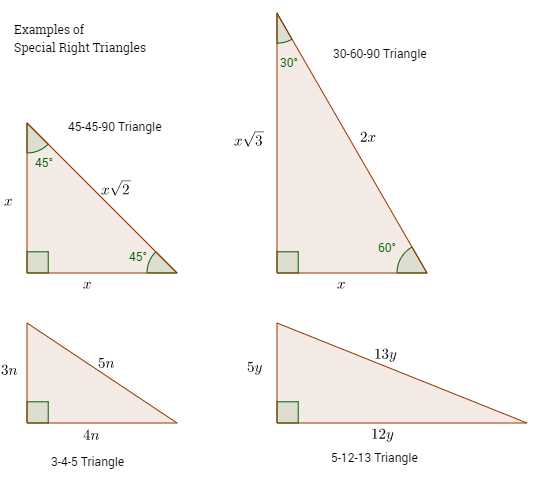
To solve for the sides of a 30-60-90 right-angled figure, always start by identifying the known and unknown values. The key to solving these problems efficiently is recognizing the ratios between the sides. The shorter leg is always half the length of the hypotenuse, and the longer leg is the shorter leg multiplied by the square root of 3.
The most common approach involves using the specific side ratios that define this shape: 1:√3:2. By knowing these relationships, you can easily calculate the missing side lengths, even when the initial information only provides one dimension. Practice applying these ratios, and soon you’ll be able to solve problems without hesitation.
When dealing with these kinds of geometric questions, accuracy is important. Remember to check your results twice and ensure your work adheres to the correct formula. It’s also recommended to draw a diagram if necessary, as visualizing the figure can often help clarify the relationships between the angles and sides.
30 60 90 Triangle Worksheet Solutions and Step by Step Guide
To solve problems involving this specific type of right-angled figure, follow these clear steps:
- Identify the given side length: Typically, you’ll either have the length of one side, the hypotenuse, or another parameter. Start by marking the known values.
- Apply the 1:√3:2 ratio: The sides of this shape follow a predictable ratio. The shorter leg is half the hypotenuse, and the longer leg is the shorter leg multiplied by √3.
- Calculate missing sides: Once the ratio is known, calculate the missing side lengths. For example, if the hypotenuse is 10, the shorter leg is 5, and the longer leg will be 5√3, approximately 8.66.
- Double-check your work: After calculating the missing side lengths, ensure that they match the 30-60-90 triangle ratios and the Pythagorean theorem.
- Draw a diagram: If you’re unsure about the configuration, sketch a diagram of the shape. Label all sides and angles to keep track of your values.
By following these steps, you can confidently solve problems involving this specific geometric figure. Practice applying these techniques to strengthen your understanding of the concepts.
For more detailed examples and practice problems, you can visit reliable educational sites like Khan Academy, where you’ll find more content related to geometry and right-angled figures.
Understanding the Properties of 30 60 90 Triangles
The 30-60-90 figure has three key properties that simplify problem-solving. First, its angles are fixed: 30°, 60°, and 90°, with the 90° angle being the right angle.
Next, the side lengths follow a specific ratio. If you know one side, you can easily calculate the others based on the following relationships:
| Side | Length in Relation to Hypotenuse |
|---|---|
| Hypotenuse | 2x (where x is the length of the shorter leg) |
| Shorter leg | x |
| Longer leg | x√3 |
This predictable ratio allows for quick calculations when solving for missing sides. For example, if the hypotenuse is 12, the shorter leg will be 6, and the longer leg will be approximately 10.39 (6√3).
By mastering these properties, you can efficiently solve for unknown side lengths in any problem involving a 30-60-90 configuration.
How to Calculate the Sides of a 30 60 90 Triangle
To calculate the sides of a 30-60-90 figure, use the ratio between the side lengths. This is based on the properties of the angles and the relative lengths:
- The hypotenuse (longest side) is twice the length of the shorter leg.
- The shorter leg (opposite the 30° angle) is half the length of the hypotenuse.
- The longer leg (opposite the 60° angle) is the shorter leg multiplied by the square root of 3.
Here’s how to calculate each side step-by-step:
- Identify the given side length. Typically, the hypotenuse is given, but the shorter leg can also be specified.
- If the hypotenuse is given, divide it by 2 to find the shorter leg. For example, if the hypotenuse is 12, the shorter leg is 6.
- To find the longer leg, multiply the shorter leg by √3. For a shorter leg of 6, the longer leg will be approximately 10.39 (6 × √3).
For example, if the hypotenuse is 14:
- Shorter leg = 14 ÷ 2 = 7
- Longer leg = 7 × √3 ≈ 12.12
Using these relationships, you can easily determine any unknown side if one side length is known.
Step by Step Instructions for Solving 30 60 90 Triangle Problems
Follow these steps to solve any problem involving a 30-60-90 figure:
- Identify the known side. Start with the given side length, which could be the hypotenuse, shorter leg, or longer leg.
- Use the side ratio. The side lengths of a 30-60-90 figure have a fixed ratio:
- The hypotenuse is twice the length of the shorter leg.
- The longer leg is the shorter leg multiplied by √3.
- Find the missing sides. Depending on the given side, calculate the other sides:
- If the hypotenuse is given, divide it by 2 to get the shorter leg, then multiply the shorter leg by √3 to find the longer leg.
- If the shorter leg is given, multiply it by 2 to get the hypotenuse, then multiply the shorter leg by √3 to find the longer leg.
- If the longer leg is given, divide it by √3 to find the shorter leg, then multiply the shorter leg by 2 to find the hypotenuse.
- Double-check your calculations. Ensure that the sides fit the correct ratio (hypotenuse:shorter leg:longer leg = 2:1:√3).
- Use the Pythagorean theorem if needed. For verification, apply the Pythagorean theorem (a² + b² = c²) where a and b are the legs, and c is the hypotenuse.
These steps will guide you through solving for any unknown side in a 30-60-90 figure using basic ratios and the Pythagorean theorem.
Identifying Key Angles and Their Relationships in 30 60 90 Triangles
The angles in a 30-60-90 figure have fixed relationships that make solving problems straightforward. The angles are always 30°, 60°, and 90°. Here’s how these angles relate to each other:
- 30° angle: This is the smallest angle and is opposite the shortest leg.
- 60° angle: This is the second largest angle, located opposite the longer leg.
- 90° angle: The largest angle in the figure, located between the two legs. This angle always measures 90°.
The relationships between the angles are consistent, allowing you to use known values to solve for missing parts of the figure. The two non-right angles always sum up to 90° (30° + 60°), which is key when using the Pythagorean theorem or applying trigonometric ratios. Understanding these relationships simplifies the calculation of side lengths and other parameters in these specific geometric shapes.
Using the Ratio Method to Solve for Unknown Sides
The ratio method is a quick way to solve for unknown sides in a 30-60-90 figure. The side lengths of these shapes have fixed ratios, making it easier to calculate missing values when one side is known.
In a 30-60-90 figure, the side lengths are related as follows:
- The length of the side opposite the 30° angle is the shortest side, labeled as x.
- The length of the side opposite the 60° angle is x√3, which is longer than the shortest side.
- The hypotenuse, opposite the 90° angle, is twice the length of the shortest side, or 2x.
To solve for an unknown side, use the known side length and apply these ratios. For example, if the shortest side is given as 5, the other two sides can be calculated as follows:
| Side | Length |
|---|---|
| Opposite 30° | 5 (x) |
| Opposite 60° | 5√3 |
| Hypotenuse (opposite 90°) | 10 (2x) |
By knowing just one side, you can easily apply the ratio method to find the other two sides, providing a quick solution for most problems involving these specific shapes.
Common Mistakes to Avoid When Working with 30 60 90 Triangles
Avoid assuming that the side opposite the 60° angle is the longest. In a 30-60-90 shape, the hypotenuse is always the longest side, and it is twice the length of the shortest side.
Another mistake is misapplying the ratios between the sides. The correct relationship is:
- The shortest side is x.
- The side opposite the 60° angle is x√3.
- The hypotenuse is 2x.
Don’t forget to check the given angles. The key feature of these shapes is that one angle is 30°, another is 60°, and the third is always 90°. If the angles are not correctly identified, the side length ratios will not hold.
Be cautious when working with square roots. Mistakes often happen when simplifying expressions like 5√3 or squaring values. Always ensure proper simplification before applying them in calculations.
Lastly, never assume that the sides will always be given in simple integer values. While the ratios remain consistent, side lengths may need to be calculated with decimals or radicals, requiring careful handling during arithmetic operations.
Real-World Applications of 30 60 90 Triangles
One common use of this shape is in architecture and construction, where precise angles are necessary for structural integrity. The 30-60-90 form is often found in roof trusses, ensuring the correct angle for load-bearing supports.
In navigation, the properties of a 30-60-90 shape help determine the distance between objects using angle measurements. For example, they are used in triangulation methods to calculate the distance between a ship and a landmark.
Surveyors use this shape for land mapping, where right-angle formations help measure elevations and slopes. The predictable side ratios simplify the calculation of distances in difficult terrain.
In mechanical engineering, components such as gears and supports often follow the same principles. Understanding the properties of these shapes helps in designing parts that need to fit at specific angles, ensuring accurate assembly.
In electronics, 30-60-90 configurations can be found in circuit layouts and designs, where precise component placement at certain angles ensures optimal space usage and function.
How to Check Your Solutions for Accuracy
To ensure that your solutions are correct, follow these steps:
- Verify the ratios of the sides. In a 30-60-90 shape, the side opposite the 30° angle is half the length of the hypotenuse, and the side opposite the 60° angle is √3 times the length of the shortest side.
- Use the Pythagorean theorem. For right-angled figures, ensure the sum of the squares of the two shorter sides equals the square of the hypotenuse.
- Cross-check angles. The sum of the angles should always be 180°. Ensure the 30°, 60°, and 90° angles are correctly placed in the figure.
- Substitute your side lengths into known formulas. For instance, if given one side length, check if the calculated values for the other sides match the expected ratios.
- Recheck your math. Double-check calculations for each step, particularly when using square roots or fractions, as small errors can affect the final result.
By following these methods, you can ensure that your work is accurate and that you’ve applied the correct formulas and principles to solve for unknowns.