Complete Guide to Ionic Bonds Practice and Solutions
To correctly solve questions related to chemical compounds, first ensure you fully grasp the concept of how atoms combine to form stable structures. Pay attention to how atoms transfer or share electrons to achieve full outer electron shells, which is the primary principle behind many of the exercises you will encounter.
In this guide, focus on recognizing common characteristics of different compounds, such as the transfer of electrons between metals and non-metals. These patterns will help you identify the structure of the compounds and solve related problems more efficiently. Use the periodic table actively to determine valence electrons, which are critical for understanding how chemical elements interact.
For complex problems, break down each step methodically. Start by identifying the participating elements, then proceed to balance charges based on the number of electrons involved in the reaction. Double-check that your calculations of electron transfer and charge balance align with the principles of atomic structure.
Chemical Compound Formation Practice and Solutions
Start by identifying the types of elements involved. Typically, a metal reacts with a non-metal to form a compound. Ensure you understand how electrons are transferred from the metal atom to the non-metal atom to achieve a stable configuration for both atoms.
For each reaction, calculate the number of electrons involved in the transfer. Remember, metals lose electrons to become positively charged ions, while non-metals gain electrons to become negatively charged. The total number of positive and negative charges should always balance to maintain neutrality in the compound.
| Element 1 | Element 2 | Electrons Transferred | Resulting Ions | Formula |
|---|---|---|---|---|
| Sodium (Na) | Chlorine (Cl) | 1 | Na+, Cl– | NaCl |
| Magnesium (Mg) | Oxygen (O) | 2 | Mg2+, O2- | MgO |
| Calcium (Ca) | Fluorine (F) | 2 | Ca2+, F– | CaF2 |
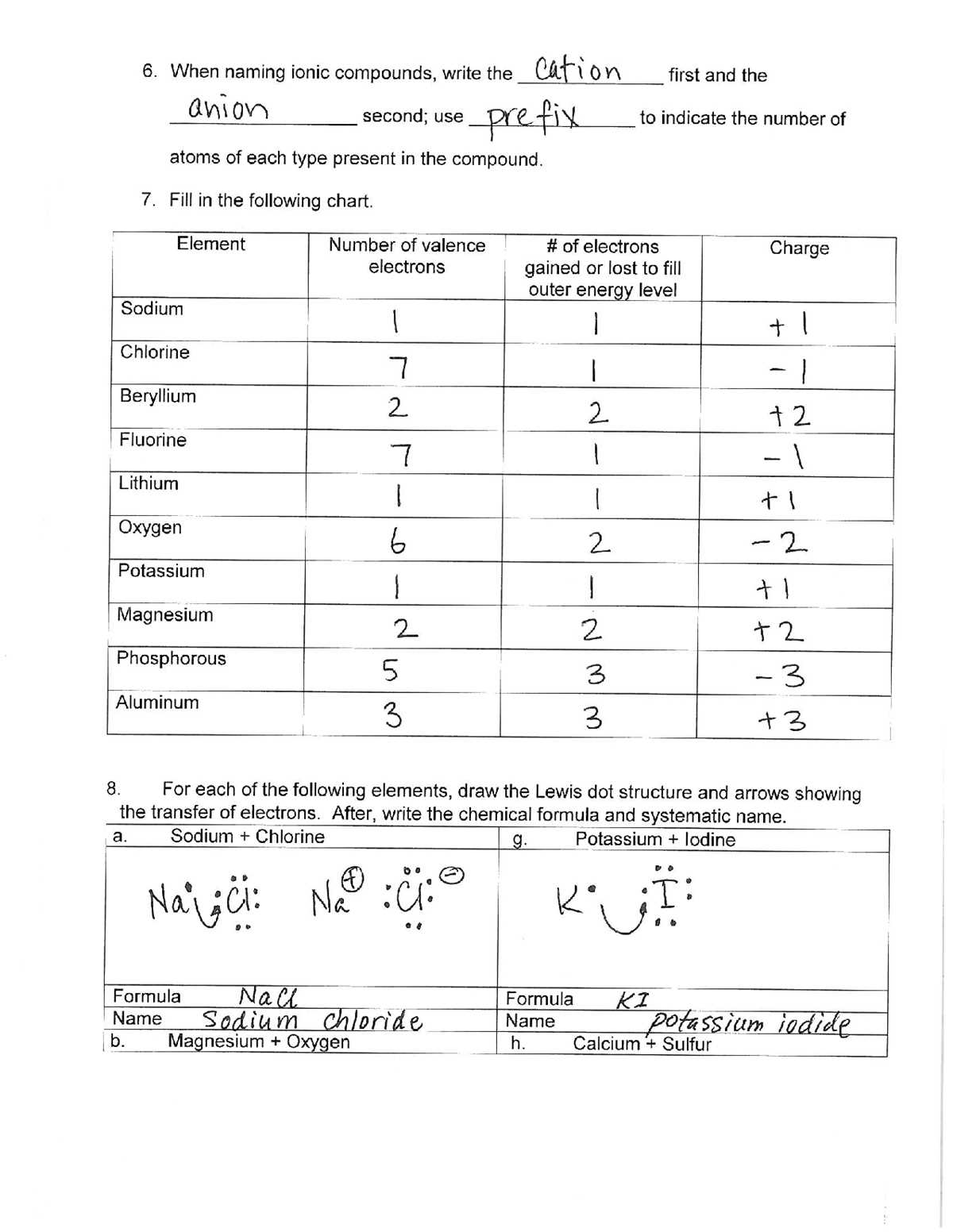
Once you’ve determined the ion charges, the next step is to balance the compound. In the case of sodium chloride (NaCl), sodium loses one electron to form Na+, and chlorine gains one electron to form Cl–. Since the charges are already balanced, the compound is formed in a 1:1 ratio.
For compounds like magnesium oxide (MgO), magnesium loses two electrons to form Mg2+, while oxygen gains two electrons to form O2-. In this case, the formula reflects a 1:1 ratio, with one magnesium ion for every oxide ion.
After practicing multiple reactions, check your results to verify that both the charges and ratios are consistent. This practice will solidify your understanding of how atoms interact to form stable compounds.
Understanding Chemical Compound Formation
When two atoms interact to form a compound, one atom typically transfers electrons to the other, resulting in the formation of charged particles called ions. The process begins with the interaction of a metal and a non-metal. The metal atom loses one or more electrons, becoming positively charged, while the non-metal atom gains those electrons, becoming negatively charged.
The opposite charges of these ions create an electrostatic attraction between them, which holds the atoms together. This attraction results in the formation of a stable compound. The charge balance between the ions ensures the overall neutrality of the resulting substance.
To better understand this process, consider the following steps:
- The metal atom loses electrons, forming a positive ion (cation).
- The non-metal atom gains electrons, forming a negative ion (anion).
- Opposite charges attract, and the ions combine to form a neutral compound.
For example, in the case of sodium and chlorine:
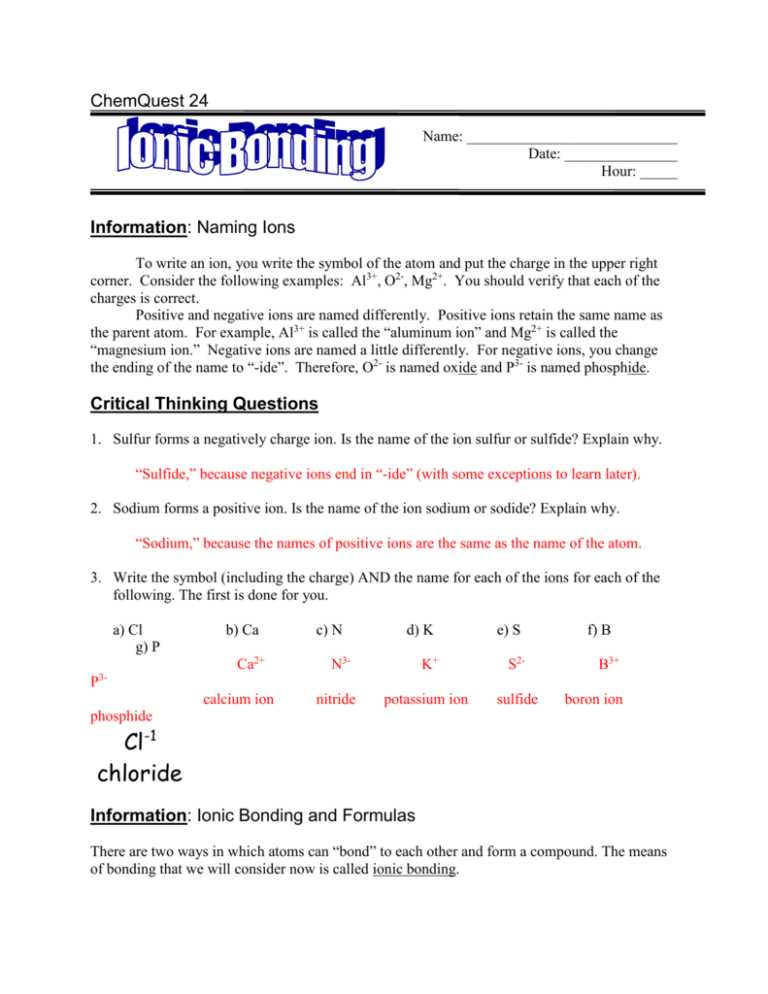
- Sodium (Na) loses one electron, forming Na+.
- Chlorine (Cl) gains one electron, forming Cl–.
- These ions then combine to form NaCl, a stable compound with no net charge.
The number of electrons lost by the metal and gained by the non-metal determines the ratio of the ions in the final compound. For compounds like magnesium oxide (MgO), where magnesium loses two electrons and oxygen gains two, the formula reflects a 1:1 ratio between the ions (Mg2+ and O2-).
Understanding the transfer of electrons and the resulting ion formation is key to grasping how many common compounds are formed in nature.
Steps to Identify Chemical Compounds in Exercises
To determine if a given compound forms through electron transfer between atoms, follow these steps:
- Check the elements involved: Identify whether the compound is made of a metal and a non-metal. Metals typically lose electrons, while non-metals gain electrons.
- Examine the charges: Look for elements that are likely to form charged ions. Metals will become positively charged (cations), and non-metals will form negatively charged ions (anions).
- Verify the electron transfer: Confirm that one atom loses electrons and the other gains electrons. This transfer is key to forming an electrically neutral compound.
- Determine the ion ratio: Ensure that the number of electrons lost by the metal matches the number gained by the non-metal. This determines the ratio of ions in the compound (e.g., Na+ and Cl– form NaCl).
- Assess the final compound: Check if the ions combine to form a stable, electrically neutral compound. The compound should not have an overall charge.
By following these steps, you can easily identify whether a compound is formed through the transfer of electrons between a metal and a non-metal, leading to a stable ionic compound.
How to Balance Charges in Chemical Compounds
To ensure a neutral compound is formed, follow these steps to balance the charges of the involved ions:
- Identify the charges of the ions: Determine the charge of the metal and non-metal ions. For example, sodium (Na) typically forms Na+, and chlorine (Cl) forms Cl–.
- Balance the total positive and negative charges: The number of positive charges must equal the number of negative charges. If one ion has a +2 charge, and another has a -1 charge, more than one of the -1 ions will be needed.
- Adjust the ion ratio: Use the lowest common multiple to determine how many of each ion are required to balance the overall charge. For instance, if magnesium (Mg2+) pairs with chloride (Cl–), the ratio will be 1:2.
- Write the formula: Once the charges are balanced, write the formula with the correct number of each ion. The number of ions will be represented as subscripts in the formula (e.g., MgCl2).
By following these steps, you can effectively balance the charges in any ionic compound and ensure it remains electrically neutral.
Common Mistakes to Avoid in Chemical Bond Questions
Here are key mistakes to watch out for when working with chemical compounds:
- Ignoring ion charges: Always account for the charges of each ion. Failing to consider the charge when balancing can result in an incorrect formula.
- Incorrectly balancing the ions: Ensure the number of positive charges equals the number of negative charges. Missing or incorrectly placing subscripts leads to an unbalanced compound.
- Confusing ionic and covalent compounds: Distinguish between ionic and covalent compounds. Ionic compounds involve the transfer of electrons, while covalent compounds share electrons.
- Assuming all compounds are neutral: While most compounds are neutral, it’s important to confirm that both the positive and negative charges balance each other out.
- Forgetting to write the correct ratio of ions: Use the simplest ratio of ions to achieve charge balance. For example, if two positive ions are needed to balance a single negative ion, don’t forget to write the correct subscript.
By avoiding these mistakes, you’ll improve your ability to work with compounds and determine the correct chemical formulas.
Analyzing Chemical Compound Properties in Real-Life Examples
Understanding the practical applications of these compounds helps explain their properties in real life. Here are some examples:
- Table Salt (NaCl): Sodium chloride is an example of a stable compound formed from a metal and a non-metal. Its high melting point and ability to dissolve easily in water are key characteristics derived from its crystal lattice structure.
- Water Treatment: Calcium chloride (CaCl2) is used in water softening processes. The strong electrostatic attraction between calcium and chloride ions allows for the effective removal of hardness-causing minerals in water.
- Battery Technology: Lithium fluoride (LiF) is utilized in battery technology, where the stability and conductivity of the compound play a vital role in energy storage solutions.
- Soaps and Detergents: Sodium stearate is commonly used in soap making. Its hydrophilic and hydrophobic properties are a direct result of its molecular structure, where the ionic nature allows it to attract both water and oil.
- Food Additives: Potassium iodide (KI) is used as a food additive to prevent iodine deficiency. Its ionic form ensures that iodine remains stable when added to salt and other food products.
By studying these examples, it’s easier to grasp the practical applications of chemical compounds in daily life and their unique properties that arise from the interaction between charged particles.
How to Use Periodic Table for Ionic Compound Calculations
To calculate the formation of compounds between metals and non-metals, the Periodic Table is a crucial tool. Here’s how to use it effectively:
- Identify the Elements: Locate the elements involved in the reaction on the table. Metals, typically found on the left side, tend to lose electrons, while non-metals on the right side gain electrons.
- Determine the Charges: Determine the ion charges based on the group number. For metals, the charge is equal to the group number (e.g., alkali metals like sodium have a +1 charge). Non-metals usually gain electrons to form negative ions, with the charge being the number of electrons gained to reach a stable octet (e.g., chlorine forms a -1 ion).
- Balance the Charges: Use the ion charges to balance the compound. The total positive charge must equal the total negative charge. For example, combining Na+ and Cl- results in NaCl, where one positive ion balances one negative ion.
- Write the Formula: The simplest formula is determined by the lowest whole number ratio that balances the charges. If combining calcium (Ca²⁺) and chlorine (Cl⁻), two chloride ions are needed to balance one calcium ion, resulting in CaCl₂.
For more detailed information on this process and to view the periodic table, visit Ptable, an interactive periodic table with ionization energy, atomic radius, and electron configurations.
Strategies for Solving Complex Ionic Compound Problems
To tackle complex problems involving the formation of compounds, follow these steps:
- Identify the Elements: Begin by noting the elements involved and their positions on the Periodic Table. Metals generally lose electrons, while non-metals gain electrons to form ions.
- Determine the Ionic Charges: Use the group numbers to predict the charges of each element. For metals, the charge corresponds to the group number (e.g., Group 1 elements form +1 ions). Non-metals usually take on a negative charge to complete their octet.
- Cross Multiply to Balance Charges: For compounds with multiple ions, use the crisscross method. For example, combining magnesium (Mg²⁺) with chlorine (Cl⁻) requires two chlorine ions to balance one magnesium ion, giving the formula MgCl₂.
- Check for Charge Neutrality: Ensure that the total positive charge balances with the total negative charge. If the charges do not balance, adjust the number of ions accordingly to achieve neutrality.
- Write the Empirical Formula: Once the charges are balanced, write the simplest whole number ratio of the ions in the compound.
For more complex cases, pay attention to polyatomic ions or transition metals with variable charges. When in doubt, refer to reliable sources for ion charge information and common ion pairs.
How to Verify Your Ionic Compound Calculations for Accuracy
To confirm the correctness of your calculations, follow these steps:
- Double-check the Ion Charges: Review the charges of each ion involved. Ensure metals are assigned positive charges based on their group, and non-metals have negative charges, typically corresponding to the number of electrons they gain.
- Balance the Charges: After assigning charges, check that the total positive charge equals the total negative charge. If they do not balance, adjust the number of ions accordingly to neutralize the compound.
- Verify the Empirical Formula: Ensure that the ratio of ions is written in the simplest whole number form. For example, for a compound formed between calcium and chloride, the formula should be CaCl₂, not Ca₂Cl₄.
- Use the Crisscross Method: When balancing charges, apply the crisscross method to correctly combine ions. Double-check that the numbers for each ion are correctly swapped to balance the charges.
- Cross-reference with Reliable Sources: Refer to the Periodic Table or trusted resources to confirm the ionic charges of elements, especially for transition metals with variable charges or complex ions.
If you find discrepancies, retrace your steps or consult a reference guide to confirm the correct charges and ratio of ions. Accuracy is crucial in achieving the correct formula for the compound.