Key Answers for Classifying Chemical Reactions Lab Exercise and Analysis
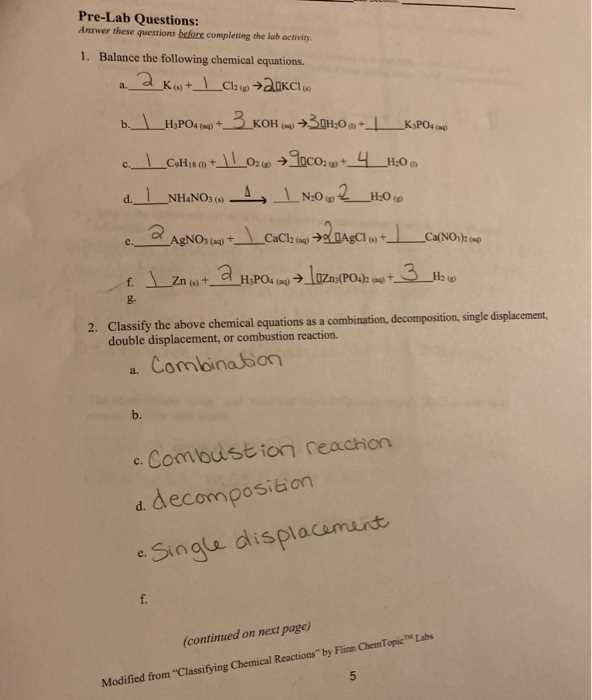
First, examine the types of transformations that occur during experiments. This knowledge is critical when identifying patterns in compound interactions. Focus on recognizing the formation of new substances, which may result from elements combining, decomposing, or displacing each other. Identifying the type of transformation depends on observing specific changes in properties or reactant-product relationships.
Next, pay attention to observable signs such as color shifts, gas production, or heat exchange. These indicators suggest particular types of processes, whether it’s the synthesis of compounds, their breakdown, or the exchange of ions. Being able to match these clues to specific categories enhances understanding of the underlying principles at play.
Additionally, consider stoichiometric relationships and balancing equations. This allows for predicting the quantities involved and understanding how substances interact under controlled conditions. For accuracy, always verify the nature of the substances and the consistency of reactions under various conditions.
Understanding the Patterns in Transformations
In order to identify the type of transformation occurring in a given scenario, start by analyzing the reactants and products. Pay attention to the nature of bonds formed or broken, and determine whether substances are combining, decomposing, or swapping components.
Here’s how you can categorize different processes:
- Synthesis: Two or more substances combine to form a new compound. Look for patterns where elements or compounds merge to create a single product.
- Decomposition: A single compound breaks down into two or more simpler products. This often occurs when energy is added to the system (e.g., heat or electricity).
- Single Displacement: One element displaces another in a compound. Typically, this involves an element reacting with a compound, where the free element replaces one part of the compound.
- Double Displacement: Two compounds exchange components to form two new compounds. This type often results in the formation of a precipitate or gas.
- Combustion: A substance reacts with oxygen, releasing energy in the form of heat and light. The products are typically carbon dioxide and water.
Next, check the state of the substances involved. Solid, liquid, gas, and aqueous phases often indicate specific types of transformations. A gas formed in a reaction may suggest a displacement or combustion process, while a solid precipitate hints at a double displacement reaction.
Finally, pay close attention to the energy changes. Some processes require heat or light to proceed (e.g., decomposition), while others release energy (combustion). By analyzing these aspects, you can determine the transformation type with more certainty.
Understanding the Basics of Chemical Reaction Classification
Identify the type of transformation by observing the change in substances involved. A combination event occurs when two reactants join to form a single product, such as hydrogen reacting with oxygen to form water.
Decomposition occurs when a compound breaks down into simpler components. Heating sodium bicarbonate, for example, produces sodium carbonate, carbon dioxide, and water.
Displacement processes involve one element replacing another. For instance, when zinc reacts with copper sulfate, zinc displaces copper from its compound.
Double displacement happens when two compounds exchange ions. This often results in the formation of a precipitate, such as when silver nitrate reacts with sodium chloride to form silver chloride.
Redox processes involve the transfer of electrons. A common example is the oxidation of iron, where iron loses electrons to oxygen, forming iron oxide.
Recognizing these categories helps predict the outcome of similar interactions and provides insight into the nature of the substances involved.
Identifying Different Types of Chemical Reactions in Experiments
To accurately identify the nature of processes in an experiment, observe specific indicators such as energy changes, the formation of new compounds, or the release of gas. These observable traits are linked to distinct forms of transformations that occur during interactions between substances.
In cases where a new substance forms as a result of mixing, a precipitate may be seen settling at the bottom of a solution. Such a transformation often indicates the occurrence of a double displacement process. In this scenario, two ionic compounds react, exchanging components to form an insoluble product.
When heat is either absorbed or released during the interaction, this provides a strong clue regarding the type of event taking place. Endothermic transformations absorb energy, while exothermic processes release energy. This feature is a reliable way to distinguish between different events, especially in the context of thermal changes.
Another common indicator is the production of a gas. During certain reactions, bubbles or effervescence appear, signaling that a new gaseous substance is being generated. This is typical of acid-base interactions or decomposition reactions.
Below is a table that categorizes typical outcomes and associated types of interactions based on observed changes in an experiment:
| Indicator | Possible Transformation Type |
|---|---|
| Formation of a precipitate | Double displacement |
| Heat absorption or release | Endothermic or exothermic |
| Gas production | Decomposition or acid-base |
| Color change | Oxidation-reduction |
By observing these distinct outcomes, it becomes clear which type of transformation is occurring during the process. This helps in making accurate conclusions about the materials involved and the specific interaction taking place.
Step-by-Step Guide to Balancing Chemical Equations
Balance the atoms of each element on both sides of the equation. Begin with the most complex molecules, adjusting coefficients to ensure that the number of atoms is the same on both sides. Always leave oxygen and hydrogen atoms for last.
Check that the number of atoms of each element is equal on both sides. If needed, modify the coefficients one at a time, ensuring that no element is left unbalanced. Avoid changing subscripts as this alters the compounds involved.
Start with elements that appear in only one compound on each side of the equation. This simplifies the balancing process. Adjust coefficients for these elements first, and then move on to elements appearing in multiple compounds.
For polyatomic ions that remain unchanged during the process, treat them as a single unit. This can save time and prevent unnecessary errors.
Lastly, ensure all coefficients are in their simplest whole number ratios. If necessary, multiply all coefficients by a common factor to achieve whole numbers. Double-check all elements for balance one final time before concluding.
Common Indicators for Identifying Reaction Types
One of the most reliable ways to determine the type of process occurring is by observing the change in energy, the formation of new substances, or the behavior of the materials involved.
For example, a noticeable temperature change can indicate either an exothermic or endothermic event. If the system releases heat, it’s likely an exothermic process, while heat absorption points to an endothermic one. The formation of a precipitate is a strong sign of a double displacement or metathesis transformation.
The production of gas is often associated with processes involving acid-base interactions or decomposition. Bubbling or the release of gas without heating can point to a reaction between an acid and a carbonate, such as the release of CO2.
Color change is another key signal. In some cases, when two substances react, the color shift may indicate a redox process, often linked with electron transfer. This shift is due to the change in the oxidation state of the elements involved.
Indicators such as the change in pH can also provide insight into the type of transformation. A sudden drop in pH suggests an acid formation, while an increase may point to a basic product.
| Indicator | Possible Reaction Type |
|---|---|
| Temperature Change | Exothermic or Endothermic Process |
| Precipitate Formation | Double Displacement |
| Gas Production | Acid-Base, Decomposition |
| Color Change | Redox Process |
| pH Change | Acid-Base Reaction |
Analyzing Precipitation Processes in the Laboratory
To identify a precipitate formation, mix solutions containing ions that combine to form an insoluble compound. Monitor for cloudiness or solid particles that emerge, signaling a reaction. Before beginning, ensure accurate measurement of reactant concentrations to predict possible products using solubility rules. Once a precipitate forms, filter it to isolate and purify the solid from the liquid phase, then analyze its composition through qualitative tests or spectroscopy to confirm its identity.
Precipitation depends on the solubility product (Ksp) of the compounds involved. By calculating the ion product (Q) and comparing it to Ksp, you can predict whether a precipitate will form. If Q exceeds Ksp, precipitation occurs. Adjusting temperature or ionic strength may influence the extent of precipitation, as certain compounds are more soluble at higher temperatures, while others may require the addition of a third ion to facilitate the formation of a precipitate.
For accurate results, always conduct a control experiment using known solutions to validate your procedure. Record temperature, concentration, and time intervals carefully, as these factors can influence the outcome. Proper washing of the precipitate to remove soluble impurities will ensure purity before conducting further tests or measurements.
For reference and further details on precipitation techniques and related solubility concepts, visit the authoritative resource at LibreTexts Chemistry.
Exploring Oxidation-Reduction Reactions with Real-Life Examples
Oxidation-reduction (redox) processes are central to many practical applications. In everyday life, these transformations occur in simple, yet essential, scenarios. For example, rust formation on iron is a common redox event, where iron loses electrons (oxidation) and oxygen gains electrons (reduction), forming iron oxide.
Another familiar instance is the way batteries work. Inside a battery, oxidation happens at the anode, where electrons are released, and reduction occurs at the cathode, where electrons are gained by other substances. This flow of electrons generates the electrical energy used in devices.
The process of digestion also involves redox. The human body uses enzymes to facilitate the transfer of electrons in metabolic pathways, ensuring energy release from food. In the process of cellular respiration, glucose is oxidized, and oxygen is reduced, producing carbon dioxide, water, and energy.
Even in environmental processes, redox plays a critical role. The formation of ozone in the atmosphere, for instance, relies on a redox cycle between oxygen molecules and solar radiation. Ozone then acts as a shield, protecting the Earth from harmful ultraviolet radiation.
Understanding these examples can help recognize the importance of oxidation-reduction in both nature and technology. By observing how energy is transferred through electron movement, we can see how integral this process is in maintaining balance and driving everyday activities.
How to Identify Combustion Events in Experimental Settings
Observe the presence of oxygen and a fuel source in the setup. The reaction involves the rapid combination of these components, producing heat and light. The key indicators are the emission of a visible flame or heat and the formation of gases, typically carbon dioxide and water vapor. Monitor for any changes in temperature or pressure during the process.
Ensure that the reactants include a carbon-based substance, such as hydrocarbons, which will undergo oxidation when exposed to a heat source. Record the initial and final states of the materials to confirm that the products consist mainly of CO2 and H2O.
Check for the release of energy in the form of light. This is a clear marker of a combustion event, as the process is exothermic. If no visible flame occurs but heat is produced, consider adjusting the amount of oxygen or fuel to optimize the conditions.
Perform qualitative tests for products. The presence of water can be confirmed by collecting any condensed vapor on a cold surface. Similarly, the formation of carbon dioxide can be tested by bubbling the gas through limewater, which should turn cloudy.
Verify that no other reactions, such as incomplete combustion, are occurring by observing the color and consistency of any residue formed, as this might indicate the formation of carbon monoxide or other incomplete products.
Interpreting Experimental Data for Accurate Reaction Classification
To interpret experimental results accurately, focus on identifying key patterns that reveal the nature of the transformation. Pay close attention to color changes, temperature shifts, the formation of solid substances, or the release of gas. Each of these indicators can provide insight into the process type.
- Color changes: These often signal the involvement of new products or intermediates, particularly in processes involving oxidation-reduction or complex formation.
- Temperature shifts: Exothermic processes release heat, while endothermic ones absorb it. The magnitude of temperature change can also indicate the reaction’s spontaneity or energy requirements.
- Gas formation: Bubbles or a distinct gas release suggest that a decomposition or substitution may be happening. Determine the nature of the gas to refine your classification.
- Precipitation: The appearance of a solid from a clear solution indicates a double displacement process or a neutralization, depending on the reactants involved.
By carefully recording these observations, you can narrow down the possible reaction mechanisms. Compare experimental data with known theoretical models to verify your assumptions. For example, the production of a gas alongside a color change may suggest an oxidation-reduction process, while precipitation paired with a temperature shift may point to a double displacement.
- Reaction rate: The speed of product formation or disappearance of reactants also provides clues. Fast reactions often involve more energetic or unstable intermediates, while slower ones may reflect more complex mechanisms or equilibrium shifts.
- Concentration effects: If varying the concentration of reactants leads to a noticeable change in reaction rate, this can suggest a certain pathway or mechanism.
Be consistent in measuring and recording results to reduce uncertainty. Experimental conditions such as pressure and temperature should be controlled and noted, as they can significantly influence the outcomes.