Complete Study Guide for Expressions and Equations with Solutions
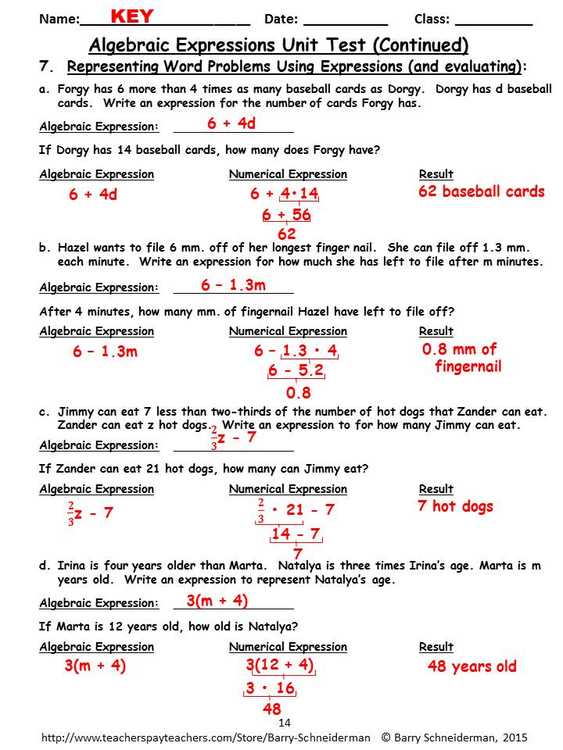
To tackle algebraic problems successfully, it’s crucial to understand the fundamental concepts of simplifying, solving, and manipulating mathematical relationships. First, identify key variables and constants, then apply the correct methods to solve for unknowns. For example, isolating the variable in a basic equation requires balancing both sides by adding, subtracting, multiplying, or dividing as needed. Follow these rules precisely to avoid errors.
When working with more complex formulas, it’s important to break down each step and apply the distributive property, factoring, or substitution techniques where applicable. Recognizing patterns and understanding their relationships can streamline problem-solving and lead to faster solutions. Don’t skip any intermediate steps, as even small mistakes can derail progress, especially in multi-step calculations.
In real-world applications, these skills are used to solve everything from calculating interest rates to determining quantities in physics experiments. By focusing on mastering the basics and practicing various types of problems, you’ll build a solid foundation in algebra that will help you approach more advanced topics with confidence.
Complete Study Guide for Simplifying Algebraic Relationships with Solutions
Begin by reviewing the basic rules for simplifying algebraic terms. For instance, combine like terms by identifying variables and constants that are the same. Apply the distributive property when necessary, especially when dealing with parentheses. An example would be: 3(x + 2) = 3x + 6, where you distribute the 3 across the terms inside the parentheses.
Next, focus on solving for unknown variables. A common method is isolating the variable by performing inverse operations. For example, to solve 2x + 5 = 15, subtract 5 from both sides, then divide by 2. This gives x = 5.
When dealing with more complex relationships, like those with multiple variables or terms on both sides of the equation, start by simplifying both sides. Then, use substitution or elimination methods to solve. For example, when given two equations y = 3x + 4 and 2x + y = 12, substitute the expression for y into the second equation to solve for x. This leads to: 2x + (3x + 4) = 12, simplifying to 5x = 8, and x = 8/5.
Don’t forget to check your solutions by substituting back into the original equations. This ensures that all operations were performed correctly. Practice solving both simple and multi-step problems regularly to reinforce these techniques.
Identifying Different Types of Algebraic Relationships
Start by recognizing the difference between linear and non-linear forms. A linear relationship is characterized by variables that are raised only to the first power and graph as straight lines. An example of a linear form is y = 2x + 3.
Non-linear forms include quadratics, cubics, and other polynomials. These involve variables with exponents greater than 1. For instance, y = x² + 5x + 6 represents a quadratic relationship, which graphs as a parabola.
Another common type is rational expressions, where variables appear in the denominator. An example is y = 1/x. These expressions often have asymptotes, which are vertical or horizontal lines that the graph approaches but never reaches.
Exponential forms involve variables in the exponent. For example, y = 2^x shows an exponential relationship, where the rate of change accelerates as x increases.
Finally, logarithmic relationships are the inverse of exponential forms. They often appear as y = log(x), where the graph increases slowly at first and then becomes steeper as x grows.
- Linear: y = mx + b
- Quadratic: y = ax² + bx + c
- Cubic: y = ax³ + bx² + cx + d
- Rational: y = 1/x
- Exponential: y = a^x
- Logarithmic: y = log(x)
By identifying these forms, you can better analyze the behavior and solve these relationships effectively.
Step-by-Step Approach to Simplifying Algebraic Forms
1. Combine Like Terms: Start by identifying terms that have the same variable raised to the same power. For example, in 3x + 5x, both terms contain the variable x, so you combine them to get 8x.
2. Distribute Multiplication: If there is a term outside parentheses, distribute it to each term inside. For example, in 2(x + 3), you multiply both x and 3 by 2, resulting in 2x + 6.
3. Simplify Fractions: If there are fractions, reduce them to their simplest form. For instance, 2/4x simplifies to 1/2x.
4. Combine Constant Terms: Any constants or numbers without variables should be added or subtracted together. For example, in 5x + 3 + 2x – 4, combine like terms to get 7x – 1.
5. Factor Out Common Terms: If terms have a common factor, factor it out. For instance, in 4x + 8, factor out 4, resulting in 4(x + 2).
6. Final Check: Ensure that no further simplification is possible and that all like terms have been combined correctly.
Solving Linear Systems: Methods and Examples
Method 1: Isolating the Variable
To solve for the unknown, isolate it on one side of the equation. For example, solve 2x + 3 = 7 by first subtracting 3 from both sides: 2x = 4. Then, divide both sides by 2 to get x = 2.
Method 2: Using the Distribution Property
Apply the distributive property to eliminate parentheses before solving. For example, in 3(x – 4) = 12, distribute the 3 to both terms inside the parentheses: 3x – 12 = 12. Then, solve by isolating x:
- First, add 12 to both sides: 3x = 24
- Then, divide both sides by 3: x = 8
Method 3: Substitution Method (for Systems)
If you are dealing with multiple unknowns, use substitution. For example, solve the system:
| y = 2x + 1 |
| 3x + y = 11 |
Substitute y = 2x + 1 into the second equation: 3x + (2x + 1) = 11. Simplify:
- Combine like terms: 5x + 1 = 11
- Subtract 1 from both sides: 5x = 10
- Divide by 5: x = 2
- Substitute x = 2 back into y = 2x + 1: y = 2(2) + 1 = 5
The solution is x = 2, y = 5.
Method 4: Graphical Solution
Plot the two sides of the equation on a graph to find the point of intersection. For example, for the equation y = 2x + 1, plot this line and solve where it intersects another line, such as y = 3x – 4.
Understanding and Applying the Distributive Property
The distributive property states that a(b + c) = ab + ac. This means you multiply a number outside the parentheses by each term inside the parentheses. It’s a vital concept for simplifying expressions.
Example 1: Applying the Distributive Property
To simplify 3(x + 4), apply the distributive property:
- Multiply 3 by x>: 3x
- Multiply 3 by 4: 12
The simplified expression is 3x + 12.
Example 2: Using the Distributive Property in a Complex Expression
For the expression 2(3x + 5y – 4), distribute the 2 across all terms inside the parentheses:
- 2 × 3x = 6x
- 2 × 5y = 10y
- 2 × -4 = -8
The simplified form is 6x + 10y – 8.
Using the Distributive Property with Negative Numbers
For expressions like -3(2x – 5), the negative sign must be distributed as well:
- -3 × 2x = -6x
- -3 × -5 = +15
The simplified expression is -6x + 15.
Distributive Property in the Context of Solving Systems
When solving systems of equations, the distributive property can simplify terms. For example, in a system where one equation is 3(x + 2) = 15, distribute to obtain 3x + 6 = 15. This simplifies the equation, allowing for easier solving.
Factoring Techniques for Solving Quadratic Equations
To solve a quadratic equation by factoring, follow these steps:
- Step 1: Ensure the quadratic is set equal to zero. For example, in x² + 5x + 6 = 0, the equation is already in standard form.
- Step 2: Look for two numbers that multiply to the constant term and add up to the coefficient of the linear term. For x² + 5x + 6, find two numbers that multiply to 6 and add to 5: 2 and 3.
- Step 3: Rewrite the quadratic as a factored form. In this case, (x + 2)(x + 3) = 0.
- Step 4: Set each factor equal to zero. Solve for x: x + 2 = 0 or x + 3 = 0.
- Step 5: Solve each equation: x = -2 or x = -3.
Example 1: Solve x² + 7x + 12 = 0 by factoring.
- Find two numbers that multiply to 12 and add to 7: 3 and 4.
- Write the factored form: (x + 3)(x + 4) = 0.
- Set each factor equal to zero: x + 3 = 0 or x + 4 = 0.
- Solve: x = -3 or x = -4.
Example 2: Solve 2x² + 8x = 0 by factoring.
- Factor out the common factor of 2x: 2x(x + 4) = 0.
- Set each factor equal to zero: 2x = 0 or x + 4 = 0.
- Solve: x = 0 or x = -4.
Factoring is an effective method for solving quadratic problems, provided the equation is factorable. If factoring seems complex, check for a greatest common factor first or consider other methods, like completing the square or using the quadratic formula.
Working with Rational Expressions and Equations
To simplify a rational function, start by factoring both the numerator and the denominator. Cancel any common factors between them.
- Step 1: Factor both the numerator and denominator. For example, for (x² – 9) / (x² – 3x), factor as ((x – 3)(x + 3)) / (x(x – 3)).
- Step 2: Cancel common factors. In this case, x – 3 appears in both the numerator and denominator, so it cancels out. The simplified form is (x + 3) / x.
Example 1: Simplify (x² – 16) / (x² – 4x).
- Factor the numerator: (x – 4)(x + 4).
- Factor the denominator: x(x – 4).
- Cancel out x – 4: (x + 4) / x.
Step 3: When working with rational equations, clear the denominators by multiplying both sides by the least common denominator (LCD) to eliminate fractions.
- Example 2: Solve (1/x) + (2/x + 1) = 3.
- Multiply both sides by the LCD, which is x(x + 1).
- After distributing, the equation becomes x + 2 = 3x(x + 1).
- Simplify and solve for x: x + 2 = 3x² + 3x.
- Rearrange to form 3x² + 2x – 2 = 0 and solve using factoring, the quadratic formula, or completing the square.
Step 4: Check for excluded values. In rational functions, any value that makes the denominator zero is not allowed. Always exclude those from the solution set.
- For (x² – 9) / (x² – 4x), the denominator is x(x – 4), so exclude x = 0 and x = 4 as solutions.
When solving rational equations, factor, cancel, clear denominators, and check for any restrictions on the variable.
Graphing Linear Equations: Intercepts and Slopes
To graph a linear relationship, start by identifying the slope and intercepts. The slope indicates the steepness, while the intercepts show where the line crosses the axes.
- Slope: The slope is calculated using the formula m = (y2 – y1) / (x2 – x1), where (x1, y1) and (x2, y2) are two points on the line. The slope represents the rate of change between the two variables.
- Intercepts: The x-intercept is the point where the line crosses the x-axis, while the y-intercept is the point where it crosses the y-axis. To find the intercepts, set y = 0 to find the x-intercept, and set x = 0 to find the y-intercept.
Example 1: Graph y = 2x + 3:
- Identify the slope: m = 2, which means the line rises 2 units for every 1 unit it moves horizontally.
- Identify the y-intercept: b = 3, which is the point where the line crosses the y-axis at (0, 3).
- Plot the point (0, 3) and use the slope to find a second point. From (0, 3), move up 2 units and right 1 unit to reach (1, 5).
- Draw a line through these points to complete the graph.
Example 2: Graph y = -x + 4:
- The slope is m = -1, indicating the line falls 1 unit for every 1 unit it moves horizontally.
- The y-intercept is b = 4, so the line crosses the y-axis at (0, 4).
- From (0, 4), move down 1 unit and right 1 unit to plot another point at (1, 3).
- Connect these points to form the line.
Key Tip: Always check your graph by ensuring the points are accurate. The slope shows how steep the line is, while the intercepts mark key points on the axes that help guide the graphing process.
Common Mistakes to Avoid When Solving Equations
Ensure to always perform the same operation on both sides of the equation. A common mistake is to apply changes to one side without doing the same on the other. This can lead to incorrect solutions.
- Ignoring Parentheses: When simplifying or solving, always distribute terms inside parentheses properly. Missing this step is a frequent error, especially in complex expressions.
- Incorrectly Handling Negative Signs: Pay close attention to negative signs. A common mistake is forgetting to distribute the negative sign across terms in parentheses, or incorrectly handling negative numbers during operations.
- Forgetting to Isolate the Variable: Always isolate the variable on one side. Failing to move all terms involving the variable to one side and constants to the other can result in confusion and incorrect solutions.
- Dividing by Zero: Never divide by zero. This leads to undefined results and is a basic error that often occurs when simplifying fractions.
- Misapplying the Distributive Property: The distributive property should be applied correctly. Make sure to multiply each term inside parentheses by the factor outside the parentheses. Overlooking this step can lead to errors in solutions.
For further information and examples, refer to this source: Khan Academy Algebra Lessons.