Dimensional Analysis Practice Problems and Step by Step Solutions
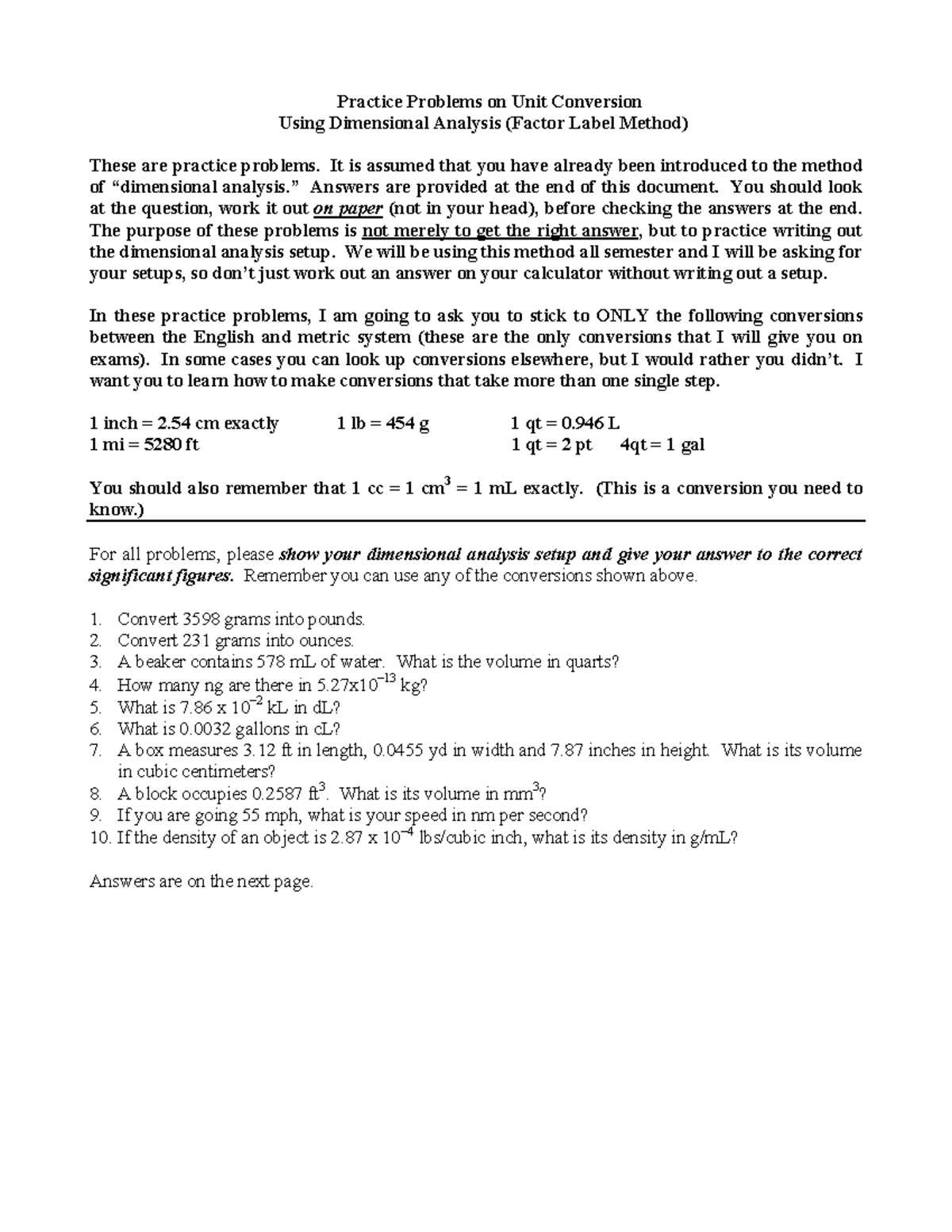
To master unit conversion and ensure consistency in calculations, begin by focusing on unit relationships. Setting up proper conversions will streamline problem-solving and avoid errors. Start by converting units step by step, ensuring every factor correctly cancels out to match the desired units.
Before tackling any complex conversions, it’s vital to understand the underlying concepts. Familiarize yourself with common units for length, mass, time, and other quantities. Building a strong foundation in unit relationships will save you time and effort in solving advanced problems.
Next, ensure that you consistently check the units at each step. It’s easy to overlook a small detail, like the wrong factor, that could lead to incorrect answers. If units do not cancel properly, revisit the setup to identify the mistake and correct it before proceeding.
In this section, we will walk through several practice exercises, each with clear solutions. These examples will help reinforce the principles and demonstrate how to apply them in real-world scenarios. The goal is to give you the skills to approach any unit conversion confidently and accurately.
Unit Conversion Exercises with Solutions
To master unit conversion, practice with specific examples that require accurate setup and consistent checking of unit cancellation. Begin by focusing on simple conversions and then move on to more complex ones as your understanding deepens.
Here are some exercises that cover a range of unit conversions. Follow the steps carefully and verify that each factor in the conversion process cancels out properly.
| Problem | Solution |
|---|---|
| Convert 5 kilometers to meters. | 5 km = 5000 meters (1 km = 1000 meters) |
| Convert 150 milliliters to liters. | 150 mL = 0.15 liters (1000 mL = 1 liter) |
| Convert 3 hours to seconds. | 3 hours = 10,800 seconds (1 hour = 3600 seconds) |
| Convert 250 grams to kilograms. | 250 grams = 0.25 kilograms (1000 grams = 1 kilogram) |
For each example, make sure to check the cancellation of units before reaching the final result. If you encounter any confusion, review the conversion factors and verify each step carefully.
After working through these exercises, continue to practice more complex conversions involving multiple units and larger quantities to build confidence in your skills.
Understanding the Basics of Unit Conversion
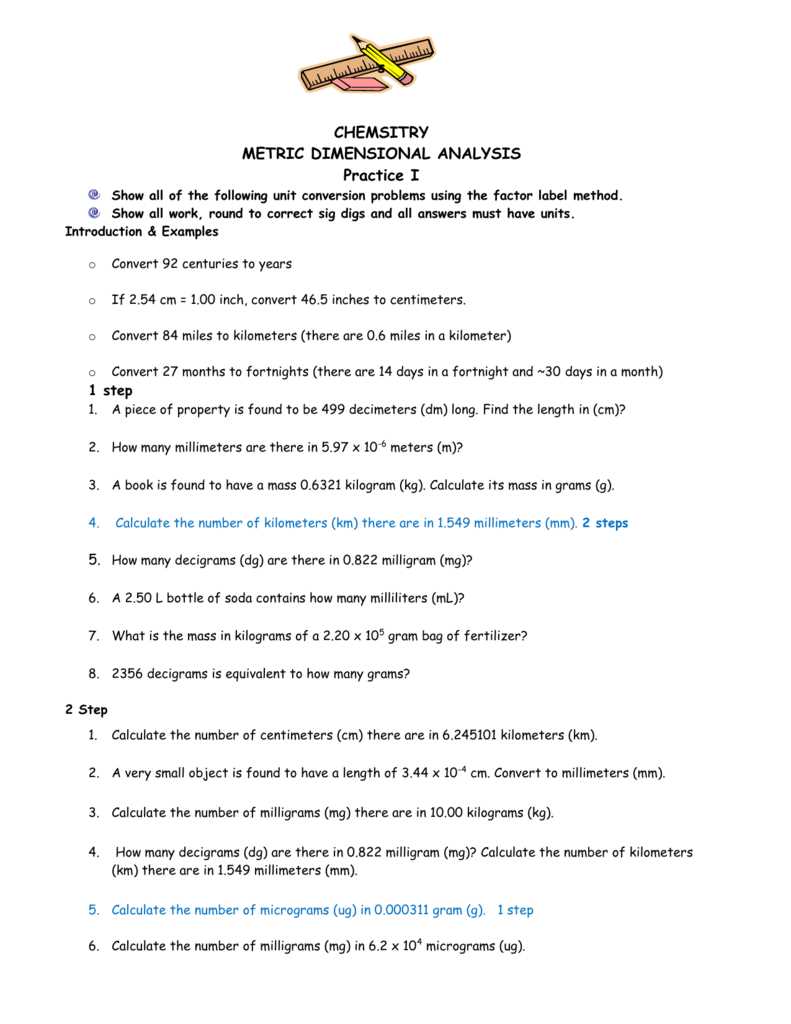
Unit conversion is a process that allows you to convert quantities from one unit to another. This process is particularly useful in science, engineering, and everyday applications. The goal is to ensure that the quantities are expressed in the appropriate units while maintaining their magnitude and relationship.
To perform a correct conversion, follow these steps:
- Identify the given unit and the unit you want to convert to.
- Find the conversion factor between the two units. This is typically a ratio that defines how one unit relates to another.
- Multiply the given quantity by the conversion factor.
- Cancel units that appear in both the numerator and denominator, leaving only the desired unit.
Here’s an example:
| Given Quantity | Conversion Factor | Result |
|---|---|---|
| 10 kilometers | 1 km = 1000 meters | 10 km = 10,000 meters |
| 500 milliliters | 1 liter = 1000 milliliters | 500 mL = 0.5 liters |
| 2 hours | 1 hour = 60 minutes | 2 hours = 120 minutes |
By following these simple steps, you can convert between different units of measurement with confidence. Make sure to always double-check your conversion factor and ensure that the units cancel out properly to avoid errors.
How to Set Up Conversion Factors for Unit Conversions
To correctly convert between different units, you must set up conversion factors that allow you to cancel out unwanted units while keeping the desired unit in the final result. Follow these steps to set up the right conversion factor:
- Identify the given unit and the unit you want to convert to: Start by knowing the unit you have and the unit you need. For example, if you need to convert miles to kilometers, your given unit is miles, and your target unit is kilometers.
- Find the relationship between the two units: This can be done by looking up the conversion factor. For instance, 1 mile = 1.60934 kilometers. This is the conversion factor you will use.
- Write the conversion factor as a fraction: The conversion factor can be written as a fraction where the unit you want to convert to is on top, and the unit you want to cancel out is on the bottom. For example, to convert miles to kilometers, you would write the conversion factor as:
- 1 mile / 1.60934 kilometers
- or equivalently, 1.60934 kilometers / 1 mile
- Convert 5 miles to kilometers:
- 5 miles × (1.60934 kilometers / 1 mile) = 8.0467 kilometers
By following these steps, you can set up accurate conversion factors for a wide range of unit conversions, ensuring that your calculations are both correct and meaningful.
Common Mistakes to Avoid in Dimensional Analysis Problems
Here are some common mistakes to watch out for when converting units or solving equations:
- Incorrectly canceling units: Ensure that units you want to cancel appear both in the numerator and denominator. For example, when converting miles to kilometers, “miles” should appear in both the numerator and denominator to properly cancel out.
- Using the wrong conversion factor: Double-check that the conversion factor is accurate for the units you’re working with. For instance, 1 inch = 2.54 cm, but using 1 inch = 2.5 cm will lead to inaccurate results.
- Failing to convert all units: Always ensure that every unit in the equation is converted to the correct one. Missing even a single unit can throw off the entire calculation.
- Not properly aligning units: When setting up the conversion factor, make sure the units match in such a way that they cancel out correctly. Mismatched units lead to incorrect results.
- Overlooking unit consistency: Keep track of the unit system you’re using. Converting between metric and imperial systems requires specific conversion factors. Mixing these up without proper conversion leads to mistakes.
- Forgetting to check significant figures: After performing the calculation, it’s important to round the final result according to the correct number of significant figures based on the given data.
Avoiding these errors will help ensure accuracy in your unit conversions and keep your results reliable.
Step by Step Guide to Solving Dimensional Analysis Problems
Follow these steps to solve unit conversion tasks accurately:
- Identify the given and required units: Write down what you know (given units) and what you need to find (desired units).
- Select the correct conversion factors: Choose the appropriate factor(s) to convert the given unit into the desired unit. Ensure that these factors are reliable. For example, use 1 inch = 2.54 cm for converting inches to centimeters.
- Set up the conversion equation: Arrange the conversion factors so that the unwanted units cancel out. Place the given unit in the denominator and the desired unit in the numerator, making sure units align properly to cancel.
- Perform the calculation: Multiply and divide the values as needed. Ensure the correct order of operations and that units cancel out appropriately, leaving only the desired unit.
- Check your units: After completing the calculation, verify that the final result has the correct units and matches the desired unit of measurement.
- Round and check for significant figures: Ensure the answer is rounded appropriately based on the number of significant figures in the given data.
For more detailed guidelines on unit conversion, visit Khan Academy’s Physics Section.
Using Dimensional Analysis in Real-World Problem Solving
To apply unit conversion methods in real-world scenarios, follow these steps:
- Identify the units involved: Determine both the initial unit and the desired unit in the problem. For example, converting miles per hour (mph) into meters per second (m/s) requires recognizing the units and understanding the relationship between them.
- Use appropriate conversion factors: Find reliable conversion factors. For example, 1 mile = 1609.34 meters and 1 hour = 3600 seconds. Use these to create a conversion factor chain.
- Set up the conversion equation: Arrange the factors so the unwanted units cancel out. In our example, miles and hours cancel out, leaving meters per second as the final unit.
- Perform the calculation: Execute the multiplication and division steps to convert the units. For instance, multiplying the given miles per hour by the appropriate conversion factors.
- Verify the result: After obtaining the final answer, check if the units match the desired outcome. Make sure the answer is in meters per second (m/s), as expected.
Real-life applications of unit conversion can include calculating speed, converting fuel efficiency rates, or determining the pressure in different units of measurement for scientific experiments. Precision in unit conversion ensures accuracy in engineering, science, and daily activities like cooking or travel planning.
For more real-world examples and practice, visit Khan Academy’s Physics Section.
Examples of Dimensional Analysis Problems and Their Solutions
Example 1: Convert 75 miles per hour (mph) to meters per second (m/s).
Solution: Start by identifying the conversion factors:
- 1 mile = 1609.34 meters
- 1 hour = 3600 seconds
Now, set up the conversion equation:
75 mph × (1609.34 meters / 1 mile) × (1 hour / 3600 seconds)
Perform the calculation:
- 75 × 1609.34 = 120700.5
- 120700.5 ÷ 3600 = 33.52 m/s
The final result is 33.52 meters per second (m/s).
Example 2: Convert 5 gallons to liters.
Solution: The conversion factor is:
- 1 gallon = 3.78541 liters
Set up the equation:
5 gallons × (3.78541 liters / 1 gallon)
Perform the calculation:
- 5 × 3.78541 = 18.92705 liters
The final result is 18.93 liters.
Example 3: Convert 120 kilometers per hour (km/h) to meters per second (m/s).
Solution: The conversion factors are:
- 1 kilometer = 1000 meters
- 1 hour = 3600 seconds
Set up the equation:
120 km/h × (1000 meters / 1 kilometer) × (1 hour / 3600 seconds)
Perform the calculation:
- 120 × 1000 = 120000
- 120000 ÷ 3600 = 33.33 m/s
The final result is 33.33 meters per second (m/s).
These examples demonstrate how to systematically convert between different units using appropriate conversion factors and simple arithmetic.
How to Check the Consistency of Your Units
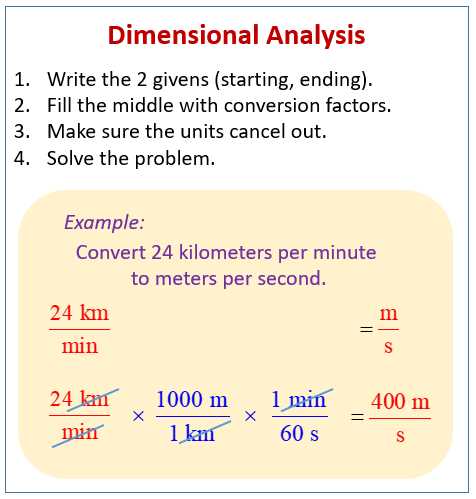
To verify the consistency of your units, follow these steps:
- Identify the units involved: List all the units that appear in the equation, conversion, or calculation. This includes both the original and target units.
- Ensure cancellation of units: When performing unit conversions, check that the units cancel properly. For example, if you’re converting from miles to kilometers, miles should cancel out, leaving kilometers.
- Compare the units of the result: After completing a calculation, verify that the resulting units match the expected units. For instance, if you are calculating speed, ensure that the final units are distance per time (e.g., meters per second, miles per hour).
- Check for dimensional consistency: Make sure the units on both sides of an equation are consistent. For instance, in equations involving force, energy, or other physical quantities, confirm that each term has matching units (e.g., both sides in terms of mass, length, and time).
- Use unit analysis to check for errors: If the final units don’t make sense or if units don’t cancel properly, review your calculations and conversions. Common errors include using incorrect conversion factors or failing to cancel units correctly.
By systematically following these steps, you can ensure that your units remain consistent throughout your calculations, preventing errors and improving the reliability of your results.
Practice Problems with Detailed Solutions and Explanations
Problem 1: Convert 25 miles per hour to meters per second.
Solution: To convert miles per hour (mph) to meters per second (m/s), use the following conversion factors:
- 1 mile = 1609.34 meters
- 1 hour = 3600 seconds
The conversion process is as follows:
- Start with 25 miles per hour.
- Multiply by the conversion factor for miles to meters: 25 miles/hour × 1609.34 meters/mile.
- Next, divide by the conversion factor for hours to seconds: 25 × 1609.34 / 3600.
- This results in 11.18 meters per second.
The final result is 11.18 m/s.
Problem 2: Convert 500 grams to pounds.
Solution: To convert grams to pounds, use the conversion factor:
- 1 pound = 453.592 grams
The steps are:
- Start with 500 grams.
- Multiply by the conversion factor: 500 grams × 1 pound / 453.592 grams.
- After performing the calculation, you get approximately 1.1 pounds.
The final result is 1.1 pounds.
Problem 3: How many seconds are in 3.5 hours?
Solution: To convert hours to seconds, use the following conversion factor:
- 1 hour = 3600 seconds
The steps are:
- Start with 3.5 hours.
- Multiply by the conversion factor: 3.5 hours × 3600 seconds/hour.
- The result is 12,600 seconds.
The final result is 12,600 seconds.
Each of these examples demonstrates how to set up conversion factors and cancel units to ensure accurate results. By following this systematic approach, you can confidently solve similar conversion tasks.