Creating and Solving Systems of Linear Equations Lesson 12.1
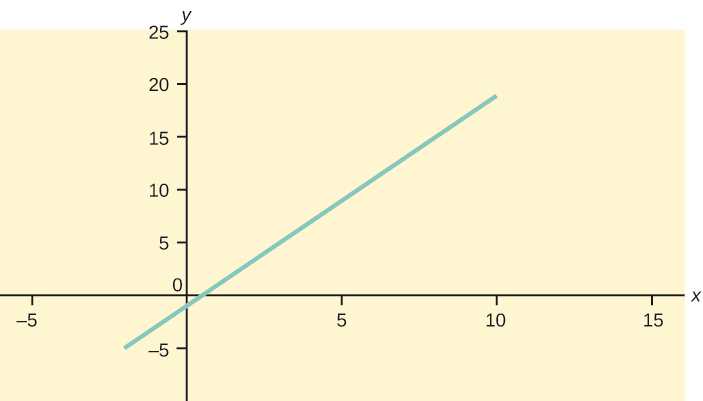
Begin by identifying the variables and constants in any given problem. Break down each statement into an algebraic form, clearly marking which elements correspond to each variable. Understanding this distinction is key to translating word problems into mathematical expressions.
Next, focus on the relationships between the variables. These relationships are often represented by two or more equations, and recognizing how they interconnect will help you determine the most appropriate method for solving them, such as substitution or elimination. Whether you’re solving by hand or using technology, practicing these methods improves accuracy and efficiency.
Once you solve the equations, verify the results by substituting the values of the variables back into the original expressions. This ensures the solution satisfies all the conditions outlined in the problem. If any errors appear, revisit your steps to identify where adjustments are needed.
Solving Pairs of Equations and Determining Their Solutions
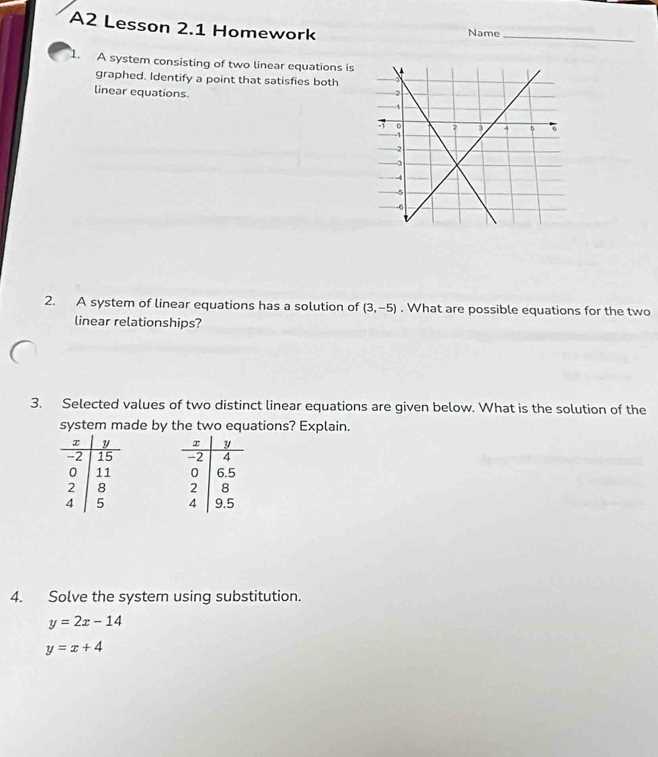
Begin by identifying the coefficients and constants in each equation. For example, in a pair of equations like 3x + 4y = 7 and 5x – 2y = 3, the goal is to find the values of x and y that satisfy both. A common method to solve is substitution, where you solve one equation for one variable and substitute it into the other.
If substitution seems complex, try elimination. Add or subtract the equations to eliminate one of the variables. This results in a single equation with only one variable, which can then be easily solved. Once you have a solution for one variable, substitute it back into either equation to find the value of the second variable.
After solving for both variables, verify the results by substituting the values of x and y back into the original equations. This step ensures that both equations are satisfied with your solution. If the results don’t match, recheck your calculations for potential errors in the process.
Step-by-Step Guide to Formulating Systems of Linear Equations
Start by identifying the real-world problem or situation that involves two or more variables. For instance, if you are determining the cost of two items bought in different quantities, define variables for the unknowns, such as x for the cost of the first item and y for the cost of the second item.
Write down the relationships or conditions that describe the situation. Each piece of information typically translates into an equation. For example, if you know that the total cost of 3 units of the first item and 2 units of the second item is $12, you can write the equation 3x + 2y = 12. Similarly, another condition might be 2x + 4y = 14, representing a different scenario involving the same items.
Ensure that the equations are in standard form (Ax + By = C) and each represents a distinct relationship in the problem. The number of equations should correspond to the number of variables you’re solving for. Once formulated, the next step is to choose a solving method–such as substitution or elimination–to find the values of the variables that satisfy all equations simultaneously.
For more detailed guidance on formulating and solving such problems, you can refer to educational resources like Khan Academy, which offers thorough explanations and practice exercises.
Identifying Variables and Constants in Linear Systems
To identify variables and constants in a system, begin by clearly defining what each term in the problem represents. Variables typically represent unknown quantities that you aim to solve for, while constants are fixed values.
For example, in a system where you are calculating the total cost of multiple items, define the variables as the unknown prices of the items. If you are given that 3 units of item A and 2 units of item B cost a total of $15, the prices of items A and B are the variables.
Constants are values that do not change within the context of the problem. In the previous example, the total cost of $15 is a constant because it remains fixed. Similarly, any coefficients in the equations (such as the 3 and 2 in 3x + 2y = 15) are also constants, as they represent the quantities of items purchased.
By clearly distinguishing between variables and constants, you can form accurate equations that describe the relationships in the problem. This will help guide the process of solving the system and finding the values of the unknowns.
Understanding the Role of Coefficients in Equation Systems
Coefficients are the numerical values multiplying the variables in an equation. They represent the relationship between variables in a mathematical model. The role of coefficients in a set of equations is crucial for determining how changes in one variable affect the others.
For example, in an equation like 4x + 3y = 12, the coefficients 4 and 3 specify how much x and y contribute to the total value of 12. Changing the coefficient of x or y will alter the balance of the equation and lead to different solutions for the variables.
In a system of equations, the coefficients help define the direction and magnitude of the relationships between multiple variables. When solving such systems, adjusting the coefficients or manipulating the equations allows you to find the intersection point of the variables, which represents the solution to the problem.
To interpret the impact of a coefficient, consider how increasing or decreasing it changes the outcome. Larger coefficients mean a stronger influence of that variable in the equation, while smaller coefficients imply a weaker effect. Understanding these relationships is key to effectively solving and manipulating equation systems.
Methods for Solving Linear Systems: Substitution and Elimination
The substitution and elimination methods are two commonly used techniques to solve a set of simultaneous equations.
Substitution Method: This approach involves solving one of the equations for one variable and then substituting that expression into the other equation. It is particularly useful when one of the equations is easily solvable for a single variable. For example, given the system:
x + y = 5
2x – y = 3
First, solve the first equation for y: y = 5 – x. Then substitute this into the second equation:
2x – (5 – x) = 3
After solving for x, substitute the value of x back into y = 5 – x to find the value of y.
Elimination Method: In this method, the goal is to eliminate one variable by adding or subtracting the equations. This is done by manipulating the coefficients of the variables to make them equal (or opposites). For example, given the system:
3x + 2y = 16
4x – 2y = 8
By adding these two equations together, the y terms cancel out:
(3x + 2y) + (4x – 2y) = 16 + 8
7x = 24
Then solve for x and substitute it back into one of the original equations to solve for y.
Both methods are reliable, but the choice depends on the structure of the equations. Substitution is often quicker when one equation is easy to solve for a single variable, while elimination is more efficient when the coefficients of the variables are easily manipulated to cancel out terms.
Solving Word Problems Involving Systems of Linear Equations
To solve word problems that involve multiple unknowns, first identify the key variables, then translate the problem into mathematical expressions. Begin by writing two or more equations that represent the relationships described in the problem.
Step 1: Define Variables
Choose appropriate symbols for the unknowns. For example, let x represent the number of one type of item and y represent the number of another type. Clarify what each variable stands for in the context of the problem.
Step 2: Translate the Problem into Equations
Break the problem into manageable parts, and for each part, form an equation. Use the relationships described in the word problem to construct these equations. Often, you will have a combination of total amounts, prices, rates, or other quantities that can be expressed as linear equations.
Step 3: Solve the Equations
Use substitution or elimination to solve the system of equations. Substitution works best when one equation is easily solvable for a single variable. Elimination is more efficient when the coefficients of one variable are aligned, allowing you to cancel out terms when the equations are added or subtracted.
Example:
A bookstore sells two types of books. The first type costs $15, and the second costs $20. The total amount spent is $220. If the bookstore sells 14 books in total, how many of each type were sold?
Let x represent the number of $15 books and y the number of $20 books.
Write the system of equations based on the problem:
| x + y = 14 |
| 15x + 20y = 220 |
Now, solve this system using substitution or elimination.
Step 4: Check the Solution
After solving, plug the values of x and y back into the original equations to verify the solution. Ensure that both equations are satisfied with the obtained values.
By following these steps, you can effectively solve word problems that involve multiple variables and find the solution to real-life scenarios involving linear relationships.
Graphical Interpretation of Systems of Linear Equations
To interpret a set of equations graphically, plot each equation as a straight line on the coordinate plane. The point where the lines intersect represents the solution to the system.
Step 1: Rearrange Equations into Slope-Intercept Form
Start by rewriting the equations into the form y = mx + b, where m is the slope and b is the y-intercept. This makes it easier to plot each line on a graph.
Step 2: Plot Each Equation
For each equation, identify the y-intercept and use the slope to determine another point on the line. Draw a straight line through these points to represent each equation.
Step 3: Identify the Intersection Point
The solution to the system is the point where the lines intersect. If the lines overlap entirely, the system has infinite solutions. If the lines are parallel and never intersect, the system has no solution.
Step 4: Analyze the Result
The coordinates of the intersection point (x, y) represent the values of the variables that satisfy both equations simultaneously. If there is no intersection, the system is inconsistent and has no solution. If there is exactly one point of intersection, the system is consistent and has one solution.
Example:
Consider the system:
- y = 2x + 1
- y = -x + 4
To graph, plot the first equation with a y-intercept of 1 and slope 2. For the second equation, plot with a y-intercept of 4 and slope -1. The point where the two lines intersect is the solution to the system.
Step 5: Verify the Solution
After finding the intersection point graphically, substitute the x and y values into the original equations to verify that both are satisfied.
Common Mistakes When Creating Systems of Linear Equations
When formulating a set of equations, several errors can undermine the accuracy and effectiveness of the solution process. Here are the most common mistakes to avoid:
- Incorrectly Setting Up the Variables
Failing to clearly define each variable or assigning the wrong variable can lead to confusion and incorrect results. Always ensure that each variable is explicitly defined and represents a real-world quantity or relationship. - Not Maintaining Consistency in Units
When using real-world data, make sure that all variables and constants are in the same units. Mixing units, such as dollars and cents with percentages, can result in errors that are difficult to correct later on. - Forgetting to Align Terms in Equations
When writing equations, ensure that terms are properly aligned on both sides of the equation. For example, variables should be grouped together, and constants should be on the opposite side to facilitate solving. - Misinterpreting the Problem’s Relationships
A common mistake is misunderstanding the relationship between variables. Whether it’s additive, multiplicative, or conditional, the relationships need to be interpreted correctly to avoid misrepresenting the problem. - Ignoring Special Cases
Pay attention to special cases where the variables may not behave according to standard assumptions. For example, situations where variables are non-negative or represent fixed values must be treated differently. - Using Complex Methods for Simple Problems
Sometimes, a system can be solved easily using basic methods such as substitution or simple elimination, but using overly complex methods can lead to unnecessary confusion and errors. - Overlooking the Possibility of No or Infinite Solutions
It’s important to verify whether the system has a unique solution, no solution, or infinite solutions. Failure to check this can result in incorrect assumptions about the solution’s existence. - Not Double-Checking Calculations
Always double-check calculations, especially when dealing with fractions, decimals, or large numbers. Simple arithmetic mistakes can lead to significant errors in the final solution.
By being mindful of these common pitfalls, you can avoid mistakes and successfully solve the system of equations.
Verifying Solutions and Checking Consistency in Equation Systems
After finding potential solutions for a set of equations, it is important to verify their correctness. This process involves substituting the values back into the original relationships to check for consistency.
- Substitute the Solution Back Into Each Equation
Begin by taking the values obtained for the variables and plugging them into each equation of the system. If the left-hand side equals the right-hand side for all equations, the solution is valid. - Look for Consistency
Ensure that all equations are satisfied simultaneously. If substituting the solution into one or more equations results in a false statement (like 5 = 7), the system is inconsistent, meaning there is no valid solution. - Use Graphical Methods to Check Consistency
When applicable, graph each equation and check if the lines (or curves) intersect at the solution point. If the lines do not intersect or overlap, the system is either inconsistent or has infinite solutions. - Check for Special Cases
In some cases, systems may have infinitely many solutions (if the equations are dependent) or no solution (if the equations are contradictory). Identifying these cases is crucial for determining the nature of the solution set. - Verify by Substitution or Elimination
If a solution seems to be correct, verify it through a different method. If the system was solved using substitution, try solving it using elimination (or vice versa) to confirm the solution’s accuracy. - Recheck Any Assumptions Made
Sometimes, assumptions made during the process (like ignoring certain variables or relationships) can lead to incorrect solutions. Always double-check that all constraints of the problem were considered.
By following these steps, you can be confident in the correctness of the solution and ensure that the system is consistent.