Complete Guide to Photosynthesis Labeling and Diagram Solutions
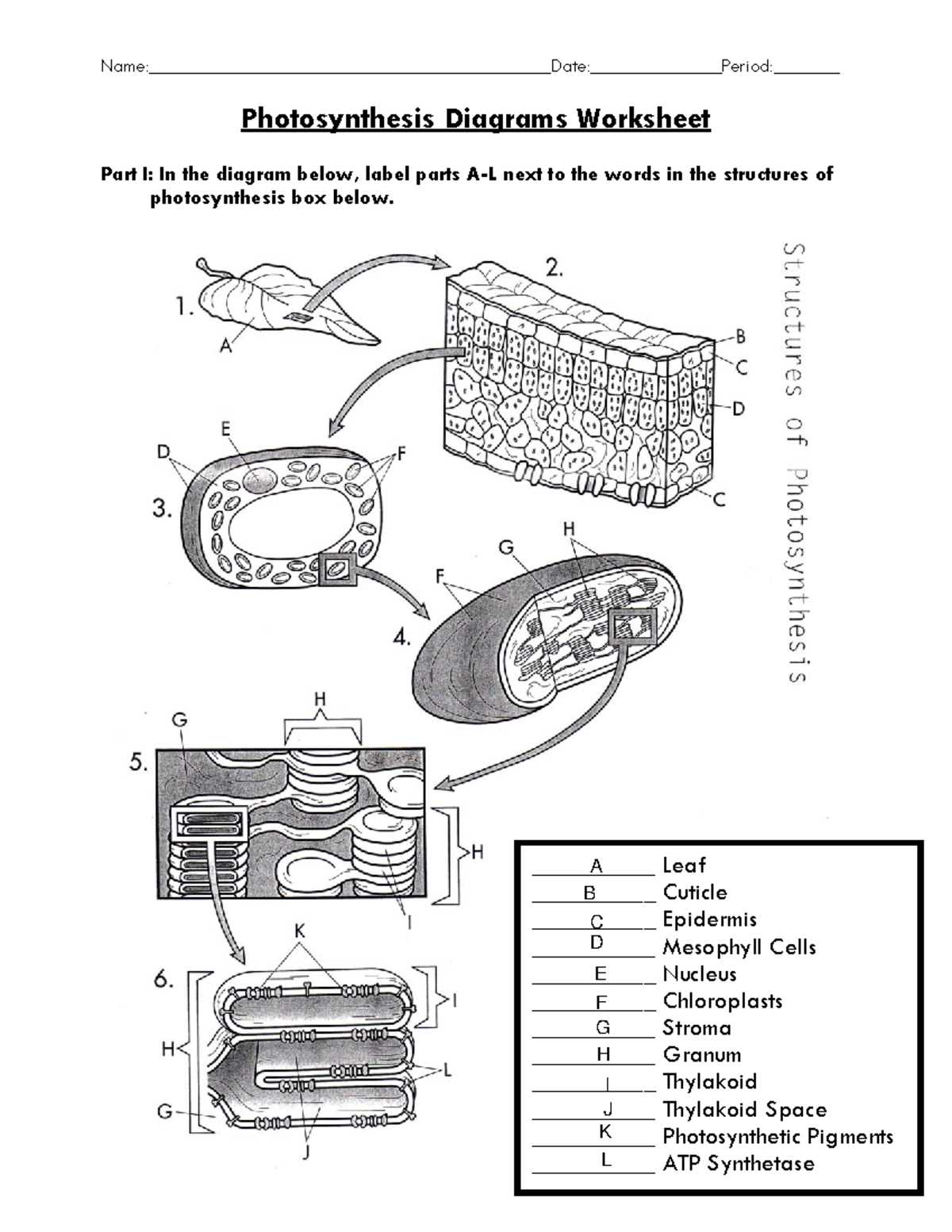
To successfully identify and name the various parts involved in plant energy production, start by focusing on the chloroplasts, which house the machinery required for this complex procedure. Key structures such as the thylakoid membranes, stroma, and the various pigment molecules play pivotal roles in converting sunlight into chemical energy.
Understanding the two main phases–one that relies on light energy and another that does not–is critical for organizing the key components correctly. The light-dependent reactions occur in the thylakoid membranes and generate ATP and NADPH, while the Calvin cycle occurs in the stroma, where carbon dioxide is converted into glucose.
Accurate identification of each step in this process helps reinforce your understanding of how plants sustain life on Earth. Make sure to distinguish between the role of each molecule, such as the absorption of light by chlorophyll and the conversion of that light into chemical bonds.
Photosynthesis Labeling Answer Key Guide
To correctly identify the parts involved in plant energy production, focus on these main components:
- Chloroplast: The site where energy conversion occurs. Found in plant cells, it houses both the light-dependent and light-independent reactions.
- Thylakoid Membranes: These membrane structures within the chloroplast are where the light-dependent reactions take place, capturing sunlight to produce ATP and NADPH.
- Stroma: The fluid-filled space surrounding the thylakoids where the Calvin cycle occurs. It utilizes the products of the light-dependent reactions to convert carbon dioxide into glucose.
- Chlorophyll: The green pigment in the thylakoids that absorbs light, primarily blue and red wavelengths, and is crucial for starting the light-dependent reactions.
- ATP and NADPH: Energy-rich molecules produced during the light-dependent reactions. They are used in the Calvin cycle to convert carbon dioxide into sugars.
Make sure to clearly distinguish between each component’s function. The chloroplast serves as the “factory,” thylakoids capture sunlight, the stroma handles chemical conversions, and chlorophyll is responsible for light absorption.
Understanding the Basic Process of Photosynthesis
The process of energy conversion in plants begins when chlorophyll absorbs light energy from the sun. This energy is used to split water molecules into oxygen, protons, and electrons in a process known as photolysis.
The electrons and protons generated are then used in the production of energy-rich molecules: ATP and NADPH. These molecules store energy for the next phase, which occurs in the stroma of the chloroplasts.
In the stroma, carbon dioxide from the atmosphere is fixed into organic molecules through a series of reactions collectively called the Calvin cycle. ATP and NADPH produced earlier power these reactions, ultimately creating glucose, which serves as the plant’s main source of stored energy.
This glucose can be used immediately by the plant for growth and metabolism, or it can be stored in the form of starch for later use. Oxygen is released as a byproduct of the initial light-dependent reactions and is vital for most life forms on Earth.
Key Components to Label in Photosynthesis Diagrams
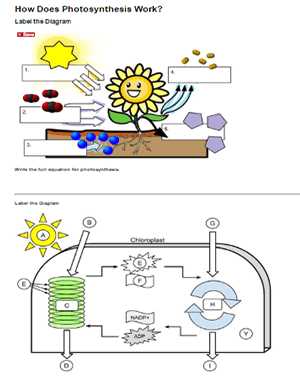
When studying diagrams of the energy production process in plants, it’s crucial to accurately identify and label the main components involved. These include:
- Chloroplast: The organelle where the process takes place, housing the thylakoids and stroma.
- Thylakoid Membrane: Site of light-dependent reactions, where sunlight is captured and used to produce ATP and NADPH.
- Grana: Stacks of thylakoid membranes, critical for energy conversion during light absorption.
- Stroma: The fluid-filled space where the Calvin cycle occurs, converting carbon dioxide into glucose.
- Chlorophyll: The pigment responsible for absorbing light energy from the sun.
- ATP and NADPH: The energy carriers produced in the light-dependent phase, used in the Calvin cycle.
- Carbon Dioxide (CO2): The raw material used in the Calvin cycle to form glucose.
- Oxygen (O2): A byproduct released during the light-dependent reactions.
How to Identify the Role of Chloroplasts in Photosynthesis
Chloroplasts are the main organelles responsible for converting light energy into chemical energy in plant cells. They contain chlorophyll, a pigment that absorbs light, primarily in the blue and red wavelengths, essential for energy conversion. To identify their role, focus on the following aspects:
- Site of Light-Dependent Reactions: The thylakoid membranes within chloroplasts are where light energy is captured and used to generate ATP and NADPH.
- Carbon Fixation: In the stroma, the chloroplast facilitates the Calvin cycle, which incorporates carbon dioxide into organic molecules like glucose.
- Energy Conversion: Chloroplasts convert solar energy into usable chemical energy, stored as glucose and other organic compounds.
- Production of Oxygen: As a byproduct of light-dependent reactions, oxygen is released, contributing to the plant’s gas exchange with the environment.
- Storage of Energy: Chloroplasts store the chemical energy produced during the reactions, which the plant uses for growth and development.
Steps for Labeling the Light-Dependent and Light-Independent Reactions
Follow these steps to accurately mark the light-dependent and light-independent stages on your diagram:
- Identify the Thylakoid Membranes: The light-dependent reactions occur in the thylakoid membranes within the chloroplast. Label this part of the diagram, noting where light absorption takes place.
- Label the Key Molecules: In the light-dependent section, mark molecules like chlorophyll, water (H2O), ATP, and NADPH. Indicate where light energy is absorbed, leading to the splitting of water and production of ATP and NADPH.
- Mark Oxygen Release: In the light-dependent phase, oxygen is released as a byproduct. Label this step clearly, indicating oxygen molecules produced from water molecules.
- Locate the Stroma: The light-independent reactions occur in the stroma of the chloroplast. Label this area for the Calvin cycle, where carbon dioxide is fixed into organic molecules.
- Label the Calvin Cycle Components: Include markers for CO2, RuBP, G3P, and RUBISCO, which are involved in the light-independent phase.
- Draw the Flow of Energy: Show how ATP and NADPH produced in the light-dependent reactions power the Calvin cycle in the light-independent phase. Use arrows to indicate the flow of energy and molecules.
Common Mistakes in Labeling Photosynthesis Diagrams
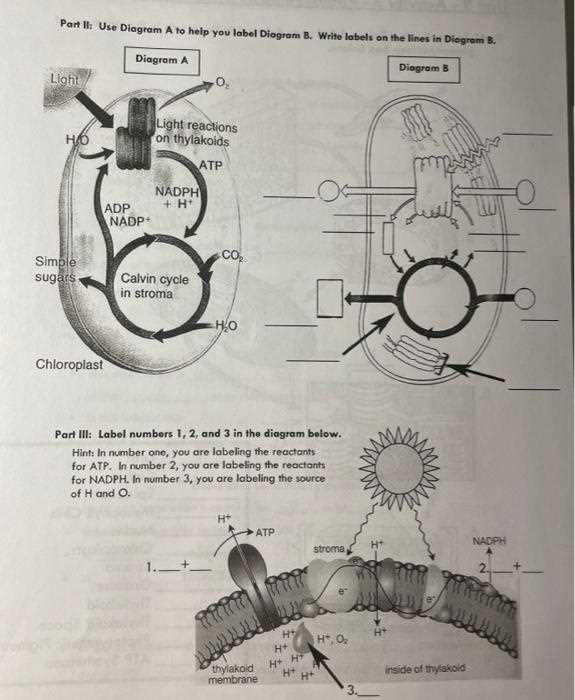
Here are the most frequent errors made when marking components of the process and how to avoid them:
| Mistake | Correction |
|---|---|
| Incorrectly labeling the location of the light-dependent reactions | Ensure the thylakoid membranes are marked correctly as the site of the light-dependent phase, not the stroma. |
| Misplacing oxygen as a product of the Calvin cycle | Oxygen is produced during the light-dependent reactions, not during the Calvin cycle. Label oxygen release at the thylakoid membranes. |
| Confusing ATP and NADPH production | ATP and NADPH are generated in the light-dependent reactions and are then used in the Calvin cycle. Mark their roles clearly with arrows indicating energy transfer. |
| Overlooking the importance of RUBISCO | RUBISCO is crucial in fixing carbon dioxide in the Calvin cycle. Make sure to label this enzyme in the stroma during the light-independent phase. |
| Incorrectly labeling the stroma and thylakoid space | The stroma is the fluid surrounding the thylakoid membranes, and the thylakoid space is where the light-dependent reactions occur. Be sure to place labels accordingly. |
Tips for Accurately Labeling the Photosynthesis Equation
Ensure the reactants and products are properly arranged, with carbon dioxide and water as inputs on the left side and glucose and oxygen as outputs on the right side.
Remember that light energy is not directly represented in the equation but is implied as it drives the reactions. You can note this above the arrow to indicate its role in the process.
Be clear about the direction of the reaction by using an arrow pointing from reactants to products, reflecting the transformation that occurs during the process.
Ensure the ratio between carbon dioxide and water is accurate. Typically, six molecules of CO₂ combine with six molecules of H₂O to form one molecule of glucose (C₆H₁₂O₆) and six molecules of oxygen (O₂).
Label the stages appropriately if drawing the process in steps. The light-dependent reactions occur first, followed by the light-independent reactions. These stages should be indicated with clear labels or annotations if relevant.
Understanding the Flow of Energy in Photosynthesis
The process begins when light energy is absorbed by chlorophyll in the chloroplasts. This energy excites electrons, starting the light-dependent reactions.
During these reactions, the energy is used to split water molecules into oxygen, protons, and electrons, generating ATP and NADPH, which store the energy for later use.
In the light-independent reactions, also known as the Calvin cycle, the ATP and NADPH produced are used to convert carbon dioxide into glucose, a form of chemical energy that plants can store and use.
The flow of energy moves from sunlight to chemical energy stored in glucose. This energy is later used by the plant for growth, reproduction, and other functions. Oxygen, a byproduct of the light-dependent reactions, is released into the atmosphere.
By understanding this energy flow, you can better appreciate how plants convert solar energy into a usable form, sustaining both themselves and life on Earth.
Resources for Practicing and Mastering Photosynthesis Labeling
To refine your understanding and skills in diagramming the plant energy conversion process, here are some reliable resources to consider:
- Khan Academy offers a variety of interactive lessons and practice exercises on plant biology, including processes like energy conversion.
- Biology Corner provides numerous worksheets and diagramming exercises related to plant functions.
- Nature frequently publishes articles and educational materials that explore plant biology, providing in-depth insights and updated research.
These platforms offer visual aids, quizzes, and detailed explanations that will help solidify your grasp on complex biological processes.