Complete Guide to Naming Molecular Compounds Using Pogil Method
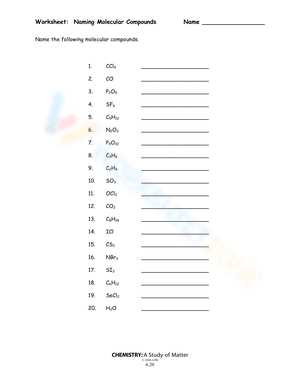
To accurately identify chemical substances, it’s crucial to follow a structured method. Begin by understanding the general rules for assigning names to elements and their combinations. For example, when working with binary substances, the name of the compound reflects both elements involved and their respective quantities. Each prefix or suffix gives you vital information on the bonding structure and the ratio of atoms present in the molecule.
When dealing with compounds containing polyatomic ions, it’s important to recognize how they interact with other elements. Familiarize yourself with the most common ions and their charges, as this directly influences how compounds are named. For instance, the ion “sulfate” or “nitrate” can determine how you form the compound name and structure.
Avoid confusion by remembering to apply the correct numerical prefixes when naming. The prefixes such as “mono-“, “di-“, or “tri-” help specify the number of atoms of a given element in a molecule. Additionally, understanding how transitional elements fit into this system is key to identifying the oxidation states they can assume in different compounds.
Regular practice with sample problems will also aid in cementing your understanding. Consistently applying these rules will lead to greater proficiency in identifying the right names and formulas for various compounds in chemistry.
Steps for Identifying and Naming Chemical Substances
To correctly identify a chemical substance, begin by analyzing its components. Start by determining the type of bonding: ionic or covalent. For ionic compounds, the name will often reflect the cation first, followed by the anion. In the case of covalent substances, prefixes such as “mono-“, “di-“, and “tri-” are used to indicate the number of atoms of each element involved in the molecule.
For ionic compounds that involve transition metals, identify the oxidation state of the metal, as this will impact the compound’s name. The oxidation state is often indicated in Roman numerals within parentheses, such as iron(III) chloride.
When naming compounds containing polyatomic ions, familiarize yourself with the common ions like sulfate (SO4²⁻) or nitrate (NO3⁻). These ions will retain their names, and their combination with other elements will determine the full compound name.
Also, remember to check for exceptions in naming, especially in organic chemistry or compounds with complex structures. Some compounds require memorization of specific names that do not follow the standard rules of nomenclature.
To practice, regularly refer to the naming conventions outlined in your study materials and complete sample exercises. Over time, this will help reinforce the correct methods for identifying and naming different chemical substances.
Understanding the Basics of Chemical Substance Naming
To begin naming chemical substances, focus on identifying the type of bonding between atoms. If the substance consists of nonmetals, it is typically named using prefixes to indicate the number of atoms of each element involved.
For ionic substances, always start by naming the cation (positive ion) first, followed by the anion (negative ion). If the cation is a transition metal, indicate its oxidation state in parentheses using Roman numerals.
For covalent substances, use prefixes like “mono-“, “di-“, and “tri-” to represent the number of atoms of each element. These prefixes help specify the exact ratio of atoms in the molecule. Remember, the prefix “mono-” is often omitted for the first element.
For polyatomic ions, it’s important to familiarize yourself with common ions such as sulfate (SO₄²⁻), nitrate (NO₃⁻), and carbonate (CO₃²⁻), which retain their names in the compound. Combining these ions with other elements will help you form the full substance name.
Use these conventions and regularly practice with exercises to reinforce the naming rules. The more you practice, the more fluent you will become in identifying and naming various chemical substances correctly.
Step-by-Step Process for Naming Binary Chemical Substances
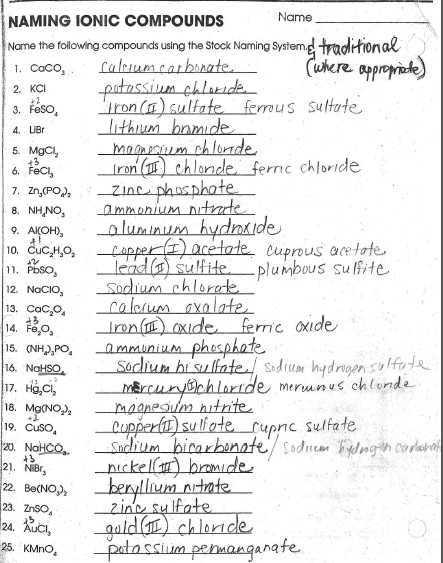
Follow these steps to accurately name binary substances formed between two nonmetals:
- Identify the elements: Determine the two elements involved. The first element (usually the one with lower electronegativity) is named first, while the second element is named second, with its suffix changed to “-ide”.
- Use appropriate prefixes: For covalent substances, use prefixes like “mono-“, “di-“, “tri-“, etc., to indicate the number of atoms of each element. For example, CO₂ is named carbon dioxide, where “di-” indicates two oxygen atoms.
- Omit “mono-” for the first element: The prefix “mono-” is not used for the first element. For example, in CO, “mono-” is omitted from carbon.
- Order of elements: The first element is always named first, regardless of its electronegativity. The second element, however, takes the “ide” suffix and is named second.
- Check for special cases: Some compounds may have specific naming rules or exceptions. For instance, when the first element is hydrogen, compounds like H₂O (water) do not follow the standard naming convention.
For further guidance, refer to this authoritative source on naming conventions from the Chemguide website.
Rules for Naming Compounds with Polyatomic Ions
To correctly name substances containing polyatomic ions, follow these key steps:
- Identify the polyatomic ion: Recognize the polyatomic ion in the compound. Common examples include sulfate (SO₄²⁻), nitrate (NO₃⁻), and ammonium (NH₄⁺).
- Use the name of the polyatomic ion: Once identified, use the standard name of the polyatomic ion. For example, Na₂SO₄ is named sodium sulfate, where “sulfate” is the polyatomic ion.
- Balance charges: Ensure the compound is electrically neutral by adjusting the number of cations and anions. For example, magnesium nitrate (Mg(NO₃)₂) balances the charges between the Mg²⁺ cation and two NO₃⁻ anions.
- Use appropriate prefixes for multiple ions: If more than one polyatomic ion is present, use parentheses to group the ions and a numerical prefix to indicate the quantity. For instance, calcium phosphate (Ca₃(PO₄)₂) uses “three” calcium ions and “two” phosphate ions.
- Follow naming conventions for special polyatomic ions: Some polyatomic ions have specific naming rules. For example, the ion OH⁻ is called hydroxide, and NH₄⁺ is called ammonium.
For more examples and a detailed list of polyatomic ions, visit Chemistry Talk.
Identifying the Correct Prefixes in Molecular Naming
To correctly apply prefixes in naming chemical substances, follow these steps:
- Mono-: Used when one atom of an element is present in the molecule. However, “mono-” is typically omitted for the first element in the formula. Example: CO is carbon monoxide.
- Di-: Used when two atoms of an element are present. Example: CO₂ is carbon dioxide.
- Tri-: For three atoms. Example: N₂O₃ is dinitrogen trioxide.
- Tetra-: For four atoms. Example: CCl₄ is carbon tetrachloride.
- Penta-: Used for five atoms. Example: P₄O₁₀ is tetraphosphorus decaoxide.
- Hepta-: For seven atoms. Example: N₇O₄ is heptanitrogen tetraoxide.
- Octa-: For eight atoms. Example: SF₆ is sulfur hexafluoride.
- Deca-: For ten atoms. Example: C₁₀H₈ is decane.
Use the above prefixes to ensure accurate molecular formulas and names. For more detailed information on prefixes, refer to a reliable chemistry resource such as ChemBlink.
Distinguishing Between Ionic and Molecular Compounds
To differentiate between ionic and molecular substances, focus on the following characteristics:
- Composition: Ionic substances consist of positively charged metal ions and negatively charged nonmetal ions, while molecular substances are formed by two or more nonmetals sharing electrons.
- Bonding: Ionic bonds result from the transfer of electrons, leading to the attraction between ions. Molecular bonds, on the other hand, are covalent, involving the sharing of electrons between atoms.
- Physical Properties: Ionic compounds typically have high melting and boiling points, are usually crystalline solids at room temperature, and conduct electricity when dissolved in water. Molecular compounds have lower melting and boiling points and do not conduct electricity in solution.
- Prefixes and Naming: Molecular compounds often use prefixes (mono-, di-, tri-) to indicate the number of atoms, while ionic compounds are named based on the metal and nonmetal ion names, with no need for prefixes.
- Example: NaCl (sodium chloride) is ionic, while CO₂ (carbon dioxide) is molecular.
Refer to reliable chemistry resources for more details, such as ChemBlink.
Common Mistakes to Avoid While Naming Compounds
Do not confuse the prefixes used in naming with the charges of ions. For example, ‘mono’ is used to indicate one atom in a molecular structure, but ionic substances do not use such prefixes.
Avoid placing a numerical prefix on the first element in a binary molecular substance if it has only one atom. For instance, CO is carbon monoxide, not monocarbon monoxide.
Do not drop the ending of the nonmetal when naming molecular substances. For example, nitrogen trifluoride should not be shortened to nitrogen trifluor.
Do not confuse the naming conventions for ionic substances and molecular ones. Ionic substances, like sodium chloride (NaCl), are named based on the metal and nonmetal ion names without prefixes.
Incorrectly using Roman numerals for nonmetals can lead to confusion. For example, iron(III) chloride (FeCl₃) should not be used for a molecular compound where elements are bonded covalently.
Check that the formula matches the name carefully, particularly when dealing with compounds that have multiple possible charges or oxidation states, such as transition metals.
How to Handle Transitional Metals in Compound Names
When dealing with transition elements, always include the oxidation state of the metal in parentheses, indicated by Roman numerals. For example, FeCl₂ is named iron(II) chloride, while FeCl₃ is named iron(III) chloride. This helps specify the charge of the metal ion.
Ensure that the oxidation state of the transition metal is correctly identified by the number of anions or the overall charge of the compound. For instance, CuSO₄ is copper(II) sulfate, as copper typically forms a +2 charge in this compound.
Do not omit the oxidation state for transition metals that can form multiple charges, as this can lead to confusion. For example, CuCl should be named copper(I) chloride, not just copper chloride.
Remember, not all metals require oxidation states. Alkali and alkaline earth metals do not need Roman numerals because their charges are fixed (e.g., NaCl is sodium chloride, not sodium(I) chloride).
When writing names of compounds involving transition metals, always cross-check the formula to ensure that the oxidation state and stoichiometry align correctly to avoid errors in the compound’s name.
Practice Problems for Mastering Compound Naming
Work through the following practice problems to enhance your ability to correctly identify and name chemical substances.
- Determine the correct name for the compound Na₂O.
- What is the name of CuCl₂? Include the oxidation state of the metal.
- Write the name for the compound P₄O₁₀.
- What is the correct name for Fe₂O₃?
- Identify the name of NiSO₄.
- Provide the full name for Cr₂O₃, indicating the oxidation state of chromium.
- What is the correct name for the compound MgCl₂?
- How would you name the compound CO₂?
For each problem, ensure that you accurately determine the oxidation state of any metals, use the appropriate prefixes for molecular elements, and consider the ionic charge when necessary. Practicing these problems will improve your skills in chemical terminology.