Step-by-Step Solutions for Exponential Growth and Decay Problems
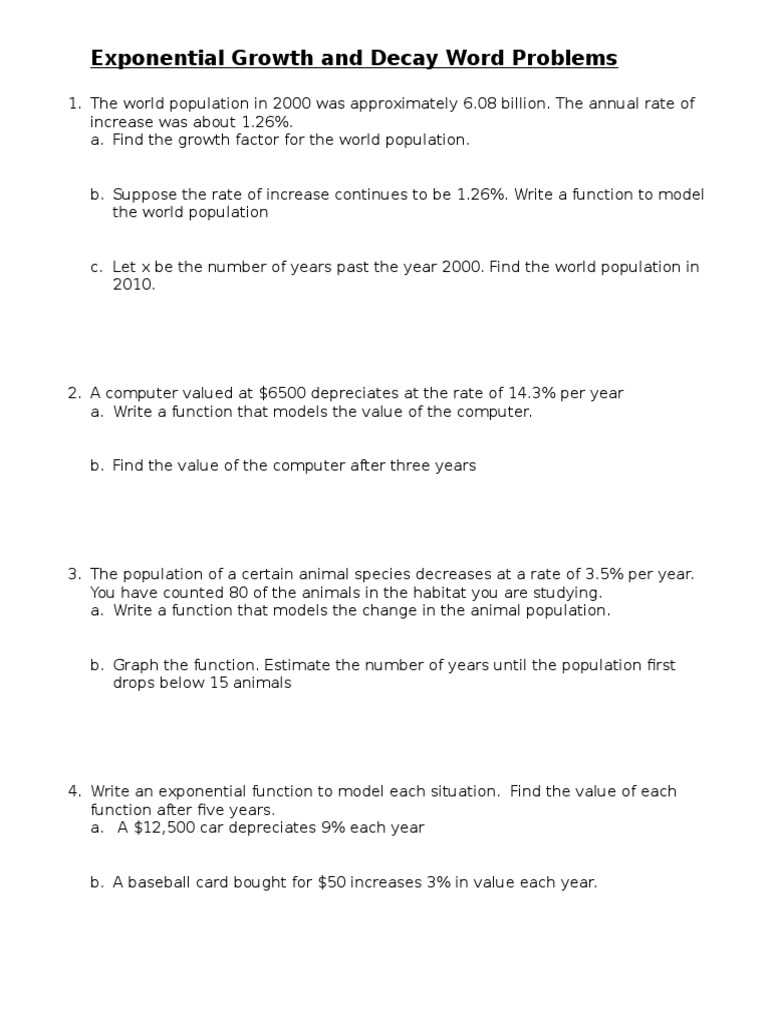
To solve problems involving rapid increases or decreases over time, identify the correct formula based on the situation. The most common formulas used for these types of calculations are the growth and decay models, which can be written as:
Growth Model: y = a(1 + r)^t
Decay Model: y = a(1 – r)^t
In these equations, y represents the final amount, a is the initial value, r is the rate of increase or decrease, and t is the time period over which the change occurs. Ensuring you recognize these components is the first step in solving such equations.
When working with these calculations, pay attention to units of time and make sure to apply the rate of change correctly, whether the situation describes a population increase, a radioactive substance decaying, or a financial investment growing. Misunderstanding the formula or confusing the rate of change can lead to incorrect results.
For practice, break down each word problem into its key elements. This approach helps ensure that you apply the correct model and manage variables correctly. As you go through more examples, you will become faster and more accurate in identifying the components that lead to the correct solutions.
Exponential Growth and Decay Solutions Guide
To solve these types of calculations, the first step is recognizing which formula to apply. For scenarios involving rapid increases, use the following:
Growth Formula: y = a(1 + r)^t
For situations with rapid decreases, apply the decay model:
Decay Formula: y = a(1 – r)^t
In both formulas, y represents the final value, a is the initial quantity, r is the rate of change (in decimal form), and t is the time period during which the change occurs.
Start by identifying the values for each of these variables from the problem. The key to solving these is ensuring you use the correct rate and time period. Be cautious with the rate – it’s usually given as a percentage, but must be converted to a decimal for use in the formula.
Example: If a population starts at 500 and grows at a rate of 4% per year, the formula becomes:
y = 500(1 + 0.04)^t
Now, plug in the value for t (the number of years) and solve for y to find the population after the given time period.
For decay, if a radioactive substance has an initial mass of 200 grams and decays at a rate of 5% per year, use:
y = 200(1 – 0.05)^t
Again, insert the time value t to determine how much of the substance remains after a certain period.
Always double-check your values before plugging them into the formula to ensure accuracy. With practice, these types of problems become straightforward to solve.
Understanding Growth and Decay Formulas
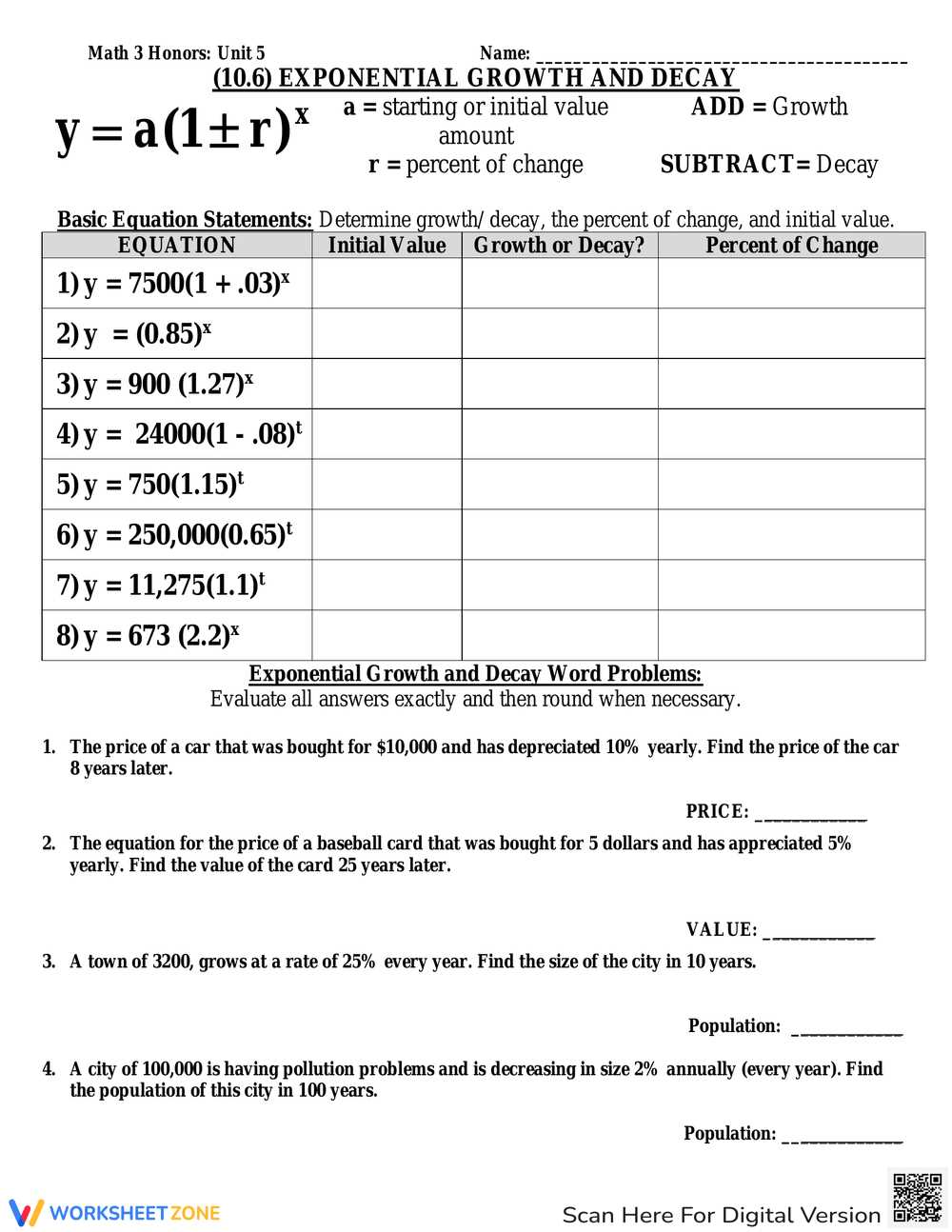
The formulas for calculating increases or decreases over time follow a specific structure. These formulas use the initial value, the rate of change, and the time period to predict future values.
Growth Formula: y = a(1 + r)^t
Decay Formula: y = a(1 – r)^t
In both formulas, y is the final value, a is the starting amount, r is the rate of change (as a decimal), and t is the time. The difference between the two formulas is in the sign of r: for growth, it is added, and for decay, it is subtracted.
To use these formulas effectively:
- Convert percentages to decimals: If the rate is given as a percentage, divide by 100. For instance, a 5% rate becomes 0.05.
- Understand the context: If a situation describes an increase, apply the growth formula. If it describes a decrease, use the decay formula.
- Time matters: Ensure that t reflects the correct unit of time (e.g., years, months, days).
By applying these formulas, you can easily calculate the final value after a specific time period, whether dealing with population growth, investment growth, radioactive decay, or any other scenario involving a constant rate of change.
Identifying Key Variables in Exponential Problems
In problems involving constant rate of change, it’s crucial to recognize and understand the key variables that affect the outcome. These variables help to set up the correct formula and solve the equation accurately.
The main variables to identify are:
| Variable | Description |
|---|---|
| a | The initial value or starting amount before any change has occurred. This is often the value at time zero. |
| r | The rate of change, expressed as a decimal. For growth, it’s added to the starting amount; for decay, it’s subtracted. |
| t | The time period over which the change happens. It can be measured in years, months, days, or other time units, depending on the problem. |
| y | The final value after the change has occurred. This is the result you are solving for. |
For accurate calculations, make sure that each variable is clearly defined within the context of the problem. For example, ensure the rate is converted to a decimal, and time units match for consistency in your formula.
Step-by-Step Solution for Growth Problems
To solve growth-related calculations, follow these steps:
- Identify the initial value: This is the starting amount, often labeled as a.
- Determine the rate of change: Express the rate as a decimal. For example, 20% growth becomes 0.20.
- Choose the correct formula: Use the formula y = a(1 + r)^t, where a is the initial amount, r is the rate, and t is time.
- Substitute the known values: Insert the values for a, r, and t into the formula.
- Solve the equation: Perform the arithmetic operations to calculate the final value y.
For example, if the initial amount is 100, the rate is 0.05, and the time is 3 years, the equation becomes:
y = 100(1 + 0.05)^3 = 100(1.05)^3 ≈ 115.76
The final value is approximately 115.76 after 3 years.
Step-by-Step Solution for Decay Problems
To solve problems involving reduction over time, follow these steps:
- Identify the initial value: This is the starting amount, denoted as a.
- Determine the rate of decrease: Express the reduction rate as a decimal. For example, a 10% decrease is written as 0.10.
- Choose the correct formula: Use the formula y = a(1 – r)^t, where a is the initial amount, r is the rate, and t is time.
- Substitute the known values: Insert the values for a, r, and t into the formula.
- Solve the equation: Perform the necessary arithmetic operations to find the final value y.
For example, if the initial value is 500, the rate of decrease is 0.2, and the time is 4 years, the equation becomes:
y = 500(1 – 0.2)^4 = 500(0.8)^4 ≈ 256
The final value is approximately 256 after 4 years.
For further reference, you can explore more on this topic at Khan Academy.
Common Mistakes to Avoid in Exponential Calculations
1. Misinterpreting the rate of change: Always confirm if the rate is a percentage or decimal. For example, a 20% increase should be written as 1.2, not 0.2.
2. Incorrectly applying the formula: Ensure you’re using the correct formula for the context. For a decrease, use y = a(1 – r)^t, and for an increase, use y = a(1 + r)^t.
3. Not using the correct time intervals: Double-check the units of time in the problem. If time is in years but the rate is annual, no conversion is necessary. If the rate is monthly, make sure to adjust the time accordingly.
4. Forgetting to round intermediate steps: Always round intermediate calculations to appropriate decimal places, but maintain accuracy until the final answer.
5. Confusing the starting value with the rate: Ensure the initial value is correctly identified and not confused with the rate of change. For example, the initial amount is often denoted as a, and the rate as r.
6. Ignoring negative results: In certain cases, such as decay, negative results could indicate an error. Double-check the setup and ensure you’re subtracting the rate correctly.
By avoiding these common pitfalls, you can improve accuracy and prevent errors in calculations.
Using Graphs to Solve Exponential Problems
1. Plot the initial point: Start by plotting the initial value, usually denoted as a, on the graph. This point represents the starting amount.
2. Determine the rate of change: Identify whether the rate is a percentage increase or decrease. This will help determine if the curve will rise or fall. For increases, the graph will show an upward curve, while for decreases, the curve will fall.
3. Find the time intervals: Ensure the time intervals on the x-axis are consistent with the units provided in the problem. For example, if the problem uses years, the x-axis should reflect that unit.
4. Draw the curve: Use the formula y = a(1 + r)^t for growth or y = a(1 – r)^t for decay. Plot the points that represent the values of y over time. The curve should gradually increase or decrease based on the rate and time.
5. Identify key points: Mark critical points on the graph, such as the point where the value reaches half its starting amount, or the time it takes to reach a certain value.
6. Use the graph for estimation: After plotting the graph, use it to estimate the value at any given time by finding the corresponding point on the curve. This method is helpful when exact calculations are difficult.
7. Check for asymptotes: In decay problems, the graph may approach a horizontal asymptote. This shows the limiting value that the function will never cross, indicating that the value decreases but never reaches zero.
By following these steps, graphs can help visualize the behavior of quantities over time, making it easier to solve and understand such calculations.
Real-Life Applications of Exponential Growth and Decay
1. Population Growth: In biology, population dynamics can be modeled using exponential functions. A population of animals or bacteria may grow rapidly under ideal conditions, following a pattern where each generation multiplies by a fixed rate over time.
2. Radioactive Decay: The decay of radioactive materials follows a similar pattern. The half-life, which is the time it takes for half of a sample to decay, is often calculated using formulas based on this principle, such as in carbon dating for archaeological purposes.
3. Compound Interest in Finance: In personal finance, the value of investments or savings can grow exponentially. Interest on an account, such as savings or loans, compounds over time, meaning that interest is earned on both the initial deposit and the accumulated interest.
4. Medicine and Drug Dosage: The concentration of certain drugs in the body decreases over time, following a decay pattern. Understanding the half-life of a medication helps in determining the proper dosage schedule and the time it takes for the drug to reach safe levels in the bloodstream.
5. Environmental Science: Pollution and resource depletion can follow exponential models, where the rate of consumption or contamination increases or decreases at a fixed percentage per time interval, impacting sustainability efforts.
6. Technology and Data Storage: The advancement of technology, such as the increase in data storage capacity and computing power, often follows an exponential trend. For example, the number of transistors that can be placed on a microchip has increased rapidly over the years.
7. Viral Spread in Epidemics: The spread of infectious diseases can often be modeled using exponential growth, where the number of infected individuals grows rapidly before it begins to slow. Understanding this pattern is key for managing public health responses to outbreaks.
8. Ecology and Carbon Emissions: The increase in atmospheric carbon dioxide, a major driver of climate change, often follows an exponential growth pattern. This has significant implications for environmental policy and global climate modeling.
Practice Problems with Detailed Explanations
Problem 1: Population of Bacteria
The population of a bacteria culture doubles every 4 hours. If the initial population is 500, how many bacteria will there be after 12 hours?
Solution: Use the formula for doubling: P(t) = P₀ * 2^(t / T), where P₀ is the initial population, t is the time elapsed, and T is the doubling time. Here, P₀ = 500, t = 12, and T = 4.
First, calculate the number of doublings: 12 / 4 = 3.
Now apply the formula: P(12) = 500 * 2^3 = 500 * 8 = 4000.
Thus, the population after 12 hours will be 4000 bacteria.
Problem 2: Radioactive Decay
A substance has a half-life of 6 hours. If the initial amount of the substance is 200 grams, how much of it remains after 18 hours?
Solution: Use the formula for decay: A(t) = A₀ * (1/2)^(t / T), where A₀ is the initial amount, t is the time elapsed, and T is the half-life.
Here, A₀ = 200 grams, t = 18 hours, and T = 6 hours.
First, calculate the number of half-lives: 18 / 6 = 3.
Now apply the formula: A(18) = 200 * (1/2)^3 = 200 * 1/8 = 25.
Thus, 25 grams of the substance remain after 18 hours.
Problem 3: Compound Interest
An investment of $1000 earns 5% annual interest, compounded quarterly. How much will the investment be worth after 3 years?
Solution: Use the compound interest formula: A = P * (1 + r/n)^(nt), where P is the principal, r is the annual interest rate, n is the number of times the interest is compounded per year, and t is the time in years.
Here, P = 1000, r = 0.05, n = 4 (quarterly), and t = 3 years.
Now apply the formula: A = 1000 * (1 + 0.05/4)^(4*3) = 1000 * (1 + 0.0125)^12 = 1000 * 1.1616 = 1161.6.
Thus, the investment will be worth $1161.60 after 3 years.
Problem 4: Drug Dosage
A drug in a patient’s body decreases by 30% every hour. If the initial dose was 100 mg, how much of the drug remains after 5 hours?
Solution: Use the decay formula: A(t) = A₀ * (1 – r)^t, where A₀ is the initial amount, r is the rate of decrease, and t is the time in hours.
Here, A₀ = 100 mg, r = 0.30, and t = 5 hours.
Now apply the formula: A(5) = 100 * (1 – 0.30)^5 = 100 * (0.70)^5 = 100 * 0.16807 = 16.807.
Thus, 16.81 mg of the drug remains after 5 hours.
Problem 5: Cooling of a Hot Object
A hot object is cooling in a room, and its temperature drops by 20% every hour. If the initial temperature is 150°C, what will its temperature be after 3 hours?
Solution: Use the decay formula: T(t) = T₀ * (1 – r)^t, where T₀ is the initial temperature, r is the rate of temperature decrease, and t is the time in hours.
Here, T₀ = 150°C, r = 0.20, and t = 3 hours.
Now apply the formula: T(3) = 150 * (1 – 0.20)^3 = 150 * (0.80)^3 = 150 * 0.512 = 76.8.
Thus, the temperature after 3 hours will be 76.8°C.