Understanding and Solving Piecewise Functions Worksheet Problems
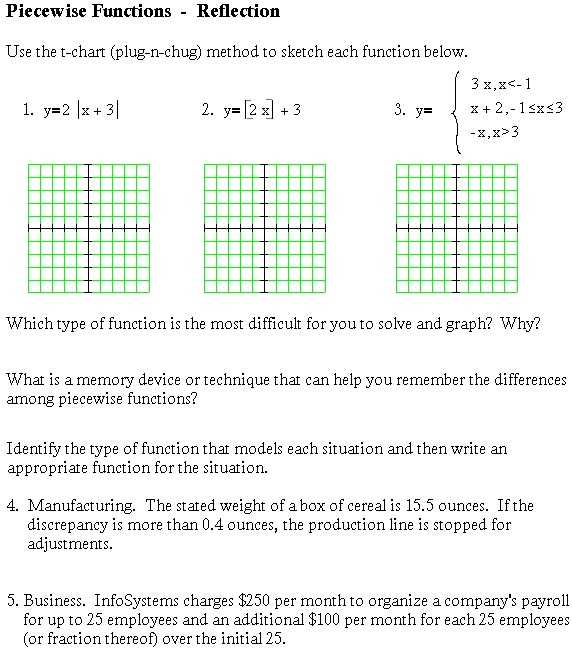
If you’re struggling with solving mathematical problems that involve multiple expressions over different intervals, the first step is understanding the structure of these challenges. Break down the problem into separate parts, each corresponding to a different condition or range. By isolating each section, you can apply the appropriate formula or method for that specific segment.
One common issue students face is interpreting the domain and range for each segment of the problem. Pay attention to how each condition defines its limits. This helps in determining which values fall under each piece of the equation. Make sure to carefully consider the boundaries for each piece, as misinterpreting these can lead to incorrect results.
After solving individual parts of the problem, check your results by evaluating the function at key points where the intervals change. Testing the continuity of the solution at these transition points will confirm whether you’ve handled the changes correctly. If your solution is smooth and consistent across the entire range, you’ve likely approached the problem with accuracy.
Piecewise Problems Worksheet Solutions
To solve each part of the worksheet, start by identifying the conditions that define each segment. Use the correct formula for the corresponding interval to ensure that the solution is accurate for each range.
| Problem | Solution |
|---|---|
| Problem 1: f(x) = 2x + 1 for x ≤ 3, f(x) = -x + 5 for x > 3 | Solution: f(2) = 2(2) + 1 = 5; f(4) = -4 + 5 = 1 |
| Problem 2: f(x) = x² for x | Solution: f(-2) = (-2)² = 4; f(2) = 2(2) = 4 |
| Problem 3: f(x) = x + 3 for x ≤ -1, f(x) = 2x – 1 for x > -1 | Solution: f(-2) = -2 + 3 = 1; f(0) = 2(0) – 1 = -1 |
Double-check each interval’s boundary to avoid mistakes. Ensure that each value is tested with the appropriate expression and that you account for any discontinuities at the points where the pieces meet.
How to Interpret Mathematical Piecewise Expressions
When faced with mathematical expressions involving multiple conditions, it’s important to break down the problem into manageable parts. Each segment of the function applies to a specific range of values, and understanding where the function changes is key to solving the problem correctly. Follow these steps:
- Identify the intervals: Each segment of the expression has a condition that defines its valid range. Make sure to carefully check where one segment ends and another begins.
- Apply the correct formula: For each value of x, determine which condition it fits into, then use the corresponding formula to calculate the result.
- Check boundaries: Pay special attention to the boundary points where the condition changes. Test these points to ensure the expression is properly evaluated at the transition.
- Evaluate piecewise segments: Once the correct formula is applied, calculate the result for each section of the problem based on the given x-values.
By following these steps, you can confidently interpret and solve problems involving functions with different expressions for various intervals.
For further details on how to solve problems involving these types of expressions, visit Khan Academy’s Mathematics Resources.
Step-by-Step Guide to Solving Problems with Multiple Conditions
To solve problems involving multiple conditions, follow these precise steps:
- Identify the condition for each range: Look at the intervals and determine which rule applies to each specific range of values. Make sure to mark the intervals clearly.
- Substitute the value: When given a specific value, find the interval it belongs to and apply the corresponding rule or expression. Plug the value into the relevant formula.
- Simplify the equation: After substituting the value, simplify the expression to calculate the output. If the formula involves basic operations, perform them step-by-step to find the result.
- Check the boundary values: Make sure to consider boundary points where the rule changes. Evaluate if the value falls on the boundary and ensure the correct formula is used.
- Double-check your calculations: Revisit your steps to ensure all the calculations are correct. Verify that the results align with the intended conditions for each range.
By following these steps, you can efficiently solve problems involving multiple conditional expressions and arrive at accurate results.
Common Mistakes in Solving Problems with Multiple Conditions
Here are some common mistakes to avoid when solving problems with multiple conditions:
- Ignoring boundary values: Failing to check if the input value lies on a boundary between two intervals can lead to applying the wrong rule.
- Incorrectly applying the formula: Using the wrong equation for the given range is a frequent error. Always ensure the formula corresponds to the correct interval.
- Forgetting to simplify: After substituting values, some people neglect to simplify the resulting expression. Always perform simplifications to avoid incorrect results.
- Misinterpreting the inequality signs: Pay close attention to inequality signs. A slight mix-up between “greater than” and “less than” can change the rule applied to a specific range.
- Overlooking discontinuities: When dealing with piecewise problems, it’s easy to overlook how one rule ends and another begins. Ensure you carefully check for continuity or discontinuity at each interval.
Avoiding these mistakes will improve accuracy and efficiency when solving problems involving multiple conditions.
How to Graph Multiple-Rule Equations for Better Understanding
Follow these steps to graph equations that involve different rules for different ranges:
- Identify the intervals: Start by determining the ranges for which each rule applies. Look at the inequalities or conditions provided in the problem.
- Plot the boundary points: Mark the points where the rule changes. These are critical to understanding where one equation ends and the next one begins.
- Graph each segment: For each rule, graph the corresponding equation on its specified interval. Make sure to use the correct values for x and y based on the rule applied.
- Check for continuity: Ensure that the graphs connect properly at the boundaries. If there’s a break or jump, note it down, as this indicates a discontinuity between rules.
- Label the axes and intervals: Clearly label each segment of the graph with its corresponding equation or rule. This helps avoid confusion about which rule is applied in each range.
Graphing these problems step by step helps clarify how different rules operate over different ranges of values and provides a visual understanding of the relationships between them.
Understanding the Domain and Range in Multiple-Rule Equations
The domain and range of an equation with multiple rules are determined by the specific intervals in which each rule applies.
Domain: To find the domain, identify the x-values over which each equation or rule applies. The domain is the set of all possible x-values that the equation includes. For each interval, the x-values are restricted based on the conditions given for that part of the problem.
Range: The range refers to the corresponding y-values produced by the equation. Once you have the domain, substitute values from the x-intervals into the equations to find the resulting y-values. The range is the set of all possible y-values that can occur over the entire domain.
For example, if one rule applies for x-values between 0 and 3, and another rule applies for x-values between 3 and 5, the domain would be the union of these two intervals: [0, 3] U [3, 5]. The range is then determined by evaluating the equations over those intervals.
Understanding the domain and range helps you see the boundaries and output values of each segment, providing a clearer picture of how the different pieces of the equation interact with each other.
How to Handle Multiple-Expression Equations
When dealing with equations that involve different expressions for different intervals, the key is to treat each piece separately based on its specific conditions.
Step 1: Identify the Interval for Each Expression
Start by carefully noting the intervals where each expression applies. For example, one expression might apply for x-values between 0 and 3, and another for x-values between 3 and 5. These intervals determine when each expression should be used.
Step 2: Apply the Correct Expression for Each Interval
For each x-value within a given interval, use the corresponding expression. For instance, if x is between 0 and 3, substitute x into the first expression. If x is between 3 and 5, use the second expression. Always ensure that you are using the correct rule for each specific range.
Step 3: Solve Each Piece
After selecting the appropriate expression for each interval, solve the equation as you would with any standard algebraic expression. Simplify and calculate the y-value for each x-value within the interval.
Step 4: Combine Results from All Intervals
Once you have solved for all intervals, combine the results to form the complete set of points for the entire equation. This will give you the full graph or solution set for the problem.
This approach allows you to handle equations with different expressions in a structured way, ensuring accuracy and clarity in your solutions.
Solving Real-Life Problems Using Mathematical Models
To solve real-world problems that require different rules under varying conditions, break the situation into distinct intervals or conditions. Each interval will have its own mathematical rule or expression that governs the behavior of the situation.
Step 1: Identify the Different Conditions
Real-life problems often have different scenarios that apply to different ranges of values. For example, in a taxi fare problem, the rate might change after a certain distance. Determine the different ranges of input values (such as time or distance) that affect the cost or outcome.
Step 2: Create a Model for Each Condition
For each interval, establish a mathematical expression that applies. For instance, the fare might be calculated as a base rate for the first few miles and then increase at a different rate for each subsequent mile. Each piece of the situation can be modeled with its own equation or rule.
Step 3: Apply the Relevant Model
Once you have the appropriate models for each interval, plug the values from your real-life scenario into the corresponding equations. For example, if you are calculating the cost for a ride that covers both short and long distances, use the first equation for the first few miles and switch to the second rule for the remaining miles.
Step 4: Combine the Results
After calculating the result for each interval, add them together to find the total result. This gives you the overall solution, such as the total cost of a taxi ride or the total time for a project with different phases.
By breaking complex real-life problems into smaller, manageable parts with specific conditions, you can apply the appropriate mathematical models to each segment, ensuring accuracy and clarity in your solutions.
How to Verify the Accuracy of Your Mathematical Model Solutions
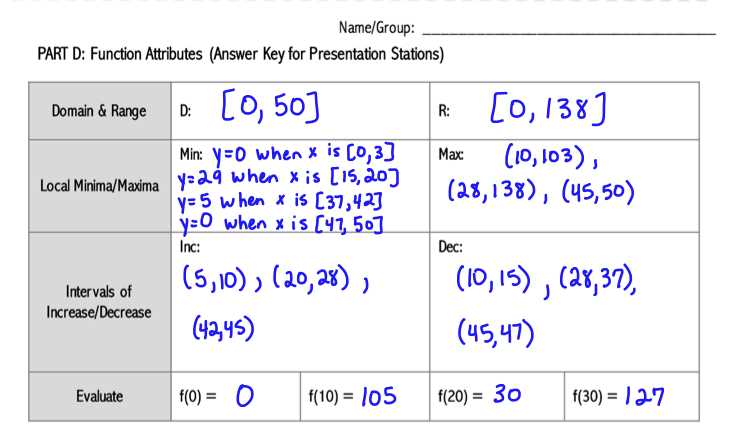
To ensure the correctness of your results, follow these specific steps:
1. Check the Interval Conditions
Ensure that the correct expression is applied to the correct interval. Double-check that each range of values corresponds to the correct mathematical rule. If a piece of the model covers a specific range, verify that all values within that range are accounted for.
2. Test Edge Cases
Examine the boundaries of each interval. Plug in the boundary values (such as the starting and ending points) into the model to make sure the solution behaves as expected at the edges of the intervals.
3. Plot the Model
Graph the entire model and inspect how it behaves across different ranges. A visual inspection of the graph can help identify errors in how the pieces of the model connect or behave at the boundaries.
4. Verify with Known Values
If possible, use known input-output pairs to verify the model. For example, if the model represents real-world data, compare the predicted results with actual data or known benchmarks to see if they align.
5. Evaluate the Continuity and Smoothness
Check if the solution is continuous or if there are abrupt jumps where the rules change. Discontinuities can signal mistakes in how the different parts of the model are defined or applied.
6. Cross-Check with Alternative Methods
If feasible, solve the same problem using a different method or approach. This can help confirm the validity of the solution. Comparing solutions from different techniques can increase confidence in the results.
By carefully verifying each part of the model and testing the solution against known conditions, you can ensure the accuracy of your results and catch any errors early in the process.