Genetics Test Review with Detailed Answer Explanations
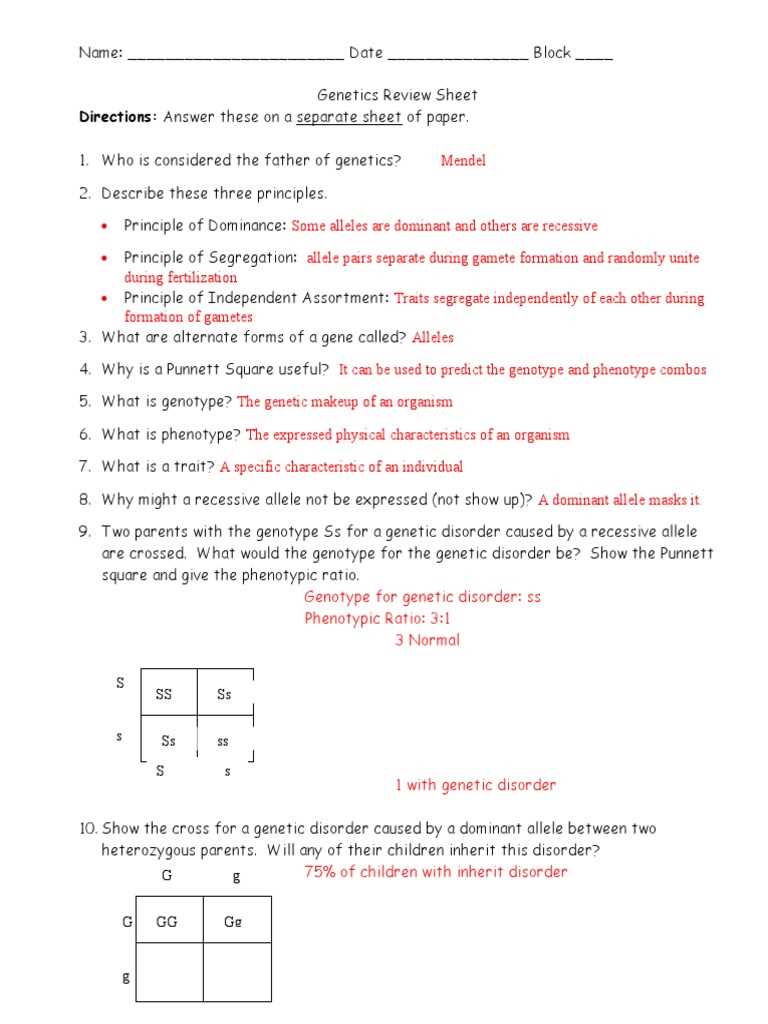
When solving problems related to heredity, the first step is to identify the type of inheritance pattern involved. Whether you’re working with dominant, recessive, or codominant traits, recognizing how traits are passed from one generation to the next is critical for understanding the outcomes of genetic crosses.
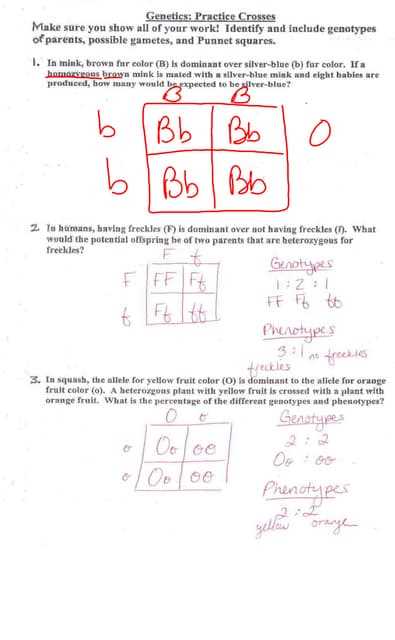
For example, using Punnett squares is a reliable method for predicting offspring genotypes in monohybrid crosses. By examining the combinations of alleles, you can quickly determine possible genetic variations. Similarly, analyzing pedigree charts helps track the inheritance of traits through generations, identifying carriers and affected individuals in cases of recessive disorders.
In addition to Mendelian inheritance, some problems may involve more complex concepts, such as incomplete dominance or multiple allele inheritance. Knowing how to apply these concepts to real-world examples will help ensure accurate problem-solving, especially in more advanced scenarios like genetic disorders and mutations.
Genetics Test Review Answer Key
For a correct understanding of inherited traits, remember that dominant alleles are represented by capital letters (e.g., “A”) and recessive alleles by lowercase letters (e.g., “a”). In a simple monohybrid cross, the genotype ratio of heterozygous parents (Aa × Aa) will be 1:2:1, with one homozygous dominant (AA), two heterozygous (Aa), and one homozygous recessive (aa) offspring.
In a dihybrid cross, analyze the inheritance of two traits at once. Use the FOIL method to determine possible gametes. For instance, in the cross (AaBb × AaBb), the expected phenotypic ratio is 9:3:3:1. Always pay attention to the distribution of alleles for each trait when constructing the Punnett square.
When working with sex-linked traits, such as color blindness, remember that males (XY) have only one X chromosome and will express the trait if they inherit the recessive allele. Females (XX) must inherit the recessive allele from both parents to express the condition. This distinction is critical when interpreting pedigree charts and solving genetic problems.
For incomplete dominance or codominance, the heterozygous phenotype will differ from both homozygous forms. For example, in incomplete dominance, a red (RR) flower crossed with a white (WW) flower will produce pink (RW) offspring. In codominance, both alleles contribute equally, as seen in the AB blood type where both A and B alleles are expressed simultaneously in the heterozygous individual.
Multiple alleles can also complicate inheritance patterns. A prime example is the ABO blood group system. A person can inherit A, B, or O alleles from each parent, which determines their blood type. Understanding these patterns requires familiarity with allelic interactions and inheritance principles.
In cases of mutations, such as a frameshift or point mutation, remember that these can result in significant changes to the protein structure, potentially leading to genetic disorders. When working through such problems, carefully analyze the DNA sequence changes and their effect on protein synthesis.
| Cross | Expected Genotype Ratio | Phenotype Ratio |
|---|---|---|
| Aa × Aa | 1 AA : 2 Aa : 1 aa | 3 Dominant : 1 Recessive |
| AaBb × AaBb | 1 AABB : 2 AABb : 2 AaBB : 4 AaBb : 1 AAbb : 2 Aabb : 2 aaBB : 4 aaBb : 1 aabb | 9 Dominant Both Traits : 3 Dominant A, Recessive B : 3 Recessive A, Dominant B : 1 Recessive Both Traits |
How to Approach Mendelian Inheritance Problems
Start by identifying the alleles involved in the cross. Dominant traits are typically represented by uppercase letters (e.g., “A”), and recessive traits by lowercase letters (e.g., “a”). Clearly define the genotype of both parents before proceeding to set up a Punnett square.
For monohybrid crosses, use a simple 2×2 Punnett square to determine the potential genotype combinations. For example, if both parents are heterozygous (Aa), the expected ratio of offspring genotypes will be 1 AA : 2 Aa : 1 aa. This ratio shows that three-quarters will exhibit the dominant trait, and one-quarter will exhibit the recessive trait.
For dihybrid crosses, use a larger Punnett square, typically 4×4, to account for two traits. Apply the FOIL method (First, Outer, Inner, Last) to determine all possible allele combinations for each parent. In a dihybrid cross, the genotype ratio for two heterozygous parents (AaBb x AaBb) is expected to be 9:3:3:1. This ratio corresponds to the phenotypic expression of both traits.
Pay attention to Mendel’s laws: the law of segregation (each parent passes only one allele for each gene to their offspring) and the law of independent assortment (genes for different traits are inherited independently of each other). These principles are key in solving inheritance problems.
If the problem involves sex-linked traits, remember that males (XY) will inherit their X allele from their mother and their Y allele from their father, while females (XX) inherit an X allele from both parents. This will affect how traits are passed down and expressed.
To solve problems involving multiple alleles or incomplete dominance, remember that more than two alleles can exist for a gene (e.g., the ABO blood group). In incomplete dominance, the heterozygote will display a blend of both alleles, such as pink flowers from red and white parents.
Lastly, check the question for any indications of lethal alleles or gene interactions that might alter the expected ratios. These nuances can change the predicted outcome of genetic crosses.
Understanding Punnett Squares and Their Applications
To construct a Punnett square, begin by writing down the genotypes of the two parents, separating the alleles. For a monohybrid cross, one parent’s alleles go on the top and the other’s on the side. Fill in the grid to represent the potential combinations of alleles that the offspring can inherit.
For a simple monohybrid cross, where both parents are heterozygous (e.g., Aa x Aa), the resulting offspring genotypes should be written as a 2×2 grid. The possible genotypic outcomes are 1 AA, 2 Aa, and 1 aa. This allows you to calculate the probability of each genotype in the next generation.
In dihybrid crosses, where two traits are considered, a larger Punnett square (4×4) is used. The alleles for both traits are placed on the sides and top of the grid. The combinations show the probabilities of offspring inheriting both traits together. For example, for a cross between two heterozygous individuals (AaBb x AaBb), the result is a 9:3:3:1 phenotypic ratio for two traits.
Punnett squares are useful for predicting the likelihood of specific traits appearing in offspring, but they are limited to showing the genotypic ratios. They cannot predict actual outcomes, as they don’t account for environmental factors or mutations.
In the case of sex-linked traits, Punnett squares help clarify inheritance patterns, especially for X-linked traits. Since males inherit only one X chromosome, their phenotype for X-linked traits will reflect the allele present on that chromosome, whereas females need two copies of the allele (one from each parent) to express the trait.
Use Punnett squares to solve questions about incomplete dominance, co-dominance, and multiple alleles. These squares can show how traits like flower color or blood type are inherited, accounting for blended or combined expressions of alleles.
Lastly, for understanding pedigree analysis, Punnett squares provide a visual method to track allele inheritance through generations, helping to identify dominant, recessive, and sex-linked traits.
Explaining Genetic Mutations and Their Effects
Genetic mutations occur when there is a change in the sequence of nucleotides in DNA. These changes can happen spontaneously or be induced by environmental factors such as radiation or chemicals.
Mutations can be classified into different types based on the nature of the DNA change:
- Point mutations: A single nucleotide is substituted, inserted, or deleted. This can lead to changes in the protein produced by the gene, such as sickle cell anemia.
- Frameshift mutations: Insertions or deletions of nucleotides that shift the reading frame, altering the entire sequence downstream of the mutation.
- Silent mutations: Mutations that do not result in a change in the protein due to redundancy in the genetic code.
- Missense mutations: A single nucleotide change leads to a codon that codes for a different amino acid, which can change the structure and function of the protein.
- Nonsense mutations: A point mutation that changes an amino acid codon to a stop codon, resulting in a truncated protein.
Some mutations are beneficial, leading to advantageous traits, such as antibiotic resistance in bacteria. However, most mutations are neutral or harmful. Harmful mutations can result in genetic disorders, such as cystic fibrosis, Huntington’s disease, or Duchenne muscular dystrophy. These disorders often arise when the mutated gene produces a nonfunctional protein or disrupts normal cellular processes.
In addition to these, mutations can have significant effects on genetic inheritance patterns. Autosomal dominant mutations, like those causing Huntington’s disease, only require one copy of the mutated gene to express the condition, whereas autosomal recessive mutations require two copies of the mutated gene.
Mutations also play a key role in evolution. Over time, beneficial mutations can accumulate, contributing to the adaptation of species to their environments. However, the process is slow, and most mutations do not have a significant impact on the organism’s fitness.
Finally, mutations can be repaired by cellular mechanisms, such as DNA proofreading and repair systems. When these repair systems fail, mutations can accumulate, potentially leading to diseases such as cancer.
Identifying Autosomal vs Sex-Linked Traits
Autosomal traits are determined by genes located on the non-sex chromosomes, known as autosomes. These traits typically follow Mendelian inheritance patterns. Both males and females inherit autosomal traits in the same way, with each parent contributing one allele. Examples include traits like eye color, blood type, and hair texture.
In contrast, sex-linked traits are determined by genes located on the sex chromosomes (X and Y). The most common sex-linked traits are linked to the X chromosome, and these traits show distinct inheritance patterns between males and females. Males, having only one X chromosome, are more likely to express X-linked recessive traits. Females, with two X chromosomes, must inherit two copies of the mutated gene to express the trait. Examples of X-linked traits include color blindness and hemophilia.
Key differences between autosomal and sex-linked traits:
- Inheritance pattern: Autosomal traits affect both genders equally, while sex-linked traits often show different patterns in males and females.
- Sex chromosomes involved: Autosomal traits involve non-sex chromosomes (chromosomes 1-22), while sex-linked traits involve the X or Y chromosome.
- Expression in males: Males are more likely to express X-linked recessive traits because they have only one X chromosome.
- Carrier status: Females can be carriers for X-linked recessive traits, meaning they carry one copy of the mutated gene but do not express the trait, while males cannot be carriers for X-linked recessive traits.
Recognizing these differences helps in predicting inheritance patterns and understanding the likelihood of certain traits appearing in offspring. For example, when analyzing family pedigrees, autosomal traits will show a more uniform inheritance, while sex-linked traits will be more prominent in one gender, typically males.
Interpreting Pedigree Charts in Genetics
Pedigree charts are diagrams that trace the inheritance of traits within a family over multiple generations. To accurately interpret a pedigree chart, follow these key steps:
- Identify the symbols: Squares represent males, and circles represent females. Shaded symbols indicate individuals who express the trait, while unshaded symbols represent those who do not.
- Examine the pattern of inheritance: Determine whether the trait is inherited in an autosomal dominant, autosomal recessive, or sex-linked manner. For autosomal dominant traits, one affected parent typically passes the trait to offspring. Autosomal recessive traits require both parents to carry the gene. Sex-linked traits often appear more frequently in males.
- Check for carriers: In the case of recessive traits, carriers are individuals who do not express the trait but carry one copy of the recessive allele. These are usually represented by half-shaded symbols in the chart.
- Look for consanguinity: Pedigree charts often include information about consanguineous relationships (marriages between relatives). This is important for identifying autosomal recessive traits that may be more likely to appear in inbred populations.
By analyzing the patterns and relationships shown in the chart, it’s possible to predict the likelihood of a trait being passed to future generations and determine the potential for genetic disorders to appear in offspring.
Reviewing Codominance and Incomplete Dominance
Codominance and incomplete dominance are two patterns of inheritance that differ from the typical dominant-recessive model. Here’s how to identify and understand each:
- Codominance: In this pattern, both alleles for a gene are fully expressed in the phenotype. For example, in some breeds of cattle, a red cow (RR) and a white cow (WW) can produce offspring with both red and white patches (RW), where both colors are visible.
- Incomplete Dominance: Here, neither allele is completely dominant over the other. This results in a blended phenotype. A classic example is the flower color in snapdragons, where a cross between a red flower (RR) and a white flower (WW) results in pink flowers (RW), a mix of both parent colors.
When solving problems involving these inheritance patterns, remember the following:
- Codominance: Both alleles are expressed equally, so offspring will show both traits simultaneously (e.g., red and white patches).
- Incomplete Dominance: The heterozygous offspring display an intermediate phenotype, blending both traits (e.g., pink flowers from red and white parents).
By understanding these inheritance patterns, you can predict the possible outcomes in crosses and correctly identify whether codominance or incomplete dominance is at play.
Analyzing Genetic Disorders and Their Inheritance Patterns
To analyze genetic disorders and understand their inheritance, first identify whether the disorder follows a dominant or recessive pattern. Common genetic disorders can be categorized based on how they are inherited:
- Autosomal Dominant Disorders: These disorders require only one copy of the mutated gene to express the disorder. Affected individuals have a 50% chance of passing it on to their offspring. Examples include Huntington’s disease and Marfan syndrome.
- Autosomal Recessive Disorders: For these disorders, two copies of the mutated gene are required to express the condition. Parents of an affected individual are often carriers. Examples include cystic fibrosis and sickle cell anemia.
- X-linked Disorders: These disorders are caused by mutations on the X chromosome. Males are more likely to be affected since they have only one X chromosome. Examples include hemophilia and Duchenne muscular dystrophy.
When analyzing a pedigree chart for these disorders:
- Check if the disorder appears in every generation (dominant) or skips generations (recessive).
- For X-linked disorders, note the pattern of inheritance in males versus females.
- Consider if both parents need to be carriers for the disorder to appear in their children (recessive), or if one parent with the disorder can pass it on to their offspring (dominant).
For detailed information on various genetic conditions and inheritance patterns, visit the GenomeWeb.
How to Solve Problems Involving Multiple Alleles
When solving problems involving multiple alleles, first identify the different alleles that exist for the gene in question. In cases with multiple alleles, there can be more than two forms of the gene, but each individual can only carry two alleles (one from each parent).
Follow these steps:
- Identify the Alleles: List all possible alleles. For example, in the ABO blood group system, there are three alleles: IA, IB, and i.
- Understand the Dominance Relationships: Some alleles may be dominant, others recessive. In the ABO blood system, IA and IB are codominant, while i is recessive.
- Determine Genotypes: Write the possible genotype combinations for the parents. For example, a mother with IAi and a father with IBi could produce offspring with four possible genotypes: IAIB, IAi, IBi, and ii.
- Determine Phenotypes: Use the dominance rules to determine the phenotypes of the offspring. For the ABO system, IAIB would express type AB blood, IAi would express type A, IBi would express type B, and ii would express type O.
By following these steps, you can solve problems involving multiple alleles and predict the possible outcomes of crosses. Understanding the specific inheritance patterns of multiple alleles, such as codominance or incomplete dominance, is key to solving these problems accurately.