Complete Guide to Macromolecule Solutions for Science Teachers
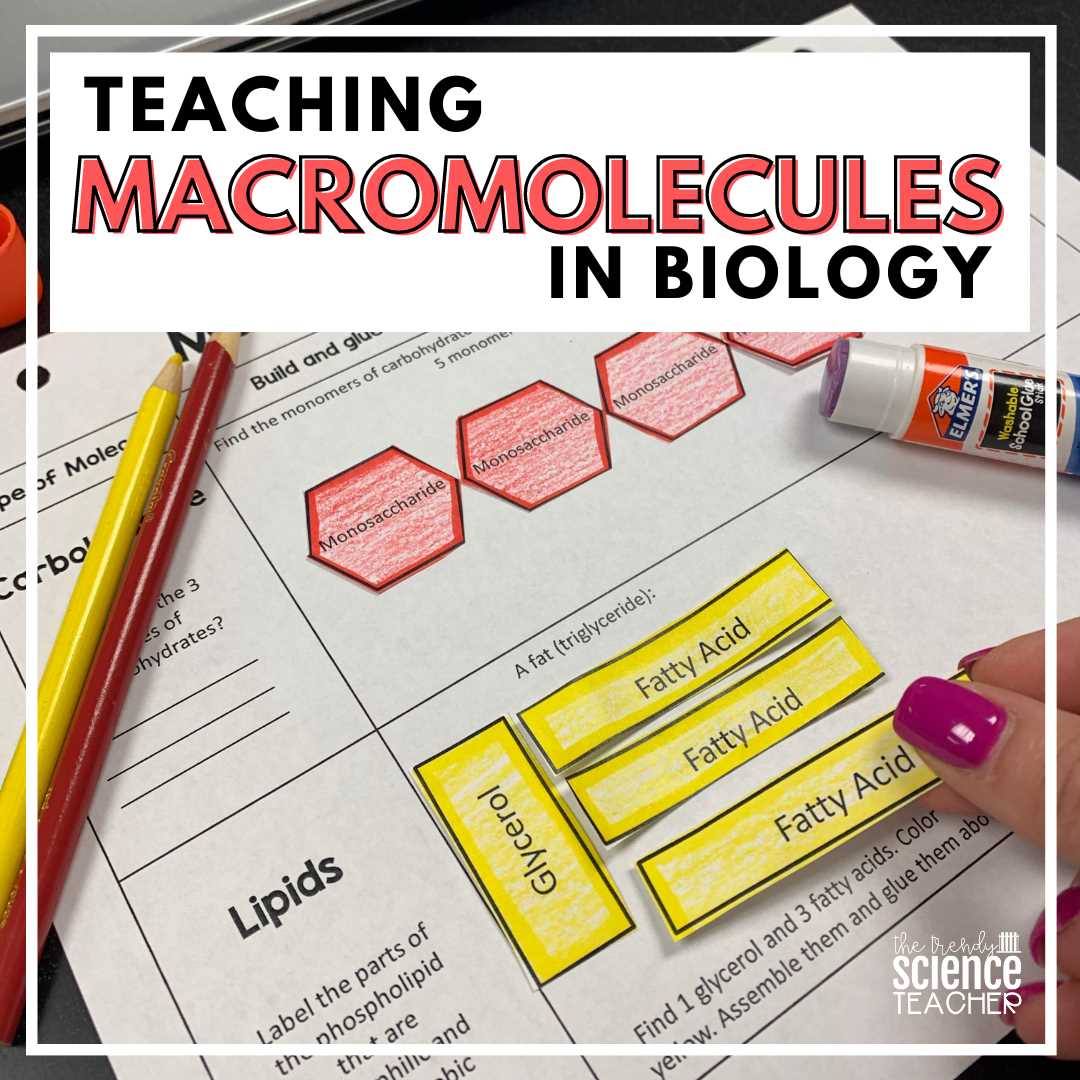
When exploring complex biological compounds, it’s important to break down their structure and function into clear, digestible segments. A solid grasp of these building blocks can significantly enhance a student’s understanding of molecular biology.
Start by emphasizing the different types of large molecules: proteins, carbohydrates, lipids, and nucleic acids. Each plays a critical role in maintaining life processes and offers practical examples to reinforce concepts. Providing visual aids, such as molecular models or diagrams, can help clarify intricate structures and processes.
Another effective approach is integrating interactive exercises that require students to apply their knowledge in solving problems related to molecular interactions. This method strengthens their understanding while keeping them engaged.
Lastly, always be ready to address common misconceptions that students may have. For example, misunderstandings about the energy storage role of carbohydrates or the complexity of protein folding can hinder progress. Address these issues by using real-world examples and encouraging critical thinking during discussions.
Understanding the Role of Macromolecules in Education
Highlight the importance of large biological compounds in student learning. These molecules serve as the foundation for understanding living systems and are critical for teaching topics in biochemistry, molecular biology, and cellular processes.
Focus on how each class of large compounds–proteins, lipids, carbohydrates, and nucleic acids–functions within the body. For example, proteins catalyze reactions and support structure, while nucleic acids store genetic information. Linking these molecules to real-life scenarios makes learning more engaging and meaningful.
Encourage students to visualize complex structures using diagrams or 3D models. Hands-on activities, such as building molecular structures or conducting experiments to observe reactions, help solidify concepts and foster active learning.
Lastly, help students see the broader picture by demonstrating how these macromolecules interact within cells to maintain homeostasis and support life. Use case studies of diseases or genetic disorders to illustrate the consequences of molecular malfunctions.
How to Teach Protein Structure and Function to Students
Introduce students to protein structure by breaking it down into its four levels: primary, secondary, tertiary, and quaternary. Use diagrams to illustrate how amino acid sequences fold into functional shapes.
Highlight the importance of the amino acid sequence in determining a protein’s function. Show how changes in the sequence can lead to diseases or malfunctions, such as sickle cell anemia.
Incorporate interactive activities like building protein structures using molecular model kits or digital simulations. These hands-on experiences will help students visualize the folding process and understand the relationship between structure and function.
Discuss the role of enzymes as proteins that catalyze biochemical reactions. Use real-life examples, like the breakdown of food in the digestive system, to illustrate their vital functions.
Incorporate case studies of proteins in different organisms to show the diversity and specialization of protein functions. This will help students appreciate the role of proteins in everything from muscle movement to immune defense.
Finally, encourage students to relate protein structure and function to other biological concepts such as gene expression and cellular signaling. Make sure to stress how proteins are integral to life processes at every level of biology.
Practical Tips for Explaining Carbohydrate Macromolecules
Start by explaining the basic structure of carbohydrates: simple sugars (monosaccharides), disaccharides, and complex sugars (polysaccharides). Show visual representations of glucose, fructose, and sucrose to highlight their differences.
Use examples students can relate to, like starch in potatoes and glycogen in animals. Emphasize their role in storing energy and how organisms break down these compounds to release energy.
Demonstrate the process of polymerization, where monosaccharides combine to form larger structures. Include a hands-on activity where students build sugar chains using molecular model kits or paper cutouts.
Explain the difference between starch and cellulose by comparing their chemical structures and their respective functions in plants and animals. Include a brief discussion on why humans cannot digest cellulose.
Incorporate real-world applications of carbohydrates, such as their role in cellular recognition and their use in the food industry as additives and preservatives. Students will better understand why these compounds are so important in biology and everyday life.
Conclude by explaining how carbohydrates interact with other macromolecules, like proteins and lipids, in cellular processes. This will help students appreciate how these substances work together to maintain biological systems.
For more detailed information, you can visit authoritative sources such as National Institutes of Health.
Using Visual Aids to Enhance Teaching of Lipids and Nucleic Acids
Start with simple diagrams to illustrate the basic structures of lipids and nucleic acids. Show students how fatty acids form lipids and how nucleotides combine to form nucleic acids. Use color-coded models to highlight the different components like phosphate groups, sugar molecules, and nitrogenous bases.
Incorporate 3D molecular models that students can manipulate to explore the structure of lipids like phospholipids and triglycerides. This hands-on approach makes abstract concepts more tangible.
Use video clips or animations to demonstrate how lipids form bilayers and how nucleic acids replicate or transcribe. Seeing dynamic processes will help students visualize and understand these complex biochemical interactions.
Provide comparative diagrams that clearly show the differences between DNA and RNA, including their structures, functions, and roles in protein synthesis. Label each part and explain how they interact within the cell.
Show how lipids and nucleic acids contribute to cellular structures and functions. For instance, illustrate how lipids make up cell membranes and how nucleic acids store genetic information.
End the lesson with interactive quizzes or digital flashcards, allowing students to test their knowledge of lipids and nucleic acids. This reinforces learning and helps students visualize key concepts.
Step-by-Step Approach to Solving Macromolecule Problems in Class
Begin by breaking down the problem into smaller, manageable parts. Identify the key components involved, such as amino acids, sugars, or nucleotides, depending on the type of molecule you’re dealing with.
Next, outline the structural features of the molecule. For example, when working with proteins, highlight the peptide bonds linking amino acids. For carbohydrates, draw attention to the glycosidic bonds between monosaccharides.
Use models or diagrams to visualize the molecular structure. Encourage students to sketch out the components to reinforce their understanding and see how smaller molecules form larger, complex structures.
Guide students through the chemical reactions involved, such as dehydration synthesis or hydrolysis, that connect and break apart these components. Provide real-world examples of where these reactions occur in living organisms.
Ask students to identify the function of the molecule in a biological system. For example, explain how proteins are involved in enzyme activity, or how lipids form membranes in cells.
Test understanding through practical exercises, such as matching a molecule’s structure to its function or solving problems based on molecular composition and reactions.
Finally, have students review the problem by explaining each step out loud or to a partner. This will reinforce their learning and allow you to assess their understanding of the concepts.
Common Misconceptions About Macromolecules and How to Address Them
One common misconception is that all large biomolecules serve the same purpose. It’s essential to clarify that different types of large molecules, such as proteins, lipids, and carbohydrates, have distinct roles. For example, proteins function in enzymes and structural support, while carbohydrates primarily provide energy.
Another misunderstanding is that all proteins are identical in structure and function. In reality, the structure of a protein is directly tied to its specific function. A slight change in the amino acid sequence can alter its function significantly, as seen in conditions like sickle cell anemia.
Students often confuse the terms “lipids” and “fats”. While fats are a type of lipid, lipids also include other molecules like phospholipids and sterols, which play key roles in cellular membranes and signaling. Clarifying these distinctions is critical in avoiding confusion.
It is also common to think that nucleic acids only exist in the form of DNA. While DNA is a well-known nucleic acid, RNA also plays a vital role in cellular functions, particularly in protein synthesis. Students should be made aware of the diverse functions of both DNA and RNA.
Many students also assume that macromolecules are always linear. However, many large molecules, like proteins and nucleic acids, fold into complex three-dimensional shapes that are critical for their functionality. Demonstrating these structures through models or diagrams can help dispel this misconception.
Finally, there is a tendency to overlook the importance of the environment in determining the behavior of these molecules. For instance, temperature, pH, and ionic concentration can significantly affect the structure and function of macromolecules, especially proteins. Addressing this in your lessons will help students grasp the concept of environmental influence on molecular behavior.
Integrating Real-World Examples of Macromolecules in Lessons
Introduce enzymes in food digestion as a real-world example of proteins at work. Discuss how amylase breaks down starches in the mouth or how pepsin helps digest proteins in the stomach. This makes the abstract concept of enzyme activity more tangible for students.
Use the structure of cell membranes as a way to explain lipids. Explain how phospholipids form bilayers, creating a semi-permeable membrane that controls what enters and exits a cell. This can be tied to the concept of selective permeability in biology classes.
Incorporate examples of carbohydrates in everyday life by examining sugars and starches in common foods. For instance, demonstrate how glucose is used for immediate energy while starches like potatoes provide long-term energy. This brings the topic of carbohydrate function to a relatable level.
Use the genetic code as a way to explain nucleic acids in the real world. Talk about how DNA contains instructions for building proteins and how mutations can affect these instructions. This can be connected to the study of genetics and inherited traits.
Illustrate how the structure of proteins correlates with their function by referencing antibodies. Show how the unique shape of each antibody allows it to bind to specific pathogens, teaching students the importance of protein conformation in immune responses.
Incorporate case studies of diseases like cystic fibrosis, where a mutation in a protein disrupts its function, to highlight the importance of protein structure. This demonstrates how molecular biology directly impacts health and disease.
Lastly, explain how lipids are crucial for storing energy by linking them to everyday examples like fats in meat or oils in cooking. This helps students grasp the role of lipids in energy storage and metabolism.
Resources for Creating Engaging Macromolecule Assignments
Utilize interactive platforms like PhET Interactive Simulations for hands-on molecular structure exploration. These simulations allow students to manipulate and visualize the molecular shapes of proteins, lipids, and nucleic acids.
Incorporate quizzes from Quizlet to create flashcards and practice tests on various biological polymers. This tool helps reinforce knowledge of functional groups, molecular structures, and biological functions in a quick and engaging format.
Use online databases like RCSB Protein Data Bank to explore real protein structures. Students can access detailed 3D models of enzymes, antibodies, and other proteins, helping them connect theoretical knowledge with real-world applications.
Explore resources from HHMI Biointeractive to integrate videos and animations that demonstrate macromolecule processes, like DNA replication or protein synthesis. These visuals provide clarity and deepen understanding of complex concepts.
Incorporate project-based assignments, using tools like Canva to have students design their own molecular diagrams or posters explaining the function of specific polymers. This allows students to actively engage with the content while practicing their creativity.
Leverage interactive textbooks, such as those from OpenStax, that offer free, detailed chapters on biological polymers. These textbooks often come with built-in quizzes and exercises that reinforce the material and allow students to test their knowledge.
Incorporate case studies from real-world examples, like protein misfolding in diseases, using articles and case reports from PubMed. These resources help students apply their understanding of macromolecules to real-life situations.