30 60 90 Special Right Triangle Worksheet Answer Key for Practice
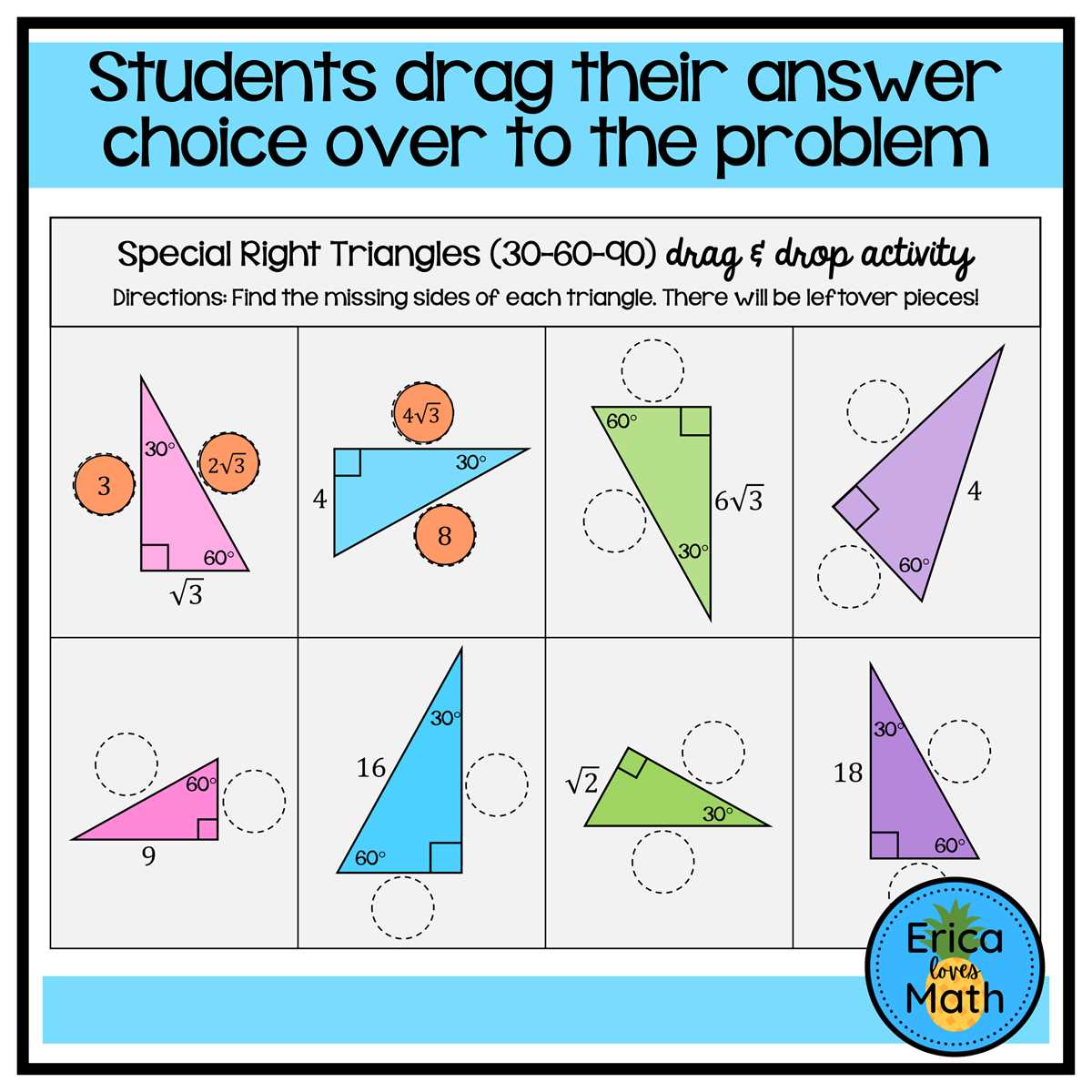
To quickly and accurately solve problems involving 30-60-90 figures, start by memorizing the side length ratios. The sides are always in a fixed relationship: the shortest leg is half the hypotenuse, and the longer leg is the shorter leg multiplied by the square root of 3. This simple rule allows you to determine any missing side length once you know one of them.
If you’re given the hypotenuse, divide it by 2 to find the shorter leg. Then, multiply the shorter leg by the square root of 3 to find the longer leg. Conversely, if the shorter leg is known, you can immediately calculate the hypotenuse and longer leg using these ratios. This approach cuts down on time and minimizes the risk of errors.
When working through problems, be careful with the units. Ensure that all measurements are consistent, and convert them if necessary. Also, don’t forget to check your final answer by verifying the side lengths match the 1:√3:2 ratio for accuracy.
For a deeper understanding, practicing with several problems will help reinforce these rules. Once you feel comfortable, you’ll be able to solve even more complex geometry problems involving these figures with confidence.
How to Use the 30-60-90 Triangle Solution Guide
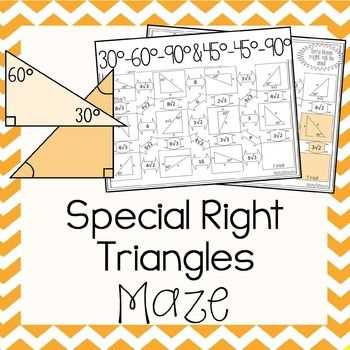
To solve for unknown side lengths in 30-60-90 figures, apply the ratio 1:√3:2. This means the shortest leg is half the length of the hypotenuse, and the longer leg is the shorter leg multiplied by √3. Knowing just one side, you can easily find the others.
If you are given the hypotenuse, divide it by 2 to find the shorter leg. Multiply the shorter leg by √3 to find the longer leg. If the shorter leg is known, use it to find the hypotenuse by multiplying by 2, and then multiply the shorter leg by √3 to determine the longer leg.
Check your results by ensuring that the side lengths satisfy the 1:√3:2 ratio. This serves as a quick verification to avoid calculation mistakes. For example, if the shorter leg is 4, the hypotenuse should be 8, and the longer leg should be approximately 6.93.
Practice with multiple examples to become comfortable with the process. Start by solving basic problems and gradually move on to more complex ones. With enough practice, you’ll be able to handle any problem involving these figures efficiently and accurately.
How to Identify a 30-60-90 Triangle from a Diagram
To identify a 30-60-90 figure, look for the following characteristics:
- The angles should measure exactly 30°, 60°, and 90°.
- The longest side, opposite the 90° angle, is the hypotenuse.
- The side opposite the 30° angle is always half the length of the hypotenuse.
- The side opposite the 60° angle is √3 times the length of the shorter leg (the side opposite the 30° angle).
Verify the side length relationships. If the shortest leg is labeled or known, the other sides should conform to the ratio 1:√3:2. For instance, if the shorter leg is 5, the hypotenuse must be 10, and the longer leg will be approximately 8.66.
Once you’ve confirmed the angle measures and side ratios, you can confidently classify the figure as a 30-60-90. This method works for both labeled diagrams and those requiring calculation based on given angles or side lengths.
Step-by-Step Guide to Solving 30-60-90 Triangle Problems
Follow these steps to solve for the missing side lengths of a 30-60-90 figure:
- Identify the given side: Determine which side length is provided. It could be the hypotenuse, the shorter leg, or the longer leg.
- Use the known ratios: Recall the ratio of the sides for a 30-60-90 figure: 1 : √3 : 2. The shorter leg is half the hypotenuse, and the longer leg is √3 times the shorter leg.
- Calculate missing sides: Depending on the given side:
- If the hypotenuse is given, divide it by 2 to find the shorter leg. Then, multiply the shorter leg by √3 to find the longer leg.
- If the shorter leg is given, multiply it by 2 to find the hypotenuse. Multiply the shorter leg by √3 to find the longer leg.
- If the longer leg is given, divide it by √3 to find the shorter leg. Then, multiply the shorter leg by 2 to find the hypotenuse.
- Verify your results: Ensure the side lengths conform to the 1 : √3 : 2 ratio. This is a quick check to confirm your calculations.
Example Problem:
| Given Side | Hypotenuse | Shorter Leg | Longer Leg |
|---|---|---|---|
| Shorter leg = 6 | 12 | 6 | 10.39 |
In this example, since the shorter leg is 6, the hypotenuse is 12 (double the shorter leg), and the longer leg is approximately 10.39 (6 times √3).
Understanding the Side Length Ratios of a 30-60-90 Triangle
The side lengths of a 30-60-90 figure always follow a specific ratio. Understanding this ratio is key to solving for missing sides when given one known side. The sides are in the following proportions:
- The shortest leg (opposite the 30° angle) is always half the length of the hypotenuse.
- The longer leg (opposite the 60° angle) is equal to the shorter leg multiplied by √3.
- The hypotenuse (opposite the 90° angle) is twice the length of the shorter leg.
For example, if the shorter leg is 5 units:
- The hypotenuse will be 10 units (double the shorter leg).
- The longer leg will be approximately 8.66 units (5 × √3).
When solving problems, use these ratios to find the missing side lengths. If the hypotenuse is known, divide it by 2 to find the shorter leg and multiply the shorter leg by √3 to find the longer leg.
How to Calculate the Hypotenuse in a 30-60-90 Triangle
To calculate the hypotenuse in a 30-60-90 figure, follow these steps based on the known side:
- If the shorter leg (opposite the 30° angle) is given, multiply it by 2 to find the hypotenuse.
- If the longer leg (opposite the 60° angle) is given, divide it by √3 to find the shorter leg, then multiply the shorter leg by 2 to get the hypotenuse.
For example, if the shorter leg is 4:
- Hypotenuse = 4 × 2 = 8
Alternatively, if the longer leg is 6.93:
- Shorter leg = 6.93 ÷ √3 ≈ 4
- Hypotenuse = 4 × 2 = 8
By using the correct side ratios, you can easily find the hypotenuse in any problem involving this type of figure.
Finding the Shorter Leg in a 30-60-90 Triangle
To calculate the shorter leg in a 30-60-90 figure, use the following methods based on the given side:
- If the hypotenuse is given, divide it by 2 to find the shorter leg.
- If the longer leg (opposite the 60° angle) is known, divide it by √3 to determine the shorter leg.
For example, if the hypotenuse is 10:
- Shorter leg = 10 ÷ 2 = 5
If the longer leg is 8.66:
- Shorter leg = 8.66 ÷ √3 ≈ 5
These steps allow you to quickly find the shorter leg based on any given side in a 30-60-90 figure.
Using the 30-60-90 Triangle Theorem for Quick Solutions
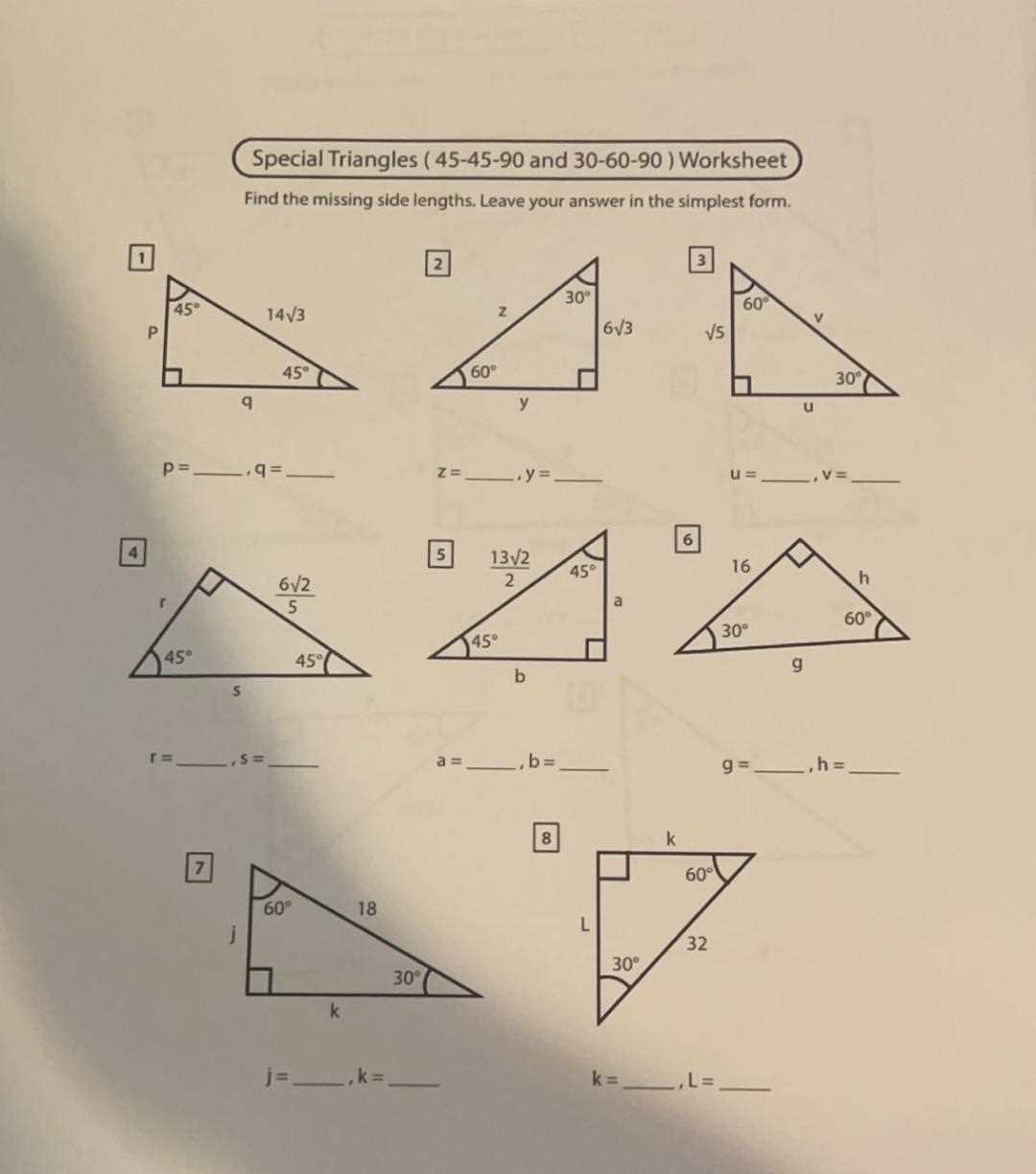
To solve problems quickly with a 30-60-90 figure, apply the theorem’s simple side length ratios: 1 : √3 : 2. This allows you to calculate any missing side length if one side is known.
If the hypotenuse is given, divide it by 2 to find the shorter leg, then multiply the shorter leg by √3 to find the longer leg.
If the shorter leg is given, multiply it by 2 to find the hypotenuse, and by √3 to find the longer leg.
If the longer leg is known, divide it by √3 to find the shorter leg, and then multiply the shorter leg by 2 to find the hypotenuse.
This method provides an efficient way to solve for missing sides without needing complex formulas. Using these ratios, you can easily and quickly solve any 30-60-90 figure problem.
Common Mistakes to Avoid When Solving 30-60-90 Triangle Problems
1. Confusing the side ratios: The correct ratio is 1 : √3 : 2. Mistakes often occur when the sides are mixed up, such as using the shorter leg for the longer leg’s ratio or vice versa.
2. Incorrect use of the hypotenuse: The hypotenuse is always twice the length of the shorter leg. Be careful not to confuse the hypotenuse with the longer leg, especially when solving for unknown sides.
3. Forgetting to divide by √3 for the longer leg: When given the longer leg, it must be divided by √3 to find the shorter leg. Neglecting this step leads to incorrect calculations.
4. Incorrectly assuming angles: Always verify that the angles are exactly 30°, 60°, and 90°. Using any other angles will result in a different set of side length ratios.
5. Not double-checking calculations: Always verify that the sides match the 1 : √3 : 2 ratio after performing the calculations. A quick check can help prevent small errors from becoming larger mistakes.
Real-World Applications of 30-60-90 Triangles in Geometry
30-60-90 figures are used in various practical applications, particularly in engineering, architecture, and design. Here are some common real-world uses:
- Construction and Architecture: These figures help in designing structures with specific angles, such as roof pitches and triangular trusses. The precise ratio of side lengths is useful when creating stable frameworks.
- Navigation and Surveying: In land surveying, these figures are often used to calculate distances and angles in triangular plots of land. The predictable side ratios allow for quick and accurate measurements.
- 3D Modeling and CAD: In computer-aided design (CAD), 30-60-90 figures are commonly used to create and model precise angles in various objects, from machinery to architectural blueprints.
- Art and Design: Many artists use these triangles in their works to create harmonious and balanced compositions, especially when working with geometric patterns or symmetry.
For more detailed applications of these geometric figures, you can explore the resources available on platforms like Khan Academy, which provides clear explanations and examples in geometry and trigonometry.