Solutions for Geometry Problems Involving Kites and Trapezoids
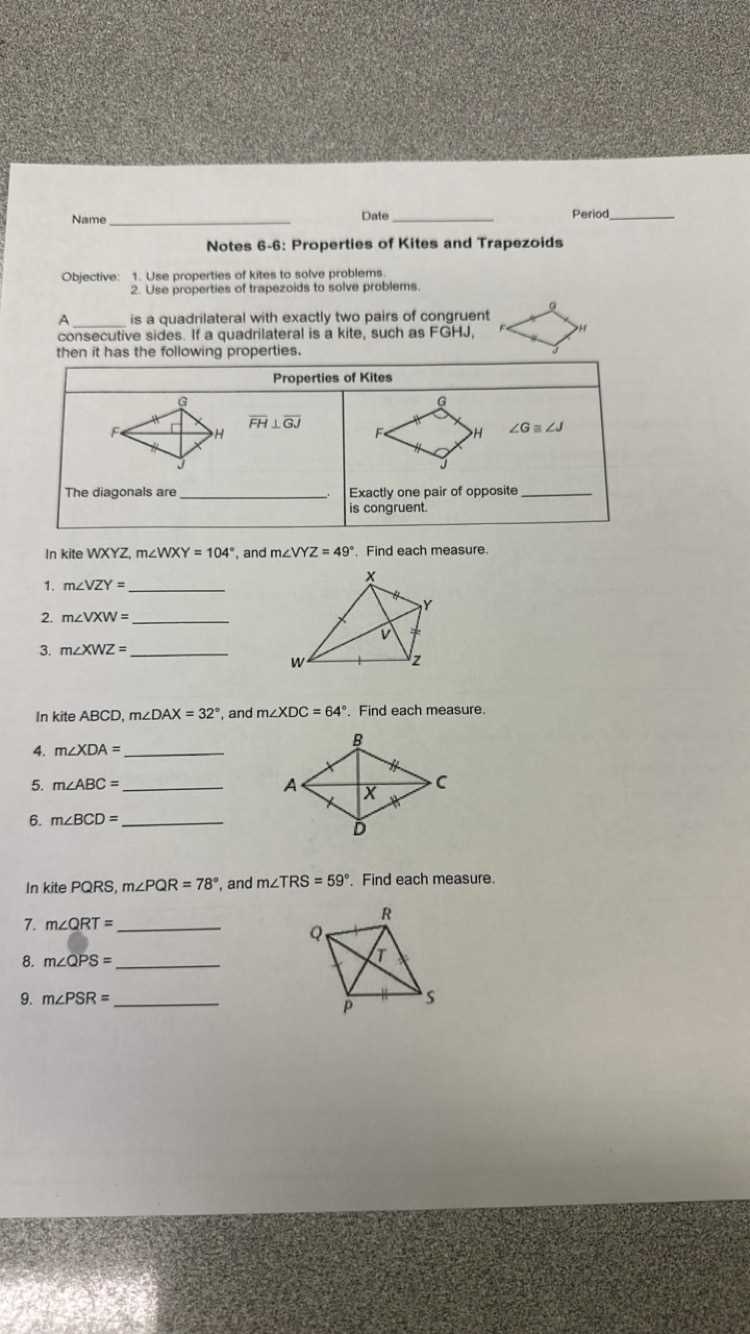
To solve problems involving quadrilaterals with specific geometric properties, focus on key relationships between sides, angles, and diagonals. For example, in a kite, two pairs of adjacent sides are equal in length, and the diagonals intersect at a right angle. Recognizing these features allows for more accurate problem-solving when determining area, perimeter, or angles.
When dealing with a trapezoid, one of the main characteristics to keep in mind is the presence of only one pair of parallel sides. The non-parallel sides may be congruent or differ, and understanding this helps when calculating distances or angles in the figure. These basic properties are vital for solving various problems accurately and efficiently.
In this guide, we’ll explore step-by-step techniques for calculating the area and perimeter of these figures, solving for unknown angles, and identifying common mistakes. Each method ensures a clearer understanding of how to approach problems involving quadrilaterals with unique features.
Step-by-Step Solutions for Quadrilateral Problems
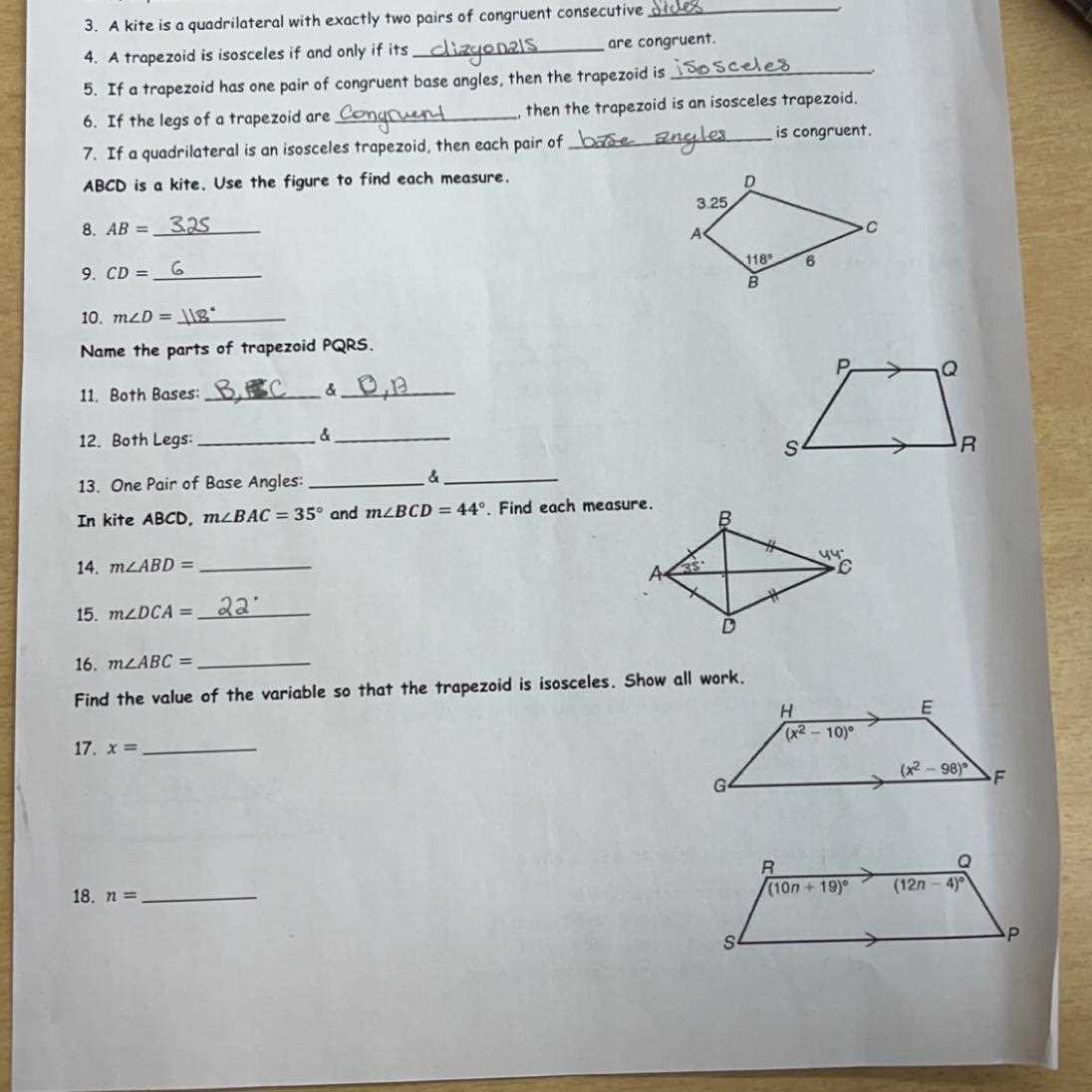
To solve problems related to quadrilaterals with congruent sides or parallel edges, apply these formulas:
- For a kite: The area is calculated by multiplying the lengths of the diagonals and dividing by two. Formula: Area = (d1 × d2) / 2, where d1 and d2 are the diagonals.
- For a parallelogram: To find the area, use the base and height measurements. Formula: Area = base × height.
- For a trapezoid: Calculate the area by averaging the lengths of the parallel sides and multiplying by the height. Formula: Area = ((b1 + b2) / 2) × height, where b1 and b2 are the lengths of the parallel sides, and height is the perpendicular distance between them.
When solving for unknown side lengths, focus on using properties such as symmetry, perpendicular diagonals, and angle relationships to find missing values. For example, diagonals of a kite intersect at right angles, allowing for direct application of the Pythagorean theorem.
To ensure your results are accurate, cross-check your calculations by verifying side and angle relationships. Also, double-check your unit conversions and consistency across all steps of the process.
Understanding the Properties of Kites and Trapezoids
For quadrilaterals with two pairs of adjacent sides that are equal in length, a key property is the perpendicular diagonals that bisect each other. This makes it easy to calculate the area by multiplying the lengths of the diagonals and dividing by two. Additionally, the longer diagonal typically bisects the shorter one, creating two right triangles within the shape.
When dealing with quadrilaterals with one pair of parallel sides, identify the parallel lines as the bases. The non-parallel sides will typically not be congruent. The area can be calculated using the formula that averages the lengths of the parallel sides and multiplies it by the height between them.
In a kite, the symmetry plays a major role. The diagonals are perpendicular, and one diagonal bisects the other. This symmetry makes finding angles and side lengths easier through properties like right triangles and the Pythagorean theorem. The two non-congruent angles are also important because they add up to 180 degrees.
For a quadrilateral with one pair of opposite sides parallel, remember that the interior angles on the same side of the parallel lines add up to 180 degrees. This property helps in calculating the missing angles when solving problems related to this shape.
Identifying Key Features in Kite Geometry Problems
When solving problems involving quadrilaterals with two pairs of adjacent sides that are equal, focus on the following properties:
- Perpendicular Diagonals: The diagonals intersect at a right angle and are key to identifying the symmetry of the shape.
- Bisection of Diagonals: One diagonal bisects the other, creating two equal halves in one of the shapes formed.
- Equal Adjacent Angles: The angles between the equal-length sides are congruent, which can simplify angle calculation.
- Area Formula: The area of the quadrilateral can be calculated by multiplying the lengths of the diagonals and dividing by two.
- Congruent Non-Diagonal Sides: The two pairs of adjacent sides are equal in length, which simplifies side relationships in problems.
Understanding these features will help in quickly identifying the correct properties and solving problems efficiently. For more detailed explanations and examples, refer to reliable geometry textbooks or academic resources like Khan Academy.
How to Calculate the Area of Kites and Trapezoids
To calculate the area of a shape with two pairs of adjacent sides that are equal, use the following formulas:
- Kite: The area is given by the formula: Area = (Diagonal 1 × Diagonal 2) / 2. Measure the lengths of both diagonals and multiply them together. Then, divide the result by two.
- Trapezoid: The area can be calculated using: Area = (Base 1 + Base 2) × Height / 2. Measure the lengths of the parallel bases and the height (the perpendicular distance between the bases). Add the lengths of the bases, multiply by the height, and then divide by 2.
For example, if the diagonals of a kite are 6 cm and 8 cm, the area is: (6 × 8) / 2 = 24 cm². Similarly, if a trapezoid has bases of 10 cm and 14 cm with a height of 5 cm, the area is: (10 + 14) × 5 / 2 = 60 cm².
Using these simple formulas, you can quickly calculate the area of these quadrilaterals in various problems.
Using Diagonals to Solve Kite Geometry Problems
To solve problems involving a quadrilateral with two pairs of equal adjacent sides, focus on the diagonals. These diagonals intersect at a right angle and bisect each other. Follow these steps:
- Step 1: Identify the lengths of the diagonals. Label them as d₁ (the first diagonal) and d₂ (the second diagonal).
- Step 2: If the problem asks for the area, use the formula: Area = (d₁ × d₂) / 2. Multiply the lengths of the diagonals and divide by 2 to find the area.
- Step 3: If you’re asked to find a side length or another unknown, use the properties of the diagonals. Remember that the diagonals bisect each other, creating two right triangles at the intersection. Apply the Pythagorean Theorem to solve for missing sides or angles in these right triangles.
For example, if the diagonals are 10 cm and 12 cm, the area is: Area = (10 × 12) / 2 = 60 cm².
If you’re given one diagonal and part of the other, use the right triangle formed by half the diagonals. For instance, if half of diagonal 1 is 6 cm, half of diagonal 2 is 8 cm, and you need to find the side length, apply the Pythagorean Theorem: side² = 6² + 8² = 36 + 64 = 100, side = √100 = 10 cm.
| Diagonal 1 | Diagonal 2 | Area |
|---|---|---|
| 10 cm | 12 cm | 60 cm² |
| 6 cm | 8 cm | 24 cm² |
Determining the Perimeter of Kites and Trapezoids
To find the perimeter of a quadrilateral with two distinct pairs of adjacent equal sides, add the lengths of all four sides. For a figure with sides labeled a, b, a, and b, the formula is:
Perimeter = 2a + 2b
For example, if the lengths of the sides are 8 cm and 5 cm, the perimeter would be:
Perimeter = 2(8) + 2(5) = 16 + 10 = 26 cm
For other quadrilaterals with non-parallel sides, like a trapezoid, use the same method to add up the lengths of the four sides. If the lengths are c, d, e, and f, then:
Perimeter = c + d + e + f
For example, if the lengths are 6 cm, 10 cm, 5 cm, and 7 cm, the perimeter would be:
Perimeter = 6 + 10 + 5 + 7 = 28 cm
Solving for Unknown Angles in Kite and Trapezoid Problems
To find unknown angles in figures with two distinct pairs of adjacent equal sides, use the properties of symmetry and parallelism. In a figure with two pairs of equal adjacent sides, the angles between the unequal sides are congruent. If you are given an angle, you can calculate its supplementary angle (the one that adds up to 180° with it) based on the property of linear pairs.
For example, if an angle is given as 70°, the adjacent angle along the same line will be:
180° – 70° = 110°
In cases where one pair of sides are parallel (such as in a trapezoid), you can use the property that the adjacent interior angles on the same side of the parallel lines are supplementary. If one angle is 75°, the adjacent angle will be:
180° – 75° = 105°
For more complex problems, use the sum of interior angles of polygons to help solve for unknown angles. The sum of the interior angles of any quadrilateral is always 360°. If three angles are given, subtract their sum from 360° to find the unknown angle.
For example, if three angles are 85°, 90°, and 95°, the unknown angle will be:
360° – (85° + 90° + 95°) = 360° – 270° = 90°
Common Mistakes to Avoid in Kite and Trapezoid Problems
One common error is assuming all angles in a quadrilateral are congruent. This is only true for squares, not for figures like kites or trapezoids. Remember, in a kite, only the two angles between the unequal sides are congruent, while in a trapezoid, the angles on the same side of the parallel lines are supplementary.
Another mistake is misapplying the symmetry properties. In a kite, the diagonals intersect at right angles, but they are not necessarily equal in length. Do not confuse this with the properties of a rhombus, where the diagonals bisect each other at right angles and are equal.
A third frequent error is neglecting to use the formula for calculating area. Many assume they can simply add up the areas of individual triangles, but this is not always accurate. For example, in a trapezoid, the area is given by the formula: Area = 1/2 * (Base1 + Base2) * Height, not just multiplying the bases or heights alone.
Lastly, forgetting to check angle relationships when solving for unknown angles is a common pitfall. Always remember that adjacent angles in a trapezoid along parallel sides add up to 180°. Make sure to check all necessary angle pairs before making assumptions about unknown values.
Practical Examples and Step-by-Step Solutions for Kites and Trapezoids
To solve problems involving a quadrilateral with congruent adjacent sides, follow this example:
Problem: A quadrilateral has two pairs of equal adjacent sides. One diagonal measures 10 cm, while the other diagonal is 12 cm. Find the area of the figure.
Solution: In this case, the area formula for the shape is Area = 1/2 * d1 * d2, where d1 and d2 are the lengths of the diagonals. Substituting the given values:
- Area = 1/2 * 10 cm * 12 cm
- Area = 60 cm²
Therefore, the area of the quadrilateral is 60 cm².
Problem: A quadrilateral has one pair of parallel sides measuring 8 cm and 5 cm. The height between these sides is 6 cm. Calculate the area of the shape.
Solution: The formula for the area of a quadrilateral with parallel sides is Area = 1/2 * (Base1 + Base2) * Height. Substituting the values:
- Area = 1/2 * (8 cm + 5 cm) * 6 cm
- Area = 1/2 * 13 cm * 6 cm
- Area = 39 cm²
Thus, the area is 39 cm².
Problem: Calculate the unknown angle of a quadrilateral where the interior angles on the parallel sides are supplementary and one angle is 60°.
Solution: Since adjacent angles along parallel lines are supplementary, we know the sum of these two angles is 180°. Therefore, if one angle is 60°, the other must be:
- 180° – 60° = 120°
The unknown angle is 120°.
These examples illustrate the step-by-step approach to solving practical problems involving quadrilaterals with specific properties. Always remember to apply the appropriate formulas and angle relationships to simplify the solution process.