Chapter 4 Work and Energy Solutions and Explanations
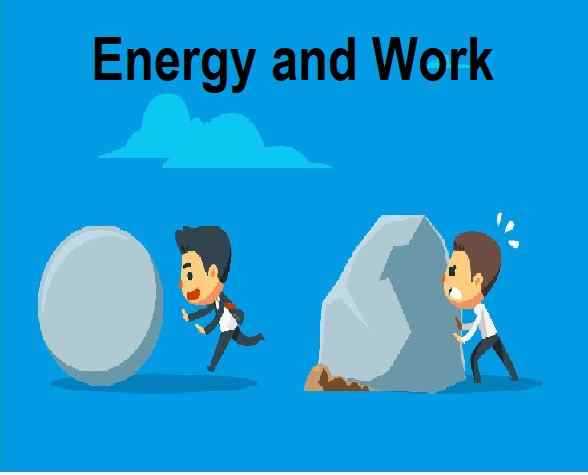
To solve problems related to force, movement, and the transfer of energy, start by carefully identifying the variables given in the problem. Begin by calculating the force acting on an object and the distance it moves in the direction of that force. This simple approach will allow you to find the amount of energy transferred during the process.
Next, consider how different forms of stored and moving energy affect the system. For instance, calculate the energy associated with motion (kinetic energy) and the energy stored due to an object’s position (potential energy). These values will help you determine the overall energy changes within the system.
Finally, make sure to account for energy conservation. In many cases, the total amount of energy remains constant, but it can change forms–kinetic energy may be converted into potential energy, or vice versa. By carefully applying these principles, you can solve complex problems with greater accuracy and confidence.
Work and Energy Solutions Guide
To solve problems involving the transfer of force and motion, begin by identifying the known values, such as force, displacement, and the angle between them. Use the equation Work = Force × Displacement × cos(θ) to calculate the energy transferred. If the angle between the direction of force and displacement is zero, the equation simplifies to Work = Force × Displacement.
For kinetic energy problems, use the formula Kinetic Energy = 1/2 × Mass × Velocity². Be sure to square the velocity and multiply it by half of the mass. This calculation tells you how much energy an object has due to its motion.
When dealing with potential energy, particularly gravitational potential energy, apply the formula Potential Energy = Mass × Gravitational Acceleration × Height. Make sure to use the appropriate value for gravitational acceleration based on the location (e.g., 9.8 m/s² on Earth).
In many cases, the principle of energy conservation is useful. If no external forces like friction are involved, the total energy in a system remains constant. This means that the sum of kinetic and potential energy stays the same before and after an event.
Lastly, when solving problems involving multiple forms of energy, use energy diagrams or equations to track how energy is transferred from one form to another. This can help ensure you account for every factor influencing the system.
Understanding the Work-Energy Theorem
The Work-Energy Theorem states that the net work done on an object is equal to the change in its kinetic energy. This can be expressed mathematically as:
Net Work = ΔKinetic Energy = Kf – Ki
Where:
- Net Work is the total work done on the object by all forces acting on it.
- ΔKinetic Energy is the change in the object’s kinetic energy, calculated by subtracting the initial kinetic energy (Ki) from the final kinetic energy (Kf).
To apply this theorem effectively, calculate the initial and final speeds of the object, then use the equation for kinetic energy:
Kinetic Energy = 1/2 × Mass × Velocity²
For example, if a car starts at rest (initial velocity = 0) and accelerates to a final velocity, you can use the theorem to determine the total work done by the engine or external forces during the acceleration. This work will be equal to the increase in the car’s kinetic energy.
In practical scenarios, ensure you consider all forces acting on the object, including friction, gravity, or any external forces that contribute to the work done. The Work-Energy Theorem helps simplify complex motion problems by relating force directly to changes in motion.
How to Calculate Work Done in Different Scenarios
To calculate the energy transferred to an object, use the formula:
Work = Force × Distance × cos(θ)
Where:
- Force is the magnitude of the force applied, measured in Newtons (N).
- Distance is the displacement of the object in the direction of the force, measured in meters (m).
- θ is the angle between the direction of the force and the direction of displacement. If the force and displacement are in the same direction, θ = 0°.
Here are some common scenarios for calculating the energy transferred:
- Force Applied in the Same Direction as Movement: If a 10 N force is applied to an object and it moves 5 m, the energy transferred is:
- Work = 10 N × 5 m = 50 J
- Work = 10 N × 5 m × cos(30°) = 10 N × 5 m × 0.866 ≈ 43.3 J
- Work = 2 kg × 9.8 m/s² × 3 m = 58.8 J
Understanding these variations will help you correctly calculate the amount of energy transferred in different physical situations.
Exploring the Relationship Between Force and Displacement
The force applied to an object and the displacement it undergoes are directly related when calculating the amount of energy transferred. To understand this relationship, it’s crucial to consider how both the magnitude and direction of the force impact the movement of the object.
The general formula used to calculate the energy transferred is:
Work = Force × Displacement × cos(θ)
Where:
- Force is the magnitude of the applied force (measured in Newtons, N).
- Displacement refers to the distance the object moves in the direction of the applied force (measured in meters, m).
- θ is the angle between the direction of the force and the direction of movement. If the force is applied in the same direction as the displacement, θ = 0°, and cos(0°) = 1.
When force is applied in the direction of the displacement (θ = 0°), the entire magnitude of the force contributes to the energy transferred. For example, if a 5 N force moves an object 10 m, the energy transferred is:
Work = 5 N × 10 m = 50 J
If the force is applied at an angle, only the component of the force in the direction of the displacement contributes to the energy transferred. For instance, if a 10 N force is applied at a 60° angle to the direction of movement, the work done is:
Work = 10 N × 10 m × cos(60°) = 10 N × 10 m × 0.5 = 50 J
This shows how the angle between force and displacement reduces the effective force contributing to the energy transfer. In scenarios where the force is perpendicular to the displacement (θ = 90°), no energy is transferred since cos(90°) = 0.
Understanding this relationship helps in correctly calculating energy transfer in various real-world scenarios, whether lifting an object, pulling a cart, or pushing an object along a surface.
Understanding Kinetic Energy and Its Calculation
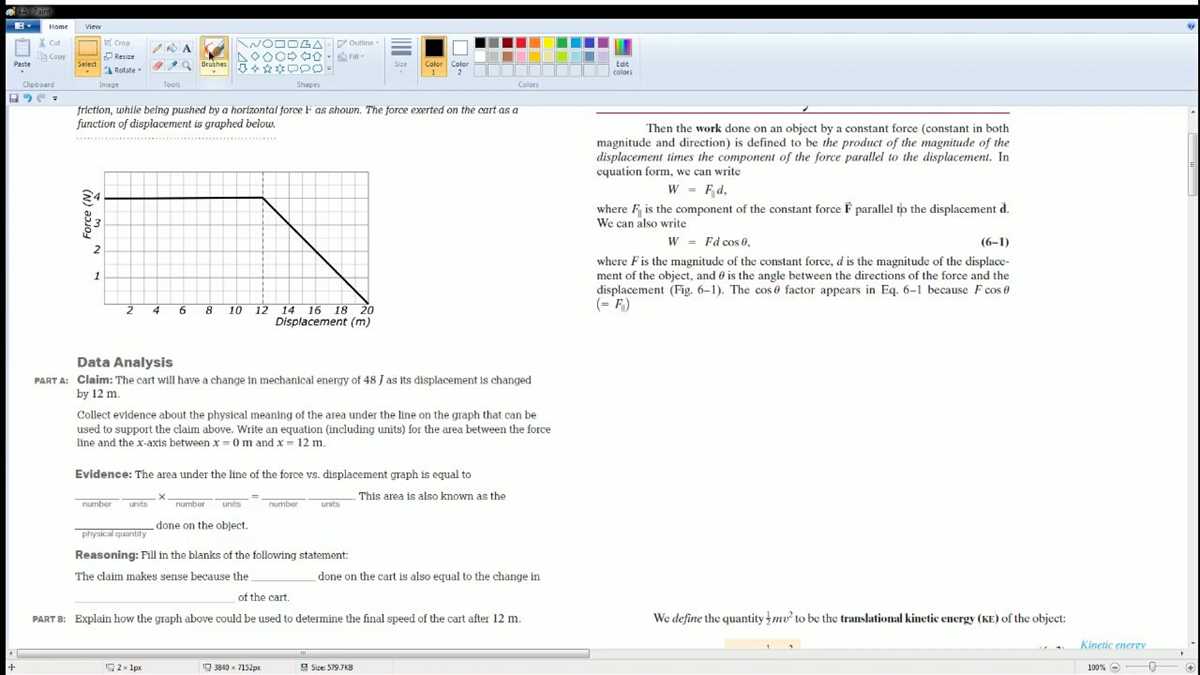
Kinetic energy refers to the energy an object possesses due to its motion. The faster an object moves, the greater its kinetic energy. The amount of this energy is directly related to both the mass of the object and its velocity.
The formula to calculate kinetic energy is:
Kinetic Energy = 0.5 × mass × velocity²
Where:
- mass is the object’s mass (measured in kilograms, kg),
- velocity is the object’s speed in a specific direction (measured in meters per second, m/s).
For example, if an object with a mass of 10 kg is moving at a speed of 5 m/s, the kinetic energy is:
Kinetic Energy = 0.5 × 10 kg × (5 m/s)² = 0.5 × 10 × 25 = 125 J
This means the object possesses 125 joules of energy due to its motion. Notice how both mass and velocity are key to determining kinetic energy; doubling the velocity of an object will quadruple its kinetic energy.
It’s important to recognize that kinetic energy is a scalar quantity, meaning it has magnitude but no direction. Understanding how to calculate it is fundamental in various fields, from physics to engineering, where it’s used to assess the motion of objects and the energy they carry.
For more detailed information, refer to The Physics Classroom for additional examples and explanations on kinetic energy calculations.
How Potential Energy is Measured and Calculated
Potential energy is the stored energy an object has due to its position or configuration. The most common type is gravitational potential energy, which depends on the height of an object relative to a reference point, such as the ground.
The formula for calculating gravitational potential energy is:
Potential Energy = mass × gravitational acceleration × height
Where:
- mass is the mass of the object (in kilograms, kg),
- gravitational acceleration is a constant (approximately 9.8 m/s² on Earth),
- height is the distance above the reference point (in meters, m).
For example, if an object with a mass of 5 kg is at a height of 10 meters, the potential energy is:
Potential Energy = 5 kg × 9.8 m/s² × 10 m = 490 J
This means the object possesses 490 joules of stored energy due to its height. As the object is lifted higher, its potential energy increases proportionally with height.
It’s important to note that the calculation assumes no other forces, like air resistance, are acting on the object. Additionally, potential energy can also be calculated in other contexts, such as in elastic systems or chemical reactions, but the general principle remains the same: energy is stored due to an object’s position or configuration.
Solving Problems Involving Conservation of Energy
To solve problems based on the principle of energy conservation, follow these steps:
- Identify the initial and final states: Understand the system’s conditions at the start and end of the process. This includes the position, velocity, and forces acting on the object.
- Apply the conservation principle: Energy can neither be created nor destroyed, only transformed. The total amount of mechanical energy remains constant in an isolated system, so the sum of kinetic and potential energies at the beginning equals the sum at the end.
- Set up the equation: For an object moving vertically, you can use the equation:
- Initial Kinetic Energy + Initial Potential Energy = Final Kinetic Energy + Final Potential Energy
- Substitute known values: Insert the given values for mass, height, velocity, and acceleration due to gravity into the energy equation. If unknowns remain, solve for them using algebraic methods.
- Simplify and solve: Solve for the unknown variable, which could be velocity, height, or energy, depending on the problem setup.
For example, if an object with a known initial velocity is dropped from a height, its initial kinetic energy plus potential energy equals the final kinetic energy just before impact. Use the equation:
mgh + ½mv² = ½mv_f²
Where:
- m is the mass of the object,
- g is the acceleration due to gravity (9.8 m/s²),
- h is the height,
- v is the initial velocity,
- v_f is the final velocity at the point of impact.
By rearranging the equation, you can solve for any missing variable, such as the final velocity just before the object hits the ground. This approach can be applied to a wide range of problems involving energy transformations in mechanical systems.
Common Mistakes When Solving Work and Energy Problems
One common mistake is neglecting the direction of the applied force. The force must be applied in the same direction as the displacement for it to contribute to the total amount of energy transferred. Always check if the force and displacement align.
Another frequent error is overlooking the units. Ensure that all quantities, such as mass, distance, and velocity, are in consistent units (e.g., kilograms, meters, seconds). Failure to convert units before solving can lead to incorrect results.
A third mistake involves misapplying the formulas for potential and kinetic energy. For example, when calculating gravitational potential energy, it’s crucial to use the correct height relative to a reference point, typically the ground or another chosen level.
Also, be cautious when assuming that mechanical energy is always conserved. In real-world scenarios, friction or air resistance can convert mechanical energy into other forms, like heat. If external forces like friction are present, they must be accounted for.
Lastly, not revisiting the system’s assumptions can lead to errors. For example, in some problems, objects might experience non-uniform motion or external forces that are not immediately obvious. Always check that you have a clear understanding of the forces acting on the system.
Practical Applications of Work and Energy Concepts
In engineering, understanding how force and displacement interact is vital when designing machines. For instance, in lifting mechanisms like cranes, the amount of force required to lift a load depends directly on its weight and the height it needs to be raised. The formula for gravitational potential energy can be used to calculate the total energy needed for the lifting process.
In everyday life, energy conservation is also critical. Consider electric vehicles. The energy required to propel the vehicle is calculated using the vehicle’s mass, the distance traveled, and the efficiency of the motor. When braking, regenerative systems convert kinetic energy back into electrical energy to recharge the battery, showcasing the practical application of mechanical energy conservation.
Below is a table that compares different scenarios where energy conservation principles are applied in real-world systems:
| System | Energy Conversion | Application |
|---|---|---|
| Cranes | Mechanical energy to potential energy | Lifting heavy loads at construction sites |
| Electric Vehicles | Kinetic energy to electrical energy (regenerative braking) | Energy efficiency in transportation |
| Roller Coasters | Kinetic energy to potential energy (at the peak) and back to kinetic energy | Entertainment and thrill ride dynamics |
| Hydropower Plants | Gravitational potential energy to kinetic energy to electrical energy | Renewable electricity generation |
Understanding these principles allows engineers to optimize performance and improve the efficiency of various devices, systems, and transportation modes. Applying concepts of mechanical energy ensures that energy is used as effectively as possible in every process, from lifting objects to powering vehicles and generating electricity.