Commas Semicolons and Colons Worksheet with Answer Key
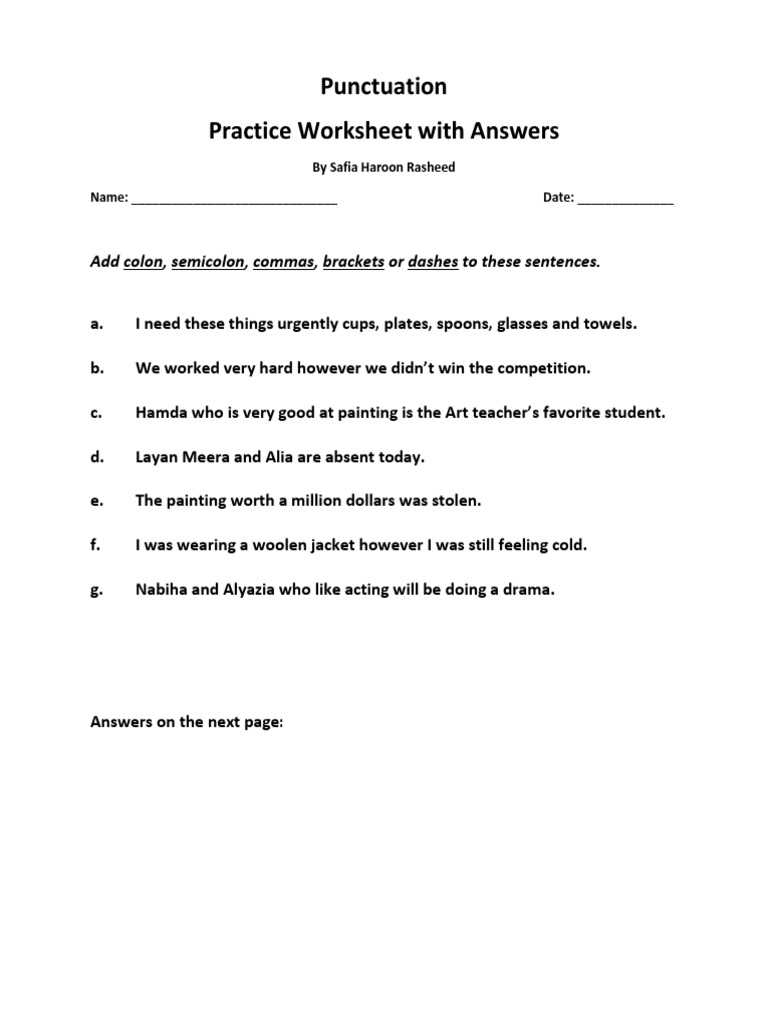
To refine your punctuation skills, focus on understanding the placement rules for different sentence structures. Practicing with various exercises will help you recognize when to pause, link related clauses, or introduce explanations.
Start by reviewing sentences with multiple clauses and understanding how punctuation marks differentiate their meaning. Knowing when to break a sentence into smaller parts can dramatically improve clarity and readability.
For example, learn to distinguish between two related thoughts that require a break with a slight pause or those that demand a full stop or explanation. By focusing on these distinctions, you’ll be able to punctuate sentences with confidence and accuracy.
These exercises are designed to target common areas of confusion. With practice, you’ll improve not only your ability to punctuate correctly but also your overall writing fluency.
Punctuation Practice Solutions
To effectively check your work, review the structure of each sentence and identify where punctuation marks are needed. Here are the steps to ensure accurate punctuation:
- Place a pause after introductory phrases or clauses. A comma is usually appropriate here.
- Use semicolons to link closely related independent clauses that aren’t connected by a conjunction.
- Colons should introduce lists, explanations, or direct quotes. Ensure the preceding clause is a complete sentence.
For example, in the sentence “She loves books; they are her passion,” the semicolon separates two related independent clauses. In another example, “There are three main ingredients: flour, sugar, and eggs,” the colon introduces the list that follows.
By regularly practicing these punctuation rules, you will gain better clarity and control over sentence structure. As you progress, you’ll find that the placement of punctuation becomes more intuitive and automatic.
How to Use Punctuation Marks Correctly in Complex Sentences
In complex sentences, use punctuation marks to separate clauses and ensure clarity. Follow these guidelines to properly structure your sentences:
- Place a punctuation mark before conjunctions (e.g., “but,” “so,” “because”) when connecting independent clauses.
- Use punctuation after introductory clauses or phrases that precede the main clause to signal a pause or shift.
- When non-essential information is inserted into the middle of a sentence, enclose it with appropriate marks to make the sentence clearer.
For example, in the sentence “Although he was tired, he kept working,” the punctuation after “tired” separates the dependent clause from the independent one. Similarly, in “The meeting, which lasted two hours, was productive,” the punctuation around “which lasted two hours” isolates additional information from the main idea of the sentence.
Mastering these rules will improve your ability to communicate complex ideas in clear, understandable sentences.
When to Use Semicolons Instead of Commas
Use semicolons to separate closely related independent clauses that are not joined by conjunctions. A semicolon is stronger than a comma, but weaker than a period, making it ideal for linking sentences that are conceptually connected. Here’s when to use it:
- To join two independent clauses without a conjunction. For example: “I have a meeting at 2 PM; I will finish the report before then.”
- To separate items in a list when the items themselves contain commas. This helps to avoid confusion. Example: “The conference includes speakers from Paris, France; Berlin, Germany; and Madrid, Spain.”
- When a transitional phrase connects two independent clauses. Example: “She loves playing tennis; however, she is too busy to practice regularly.”
Remember, a semicolon is appropriate for situations where a comma would create ambiguity or when the clauses are too closely related to be separated by a period.
Rules for Using Colons in Lists and Explanations
Use a colon to introduce a list when the preceding sentence is a complete thought. The phrase leading up to the colon should set up the expectation of what follows. For example: “The meeting will cover three main topics: budget, deadlines, and staffing.” The items listed after the colon are directly related to the initial clause.
Do not use a colon after an incomplete sentence. The sentence before the colon must be independent. For example, “The team discussed the following:” is incorrect without completing the thought. It should be written as “The team discussed the following points:”.
In explanations or clarifications, a colon can be used to provide further details or a breakdown of an idea. For instance: “She was determined to succeed: nothing would stop her.” The colon connects the general statement with the elaboration that follows.
Use a colon for a formal or extended explanation in business, academic, or professional writing. For example, “The project includes several phases: planning, execution, testing, and deployment.” This type of usage emphasizes the structure or sequential order of the items being described.
When listing items that are phrases or complex structures, use a colon for clarity. Example: “The presentation will cover these key aspects: how to improve efficiency, strategies for team collaboration, and ways to increase productivity.” Each listed point is a phrase that requires separation for better understanding.
Do not capitalize the first word after a colon unless it is a proper noun or the start of a complete sentence. Example: “He had three options: start over, ask for help, or quit.” However, if what follows the colon is a complete sentence, capitalize the first letter: “She had one final thought: We must act now.”
Common Mistakes with Commas and How to Avoid Them
Placing commas incorrectly in compound sentences is a frequent error. When two independent clauses are joined by a conjunction like “but,” “or,” or “so,” a comma is needed before the conjunction. For example, “I wanted to go to the park, but it started raining.” Without the comma, the sentence would be harder to read and understand.
Not using a comma after introductory phrases often leads to confusion. An introductory word or phrase sets the stage for the main sentence, so it should be followed by a comma. For instance, “After the meeting, we went for lunch” is correct, while “After the meeting we went for lunch” creates unnecessary ambiguity.
Omitting commas in a list is another common mistake. When listing three or more items, commas separate each element, except for the last one before “and” or “or.” Example: “We bought apples, bananas, oranges, and grapes.” Be cautious, as omitting commas can cause ambiguity, especially with longer items.
Unnecessary commas between subject and verb should be avoided. For example, “My brother, runs fast” is incorrect because no pause is needed. The correct version would be “My brother runs fast.” Similarly, avoid placing commas between the subject and its object unless they are nonessential elements.
Misplacing commas with coordinating adjectives is another frequent issue. When two adjectives equally modify a noun, a comma should separate them. For example, “It was a long, exhausting day” is correct, while “It was a long exhausting day” can sound awkward. Ensure that both adjectives modify the noun equally before adding a comma.
| Common Mistake | Corrected Example |
|---|---|
| Missing comma before conjunction in compound sentence | She likes to read, and she enjoys writing. |
| Omitting a comma after introductory phrase | In the morning, we will start the project. |
| Not separating items in a list | The cake needed eggs, flour, sugar, and butter. |
| Unnecessary commas between subject and verb | She studied hard for the exam. |
| Incorrect placement with coordinating adjectives | It was a cold, windy day. |
For more detailed rules, refer to resources like Merriam-Webster.
Step-by-Step Guide to Identifying Sentence Clauses for Proper Punctuation
Step 1: Identify the independent clauses. These are complete thoughts that can stand alone as sentences. For example, “She finished her work” is an independent clause.
Step 2: Find the conjunctions. Common conjunctions include “for,” “but,” “so,” “yet,” and “nor.” When two independent clauses are joined by one of these, punctuation is needed. For example, “She finished her work, but she was tired.”
Step 3: Look for dependent clauses. A dependent clause cannot stand alone and relies on an independent clause. Words like “although,” “because,” and “if” often introduce these clauses. Example: “Because she was tired, she went to bed early.” The dependent clause “Because she was tired” cannot stand alone.
Step 4: Determine the proper punctuation for combined clauses. When an independent clause is joined with a dependent clause, no punctuation is needed between them unless the dependent clause is at the start of the sentence. Example: “She went to bed early because she was tired.” If the dependent clause comes first, a comma is needed: “Because she was tired, she went to bed early.”
Step 5: Separate items in a list or series of clauses with the correct marks. When listing multiple clauses, use punctuation between them for clarity. Example: “She went to bed early, finished her book, and turned off the lights.” The clauses are linked in a series, so commas separate them.
Understanding the Difference Between a Semicolon and a Colon
A semicolon is used to connect two independent clauses that are closely related but could stand alone as separate sentences. It is stronger than a comma but not as final as a period. For example: “She loves reading; her favorite genre is fantasy.” This shows a connection between two related ideas without a conjunction.
A colon is used to introduce a list, explanation, or elaboration after an independent clause. The clause before the colon must be a complete sentence. For example: “He brought three items: a backpack, a notebook, and a pen.” The colon introduces the items being listed.
Key Differences:
| Semicolon | Colon |
|---|---|
| Connects two closely related independent clauses. | Introduces a list, explanation, or elaboration. |
| Used without a conjunction between clauses. | Used after a complete sentence to set up what follows. |
| Example: “The sun set; the sky turned purple.” | Example: “She has three hobbies: knitting, painting, and hiking.” |
Remember: If the second part of the sentence after a semicolon is a complete idea, it’s often better to separate the clauses into two sentences rather than using a semicolon. However, when introducing a list or further explanation, a colon is the appropriate choice.
How to Apply the Correct Punctuation in Multiple Clauses
When dealing with multiple clauses, the correct punctuation helps to clarify meaning and improve readability. Follow these guidelines to ensure clarity in your writing:
- Separate independent clauses with punctuation: Use a semicolon between two closely related independent clauses. If a conjunction is present, use a comma. Example: “She enjoys reading; she prefers mystery novels.” or “She enjoys reading, but she prefers mystery novels.”
- Use a comma before a conjunction when joining two independent clauses. The conjunctions “for,” “but,” “so,” “yet,” and “or” require a comma before them. Example: “I wanted to go to the store, but it started raining.”
- Start with a dependent clause only if it introduces the main idea of the sentence. Use a comma after the dependent clause. Example: “Because it was late, we decided to stay home.” If the dependent clause follows the independent clause, no comma is needed: “We decided to stay home because it was late.”
- Introduce lists or explanations with a colon after a complete independent clause. Example: “The meeting covered three topics: budgeting, staffing, and timelines.”
- Use a comma for items in a series: When listing three or more items, use commas between them. The last item is preceded by a conjunction (e.g., “and” or “or”). Example: “The package includes a book, a pen, a notebook, and a pencil case.”
By identifying the relationship between the clauses and understanding the role of each punctuation mark, you can apply the correct punctuation to create clear, effective sentences.
Practical Exercises to Master Commas, Semicolons, and Colons
Exercise 1: Add the correct punctuation to these sentences. Identify where commas, semicolons, or colons are needed based on the structure of each sentence.
- She wanted to visit the museum, the library, and the park.
- I went to the store, I forgot my wallet.
- The cake requires three ingredients: flour, sugar, eggs, and butter.
- John loves to read, but he hates writing essays.
- The project includes several stages: planning, design, development, and testing.
Exercise 2: Correct the punctuation in the following passage:
After the meeting we discussed several ideas the first was to improve the design the second was to increase efficiency the third was to reduce costs. We agreed on the first two, but not on the last.
Exercise 3: Complete the following sentences using appropriate punctuation:
- We met at the coffee shop ____ we talked for hours.
- The manager outlined three goals ____ increase sales, improve customer satisfaction, and reduce costs.
- It was a long day ____ we worked from dawn till dusk.
- She loves hiking, biking ____ swimming.
Exercise 4: Create your own sentences that require a semicolon to link two independent clauses. Then, practice using a colon to introduce a list in a sentence. Share your sentences for feedback.
Practice regularly and review your results to build confidence and improve your punctuation skills.