Factoring Review Worksheet Solutions and Step by Step Guide
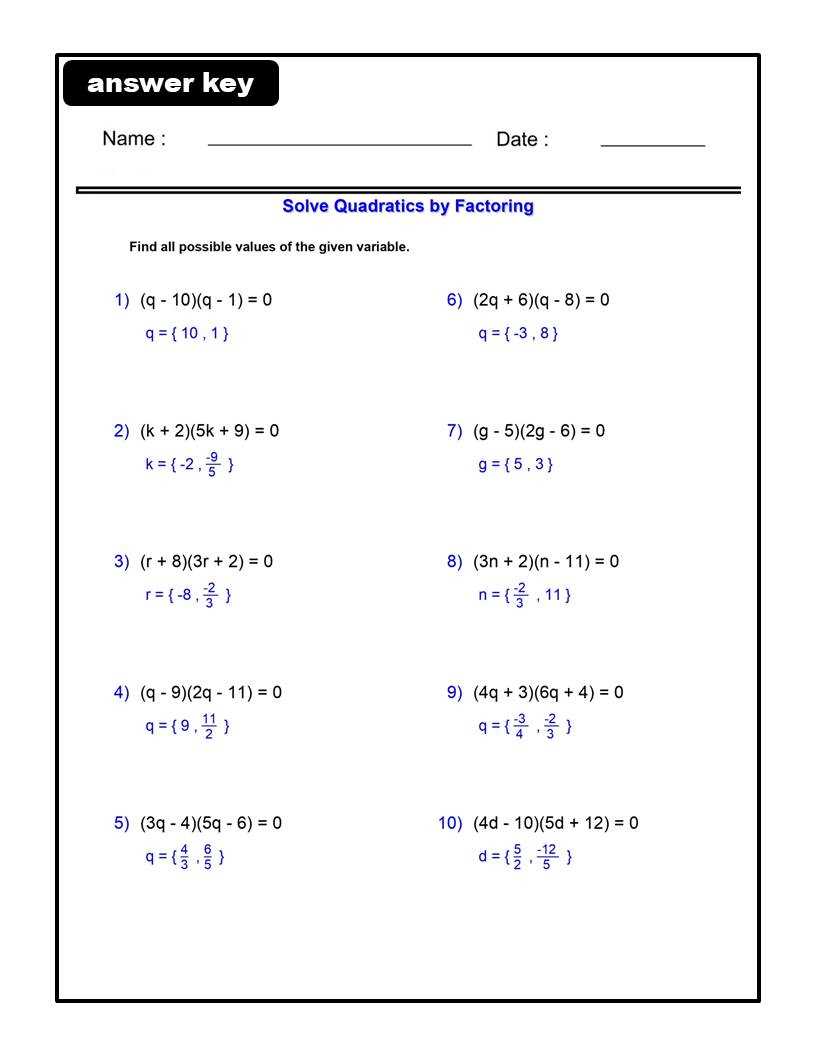
Start by identifying the common forms of expressions that need simplification. Focus on recognizing patterns in algebraic expressions, as this is the first step toward solving any related problems. Use strategies like grouping terms or using the distributive property to break down complex expressions into simpler forms.
It’s important to practice with different types of expressions, from binomials to trinomials. For example, when you encounter an expression like x² + 5x + 6, look for two numbers that multiply to 6 and add up to 5. Once you spot these, you can rewrite the expression in a simpler factored form, like (x + 2)(x + 3).
One useful approach is to work through sample problems, taking the time to manually perform each step rather than jumping straight to the solution. This builds both your confidence and your ability to spot patterns that can help with factoring larger polynomials.
When tackling problems like these, focus on applying your understanding of algebraic properties such as the distributive property, the difference of squares, and perfect square trinomials. The more you practice, the more intuitive these operations become, allowing you to solve problems quickly and accurately.
Step by Step Guide to Solving Polynomial Expressions
Start by identifying the structure of the given polynomial. Break it down into manageable parts, looking for common factors or terms that can be grouped together. For example, in the expression x² + 7x + 10, observe that 10 can be factored as 2 × 5, and the sum of 2 and 5 equals 7. This lets you rewrite the expression as (x + 2)(x + 5).
Next, apply the distributive property to check your work. Multiply the two binomials (x + 2)(x + 5) to confirm that you return to the original expression x² + 7x + 10. This is a key step to ensure you’ve factored the expression correctly.
For more complex trinomials, use trial and error to find the right pair of factors. For example, with x² + 8x + 15, the numbers 3 and 5 multiply to 15 and add up to 8. This allows you to rewrite the expression as (x + 3)(x + 5).
If you encounter a difference of squares, use the formula a² – b² = (a + b)(a – b). For instance, x² – 9 can be factored as (x + 3)(x – 3). This is a quick way to solve problems involving the difference of squares.
Continue practicing by applying these techniques to a variety of problems, paying close attention to the signs and coefficients. With enough practice, recognizing patterns and factoring polynomials will become increasingly intuitive.
Understanding the Basics of Breaking Down Expressions
To simplify expressions, start by identifying the greatest common factor (GCF) of all terms. For instance, in the expression 6x² + 9x, the GCF is 3x. Factor it out, resulting in 3x(2x + 3).
Next, recognize patterns that simplify the process. For example, a difference of squares like x² – 16 can be written as (x + 4)(x – 4). This works because x² – 16 is equivalent to (x² – 4²), which is a standard formula.
Another important pattern is factoring trinomials. For x² + 7x + 12, find two numbers that multiply to 12 and add up to 7. These numbers are 3 and 4, so the factored form is (x + 3)(x + 4).
When handling expressions with multiple terms, look for common factors in each group. For example, in 3x² + 6x + 4x + 8, group terms like (3x² + 6x) and (4x + 8), then factor each group separately to get 3x(x + 2) + 4(x + 2). Finally, factor out the common binomial (x + 2), resulting in (x + 2)(3x + 4).
By mastering these basic techniques, you’ll gain the confidence to simplify more complex expressions. Practice these methods regularly to become more proficient in breaking down algebraic terms and expressions.
Identifying Common Types of Algebraic Expression Problems
Start by recognizing expressions that require separating out the greatest common factor (GCF). For example, in 4x² + 8x, the GCF is 4x, so factor it out to get 4x(x + 2).
Another type of problem is dealing with the difference of squares. Expressions like x² – 9 can be simplified into (x + 3)(x – 3) because it follows the standard formula a² – b² = (a + b)(a – b).
Trinomial expressions often require finding two numbers that multiply to give the constant term and add up to the middle coefficient. For instance, x² + 5x + 6 factors into (x + 2)(x + 3).
Sometimes, grouping is necessary when an expression contains four terms. For example, x² + 3x + 2x + 6 can be grouped as (x² + 3x) + (2x + 6). Factor each group separately to get x(x + 3) + 2(x + 3), and finally factor out the common binomial (x + 3), resulting in (x + 3)(x + 2).
In complex cases, quadratic expressions like ax² + bx + c can often be factored by finding pairs of numbers that multiply to ac and add up to b. This method works when simple grouping does not apply.
How to Break Down Quadratic Expressions
To simplify a quadratic expression like ax² + bx + c, start by identifying the values of a, b, and c. For example, in the expression x² + 5x + 6, a = 1, b = 5, and c = 6.
Next, find two numbers that multiply to give ac (in this case, 1 * 6 = 6) and add up to b (which is 5). These numbers are 2 and 3, since 2 * 3 = 6 and 2 + 3 = 5.
Rewrite the middle term, 5x, as the sum of 2x + 3x. This gives: x² + 2x + 3x + 6.
Now, group the terms: (x² + 2x) + (3x + 6). Factor out the greatest common factor (GCF) from each group: x(x + 2) + 3(x + 2).
Finally, factor out the common binomial term (x + 2)>, resulting in the factored form: (x + 2)(x + 3).
Step-by-Step Guide to Simplifying Trinomials
To begin simplifying a trinomial such as ax² + bx + c, follow these steps:
Step 1: Identify the Coefficients
Identify the values of a, b, and c in the trinomial. For example, in 2x² + 7x + 3, a = 2, b = 7, and c = 3.
Step 2: Multiply a and c
Multiply a and c together. For this example, 2 * 3 = 6.
Step 3: Find Two Numbers
Find two numbers that multiply to ac (in this case, 6) and add up to b (which is 7). These numbers are 6 and 1, since 6 * 1 = 6 and 6 + 1 = 7.
Step 4: Split the Middle Term
Rewrite the middle term 7x as the sum of 6x + 1x. This gives: 2x² + 6x + 1x + 3.
Step 5: Group the Terms
Group the terms in pairs: (2x² + 6x) + (1x + 3).
Step 6: Factor Out the Greatest Common Factor (GCF)
Factor out the GCF from each pair: 2x(x + 3) + 1(x + 3).
Step 7: Factor the Common Binomial
Factor out the common binomial term (x + 3)>, resulting in the factored form: (2x + 1)(x + 3).
Factoring by Grouping: A Practical Approach
To apply the method of grouping, follow these steps carefully for expressions with four terms:
Step 1: Identify the Expression
Ensure the expression consists of four terms. For example: ax² + bx + cx + d.
Step 2: Group the Terms
Divide the four-term expression into two groups. In the case of 2x² + 5x + 4x + 10, group it as (2x² + 5x) + (4x + 10).
Step 3: Factor Each Group
Factor out the greatest common factor (GCF) from each group. For the first group (2x² + 5x), the GCF is x>, so factor it out to get x(2x + 5). For the second group (4x + 10), the GCF is 2, resulting in 2(2x + 5).
Step 4: Factor Out the Common Binomial
Now, you should have a common binomial factor in both groups. In this example, (2x + 5) is common. Factor it out: (2x + 5)(x + 2).
Step 5: Verify the Solution
To confirm, expand (2x + 5)(x + 2) to ensure it matches the original expression: 2x² + 5x + 4x + 10.
Recognizing Special Factoring Patterns
Recognizing specific patterns in algebraic expressions helps simplify the factoring process. Below are common patterns to watch for:
- Difference of Squares: An expression like a² – b² factors into (a + b)(a – b). Example: x² – 9 becomes (x + 3)(x – 3).
- Perfect Square Trinomial: An expression like a² + 2ab + b² factors into (a + b)², while a² – 2ab + b² factors into (a – b)². Example: x² + 6x + 9 becomes (x + 3)².
- Sum or Difference of Cubes: The sum a³ + b³ factors into (a + b)(a² – ab + b²), while the difference a³ – b³ factors into (a – b)(a² + ab + b²). Example: x³ – 8 becomes (x – 2)(x² + 2x + 4).
Identifying these patterns early makes the factoring process much faster and easier. For more examples and explanations, visit Khan Academy – Special Products.
Checking Your Work: How to Verify Factored Expressions
To confirm the accuracy of your factored expressions, use the following methods:
- Expand the Factored Form: Multiply the binomials or terms back together. If the result matches the original expression, the factorization is correct. For example, if you have (x + 3)(x – 2), expanding it should give x² + x – 6.
- Use the Distributive Property: Distribute each term in the factored form and combine like terms. This process should match the original polynomial. For example, (2x + 5)(x – 4) expands to 2x² – 8x + 5x – 20, which simplifies to 2x² – 3x – 20.
- Check for Common Factors: Ensure that the factored terms do not contain common factors that were not accounted for in the process. This ensures you have fully simplified the expression.
If the expanded form or distribution does not match the original, recheck your steps for mistakes, such as incorrect sign handling or missed common factors.
Common Mistakes in Factoring and How to Avoid Them
Many errors can occur when breaking down algebraic expressions. Here are some of the most frequent mistakes and how to avoid them:
- Missing Common Factors: Ensure that all common factors are extracted from each term. Failing to do so can lead to incomplete simplifications. Always check for factors like gcd (greatest common divisor) before starting.
- Incorrect Distribution: When multiplying out terms, it’s easy to forget to distribute properly. Double-check each step to confirm that you’ve multiplied all terms correctly.
- Sign Errors: Incorrect handling of positive and negative signs is a common mistake. Be particularly cautious with subtracting terms and distributing negative signs. Recheck each step to verify that signs match the original expression.
- Forgetting to Check for Prime Expressions: Not every expression can be simplified further. Sometimes, after extracting factors, the remaining terms are prime. Ensure that you cannot factor further before finalizing the expression.
- Overlooking Perfect Squares: Expressions like x² – 16 should be factored as (x – 4)(x + 4), recognizing the difference of squares. Make sure to identify such patterns.
- Failing to Verify Results: After factoring, always verify by expanding the terms back to ensure the result matches the original expression. This ensures no step was missed or miscalculated.
Avoiding these mistakes requires attention to detail and careful review at each step of the process. Practicing regularly will help reduce errors and improve your factorization skills.