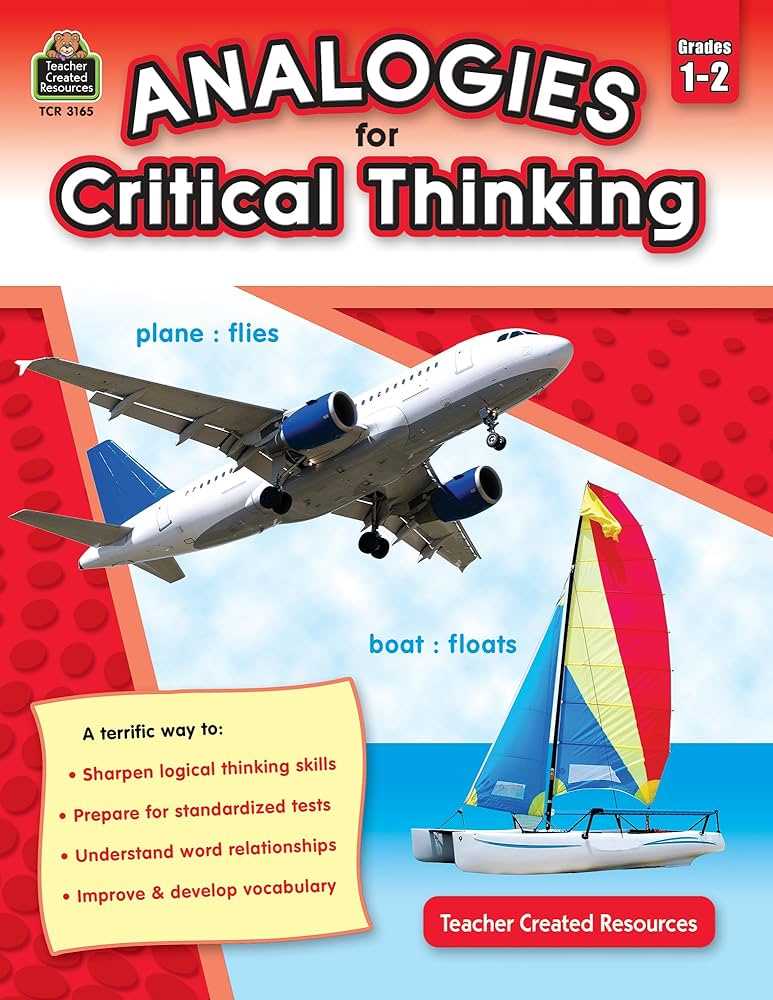
When solving reasoning exercises, focus on recognizing the relationships between terms. Identifying how two concepts are related is the first step toward deriving the correct conclusion. If you’re asked to choose the pair that corresponds most closely to the original relationship, start by analyzing each element carefully.
Break down the problem by examining the logic behind the connection. For example, if the first term in a pair is linked to the second by a certain function (like cause and effect, part to whole, or opposites), find a corresponding relationship in the choices. If needed, visualize the relationships using diagrams to clarify your thought process.
Use practice to build familiarity with common logical connections. Over time, recognizing patterns becomes second nature, and your ability to make quick, accurate decisions improves. By refining your approach and avoiding common errors, you can consistently solve reasoning puzzles with greater confidence.
Critical Thinking Analogies Solutions and Explanations
To solve reasoning challenges, first identify the relationship between the first pair of terms. Then, find the pair from the options that share the same type of connection. Below is a breakdown of common types of relationships and example solutions:
| Relationship Type |
Example Pair |
Correct Pair |
| Cause and Effect |
Rain : Flood |
Fire : Smoke |
| Part to Whole |
Leaf : Tree |
Wheel : Car |
| Opposites |
Hot : Cold |
Light : Dark |
| Function |
Knife : Cut |
Pen : Write |
Always check for the consistency of the relationship. If you recognize a cause-and-effect link, look for another cause-and-effect pair among the options. For part-to-whole relationships, ensure that the second term represents the whole. Carefully considering these connections will improve your accuracy in solving these types of problems.
Understanding the Structure of Analogies in Reasoning
To solve reasoning puzzles, it’s important to first recognize the structure of the given comparison. An analogy typically compares two pairs of terms that have a specific relationship. These relationships fall into several categories: cause and effect, part to whole, function, or opposites, among others.
When analyzing an analogy, focus on identifying the connection between the first two terms. Once the relationship is clear, search for a second pair that mirrors this structure. For example, if “Fire” is to “Heat” as “Ice” is to “Cold”, the connection is based on the nature of temperature effects. Below is a breakdown of common analogy structures:
| Relationship Type |
Example Pair |
Matching Pair |
| Cause and Effect |
Sun : Warmth |
Wind : Chill |
| Part to Whole |
Branch : Tree |
Step-by-Step Guide to Solving Common Comparisons
Start by analyzing the first pair of terms. Determine the exact relationship between them, such as cause and effect, function, part to whole, or opposites. For example, if “Tree” is to “Leaf,” the relationship is part to whole.
Next, identify the same type of relationship in the options provided. If the first pair shows part to whole, look for another pair that follows the same structure, like “Page” and “Book.”
Cross-check the options to make sure the second term in the pair mirrors the function or effect of the first term. If a connection seems off, discard that option and continue checking until you find the pair that matches perfectly.
Once you’ve identified a correct pair, verify that both terms in the selected pair fit the established relationship. This will help ensure that you’re choosing the best possible option.
Practice this approach regularly to sharpen your ability to identify relationships quickly and accurately.
Identifying the Relationship Between Terms in Comparisons
To solve a reasoning problem, start by identifying the type of connection between the first pair of terms. Here’s how to categorize the relationship:
- Cause and Effect: One term causes the other. Example: “Heat : Expansion” (Heat causes expansion).
- Part to Whole: One term is a part of the other. Example: “Wheel : Car” (A wheel is part of a car).
- Function: One term describes the function of the other. Example: “Knife : Cut” (A knife is used to cut).
- Opposites: The terms are opposites. Example: “Hot : Cold” (These are opposite in temperature).
Once the relationship is clear, analyze the options and look for a pair with the same connection. For example, if “Heat” is to “Expansion,” find another pair where one term leads to the other in the same way.
Focus on how the two terms interact. If you recognize a cause-effect connection, search for another cause-effect relationship in the options. Similarly, if the first pair shows part-to-whole, find another part-to-whole pair.
By accurately identifying the connection, you can quickly eliminate incorrect options and choose the pair that mirrors the structure of the original terms.
Common Pitfalls to Avoid in Reasoning Puzzles
When solving comparison problems, avoid these common mistakes:
- Misunderstanding the Relationship: Carefully assess the connection between the first pair of terms. If you confuse the type of relationship (e.g., part-to-whole vs. cause-and-effect), you might select an incorrect pair.
- Rushing Through the Options: Always take the time to evaluate all options. A quick decision based on an initial impression can lead to mistakes, especially if you overlook subtle differences in the terms.
- Choosing a Pair That’s Only Partially Similar: Don’t settle for an option that has some similarity but doesn’t match the full structure of the original relationship. Ensure the second pair mirrors both terms and the relationship.
- Ignoring Contextual Clues: Some comparisons may include context or specific traits. For instance, “Dog” : “Puppy” is a part-to-whole relationship, but don’t confuse this with “Dog” : “Cat,” which represents a different cat
How to Improve Your Ability to Solve Comparisons
To enhance your skills in solving reasoning puzzles, practice identifying the relationship between terms more effectively. Focus on these steps:
- Identify the Relationship Type: For each term pair, quickly classify the connection–whether it’s part-to-whole, cause-and-effect, or something else. The clearer you are about the relationship, the easier it will be to find the right match in options.
- Practice with Diverse Examples: The more problems you solve, the sharper your skills will become. Engage with a variety of puzzles to get comfortable with different structures and relationships. Websites like Khan Academy provide a wealth of practice material for building reasoning skills.
- Learn to Eliminate Incorrect Options: After identifying the relationship in the first pair, systematically eliminate options that don’t match the structure. Focus on subtle differences between the terms to spot mismatches more quickly.
- Use Contextual Clues: Pay close attention to the context or theme presented in the problem. Sometimes, terms are linked by a category or specific context, such as animals or tools, which can guide you to the correct answer.
- Review and Reflect: After solving a puzzle, review both the correct and incorrect answers. Understanding why a particular pair works or doesn’t work will help you improve for future problems.
By following these strategies and practicing consistently, you can boost your ability to identify the relationships in comparison-based tasks with confidence.
Using Visual Aids to Clarify Reasoning
To improve your ability to solve relational problems, visual tools are an effective way to highlight connections. Here’s how to make the most of them:
- Diagrams: Drawing a diagram to represent relationships between objects can simplify complex comparisons. Use shapes or arrows to clearly mark how different elements are related.
- Tables: Arrange terms or concepts in a table format for easy comparison. This method allows you to quickly identify similarities and differences between pairs of ideas.
- Venn Diagrams: Use Venn diagrams to illustrate shared characteristics between concepts. This approach is particularly helpful for identifying overlap and distinctions in relational sets.
- Flowcharts: For cause-and-effect or step-by-step relationships, flowcharts visually represent the sequence and progression, which can clarify the structure of complex comparisons.
- Highlighting Key Points: Use color-coding or underlining to draw attention to the most important features in a pair of items. This method emphasizes critical elements in the relationship, making it easier to spot patterns.
These visual strategies help clarify complex relationships and make reasoning tasks more manageable.
How to Check Your Solutions in Logical Puzzles
Start by reviewing the relationships between elements. Each pair or group should follow a consistent pattern. If you notice discrepancies, go back and reassess the connections. Look for similarities, differences, and transformations in the elements provided. For example, if you’re working with numbers, check for arithmetic operations, such as addition, multiplication, or division. If it’s about objects or concepts, identify any qualities that might link them together (e.g., size, color, function). Ensure that the pattern used to solve the first part applies equally to the second.
Next, verify consistency in the solution structure. If you’ve concluded that one object or idea corresponds to another, ensure that your reasoning holds up across other examples. Apply the same logic in a similar situation to confirm that no contradictory conclusions are drawn. This step prevents assumptions from clouding your judgment and helps solidify your conclusions. If necessary, test your findings against alternative solutions to check if they provide the same or a similar result.
Cross-check with the original prompt. Ensure all elements from the task are accounted for in your solution. Sometimes, skipping details can lead to errors. Double-check that every requirement has been met without missing key components. If the puzzle or exercise involves multiple parts, verify that the solution applies universally to each segment and remains logical when all pieces are combined.
Finally, test your answer in reverse. Take your result and try to apply it backward, retracing your steps. If the outcome still fits the original premise when reversed, the solution is likely correct. If not, reconsider the approach you took, as the process should yield consistent results whether approached forwards or backward.
Applying Analogical Reasoning in Real-Life Situations
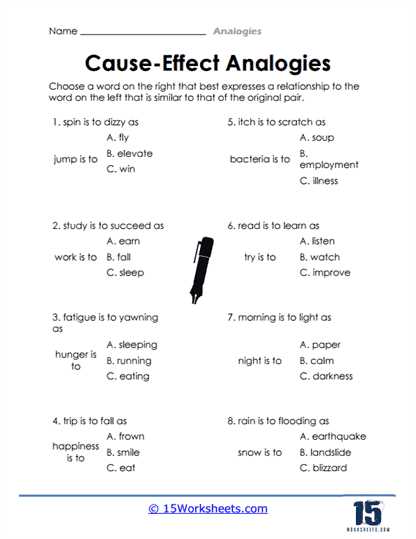
To use comparison effectively in everyday scenarios, start by identifying the key similarities between a current situation and a past experience or familiar concept. Focus on the underlying structure of both, rather than surface-level details. This can help reveal patterns that apply across different contexts.
- In decision-making, compare past choices with the present options. Ask yourself: What worked in the past? What didn’t? Apply those lessons to guide your current decisions.
- When solving problems, break them down into simpler, related scenarios. If you’ve encountered a similar issue before, consider how you resolved it, and check if the same solution applies now.
Test the validity of the comparison by considering key differences. If the analogy holds under scrutiny, you can move forward with greater confidence. However, be cautious of oversimplification–what worked in one instance may not be directly transferable due to context variations.
- For example, in business, consider how a competitor overcame a challenge. Compare their strategies to your current needs. Does their approach align with your resources and goals?
- In relationships, use past communication strategies to handle current conflicts. If a previous method brought understanding, try applying it again while adjusting to the new situation.
Finally, evaluate the long-term implications of the analogy. Does applying the same logic today produce similar outcomes? Reflect on the results of past analogies and assess their effectiveness to refine your approach for future situations.