Understanding the Area Calculation for Compound Shapes with Solutions
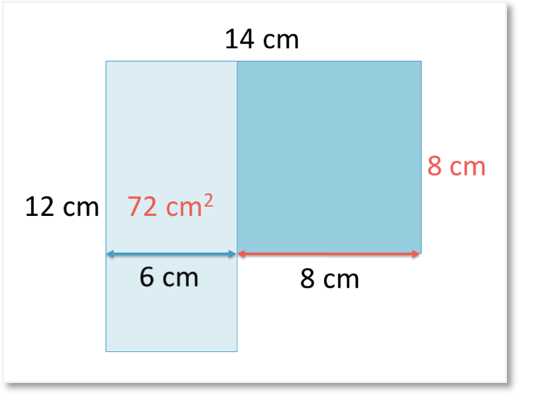
To calculate the space inside complex forms, break them down into smaller, recognizable figures like rectangles, triangles, and circles. By solving for the area of each individual shape, you can then combine the results to find the total area of the entire figure.
Start by identifying the shapes within the larger figure and assigning appropriate formulas for each. For example, if part of the figure is a rectangle, use the length and width to find its area. If another part is a circle, apply the formula for the area of a circle. Once each section is calculated, add them up for the final result.
For irregular structures, divide them into smaller sections that can be treated as basic geometric forms. Don’t forget to subtract areas when parts of the shape are missing or cut out. This method ensures accuracy and avoids overlooking portions of the figure.
Solving for Total Surface Space in Complex Figures
To find the total surface space of a multi-part figure, break it down into its individual sections. Identify each section’s shape and apply the corresponding formula to calculate its area. For rectangles, multiply length by width; for triangles, use the formula 1/2 * base * height; and for circles, apply the formula π * radius². Once each part is calculated, sum all areas to get the final result.
When working with a figure that has missing sections or overlaps, ensure you subtract or add areas as needed. For example, if there’s a smaller circle cut out from a rectangle, subtract the circle’s area from the rectangle’s area. This will give you the correct remaining surface space.
For figures with irregular outlines, divide them into smaller, simpler shapes and solve each one separately. If the figure involves curved boundaries, approximate the area using simpler geometric shapes or advanced methods like integration if necessary.
Step-by-Step Process for Finding the Area of Compound Shapes
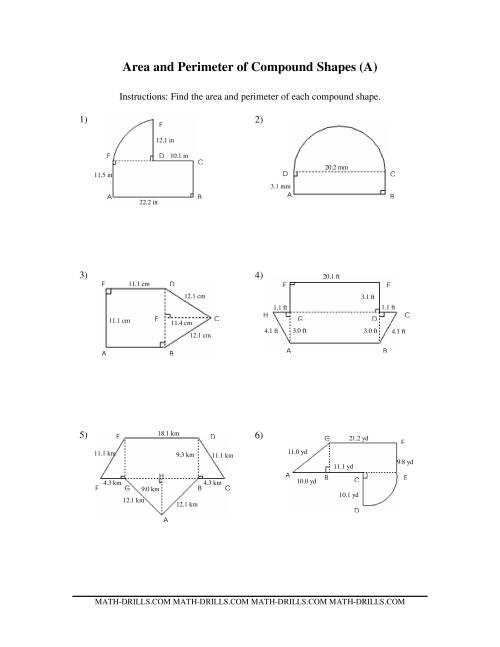
1. Break down the figure: Identify and separate the figure into smaller, simpler parts like rectangles, triangles, and circles.
2. Find the dimensions: Measure or note the required dimensions for each part, such as length, width, height, and radius.
3. Apply the correct formula: Use the appropriate formula for each part. For rectangles, multiply length by width. For triangles, use 1/2 * base * height. For circles, apply π * radius².
4. Calculate individual areas: Perform the necessary calculations for each part separately.
5. Add or subtract areas: If parts overlap or if a section is removed, adjust the total by adding or subtracting the relevant areas.
6. Sum the areas: Add up the areas of all individual parts to get the total surface space of the entire figure.
Breaking Down Complex Figures into Simpler Figures
1. Identify distinct components: Look at the complex figure and identify all the simpler, recognizable parts such as squares, rectangles, triangles, or circles.
2. Draw boundary lines: If necessary, draw lines to divide the complex figure into individual, manageable sections. Ensure these divisions follow the natural contours of the figure.
3. Label dimensions: For each separated section, clearly label the dimensions, such as height, width, base, or radius, to apply the correct formulas later.
4. Use appropriate formulas: For each simpler section, apply the correct geometric formula to calculate its size. For instance, use length × width for rectangles or ½ × base × height for triangles.
5. Consider overlaps: If parts of the figure overlap or intersect, subtract the overlapping areas where necessary to avoid double counting.
6. Add the results: Once each section’s size is calculated, sum them together to get the total space of the figure.
7. Check for irregularities: If the figure has curves or angles, use the appropriate methods, like integrating for curves or applying the Pythagorean theorem for angled sections, to find exact dimensions.
Common Formulas Used in Size Calculations for Complex Figures
To accurately determine the dimensions of combined geometric figures, the following formulas are commonly applied:
- Rectangle: Length × Width
- Square: Side × Side
- Triangle: ½ × Base × Height
- Circle: π × Radius²
- Parallelogram: Base × Height
- Trapezoid: ½ × (Base₁ + Base₂) × Height
- Circle Sector: (θ/360) × π × Radius², where θ is the central angle
Once the individual sections are broken down, each formula can be applied to the separate parts. Afterward, combine the results by adding or subtracting the areas of the individual sections to determine the total size.
Examples of Complex Figures and Their Size Solutions
Below are some practical examples illustrating how to calculate the total dimensions of combined figures by breaking them into simpler parts:
-
Example 1: A rectangle with a length of 6 cm and a width of 4 cm is combined with a right triangle having a base of 4 cm and height of 3 cm.
Solution: Calculate the area of the rectangle: 6 × 4 = 24 cm². Then, calculate the area of the triangle: ½ × 4 × 3 = 6 cm². Total: 24 + 6 = 30 cm².
-
Example 2: A circle with a radius of 5 cm is attached to the side of a square with a side length of 8 cm.
Solution: Calculate the area of the square: 8 × 8 = 64 cm². Then, calculate the area of the circle: π × 5² ≈ 78.54 cm². Total: 64 + 78.54 = 142.54 cm².
-
Example 3: A trapezoid with bases of 6 cm and 10 cm, and a height of 4 cm, is combined with a rectangle having a length of 5 cm and a width of 4 cm.
Solution: Calculate the area of the trapezoid: ½ × (6 + 10) × 4 = 32 cm². Then, calculate the area of the rectangle: 5 × 4 = 20 cm². Total: 32 + 20 = 52 cm².
These examples demonstrate how to break down complex figures into simpler components, apply the appropriate formulas to each, and combine the results for a complete solution.
How to Handle Irregular Figures in Size Calculations
To calculate the total dimensions of irregularly shaped figures, follow these steps:
-
Step 1: Break down the figure into smaller, simpler forms. Identify recognizable geometries such as rectangles, triangles, circles, or trapezoids.
-
Step 2: Calculate the size of each individual part using the appropriate formulas. For example, use the formula for a rectangle (length × width), triangle (½ × base × height), or circle (π × radius²).
-
Step 3: If necessary, subtract the area of any cut-out sections. For example, if a circle is subtracted from a square, calculate the area of both and subtract the circle’s size from the square’s.
-
Step 4: Add the areas of all the components together to find the total size. Ensure that all units are consistent (e.g., all in centimeters squared).
By decomposing irregular figures into basic shapes and applying standard formulas, you can efficiently calculate their total size without complex measurements.
Tips for Avoiding Common Mistakes in Size Calculations
1. Double-check measurements: Always ensure that the dimensions you use are accurate. A small error in length or width can significantly affect the result.
2. Consistent units: Verify that all units of measurement are the same before calculating. If some values are in inches and others in centimeters, convert them to one consistent unit.
3. Use correct formulas: Ensure you are applying the correct formula for each individual part. For example, remember that the formula for the area of a triangle is different from that of a rectangle.
4. Break down complex forms: If the figure is irregular, divide it into simpler parts and calculate each separately before summing their sizes.
5. Check for overlapping areas: Be cautious of any sections that might overlap or intersect. Subtract those areas if necessary to avoid double-counting.
6. Avoid rounding too early: Round your results only after completing all calculations to maintain precision throughout the process.
By following these steps, you can minimize errors and achieve more accurate calculations.
Using the Size of Complex Figures in Real-World Applications
1. Architecture and Construction: When designing buildings or other structures, knowing how to calculate the space required for floors, roofs, or other components is crucial. Complex layouts often consist of a combination of rectangles, circles, and triangles, so breaking them down into smaller, manageable areas ensures accurate planning and material estimation.
2. Landscaping and Urban Planning: City planners use these calculations to determine land usage, including parks, streets, and other public spaces. Understanding the total covered space helps in optimizing the use of available land for construction or recreational purposes.
3. Flooring and Tiling: Contractors use the principles of measuring irregular surfaces to calculate the number of tiles or flooring materials needed for irregularly shaped rooms. Dividing the area into smaller figures simplifies the process of determining the correct amount of materials.
4. Art and Design: Artists working on large murals or intricate designs use geometric principles to break down complex patterns into simple areas. This helps in scaling designs accurately for specific spaces and ensuring the proportions align with the intended aesthetic.
5. Fabric and Pattern Design: In industries such as fashion or textile design, calculating fabric requirements for intricate patterns requires understanding how to measure and break down irregular shapes. By dividing the design into basic forms, designers can more easily estimate how much fabric is needed.
6. Agriculture: In farming, especially when planting crops on irregular plots of land, calculating the size of fields helps optimize planting patterns and resource allocation. Farmers break down land into smaller sections to understand how much seed or fertilizer is needed.
Understanding the Importance of Units in Measurement Calculations
When calculating the size of complex figures, using the correct units is fundamental. Units determine the scale of the measurements and directly affect the accuracy of the result. For example, if you measure lengths in centimeters but calculate the final size in meters without converting the units, your result will be incorrect. Always ensure consistency in the units used for all dimensions.
Choosing the appropriate unit of measurement depends on the context. For smaller calculations, such as measuring room dimensions, centimeters or inches are ideal, while larger areas might require square meters or even hectares. For complex structures or large plots of land, using larger units like square kilometers may be necessary to avoid overly large numbers.
Additionally, units should match across all dimensions when performing calculations. For instance, if you are calculating the combined size of multiple sections of a floor plan, ensure that all sections are measured in the same units, and adjust for any discrepancies before performing the final calculation.
To avoid errors, it’s also crucial to convert between units where needed. For example, if a figure’s dimensions are provided in inches, and the calculation is required in square feet, convert all lengths to feet before performing the calculation.
For more information on unit conversion and measurement standards, you can refer to the official guidelines provided by organizations such as the National Institute of Standards and Technology (NIST) at https://www.nist.gov.