Step by Step Methods to Balance Chemical Equations with Accurate Coefficients
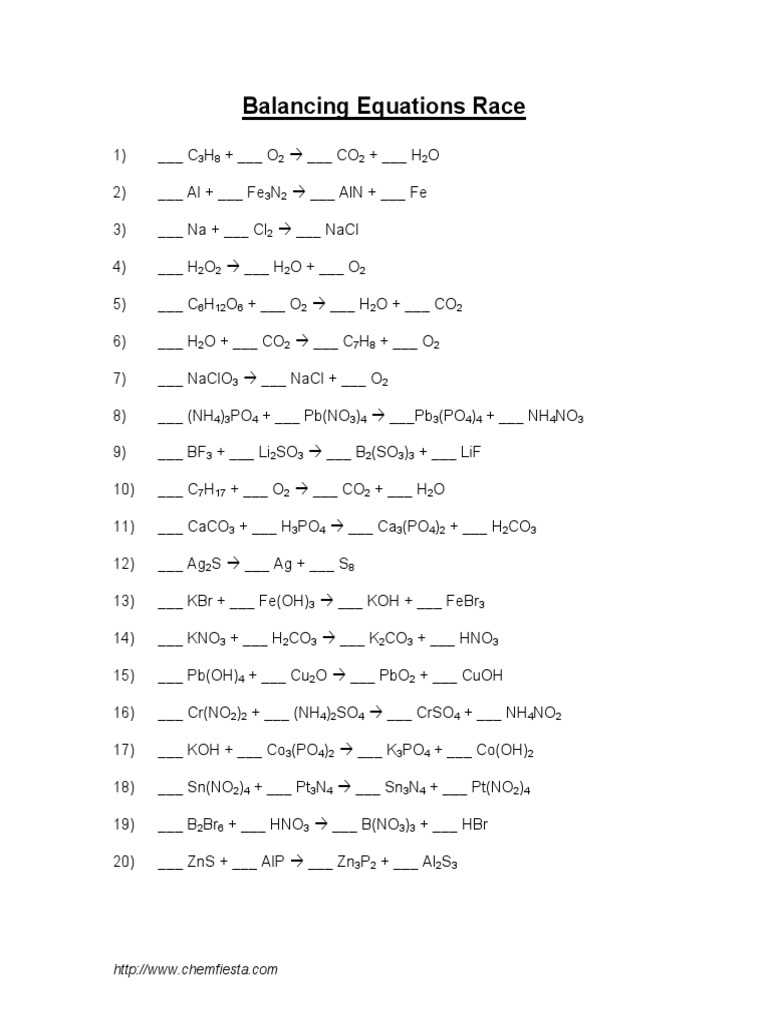
Begin by identifying all components involved in a chemical transformation. List each element and count the number of atoms on both sides of the reaction to detect discrepancies.
Apply systematic adjustments using coefficients. Start with elements that appear in the fewest compounds to simplify calculations and avoid repetitive corrections.
For combustion or redox reactions, prioritize hydrogen and oxygen adjustments. Check diatomic molecules like O₂ or H₂, ensuring their counts match on both sides before modifying other compounds.
Consider grouping polyatomic ions that remain unchanged throughout the reaction. Treat them as single units to reduce calculation complexity and maintain consistency in atom distribution.
After modifying coefficients, verify total atom counts for each element. Ensure that mass is conserved and that all coefficients are reduced to the smallest whole numbers to finalize the reaction structure.
Step by Step Methods to Equalize Reactants and Products in Practice
Begin with a thorough inventory of all elements present in the reaction. List each atom and tally its occurrences on both sides to identify imbalances.
Follow a systematic adjustment process:
- Prioritize single elements: Start with atoms that appear in only one compound on each side.
- Handle hydrogen and oxygen last: These often appear in multiple compounds and adjusting them too early can create new imbalances.
- Group polyatomic ions: If a polyatomic ion remains unchanged throughout the reaction, treat it as a single unit to simplify counting.
Apply coefficients incrementally:
- Choose a coefficient to equalize one element.
- Recount all atoms to ensure consistency.
- Adjust other coefficients as needed without altering previously balanced elements.
Finalize the reaction:
- Confirm atom conservation: Every element should have the same total on both sides.
- Reduce coefficients: Convert all coefficients to the smallest whole numbers that maintain equality.
- Verify the reaction: Check that the final form obeys the law of conservation of mass with no discrepancies.
Recognizing Reactants and Products in Multi-Step Reactions
Identify each compound’s role by analyzing the initial and final states of the reaction. Reactants are substances consumed, while products are newly formed molecules.
Break down multi-step processes into individual stages:
- Step separation: Isolate each intermediate transformation to understand which species participate in each stage.
- Track atom movement: Follow specific atoms or groups to see how they shift from reactants to products.
- Identify recurring compounds: Recognize intermediates that appear in multiple steps to avoid double-counting.
Use a systematic approach to map compounds:
- Create a table listing all reactants and products for each step.
- Mark unchanged species that carry through multiple stages.
- Highlight compounds appearing for the first or last time to clarify overall changes.
Verify your mapping by ensuring mass conservation at each stage and consistency across the entire reaction sequence. This guarantees accurate identification of all consumed and produced substances.
Counting Atoms to Ensure Both Sides Align
Start by listing every element present in all compounds on both sides of the reaction. Count each atom carefully to verify totals match across reactants and products.
Use a stepwise approach:
- Create a table: List elements in rows and compounds in columns for clarity.
- Track subscripts: Multiply by coefficients to get the actual number of atoms for each species.
- Compare sides: Identify any discrepancies where atoms are missing or in excess.
- Adjust systematically: Modify coefficients incrementally, starting with elements that appear only once per side.
Double-check totals after each adjustment to ensure mass consistency and verify that no atoms are lost or duplicated in the transformation process. This guarantees proper alignment throughout the reaction.
Balancing Hydrogen and Oxygen in Combustion Reactions
Begin by counting hydrogen atoms in the fuel and matching them with the number of hydrogen atoms in water molecules produced. Adjust coefficients on water to equal the total hydrogen count from the reactant side.
Next, focus on oxygen atoms. Sum oxygen atoms present in both carbon dioxide and water molecules. Compare this total to the oxygen atoms available in the reactant molecules, including O2. If necessary, modify the coefficient on O2 to achieve equal totals.
Check that all atoms are accounted for after each adjustment. Ensure the number of hydrogen and oxygen atoms is identical on both sides before proceeding to carbon or other elements. This method maintains consistency and prevents errors during the process.
Treating Polyatomic Groups as Single Units
Identify recurring polyatomic ions such as SO42−, NO3−, or OH− on both sides of the reaction. Consider each group as a single unit when adjusting coefficients, which reduces calculation errors and simplifies the process.
Check the total count of these units after applying coefficients. Do not break the internal atom structure within polyatomic groups during adjustment; treat them consistently to maintain the correct stoichiometric ratios.
Apply the same approach for multiple occurrences of the same polyatomic unit. Adjust other elements around these groups only after the polyatomic totals align on both sides to ensure stability and accuracy throughout the reaction.
Adjusting Coefficients in Single and Double Replacement Reactions
Start by identifying the species that will swap places: in a single‑replacement scenario, one element displaces another; in a double‑replacement reaction, two ions exchange partners.
Set up a provisional balance by writing the skeletal form, for example: A + BC → AC + B or AB + CD → AD + CB. Next, count atoms of each element on both sides to find mismatches.
Adjust coefficients carefully:
- For single replacement: Increase the displaced element’s coefficient if it’s produced in excess, or adjust the replacing element’s coefficient if the new compound has too many atoms.
- For double replacement: Balance one ion at a time by matching cations and anions in the products, considering their stoichiometric ratios.
Check your work by recounting all atoms and comparing both sides. Make sure that no charge imbalance occurs and that the mass is conserved.
If ions or elements remain unbalanced, re‑adjust coefficients systematically until all species align. Use a reliable chemistry reference such as Khan Academy’s guide to double‑replacement reactions: Khan Academy: Double Replacement Reactions. :contentReference[oaicite:0]{index=0}
Using Fractional Coefficients and Converting to Whole Numbers
Apply fractional coefficients when an element appears in multiple compounds and cannot be matched with a whole number initially. For example, in the reaction C3H8 + O2 → CO2 + H2O, placing 5/2 in front of O2 balances oxygen atoms: C3H8 + 5/2 O2 → 3 CO2 + 4 H2O.
After fractions are introduced, convert all coefficients to whole numbers by multiplying the entire set by the least common multiple of denominators. Using the previous example, multiply every coefficient by 2: 2 C3H8 + 5 O2 → 6 CO2 + 8 H2O.
Steps to follow:
- Identify the element that leads to fractional coefficients.
- Assign the fraction to match atom counts across reactants and products.
- Determine the least common multiple of all denominators present.
- Multiply each coefficient by that multiple to obtain whole numbers.
- Verify that atom counts are equal on both sides after conversion.
This method ensures stoichiometric consistency while avoiding unnecessary trial-and-error adjustments with whole numbers initially.
Verifying Balances Through Mass and Atom Checks
Confirm that each element has identical atom counts on both sides by creating a simple table listing all elements with their quantities in reactants and products. For example, in 2 H2 + O2 → 2 H2O, hydrogen totals 4 atoms on both sides, and oxygen totals 2.
Check total mass by multiplying the number of atoms by their atomic masses. In the previous reaction, hydrogen contributes 4 × 1.008 = 4.032 u, and oxygen contributes 2 × 16.00 = 32.00 u on both sides, confirming mass consistency.
Steps to verify:
- List each element present in the reaction.
- Count atoms in reactants and products separately.
- Calculate mass contributions using atomic weights.
- Compare totals for both sides to ensure equality.
- Adjust coefficients if discrepancies are detected.
Performing these atom and mass checks prevents hidden errors and ensures the reaction representation accurately reflects physical laws.
Common Errors and Troubleshooting Misbalanced Equations
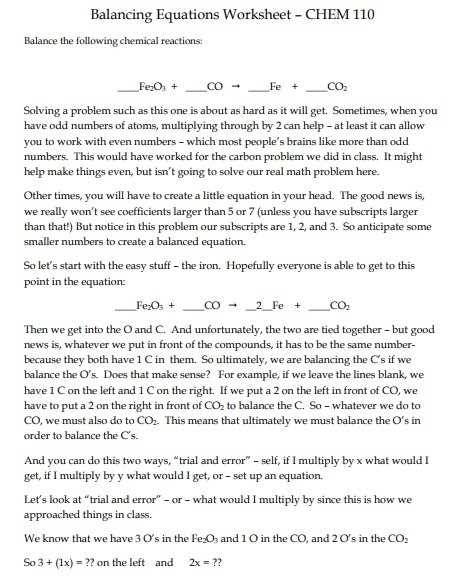
Focus on identifying discrepancies in atom counts and coefficient placements to correct inaccuracies in chemical representations. Typical mistakes occur when polyatomic groups are split unnecessarily or fractional coefficients are mishandled.
Use a systematic table to track element totals and quickly spot mismatches:
| Element | Reactant Count | Product Count | Adjustment Needed |
|---|---|---|---|
| H | 4 | 2 | Double product coefficient |
| O | 2 | 2 | None |
| Na | 1 | 2 | Halve product coefficient |
Additional troubleshooting steps:
- Verify each element individually rather than adjusting globally.
- Keep polyatomic ions together as single units when possible.
- Check for common multiples to convert fractional coefficients to whole numbers.
- Reassess double replacement reactions separately to ensure atom swaps maintain totals.
Systematic verification prevents propagation of errors and ensures the chemical representation remains consistent with atom conservation rules.