How to Convert Fractions Decimals and Percents Step by Step
To quickly switch between percentages, decimal numbers, and ratios, mastering a few simple techniques is key. Begin by focusing on recognizing the relationships between these values, such as how 0.75 represents 75% or how 3/4 equals 0.75. Each conversion relies on understanding the base of the system you’re working within, whether it’s a hundred for percentages or a whole number for decimals and ratios.
For instance, to change a ratio into a decimal, simply divide the numerator by the denominator. This step works for any fraction, ensuring that you can always get a decimal equivalent. Similarly, transforming a decimal into a percentage only requires multiplying by 100, which is often easier than it seems. Start with the basic conversion rules, and with a bit of practice, you’ll quickly gain confidence.
Additionally, always check your results by reversing the process. For example, if you’ve converted 0.6 to 60%, try turning it back into a fraction to see if you arrive at 3/5. This practice not only ensures accuracy but also helps reinforce the connection between these different forms of representing numbers.
Converting Fractions Decimals and Percents Answer Key
To solve these types of problems, it’s important to understand the relationship between each form of representation. For example, to transform a ratio like 3/4 into a decimal, divide the numerator (3) by the denominator (4). The result is 0.75. To express this as a percentage, simply multiply 0.75 by 100, which gives you 75%.
For a decimal such as 0.6, convert it to a fraction by recognizing it as 6/10, which can be simplified to 3/5. To turn this into a percentage, multiply 0.6 by 100 to get 60%. Similarly, to express a percentage like 45% as a decimal, divide by 100: 45 ÷ 100 = 0.45. As a fraction, this is 45/100, which simplifies to 9/20.
By using these basic steps, you can easily transition between the different forms and check your results to confirm accuracy. Practice with various examples to solidify your understanding and improve speed with these conversions.
Steps for Converting Fractions to Decimals
To change a ratio into a decimal, start by dividing the numerator (top number) by the denominator (bottom number). For example, to transform 3/4, divide 3 by 4. This gives 0.75.
If the division doesn’t result in a whole number, continue the division by adding zeros to the right of the decimal point. For example, dividing 2 by 3 will give 0.666… which repeats indefinitely, often rounded to 0.67 for simplicity.
For improper ratios, where the numerator is larger than the denominator, divide as usual. For instance, 7/2 equals 3.5. If the numerator is much larger, the result will be a larger decimal value, such as 11/4, which equals 2.75.
How to Convert Decimals to Fractions
To change a decimal into a ratio, start by identifying the place value of the last digit in the decimal. For example, 0.75 has a 5 in the hundredths place, so it becomes 75/100.
Next, simplify the ratio by dividing both the numerator and the denominator by their greatest common divisor (GCD). For 75/100, the GCD is 25, so divide both 75 and 100 by 25, resulting in 3/4.
If the decimal is a repeating decimal, such as 0.666…, express it as a ratio by first writing the repeating decimal as a fraction of the repeating digits. In this case, 0.666… becomes 2/3.
For further information on these conversion steps, refer to reliable sources like Khan Academy.
Converting Percentages to Decimals
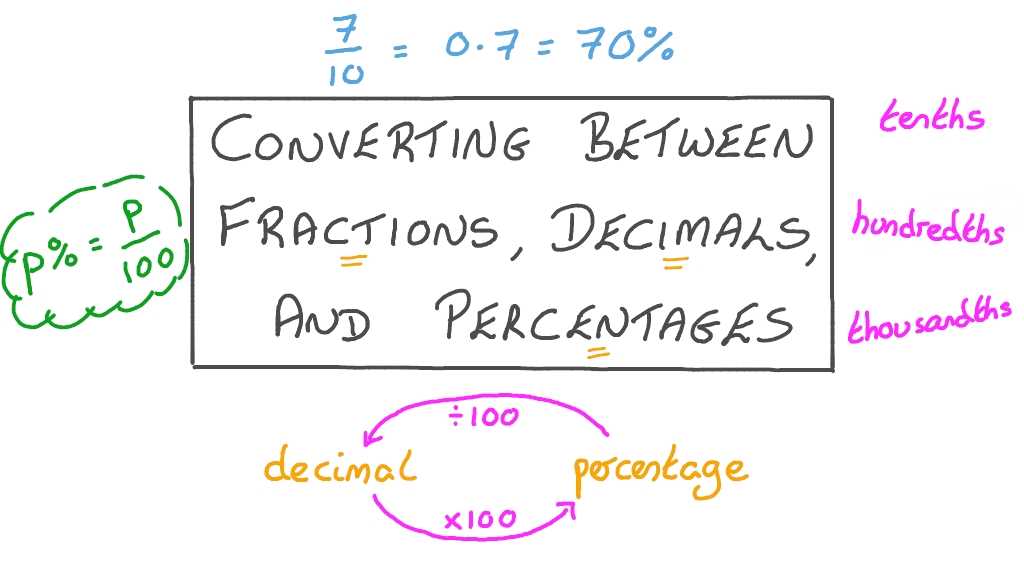
To turn a percentage into a decimal, simply divide the percentage by 100. This is done by shifting the decimal point two places to the left. For instance, 75% becomes 0.75.
If you have a percentage like 18%, move the decimal point two positions left to get 0.18. For 4%, it would become 0.04.
For percentages with decimals, such as 5.5%, divide by 100 to get 0.055. This process works the same for any percentage value.
Understanding the Relationship Between Fractions and Percentages
To change a fraction to a percentage, divide the numerator by the denominator and then multiply the result by 100. For example, for 3/4, divide 3 by 4 to get 0.75, then multiply by 100 to get 75%.
If the fraction is a simple number like 1/2, divide 1 by 2 to get 0.5 and multiply by 100, resulting in 50%. For 2/5, divide 2 by 5 to get 0.4, and multiply by 100 to get 40%.
The reverse is also true. To convert a percentage into a fraction, divide the percentage by 100 and simplify. For example, 60% becomes 60/100, which simplifies to 3/5.
For more complex percentages, like 12.5%, write it as 12.5/100, which simplifies to 1/8. The relationship between these values is based on multiplying or dividing by 100, making it easy to transition between the two forms.
Common Mistakes to Avoid When Converting Fractions to Decimals
One common mistake is failing to divide the numerator by the denominator correctly. For example, when converting 3/8, ensure you divide 3 by 8, which gives 0.375, not 0.38.
Another error is neglecting to round properly. Rounding too early or inaccurately can distort the result. Always round at the final step if needed, based on the required decimal places.
Confusing repeating decimals is also a frequent issue. For instance, 1/3 results in 0.3333…, which repeats infinitely. Recognizing repeating decimals and expressing them correctly (like 0.33 or 0.333…) is important.
| Fraction | Incorrect Conversion | Correct Conversion |
|---|---|---|
| 3/8 | 0.38 | 0.375 |
| 2/5 | 0.4 | 0.4 |
| 1/3 | 0.33 | 0.333… |
Ensure you’re dividing accurately and rounding only when necessary to avoid these common pitfalls.
Using Long Division to Convert Fractions to Decimals
To convert a fraction into a decimal using long division, follow these steps:
- Place the numerator (top number) inside the division bracket and the denominator (bottom number) outside.
- Perform the division step by step. Start by dividing the numerator by the denominator.
- If the numerator is smaller than the denominator, add a decimal point and a zero to the numerator, then continue dividing.
- Keep dividing until the remainder is zero or the division starts repeating.
- Round the result as needed based on the required number of decimal places.
For example, to convert 3/8:
- Start with 3 ÷ 8. 8 goes into 3 zero times. Place a 0 and a decimal point.
- Add a zero to the right of the 3 to make it 30. Now, divide 30 by 8. The result is 3, so place 3 in the decimal.
- Subtract 24 from 30, leaving 6. Add another zero to the 6, making it 60.
- Divide 60 by 8. The result is 7. Subtract 56 from 60, leaving a remainder of 4.
- Add another zero and repeat the process, continuing until the remainder is zero or the result starts repeating.
Following this method, you’ll get 0.375 as the decimal representation of 3/8.
How to Check Your Work When Converting Percentages
To ensure accuracy when working with percentages, follow these steps:
- After performing the conversion, double-check your final result. For example, if you’re transforming a percentage to a fraction or a decimal, verify that the values make sense within the context of the problem.
- Cross-reference the decimal or fraction you obtained by converting it back to a percentage. Multiply the result by 100 and check if it matches the original percentage.
- Use an online calculator or conversion tool as a reference to verify your solution. These tools can help confirm your results quickly.
- For a fraction to percentage conversion, divide the numerator by the denominator and then multiply by 100. Compare this percentage to your initial calculation.
- Ensure that you’re using the correct number of decimal places when rounding off, especially for more precise calculations.
For example, if you convert 0.75 to a percentage, you would multiply 0.75 by 100 to get 75%. Check if this matches your original value.
Real-Life Applications of Fraction, Decimal, and Percent Conversions
In budgeting, it’s critical to understand how to translate values into percentages for expenses, savings, and taxes. For example, if you need to calculate a 20% tip on a $50 meal, you can multiply 50 by 0.20 (the decimal form of 20%) to get $10.
In the retail industry, sales and discounts are often given as percentages. If a store advertises a 30% discount on an item worth $80, you can convert the percentage into a decimal (0.30) and multiply it by the original price to find the discount amount, $24. Subtract this from the original price to determine the sale price of $56.
In cooking, recipes may require scaling ingredients based on serving sizes. If a recipe calls for 2/3 cup of sugar for 4 servings, but you’re cooking for 6, you’ll need to adjust the amounts proportionally by converting the fraction to a decimal or percentage to make accurate measurements.
In finance, understanding interest rates on loans or savings accounts requires familiarity with percentage conversions. For example, if a bank offers 5% annual interest on a savings account with a $1,000 balance, you can multiply 1,000 by 0.05 to determine the interest earned after one year: $50.
In construction, measurements are often given as fractions or decimals, requiring quick conversions for accurate project planning. For instance, a blueprint might use fractional measurements, but equipment or materials might be sold in decimal units, so knowing how to switch between these formats is necessary for accurate estimations.