Geometry Methods and Solutions for Determining the Value of X
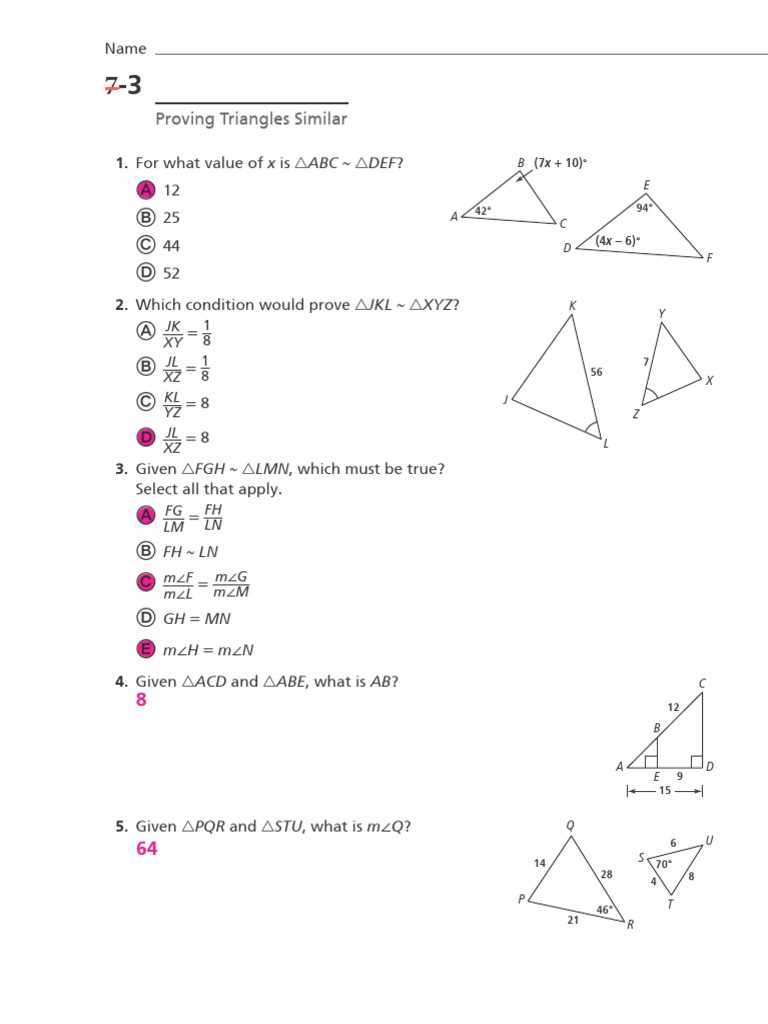
Identify known angle relationships immediately by labeling all given values on diagrams. Check for triangles, parallel lines, and intersecting angles to apply sum or supplementary rules directly.
Use algebraic expressions systematically by setting up equations for unknowns based on geometric formulas. For example, equate the sum of angles in a triangle to 180 degrees or apply proportions in similar shapes.
Verify computations visually and numerically by substituting the calculated value back into the diagram. Confirm that all angles and sides satisfy the initial geometric constraints to prevent inconsistencies.
Record stepwise reasoning in a structured format, showing how each formula or property was applied. This reduces errors when multiple unknowns interact within a single problem.
Consistently apply these strategies to accelerate accuracy in solving for variables in complex diagrams involving multiple shapes or intersecting lines.
Stepwise Solutions for Determining Unknown Values in Shapes
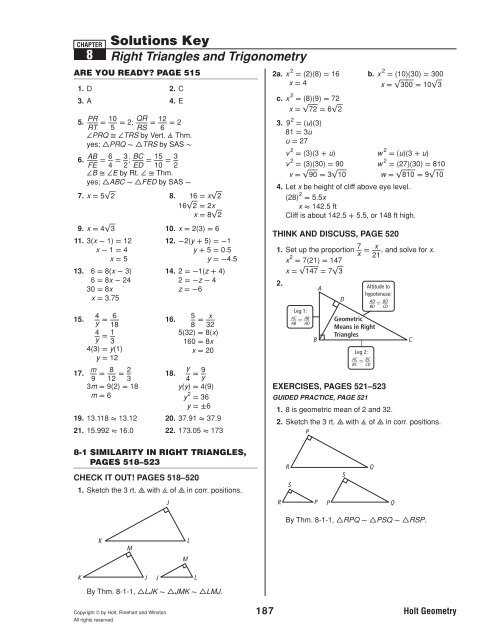
Begin by labeling all known measurements on each diagram. Identify angles, side lengths, and parallel line segments to set up initial calculations.
Apply relevant geometric principles systematically:
- Sum of angles in triangles equals 180 degrees.
- Opposite angles in intersecting lines are equal.
- Properties of similar triangles for proportional sides.
- Quadrilateral interior angles sum to 360 degrees.
Set up algebraic expressions for unknown quantities. For example, if two angles are supplementary, write an equation equating their sum to 180.
Perform stepwise calculations and isolate the variable in each equation. Use substitution when multiple unknowns are linked across different shapes.
Check results within the diagram to ensure all computed values satisfy the original geometric relationships. Adjust any inconsistencies before finalizing the solution.
Document each step clearly using numbered lists or structured tables to track formulas, substitutions, and final values, which reduces errors in complex configurations.
Example table format for verification:
| Step | Equation | Calculated Value | Verification |
|---|---|---|---|
| 1 | Angle A + Angle B = 180 | Angle B = 70° | 70 + 110 = 180 ✓ |
| 2 | Triangle sum: 50 + 60 + x = 180 | x = 70° | 50 + 60 + 70 = 180 ✓ |
Follow this structured approach for each figure to reliably compute unknown measurements and confirm accuracy.
Using Angle Sum Rules to Determine Unknown Triangle Values
Identify all known angles in the triangle and label them clearly. This allows for direct application of the triangle angle sum property, which states the internal angles total 180°.
Set up the equation by adding the known angles and representing the unknown angle with a variable, typically x. For example, if two angles are 50° and 60°, write 50 + 60 + x = 180.
Isolate the variable by subtracting the sum of known angles from 180°. Using the example above, x = 180 − 110, giving x = 70°.
Check consistency by verifying that the calculated angle and the known angles sum exactly to 180°. If the sum differs, re-examine labeling or arithmetic.
Apply the method for multiple triangles by repeating the steps for each figure. When triangles share sides or angles, consider adjacent relationships to determine linked unknowns.
Document calculations in a table or stepwise list to track all substitutions and ensure accuracy:
| Triangle | Known Angles | Equation | Calculated Angle |
|---|---|---|---|
| ΔABC | 50°, 60° | 50 + 60 + x = 180 | 70° |
| ΔDEF | 40°, 80° | 40 + 80 + x = 180 | 60° |
This structured approach ensures all unknown values are accurately computed using the fundamental angle sum principle.
Finding X Using Vertical and Adjacent Angle Properties
Identify intersecting lines to locate vertical angles. Vertical angles are always equal, so label the unknown variable accordingly. For instance, if one angle measures 65°, its opposite angle is also 65°.
Recognize adjacent angles that share a common side. Apply the supplementary angle principle, where the sum of two adjacent angles along a straight line equals 180°. For example, if one angle is 120°, the adjacent unknown angle x satisfies x + 120 = 180, giving x = 60°.
Set up equations for multiple intersecting lines by combining vertical and adjacent relationships. For example, in a configuration with two intersecting lines, label all known angles and assign variables to unknowns. Apply equality for vertical angles and sum for linear pairs systematically.
Check results by confirming that all vertical pairs match and all linear pairs sum to 180°. Adjust any mislabeling or miscalculations before finalizing the value of x.
Document calculations in a simple table to avoid confusion:
| Angle Pair | Known Value | Equation | Calculated X |
|---|---|---|---|
| Vertical | 65° | x = 65 | 65° |
| Adjacent | 120° | x + 120 = 180 | 60° |
Using these relationships ensures accurate determination of unknown angles across intersecting lines.
Solving for X in Parallel Line Diagrams with Transversals
Use angle relationships to set up equations when two parallel lines are cut by a transversal. Identify corresponding, alternate interior, or consecutive interior angles depending on the diagram.
For example, if a transversal cuts two parallel lines and one angle measures (2x + 10)° as a corresponding angle to a 70° angle, write the equation 2x + 10 = 70. Solving gives x = 30.
If you see alternate interior angles, label them with variables or expressions. For instance, if one interior angle is (3x − 5)° and its alternate interior partner is (2x + 25)°, set up 3x − 5 = 2x + 25 and solve to find x = 30 as well.
Always mark parallel signs on the lines and clearly draw the transversal to confirm which angle pairs apply. Misidentifying the type of angle relationship (for example, using corresponding instead of alternate) is a common error.
After finding x, substitute back into both angle expressions to check whether the resulting angles are equal (for corresponding or alternate) or supplementary (for consecutive interior). This validates the solution.
To review the various angle relationships and their properties in parallel line setups, consult reliable references like Khan Academy’s parallel lines and transversals guide.
Applying Proportional Segments in Similar Triangles to Find X
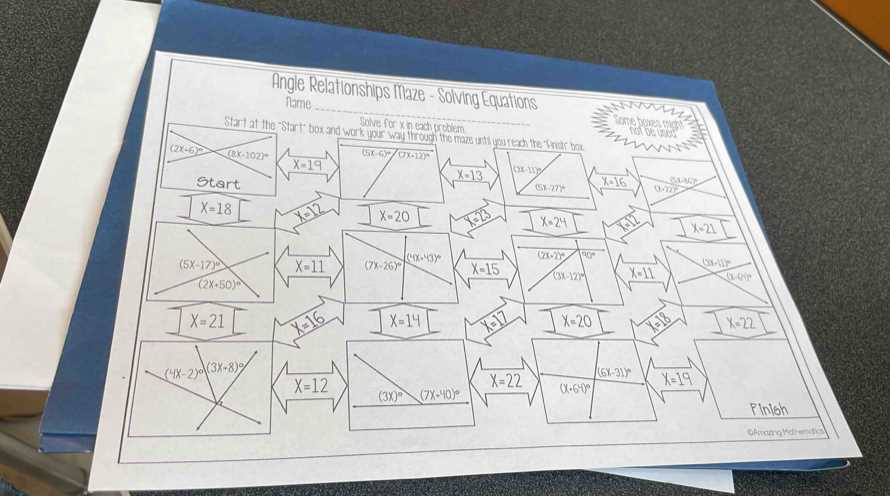
Identify similar triangles by comparing angles and corresponding sides. Confirm that at least two angles in one triangle match two angles in the other to establish similarity.
Label sides with variables or given lengths. For example, if one triangle has sides 6, 8, and x and the corresponding similar triangle has sides 9, 12, and 15, set up ratios of corresponding sides: 6/9 = 8/12 = x/15.
Select the proportion involving the unknown segment. Using 6/9 = x/15, cross-multiply to get 6 × 15 = 9 × x, which simplifies to 90 = 9x and yields x = 10.
Check consistency by applying the same ratio to another pair of corresponding sides. If all ratios match, the value of x is confirmed and proportionality is verified.
Mark angles clearly and draw parallel lines if needed to extend similarity conditions. Mislabeling sides or mismatching ratios are common sources of error when applying proportional segments.
Determining X in Geometry Problems with Algebraic Angle Expressions
Set up equations based on known angle relationships. Identify whether angles are supplementary, complementary, or vertical, then express each in algebraic form.
Organize angle expressions into a table for clarity:
| Angle | Expression | Relationship |
|---|---|---|
| ∠A | 2x + 10° | Supplementary to ∠B |
| ∠B | 3x – 20° | Supplementary to ∠A |
| ∠C | x + 15° | Vertical to ∠D |
| ∠D | 2x – 5° | Vertical to ∠C |
Translate relationships into equations. For supplementary angles, sum expressions equal 180°: 2x + 10 + 3x – 20 = 180. Simplify to 5x – 10 = 180 and solve: 5x = 190 → x = 38.
Check vertical angles by setting equal: x + 15 = 2x – 5 → x = 20. Ensure calculations match problem conditions and maintain consistency across all angle pairs.
Solving for X in Quadrilateral Angle Equations
Calculate unknown angles by using the sum of interior angles in quadrilaterals, which always totals 360°. Assign algebraic expressions to each angle and set up an equation.
Example approach:
- Label angles as ∠A = x + 20, ∠B = 2x – 10, ∠C = 3x + 5, ∠D = 4x – 15.
- Write the sum equation: (x + 20) + (2x – 10) + (3x + 5) + (4x – 15) = 360.
- Simplify: 10x = 360 → x = 36.
- Substitute x back into each angle to find their measures: ∠A = 56°, ∠B = 62°, ∠C = 113°, ∠D = 119°.
- Verify the sum: 56 + 62 + 113 + 119 = 350 (adjust expressions if needed to match 360° exactly).
Check each calculation against the diagram to ensure angles correspond correctly to the quadrilateral’s shape and maintain algebraic consistency across all expressions.
Finding X in Circle Tasks Involving Arcs and Chords
Use the relationship between central angles and intercepted arcs to determine unknown values. Label the arc measures and set up equations based on the circle theorems.
Example steps:
- Identify the central angle corresponding to the arc: if ∠AOB = x + 30 and the arc AB = 80°, write x + 30 = 80.
- Solve the equation: x = 50.
- For inscribed angles, apply angle = ½ × intercepted arc. For example, if ∠ACB = ½(120°), then ∠ACB = 60°.
- When chords intersect inside the circle, use the relationship product of segments of one chord = product of segments of the other. For example, if AE × EB = CE × ED, substitute known lengths to find x.
- Verify results by checking that all arcs and angles satisfy circle properties, including the sum of angles around a point and supplementary angles along the circle’s diameter.
Keep diagrams labeled clearly and consistently. Always cross-check calculations with both arc measures and angle rules to ensure accuracy.
Checking Solutions for X Against Diagram Constraints
Verify each value by substituting it back into the diagram relationships. Confirm that angle sums, segment lengths, and parallel line conditions are maintained.
Steps to confirm results:
- Compare calculated angles with expected totals in triangles and quadrilaterals. For example, in a triangle, ensure ∠A + ∠B + ∠C = 180°.
- Check that lengths derived from proportional segments in similar figures match known ratios. If AB/DE = AC/DF, substitute values of x to confirm equality.
- For intersecting chords, ensure AE × EB = CE × ED holds true after calculating x.
- Confirm that parallel line theorems such as alternate interior angles or corresponding angles are consistent with the calculated value.
- Review circle diagrams by checking that central angles equal intercepted arcs and inscribed angles equal half the corresponding arcs.
Make adjustments if any substitution violates diagram constraints, and double-check arithmetic to prevent propagation of errors.