How to Calculate the Average Rate of Change with Examples
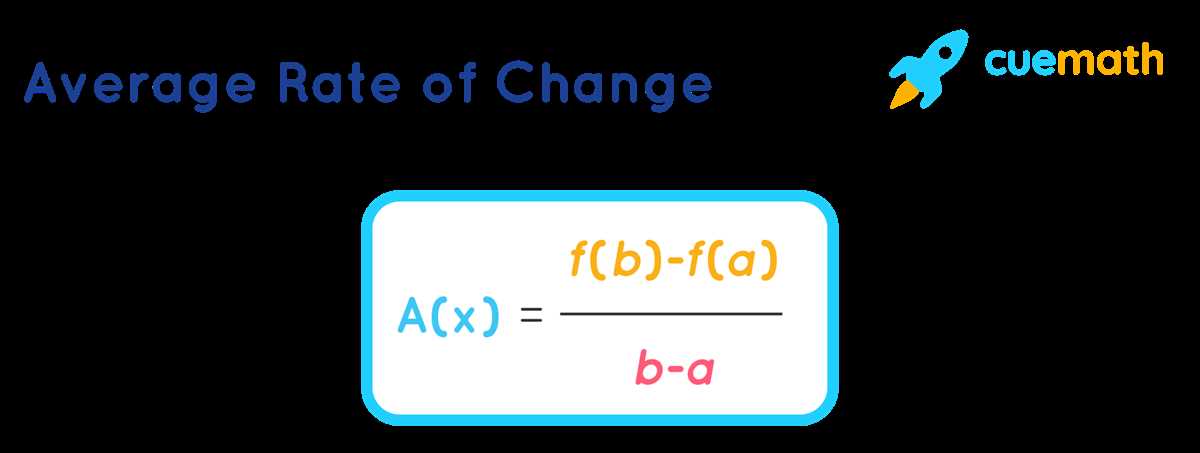
To calculate the change in a quantity over a specific interval, use the formula: Change in Value ÷ Time Interval. This formula allows you to determine how much a quantity increases or decreases per unit of time or space. It can be applied to various types of problems, whether it’s finding the speed of a moving object or determining the profit growth of a business.
Always ensure you correctly identify the start and end points of your interval. The numerator represents the difference between the final and initial values of the quantity in question. The denominator corresponds to the time or space interval during which the change occurs. Pay attention to units to avoid mismatches that can lead to incorrect results.
By mastering these calculations, you will be able to interpret data more accurately, whether in academic exercises or real-life situations like calculating the efficiency of a process or analyzing trends in business and science.
How to Calculate the Change Between Two Points
To determine the variation between two values, apply the following formula: Final Value – Initial Value divided by the Time or Distance Interval. This formula helps quantify how much a variable has shifted during a given period or over a specific range. It’s important to correctly identify the starting and ending points for accurate calculations.
Be sure to express both values in consistent units. If dealing with time, for example, both points should be in the same unit of time (seconds, minutes, hours, etc.). For spatial data, ensure the distance is measured using the same unit throughout. Double-checking unit consistency will help prevent errors in your calculation.
Once you’ve computed the change, this figure provides a clear understanding of how the variable behaves over the interval in question, whether it’s the speed of an object or the growth of a financial asset.
Understanding the Formula for Change Over Time
The formula for calculating how much a quantity varies over a given period is simple but effective. It is derived by dividing the difference between the final and initial values by the time or space interval. This is expressed as:
Change = (Final Value - Initial Value) / (End Time - Start Time)To apply this formula correctly, follow these steps:
- Final Value: The value at the end of the observation period (e.g., final temperature, position, or cost).
- Initial Value: The value at the beginning of the observation period.
- End Time or Distance: The point at which the final value is measured (e.g., time, distance).
- Start Time or Distance: The point at which the initial value is measured.
This formula provides insight into how a variable has evolved over a specified period. Whether tracking movement, growth, or any other change, the result shows the amount of change per unit of time or distance.
When using this formula, ensure that both the values and the intervals use the same units. This guarantees the result is meaningful and accurate. For example, if measuring speed, use consistent units for distance and time, such as meters and seconds, to get a valid calculation.
Identifying Variables in Rate of Change Calculations
To calculate how a quantity shifts over time or another variable, it’s critical to properly identify the relevant variables. These are the key factors that influence the result of your calculations.
| Variable | Description |
|---|---|
| Final Value | The measurement or amount at the end of the observed period. |
| Initial Value | The measurement or amount at the start of the observed period. |
| Time Interval | The period over which the measurement is observed. |
| Distance or Other Units | The space, length, or other measurable unit over which the change occurs. |
| Difference Between Values | The difference between the final value and the initial value (final value minus initial value). |
Identifying these variables correctly ensures that the calculation reflects the true relationship between the two quantities being compared. For example, in velocity calculations, identifying the distance traveled and the time taken is crucial for accurate results.
Step-by-Step Guide to Solving Average Rate of Change Problems
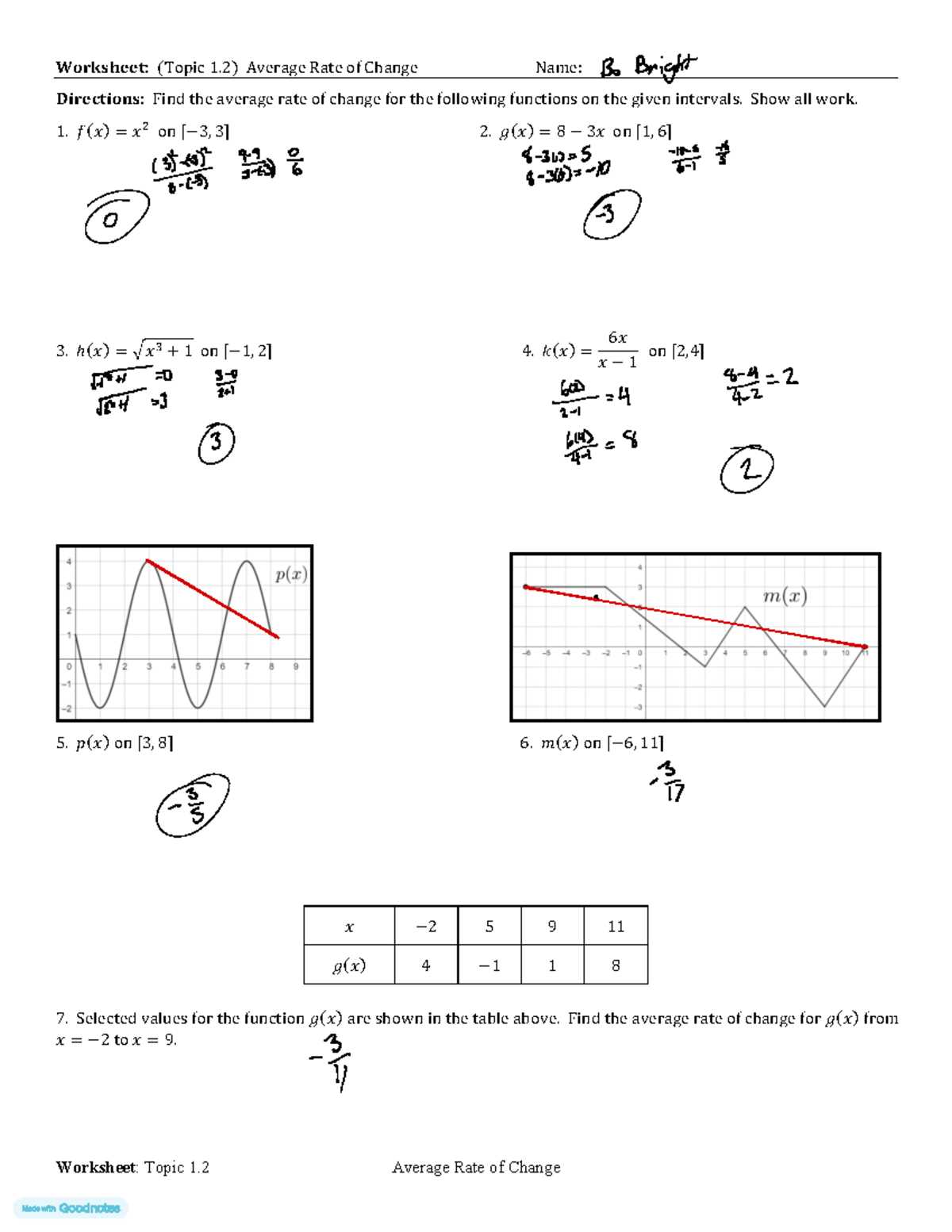
Step 1: Identify the initial and final values. These are the two measurements at the start and end of the interval you’re considering.
Step 2: Calculate the difference between the final and initial values. This gives you the total difference in the quantity you’re measuring.
Step 3: Determine the interval over which the change occurred. This could be time, distance, or any other relevant measurement.
Step 4: Divide the difference in values by the interval. This calculation provides the rate of variation per unit of the interval.
Step 5: Interpret the result. The value obtained represents how much the quantity has shifted per unit of the interval, giving you insight into the behavior of the measured entity.
For example, if you’re analyzing how the temperature has fluctuated over a period, you subtract the initial temperature from the final one and divide by the time difference.
Common Mistakes to Avoid in Rate of Change Calculations
1. Incorrect Interval Selection: Ensure that the time or spatial intervals are correctly identified. Using incorrect intervals can lead to misleading results and incorrect conclusions.
2. Mixing Up Starting and Ending Points: Double-check that the initial and final values are correctly assigned. Reversing them will yield incorrect values, affecting your calculation.
3. Wrong Subtraction Order: Always subtract the initial value from the final value. Swapping this order can result in inaccurate, and often misleading, calculations.
4. Not Taking Units into Account: Pay attention to the units used for both the values and the intervals. Using inconsistent or incompatible units can distort the outcome.
5. Ignoring the Units in the Final Answer: After calculating the difference, ensure you include the correct units for the result. For example, a result could be “miles per hour” or “degrees per minute,” depending on the context.
6. Overlooking Large or Small Intervals: When working with very large or small intervals, be careful of rounding errors or misunderstandings regarding the scale of the result.
Interpreting the Results of an Average Rate of Change Calculation
1. Positive Result: A positive result indicates an increase in the dependent variable as the independent variable increases. This means the quantity is growing over the interval.
2. Negative Result: A negative result means the dependent variable is decreasing as the independent variable increases. The value suggests a decline over the interval.
3. Zero Result: A result of zero indicates no change in the dependent variable between the two points. This suggests that the quantity remained constant throughout the interval.
4. Magnitude: The magnitude of the calculated value shows how much the dependent variable changes in response to the independent variable. Larger values reflect a greater degree of change, while smaller values suggest less change.
5. Units of Measurement: Always consider the units associated with the result. For example, “miles per hour” suggests distance traveled over time, while “dollars per unit” reflects financial change per item.
6. Contextual Understanding: To interpret the result accurately, relate it to the real-world context. For example, a positive change in temperature could indicate warming, while a negative change in price could signify a decrease in cost.
Real-World Applications of Average Rate of Change
1. Speed Calculations: In transportation, the calculation of how fast an object is moving over time is a direct application of this concept. For instance, determining the speed of a car on a trip involves measuring the distance traveled over a specific time period.
2. Financial Analysis: In economics and finance, understanding the variation of stock prices, market trends, or inflation over time relies on measuring the change in value per unit of time. Investors use this information to predict future movements and make informed decisions.
3. Environmental Monitoring: In environmental science, calculating how temperature or pollution levels change over time is crucial for understanding climate trends. For example, scientists calculate the increase in average global temperatures year-over-year to analyze the effects of climate change.
4. Medical Studies: In healthcare, the growth rate of a population of cells, the progression of a disease, or the effectiveness of a treatment over time is commonly analyzed using this method. Doctors use these calculations to assess treatment efficacy and predict patient outcomes.
5. Business Performance: Companies calculate sales growth, revenue increase, or profit margins over different periods to track performance. Understanding how these factors evolve helps businesses make strategic decisions regarding budgeting, marketing, and staffing.
6. Manufacturing Efficiency: In manufacturing, the output of goods per hour or the reduction in waste over time can be calculated using this method. Manufacturers rely on these metrics to optimize processes, improve productivity, and reduce costs.
How to Calculate Average Rate of Change for Linear Functions
To calculate the change in a linear function over a given interval, follow these steps:
- Identify the two points: Choose two points on the line, labeled as (x1, y1) and (x2, y2). These represent the x- and y-values at two distinct positions on the line.
- Calculate the difference in y-values: Subtract the y-coordinate of the first point from the y-coordinate of the second point: (y2 – y1).
- Calculate the difference in x-values: Subtract the x-coordinate of the first point from the x-coordinate of the second point: (x2 – x1).
- Divide the differences: Divide the difference in y-values by the difference in x-values: (y2 – y1) / (x2 – x1). This will give you the slope, which is the desired value.
This formula will provide the rate at which the y-value changes as the x-value increases between the two points. For linear functions, this value remains constant throughout the function’s domain.
For a more detailed explanation, you can visit Khan Academy’s Slope Article.
Advanced Examples of Calculations for Changes Between Points
To find how much one quantity shifts between two points, follow these steps:
- Identify the initial and final values. Let’s say we have a function f(x), and the interval spans from x = a to x = b.
- Calculate the difference in the function values: f(b) – f(a).
- Divide this difference by the difference in x-values: b – a.
Here’s a concrete example:
Let’s consider the function f(x) = x², and we want to find the shift from x = 1 to x = 4.
- At x = 1, f(1) = 1² = 1.
- At x = 4, f(4) = 4² = 16.
- Now, the change in the function’s output is 16 – 1 = 15.
- The difference in x-values is 4 – 1 = 3.
- Now, divide the change in output by the change in x: 15 / 3 = 5.
In this case, the difference between the points is 5 units per unit of x.
Another example involves a real-world scenario: a car’s speed. Suppose a car’s position is given by the function s(t) = 2t³ – 5t² + 3t. If we want to know how the position shifts between t = 2 and t = 5:
- At t = 2, s(2) = 2(2)³ – 5(2)² + 3(2) = 16 – 20 + 6 = 2.
- At t = 5, s(5) = 2(5)³ – 5(5)² + 3(5) = 250 – 125 + 15 = 140.
- Now, subtract the initial position from the final position: 140 – 2 = 138.
- The time difference is 5 – 2 = 3.
- Finally, divide the position difference by the time difference: 138 / 3 = 46.
So, in this example, the car’s position shifts by 46 units per time unit.
For functions that are non-linear, like quadratic or cubic functions, follow the same method but be prepared for more complex calculations. In some cases, you may need to break the problem down into smaller intervals for better accuracy, especially if the function behaves irregularly over time.
For advanced calculations, ensure that your approach is systematic: always start by isolating the values for your specific interval, then compute the differences. This method can be applied to both theoretical and real-world problems, from physics to economics.