Converting Fractions to Decimals Worksheet Solutions and Guide
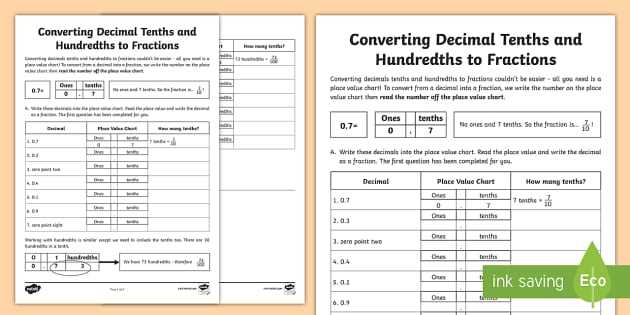
To efficiently switch between different numeric formats, practice using long division is key. Start with the simple step of dividing the numerator by the denominator. This process will give you a clearer understanding of how to perform these calculations accurately.
It’s important to first simplify any numbers if possible. Reducing the numerator and denominator helps make the conversion process quicker and easier. This not only streamlines the math but also ensures fewer errors when calculating the final result.
Another useful tip is to recognize repeating decimals. These often occur when dividing numbers that don’t have an exact whole number result. Identifying these patterns early helps avoid confusion and unnecessary steps in your calculations.
Consistency is key in mastering these conversions. Practicing regularly with various examples will reinforce your understanding and improve accuracy. For best results, use a variety of examples and challenge yourself with different difficulty levels.
Understanding the Basics of Fractions and Decimals
To fully grasp numeric conversions, it’s important to understand how each format represents parts of a whole. A fraction consists of two numbers: a numerator and a denominator. The numerator represents how many parts we have, while the denominator indicates how many equal parts the whole is divided into. For example, 3/4 means 3 parts out of 4.
On the other hand, a decimal format expresses parts of a whole using place values after the decimal point. The number to the left of the decimal point is the whole number, and the digits to the right represent fractional parts based on powers of 10. For instance, 0.75 is the decimal equivalent of the fraction 3/4.
Recognizing the relationship between these two forms is crucial. Converting from one to the other involves mathematical operations, with long division often being the most straightforward method. Understanding this connection is fundamental to mastering numeric transformations efficiently.
Step-by-Step Process for Converting a Fraction to a Decimal
Begin by dividing the numerator by the denominator. This can be done using long division. For example, if you are working with 3/4, divide 3 by 4. Set up the division so that the numerator is inside the division bracket and the denominator is outside.
Next, perform the division. If the numerator does not divide evenly, add a decimal point to the quotient and continue the division. For example, 3 divided by 4 gives 0.75. Keep dividing until you reach the desired level of precision, such as two decimal places.
If you encounter a repeating decimal, indicate the repeating part with a bar notation (e.g., 0.333… becomes 0.3̅). This indicates that the digit repeats indefinitely.
Finally, check the result by multiplying the decimal back by the denominator to confirm it equals the original numerator. This ensures accuracy in the conversion.
Common Mistakes to Avoid When Changing a Fraction to a Decimal
One common mistake is forgetting to add the decimal point when performing the division. Always ensure the decimal is placed correctly to avoid incorrect results.
Another mistake is stopping the division too early. If the division does not end neatly, you should continue adding decimal places until you reach the desired level of accuracy.
Be cautious with repeating decimals. It’s important to either round them appropriately or use notation (such as a bar) to indicate that the number repeats indefinitely.
Finally, avoid multiplying the decimal by the wrong factor when checking your work. Ensure the decimal is multiplied by the denominator, not the numerator, to verify accuracy.
How to Simplify Numbers Before Moving to Decimal Form
Before changing a number to its decimal equivalent, always check if it can be simplified. A smaller number makes the process easier and faster.
Follow these steps to simplify a number:
- Find the greatest common divisor (GCD) of the two numbers in the fraction.
- Divide both the numerator and the denominator by the GCD.
- Check if the new fraction is easier to work with, or if it reduces further.
For example, simplifying 6/8 to 3/4 reduces the division process when turning it into a decimal.
Once the fraction is simplified, you can proceed with division, resulting in a more accurate and manageable decimal.
For more detailed steps on simplifying and working with fractions, refer to the educational materials on Khan Academy.
Using Division to Change Numbers into Decimal Form
To transform a fraction into a decimal, divide the numerator (the top number) by the denominator (the bottom number). This simple division process will give you the decimal equivalent.
Follow these steps:
- Write the fraction as a division problem (numerator ÷ denominator).
- Perform the division using long division or a calculator to get the decimal value.
- If the result is repeating, round the decimal to the desired number of places.
For example, to convert 3/4 into a decimal, divide 3 by 4. The result is 0.75.
This method is the most straightforward and commonly used technique to change a fraction into a decimal form quickly and accurately.
Real-Life Applications of Ratios and Decimal Values
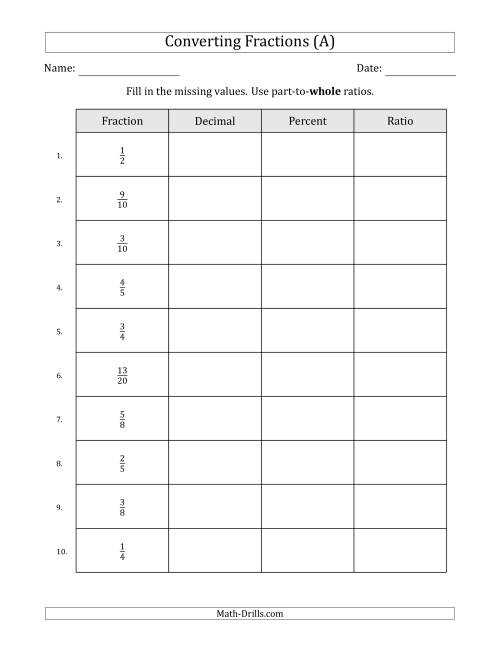
Understanding how to work with ratios and their decimal equivalents plays a significant role in everyday situations. Whether shopping, cooking, or calculating distances, these numerical concepts are crucial.
Here are some practical examples:
- Shopping and Discounts: When a store offers a 25% discount, you calculate the new price by converting 25% into a decimal (0.25) and multiplying by the original price.
- Cooking Measurements: Recipes often require specific proportions, such as 3/4 cup. Converting this into decimal form (0.75) helps when using measuring cups with decimal markings.
- Travel and Distance: Calculating fuel efficiency often involves decimals. For instance, if a car runs 12 miles per gallon, it can be converted to 12.0 mpg for clarity in tracking fuel usage.
- Finance and Budgeting: Understanding percentage increases in savings or investments involves turning percentages into decimal values for precise calculations (e.g., a 5% increase is 0.05).
In all these cases, knowing how to convert between fractions and decimal numbers simplifies calculations, making them more efficient and accurate.
How to Check Your Work After Conversion
After transforming a ratio or fraction into a numerical value, it’s crucial to verify your result for accuracy. Here’s how to do it effectively:
- Reverse the Process: If you started with a ratio, you can convert the resulting decimal back into a ratio to check if it matches the original one. For example, convert 0.75 back to 3/4 to confirm correctness.
- Use Estimation: Before performing the calculation, estimate the expected result. For example, 1/4 should convert to something around 0.25. If your result is far off, reassess the calculation.
- Cross-Check with a Calculator: A reliable calculator can provide an accurate result to verify your work. Input the numbers again to ensure your manual conversion aligns with the machine result.
- Compare with Real-World Examples: Check if your results make sense in practical situations. For instance, 1/2 should equal 0.5. If this doesn’t hold, it’s a sign something went wrong during the process.
By reversing the steps, estimating, using tools, and applying real-world logic, you can confidently confirm that your conversion process was accurate.
Additional Resources for Practicing Fraction to Decimal Conversions
To strengthen your skills, utilize the following resources to practice and refine your understanding:
- Khan Academy: Offers free lessons on mathematical operations and number conversions. Visit khanacademy.org for interactive exercises.
- IXL: Provides a wide range of exercises that allow you to practice ratios, proportions, and related concepts. Go to ixl.com for targeted practice.
- Mathway: A tool that helps with step-by-step solutions for mathematical problems, including division and simplification tasks. Check out mathway.com.
- Brilliant.org: Engage in interactive lessons and problem-solving for a deeper understanding of number systems. Visit brilliant.org.
- Wolfram Alpha: This computational engine offers accurate and fast solutions, showing both the process and result. Access it at wolframalpha.com.
Use these platforms to practice regularly and enhance your proficiency in transforming numbers from one format to another.