Cladogram Analysis and Construction Guide with Solutions
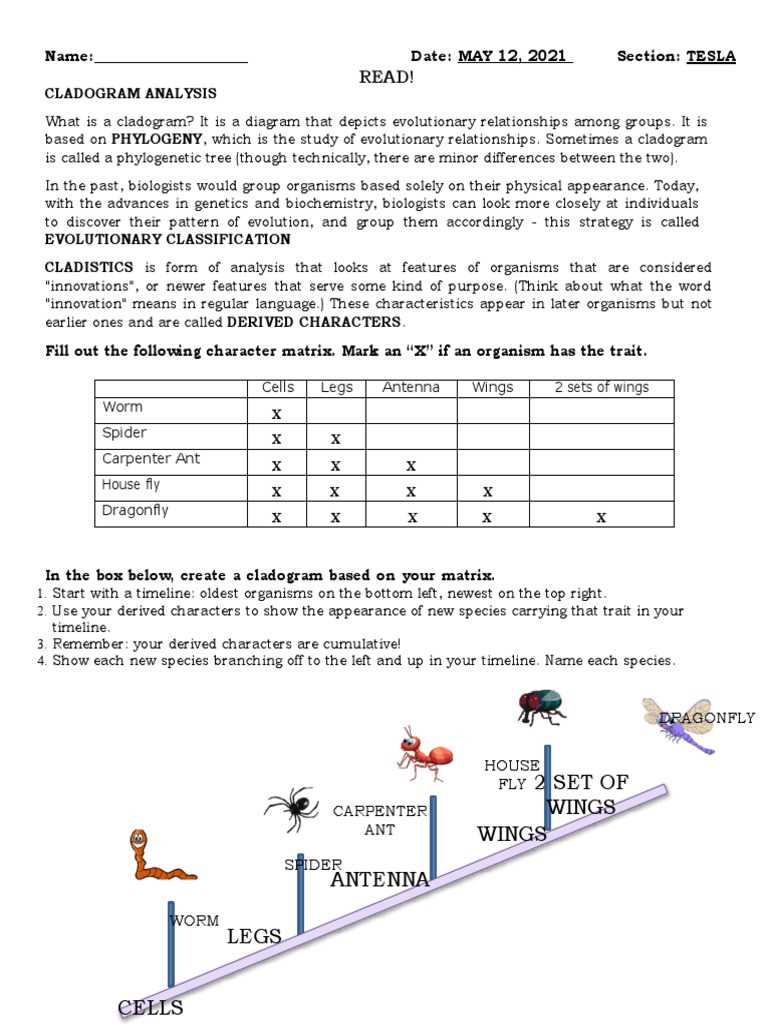
Begin with identifying shared characteristics across species. These traits, often molecular or morphological, form the basis for grouping organisms. Grouping begins with the most primitive or ancestral features, progressing toward more derived ones. Select the traits that best highlight evolutionary divergence and exclude those with minimal impact on branching.
The next step is to place the organisms on the diagram according to their shared characteristics. Focus on placing species with the least differences near each other. The branching structure should reflect these evolutionary relationships, with each node representing a common ancestor of the species that branch from it.
When connecting species to their common ancestors, be mindful of simplifying relationships. Using too many features or overly complex traits can cloud the interpretation. Instead, prioritize clarity and precision, ensuring that the tree represents the simplest evolutionary scenario. Consider revising your model when new data comes in, as even small adjustments can clarify or correct earlier assumptions.
Finally, evaluate the accuracy of your tree by comparing it with known phylogenies. Verify that your branches align with established evolutionary patterns or scientific consensus. Regularly updating your methodology and data sources will refine the tree and improve its reliability as a tool for understanding organismal relationships.
Organizing Species Based on Evolutionary Relationships
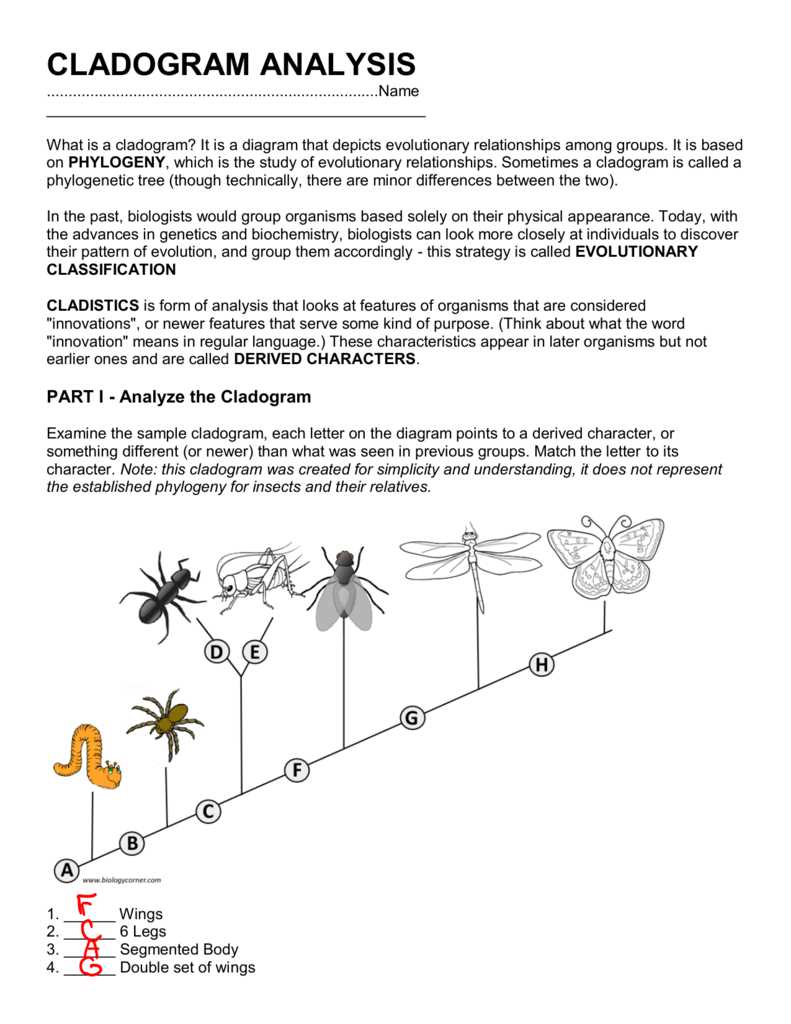
Begin by selecting relevant traits that exhibit variation across the organisms in question. These can include genetic markers or morphological features. Focus on characteristics that indicate evolutionary divergence rather than traits that may have converged independently.
Next, identify the shared characteristics and group the species according to the traits they possess in common. The goal is to arrange them into clusters that reflect evolutionary proximity. Use the simplest traits first to establish basic relationships, then move toward more complex traits as you refine the structure.
For clarity, focus on the following steps:
- Identify homologous traits that appear in multiple species, indicating a common ancestry.
- Place the species with the least differences near each other, representing more recent common ancestors.
- Group organisms based on derived characteristics, which are features that evolve after divergence.
When mapping the tree, ensure that each node represents a common ancestor of the organisms branching from it. Use branch points to indicate evolutionary splits, and avoid overlapping or redundant branches. The tree should reflect the simplest, most direct evolutionary path, minimizing assumptions.
Check the relationships against established phylogenies to ensure accuracy. Regularly revise your tree as new data becomes available or as new techniques in evolutionary biology offer improved understanding.
Understanding the Basics of Phylogenetic Trees: Key Principles
Begin by identifying homologous traits across species. These are characteristics that are inherited from a common ancestor, which help determine evolutionary relationships. Focus on traits that are consistent and can be measured, such as genetic sequences or morphological features.
The next step is to group species based on shared derived traits, known as synapomorphies. These traits distinguish a group from other species. Make sure to organize species into clades, where each clade represents a single branch stemming from a common ancestor.
Keep in mind the principle of parsimony. This means that the simplest explanation, requiring the fewest evolutionary changes, is often the most accurate representation of relationships. Avoid adding unnecessary complexities to the diagram.
Each branching point represents a common ancestor, which means that species diverged from this ancestor at different points in evolutionary time. The length of branches can indicate the amount of evolutionary change, although in some cases, the diagram may not include branch lengths.
As a final check, compare your diagram with known phylogenies. This will help verify if your tree reflects the actual evolutionary history of the organisms and ensure that the relationships make logical sense based on current scientific knowledge.
Steps for Constructing a Phylogenetic Tree from Genetic Data
Begin by selecting a set of species for which you have genetic data. The data should be in the form of DNA sequences or other molecular markers that can be compared across species.
Next, align the genetic sequences to ensure they are comparable. Use a sequence alignment tool to identify regions of similarity and differences in the data. This step is crucial for accurate comparison.
Once the sequences are aligned, identify the genetic differences (mutations or substitutions) that distinguish each species. Focus on loci that exhibit variability, as these will provide the most useful information for constructing evolutionary relationships.
Construct a matrix or data table to record the presence or absence of each genetic feature in every species. This matrix will serve as the basis for grouping species based on shared traits.
Use a method such as maximum parsimony, neighbor joining, or maximum likelihood to create the branching diagram. These methods apply different algorithms to determine the most likely evolutionary relationships based on the genetic data.
Verify the tree by comparing it to known phylogenetic models or using statistical methods like bootstrap analysis to test the robustness of the tree.
Finally, update the tree as new genetic data becomes available, ensuring that the evolutionary relationships remain accurate as more species or genetic information are included.
Identifying Common Ancestors in Phylogenetic Diagrams
To identify common ancestors, focus on the branching points, or nodes, where species diverge. Each node represents the most recent common ancestor shared by the species branching from it. The position of these nodes should correspond to points in evolutionary history where distinct lineages split off from a single lineage.
Examine the traits that define each branching point. These traits are shared by all species that branch from the node, helping to identify the evolutionary innovation that led to their divergence. Typically, the node represents the last common ancestor of the species grouped below it.
In some cases, outgroup species are used to identify the root of the diagram. The outgroup is the species that is least closely related to the others, helping to establish the baseline for the evolution of the entire group. This comparison clarifies which features are primitive and which are derived in the group under study.
Verify the common ancestors by reviewing genetic or morphological data. The species that share the most recent common ancestor should exhibit traits that align with the branching structure. Ensure that the tree reflects the simplest evolutionary path, minimizing unnecessary assumptions about relationships.
Review known evolutionary models to confirm the positioning of ancestors. Established phylogenies can provide a reference point for accurate placement of nodes, ensuring the tree is consistent with current scientific understanding.
Choosing the Correct Traits for Cladistic Grouping
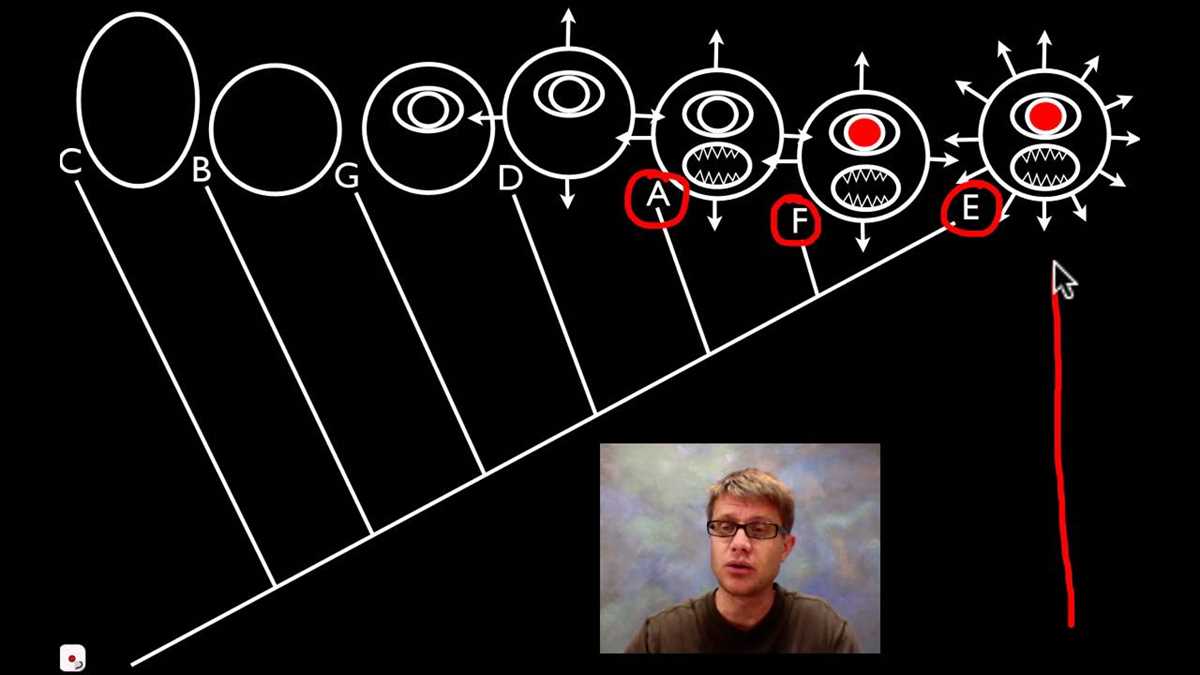
Select traits that are both variable and heritable. Traits must differ across the species you are studying while being consistent enough to trace their evolutionary origin. Focus on those that show clear genetic or morphological changes, such as nucleotide substitutions or distinct physical features.
Avoid using traits that are too widespread or convergent across different lineages. These traits can obscure evolutionary relationships rather than clarify them. Instead, choose features that evolved after lineages diverged, as these will be more useful in defining branches.
Use both primitive (ancestral) and derived (evolved) traits to create a balance between general and specific characteristics. Primitive traits appear early in evolutionary history and are shared by many groups, while derived traits are more specific and reflect recent changes.
Below is an example of how to categorize traits for evolutionary grouping:
| Trait | Primitive (Ancestral) | Derived (Evolved) |
|---|---|---|
| Body Size | Small | Large |
| Wing Structure | Absent | Present |
| Leaf Type | Simple | Compound |
Ensure that selected traits are comparable across all species in your dataset. Inconsistent data may lead to misleading relationships. Validate your choices by checking how these traits align with known evolutionary patterns or genetic studies.
Common Mistakes in Phylogenetic Tree Construction and How to Avoid Them
1. Using Homoplasy Instead of Homology: One common mistake is confusing traits that evolved independently (homoplasy) with those inherited from a common ancestor (homology). Always verify that the traits you’re using reflect true evolutionary relationships. Focus on genetic data or clearly defined morphological features to avoid misinterpretation.
2. Overcomplicating the Tree: Adding too many traits can result in a cluttered, difficult-to-interpret diagram. Stick to a manageable number of characteristics, prioritizing those that reveal the most significant evolutionary changes. Simple, well-defined traits often provide the clearest insights.
3. Misplacing Outgroups: The outgroup is crucial for determining the root of the tree. If the outgroup is not correctly placed, it can distort the entire structure of the diagram. Ensure that the outgroup is properly chosen based on the species that is most distantly related to the others in your study.
4. Not Considering Convergent Evolution: Convergent evolution occurs when unrelated species develop similar traits due to similar environmental pressures, not shared ancestry. Always be cautious when using traits that might have evolved independently in separate lineages, as these can mislead the tree’s structure.
5. Ignoring Statistical Validation: Not using statistical methods to validate the tree’s structure is a mistake. Use techniques like bootstrap analysis to test the robustness of your tree. This will help ensure that your conclusions are reliable and not based on random patterns in the data.
6. Misinterpreting Branch Lengths: If your tree includes branch lengths, ensure they reflect actual evolutionary distances. Some methods use branch lengths to indicate the number of genetic changes, while others may only show branching order. Clarify what the branch lengths represent to avoid confusion.
7. Neglecting to Update with New Data: Evolutionary relationships can change as more data becomes available. Regularly update your tree with new genetic or morphological information to keep it accurate and reflective of the latest scientific findings.
Interpreting Phylogenetic Trees: What the Branches Represent
Each branch in a phylogenetic diagram represents a lineage, showing how species or groups are related through shared ancestry. The branching points, or nodes, indicate where species diverged from a common ancestor, with each subsequent branch pointing to a different evolutionary pathway.
The length of a branch can indicate the amount of evolutionary change that has occurred, though this is not always the case. In some trees, branch length is used to show genetic differences, while in others, it simply illustrates the relationship between species without reflecting the degree of divergence.
Branches connecting species at the tips of the tree represent current or extinct species, while internal branches reflect past divergences between ancestors. The further apart two species are on the tree, the more distantly related they are.
Nodes represent common ancestors, and each node marks a point where a lineage split into two or more distinct groups. The species emerging from the same node share a recent common ancestor, while species that diverged earlier in the tree have more distant shared ancestors.
When interpreting the tree, consider that the order of branches matters. It indicates the sequence of divergence, with the most recent splits occurring near the tips of the tree. This sequencing helps identify evolutionary trends and patterns.
Comparing Different Methods of Phylogenetic Tree Construction
Maximum Parsimony: This method focuses on minimizing the number of evolutionary changes, assuming that the simplest explanation is most likely. It is ideal for small datasets where trait changes are easily observed. However, it can become inaccurate when evolutionary changes are too complex or when convergent evolution occurs frequently.
Neighbor-Joining: This method builds a tree based on genetic distance, grouping species with the smallest differences. It is fast and efficient, making it suitable for large datasets. However, it may not always produce the most accurate tree because it does not consider evolutionary history beyond genetic distances.
Maximum Likelihood: This technique evaluates the probability of a tree’s structure given specific models of evolution. It is more statistically robust and often provides more accurate trees, especially when dealing with large and complex datasets. The downside is that it is computationally intensive and requires a well-defined model of evolution.
Bayesian Inference: Similar to maximum likelihood but using Bayesian statistics to estimate the probability of different tree configurations. It is highly accurate and useful for complex datasets, but like maximum likelihood, it can be computationally demanding. It also requires prior knowledge about evolutionary models to be effective.
UPGMA (Unweighted Pair Group Method with Arithmetic Mean): A simpler method that assumes a constant rate of evolution across all lineages. While it is easy to implement and quick, it can lead to inaccurate results if the rate of evolution varies significantly between species.
Choose a method based on your dataset’s size, complexity, and the accuracy required. For smaller datasets, maximum parsimony may be sufficient, while larger datasets with complex evolutionary histories may benefit from maximum likelihood or Bayesian inference. Always validate your results with external data or statistical support to ensure reliability.
Practical Applications of Phylogenetic Tree Construction in Evolutionary Studies
Phylogenetic trees are widely used to trace evolutionary histories and understand the relationships between different species. They help identify common ancestors and reconstruct the lineage of species, allowing researchers to track the evolution of traits over time.
One key application is in the study of biodiversity. By mapping the evolutionary relationships of species, scientists can assess how species have adapted to different environments and how these adaptations contribute to survival. This is particularly useful in conservation biology, where understanding evolutionary relationships helps prioritize species for protection.
Another practical use is in the investigation of disease evolution, particularly with viruses and bacteria. By constructing phylogenetic trees, researchers can track the origin and spread of infectious diseases, as seen with the ongoing studies of SARS-CoV-2 (COVID-19). This allows for a better understanding of how pathogens evolve, how they spread across populations, and how new strains emerge.
Additionally, these trees are crucial in understanding the genetic basis of diseases. By comparing the genetic makeup of different species, scientists can identify conserved genes and evolutionary changes that may be linked to specific traits or health conditions. This is important for advancing personalized medicine and targeted treatments.
For more information on how phylogenetic methods are applied in modern biology, you can refer to the latest research published by the National Center for Biotechnology Information (NCBI), which provides access to peer-reviewed studies and databases relevant to these topics.