Step by Step Solutions for Chapter 4 Demand and Elasticity Worksheet
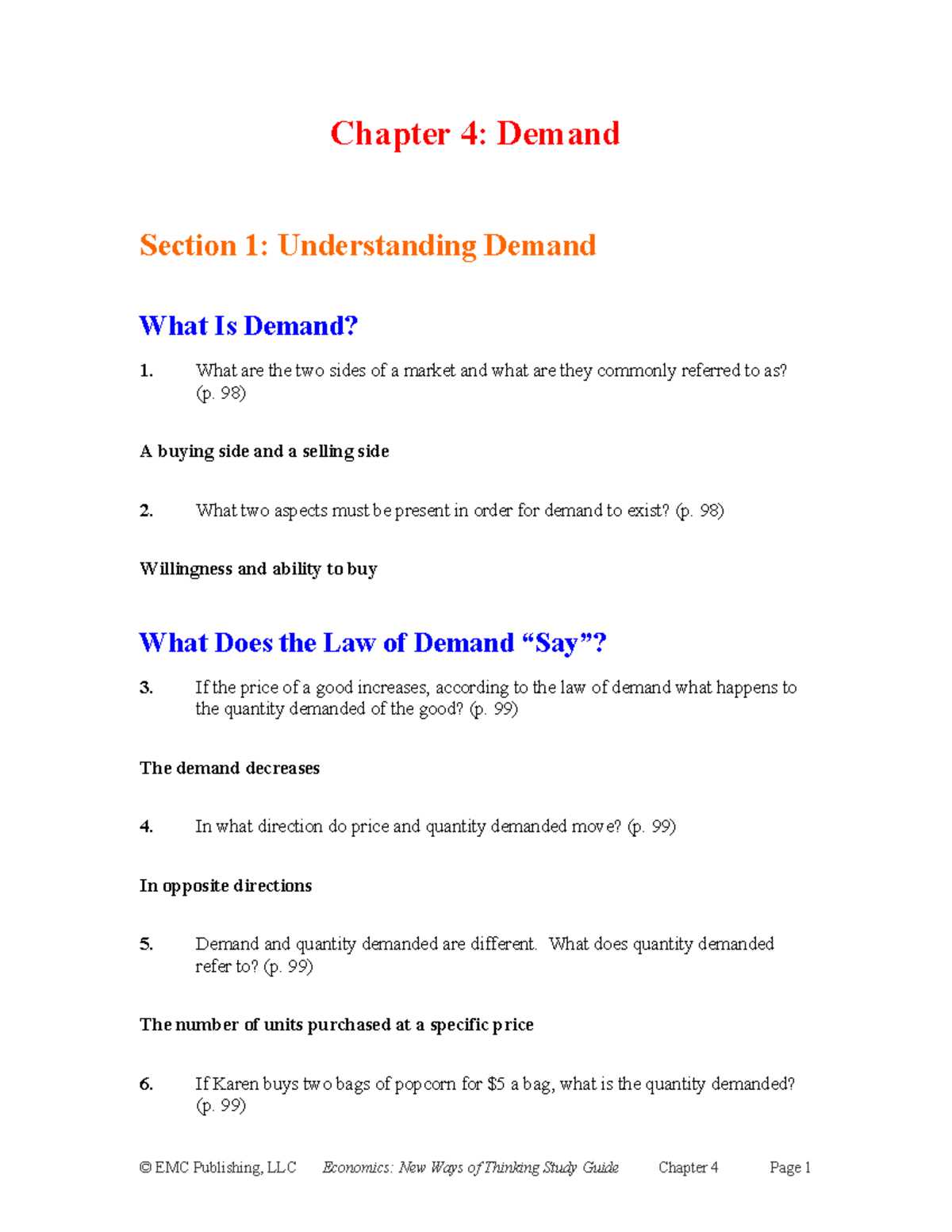
Use the percentage change formula to determine how buyers respond to price fluctuations. Focus on calculating the ratio of change in quantity purchased to change in cost for each product scenario. Maintain precise decimal values to avoid cumulative errors in multi-step calculations.
Analyze how shifts in consumer income affect spending patterns. Apply the income variation ratio to compare basic goods versus luxury items. Track proportional changes to identify which products exhibit stronger responsiveness to financial shifts.
Cross-compare related goods to detect substitution or complement effects. Evaluate pairs of items to calculate interdependence in consumption. Highlight positive or negative correlations and interpret the numerical results for practical decision-making.
Use graphical representations to visualize sensitivity trends. Plot each scenario on a coordinate grid to see how quantity purchased reacts to varying costs. Identify linear versus nonlinear patterns for more accurate predictions in future exercises.
Double-check all computations against typical errors such as sign misplacement or incorrect ratios. Maintain a structured table for inputs and outputs to ensure each step aligns with the formula logic. This approach reduces mistakes and reinforces conceptual understanding.
Detailed Solutions for Chapter 4 Demand Sensitivity Problems
Calculate price–responsiveness using the standard formula:
Elasticity = (% change in quantity)/( % change in price). For example, if quantity falls from 200 to 180 when price rises from $10 to $12, then ΔQ/Q = –20/200 = –0.10, ΔP/P = 2/10 = 0.20, so elasticity = –0.10 ÷ 0.20 = –0.5 (inelastic).
Interpret sensitivity categories:
Use absolute values to classify responsiveness. |e| > 1 means highly responsive, |e|
Work through each exercise’s income‑response section:
Apply the income variation formula similar to price elasticity. For example, if income increases by 5% and quantity by 10%, income responsiveness = 10%/5% = 2, indicating a luxury-type change.
Verify cross‑good interactions:
Spot whether goods are substitutes or complements by computing cross sensitivity. If an increase in price of one good reduces demand for another, negative cross‑sensitivity confirms complementarity.
Use revenue implications:
Relate sensitivity to total income changes. If elasticity is less than 1, raising price may boost total income; if greater than 1, a price drop could increase overall intake. This aligns with the total revenue test. :contentReference[oaicite:1]{index=1}
Double-check with formal elasticity definitions:
Refer to established economics sources to confirm your method and calculations. :contentReference[oaicite:2]{index=2}
Highlight common calculation pitfalls:
Watch for sign errors, incorrect base values for percentage change, or misuse of mid‑point versus point formulas.
Create graphs when needed:
Plot price versus demand to visualize responsive versus rigid demand. This can help clarify when elasticity values change across price ranges.
::contentReference[oaicite:3]{index=3}
Calculating Price Sensitivity for Various Goods
Use the standard formula:
Price responsiveness = (% change in quantity) ÷ (% change in price). For example, if sales drop from 150 to 120 units when price rises from $8 to $10, ΔQ/Q = –30/150 = –0.2, ΔP/P = 2/8 = 0.25, so sensitivity = –0.2 ÷ 0.25 = –0.8, indicating inelastic response.
Compare multiple products:
Apply the same formula to different items to identify which goods react strongly to price changes and which remain relatively stable. For instance, luxury items often exceed 1 in absolute value, whereas necessities tend to be below 1.
Consider mid-point calculation for accuracy:
Use the average of initial and final quantities and prices to reduce bias. For the previous example, Q avg = (150+120)/2 = 135, P avg = (8+10)/2 = 9, giving ΔQ/Q avg = –30/135 ≈ –0.222, ΔP/P avg = 2/9 ≈ 0.222, so elasticity ≈ –1, showing unit response.
Analyze results by category:
Group products into categories such as essentials, luxuries, or substitutes. Identify trends, for example, staple foods often show inelastic responses while non-essential electronics show high sensitivity.
Document calculations systematically:
Maintain tables with columns for initial quantity, final quantity, initial price, final price, percent changes, and computed sensitivity. This helps track differences across products and avoids miscalculations.
Interpret impact on revenue:
For inelastic products, increasing price may increase total revenue, while for elastic products, lowering price can boost overall sales. Graphical representation of price vs quantity helps visualize these patterns.
Verify with authoritative sources:
Confirm methodology and standard formulas with economics references such as [Investopedia](https://www.investopedia.com/terms/p/priceelasticity.asp).
Analyzing Income Sensitivity on Consumer Choices
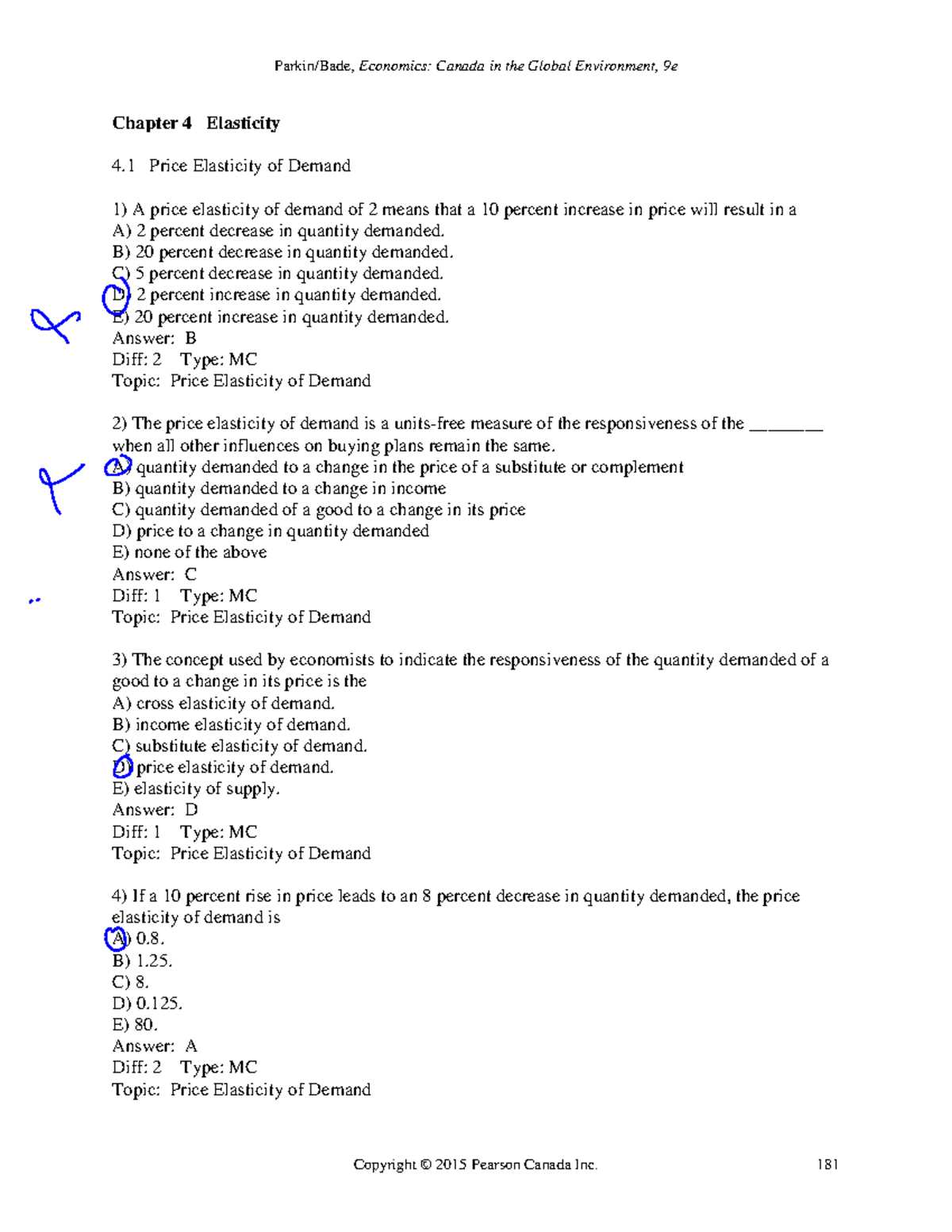
Calculate responsiveness: Use the formula income sensitivity = (% change in quantity purchased) ÷ (% change in consumer income). For instance, if purchases rise from 80 to 100 units after a $2000 to $2500 income increase, ΔQ/Q = 20/80 = 0.25, ΔI/I = 500/2000 = 0.25, so sensitivity = 1, indicating proportional response.
Classify products: Positive sensitivity above 1 indicates luxury items, while 0–1 shows normal necessities. Negative values indicate inferior goods where consumption decreases as income rises.
Compare across demographics: Measure income responsiveness for different consumer groups to identify which segments adjust spending more rapidly. Younger households may respond differently than older households for the same product category.
Track trends over time: Record income changes and corresponding consumption variations monthly or quarterly. This allows identification of patterns for long-term forecasting and inventory planning.
Integrate with pricing strategies: Combine income sensitivity data with price responsiveness to predict total revenue changes when both income and prices shift simultaneously. High sensitivity items may tolerate higher price fluctuations when income grows.
Document calculations systematically: Maintain tables with columns for initial quantity, final quantity, initial income, final income, percent changes, and computed sensitivity. This ensures clarity and reduces errors.
Reference authoritative sources: Verify methodology and examples with reputable economics resources such as Investopedia on income responsiveness.
Cross Sensitivity Between Complementary and Substitute Products
Measure responsiveness: Apply the cross sensitivity formula = (% change in quantity of Product A) ÷ (% change in price of Product B). For example, if sales of coffee rise from 100 to 120 units when tea prices increase from $2 to $2.50, ΔQ/Q = 20/100 = 0.2, ΔP/P = 0.50/2 = 0.25, giving cross sensitivity = 0.8, indicating a moderate substitute relationship.
Identify product type: Positive values indicate substitutes, negative values indicate complements. Magnitude shows intensity of the relationship–values above 1 suggest strong substitution or strong complementary effect.
Segment analysis: Compare cross sensitivity across consumer groups to determine which segments are more likely to switch products based on relative price changes.
Track price fluctuations: Record historical pricing and sales data for related products to refine cross sensitivity calculations and anticipate market reactions.
Combine with own-price responsiveness: Use together with individual price sensitivity to forecast total revenue effects when multiple products change prices simultaneously.
Document systematically: Maintain tables with columns for initial and final quantities, price changes, percent changes, and calculated cross sensitivity for clarity and repeatable analysis.
Reference source: Consult authoritative resources such as Investopedia on cross responsiveness for methodology and examples.
Interpreting Responsiveness Values from Data Sets
Use each coefficient to determine how quantity reactions relate to price movements. A value above 1 signals strong sensitivity, below 1 signals limited reaction, equal to 1 signals proportional change.
To avoid misreading results, verify three elements:
- Sign: Positive values indicate a move in the same direction as price, negative values indicate opposite movement.
- Magnitude: Large absolute values reveal significant shifts in quantity, small values point to muted reactions.
- Context: Compare figures across distinct goods, time periods, or consumer segments for clearer interpretation.
When reviewing multi-row data, apply a consistent process:
- Check initial quantity, final quantity, initial price, final price.
- Convert each shift into a percent change using midpoint formulas.
- Divide quantity percent change by price percent change to obtain the responsiveness coefficient.
- Classify each coefficient using predefined thresholds that match your economic model.
For mixed goods categories, summarize results in a table with columns for percent shifts, coefficient values, classification tags, plus notes on market structure or income level if relevant.
Use official economic glossaries such as the Federal Reserve resource hub: https://www.federalreserve.gov/ for terminology guidance.
Identifying Factors That Influence Demand Sensitivity
Prioritize an evaluation of how buyers react to price shifts by isolating structural drivers within each market segment. Begin with product categorization, separating necessities from discretionary items, because the former typically shows muted quantity responses while the latter fluctuates sharply when costs rise.
Assess substitution options next. A broad pool of comparable goods increases responsiveness. Track competitor pricing, promotional cycles, feature changes, supply disruptions, and customer switching costs to determine how easily buyers migrate to alternatives.
Review income brackets across your target audience. Higher-income groups often preserve purchasing levels despite price variation, while lower-income groups reduce or postpone purchases quickly. To refine this assessment, map each good to income-sensitivity classes such as luxury, staple, or inferior.
Inspect purchase frequency patterns. Goods bought daily or weekly typically allow consumers to notice even small shifts in price, while infrequent purchases slow behavioral adjustments. Combine this with data on habit formation, brand loyalty strength, contract obligations, or bulk-buy behavior for additional clarity.
Check inventory flexibility from the buyer’s perspective. Products that can be stored for long periods trigger accelerated buying when prices fall and slower buying when prices rise. Perishable items offer less flexibility, reducing the amplitude of quantity response.
Integrate these variables into a structured matrix so each product receives a sensitivity score based on substitution breadth, income profile alignment, purchase timing, storability, and necessity level. This scoring system helps forecast future reactions with greater precision.
Applying Formulas to Solve Quantity and Price Changes
Use proportional-change equations to quantify how shifts in cost levels affect purchased volumes. Rely on midpoint calculations to avoid distortions that arise when using starting values only. This method provides stable ratios when both price and quantity vary across wide intervals.
Apply the midpoint structure as follows:
| Variable | Formula |
|---|---|
| ΔQ% | ((Q₂ − Q₁) / ((Q₂ + Q₁)/2)) × 100 |
| ΔP% | ((P₂ − P₁) / ((P₂ + P₁)/2)) × 100 |
Insert these two outputs into ratio-based models to evaluate how strongly quantity shifts relative to price adjustments. The midpoint approach prevents skewing that occurs when Q₁ or P₁ are very low or when the interval between starting and final values is large.
Check each data pair for consistency errors before calculating. Mismatched units, missing negatives for price reductions, or swapped time periods can distort the resulting ratio. Always verify whether Q₁ represents the earlier observation and confirm that P₂ aligns with the revised cost level.
Once processed, compare computed ratios across multiple products to identify which items exhibit sharper reactions. This comparison helps prioritize items that require closer monitoring during cost changes, promotional experiments, or supply adjustments.
Common Errors in Elasticity Calculations and How to Avoid Them
Verify that all price figures match the same units before computing ratios; mixing per-unit values with bulk prices produces distorted outcomes. Standardize every currency input to a single unit, such as cost per item, to prevent inconsistent percentage shifts.
Prevent sign mistakes by assigning negative values to price drops and positive values to increases. Many miscalculations stem from treating all changes as positive, which reverses the interpretation of how quantity responds to cost movements.
Avoid substituting initial values directly into percentage-change formulas without using midpoint structure. Relying solely on starting numbers inflates the result when values shift sharply. Midpoint ratios stabilize the calculation by balancing beginning and ending figures.
Check that Q₁ represents the earlier observation. Reversed quantity inputs create inverted ratios that misrepresent the intensity of consumer reaction. Always pair Q₁ with P₁ from the same time period and Q₂ with P₂ from the updated period.
Eliminate rounding too early. Truncating decimals before computing the final ratio leads to overly compressed results. Retain at least three decimal places until the final output, then round only the finished metric.
Using Graphs to Visualize Demand Responsiveness
Plot price on the vertical axis and quantity on the horizontal axis to highlight how steepness or flatness reflects sensitivity levels. A flatter curve signals a stronger reaction to cost shifts, while a steeper line indicates limited adjustment in purchasing activity.
Mark two clear points–(P₁, Q₁) and (P₂, Q₂)–to display how buyers respond to a specific price movement. Connecting these coordinates with a straight segment offers a quick view of whether the reaction is proportionate, minimal, or exaggerated.
Use separate lines for different product groups so variations are easy to compare. Contrasting a necessity profile with a luxury profile on one chart reveals which category shows sharper quantity shifts under identical cost adjustments.
Highlight midpoints between paired observations to support consistent interpretation. The midpoint visually demonstrates the average position between initial and revised data, reducing distortion caused by unbalanced changes in price or volume.
Integrate labels showing percentage shifts to reinforce numeric clarity. Displaying %ΔP next to the vertical change and %ΔQ next to the horizontal change helps identify whether the observed reaction is minor, moderate, or highly responsive.