Genotype practice worksheet solutions with clear allele pattern guides
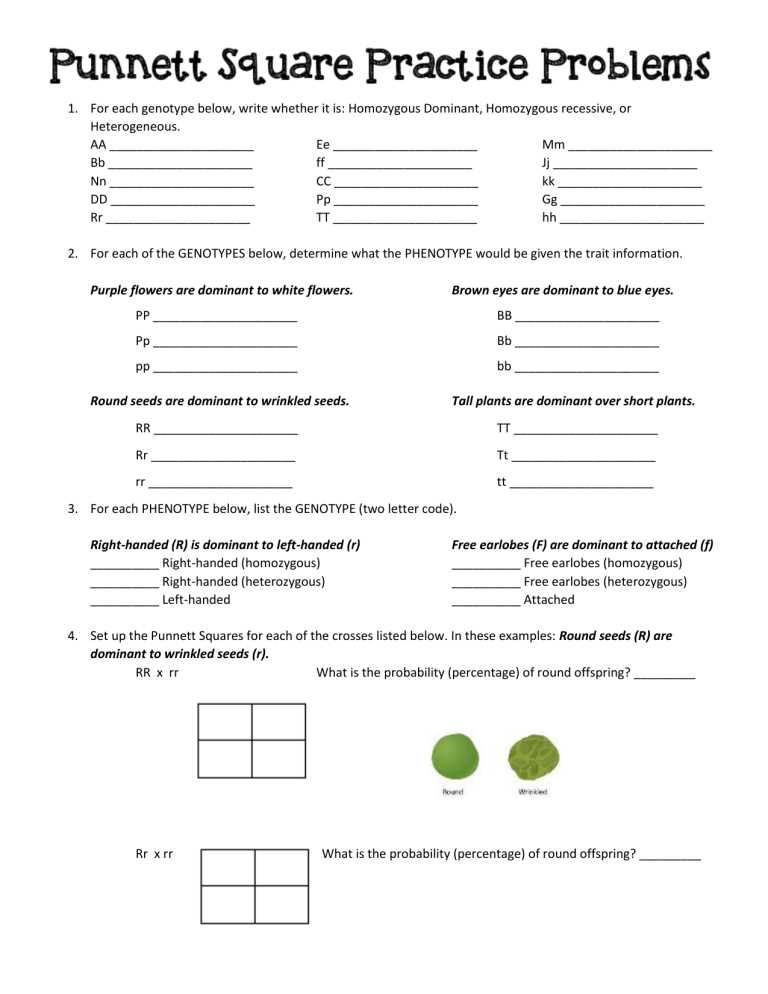
Review each heredity task by confirming allele labels first, ensuring that every symbol remains consistent across all crosses. This prevents mismatched traits and avoids ratio distortion in later steps.
Apply Punnett-square grids only after verifying parental pairs with clear dominance rules, such as A over a in a single-trait scenario. This keeps trait outcomes aligned with the original prompt and supports accurate phenotype checks.
Compare predicted offspring groups with standard Mendelian ratios such as 3:1 or 1:2:1. Any deviation signals arithmetic slips–often reversed parental placement, missing gametes, or duplicated boxes.
Validate multi-trait crosses by listing all gamete combinations explicitly. Use a structured list (AB, Ab, aB, ab) before drawing grids, ensuring no combination is skipped or repeated.
Punnett square setups used in monohybrid tasks
Confirm trait notation before drawing any grid, keeping dominant and recessive symbols consistent throughout all crosses, such as using A and a without substitution.
Place parental gametes along the top and left edges after listing them explicitly; for example, a pair with traits Aa × aa generates gametes A, a and a, a, ensuring no duplicated or missing entries.
Fill each cell by combining symbols from intersecting gametes in the same left-to-right order to prevent reversal errors that corrupt dominance checks.
Compare produced groups against expected ratios such as 1:1 for heterozygous × recessive tests; any mismatch typically indicates forgotten gametes or swapped parental alleles.
Interpreting allele symbols in worksheet prompts
Verify trait labeling by checking whether capital letters indicate dominant forms and lower-case letters indicate recessive forms, keeping each pair strictly matched.
- Confirm that every symbol corresponds to a single trait; avoid mixing letters such as B and D when only one feature is described.
- Check whether the prompt assigns phenotype descriptions directly beside each symbol, such as T = tall and t = short; treat these tags as fixed.
- Scan all provided parental sets to ensure there are no swapped or inverted symbols; mismatches often appear when a task lists Tt in one line and tT in another.
Apply consistent interpretation across all stages of a cross by following an ordered approach.
- Read the trait definition block and extract each symbol–phenotype mapping.
- Rewrite parental forms using the same order every time, such as dominant first.
- Generate gametes using the extracted mappings without introducing new letters.
Check ambiguous notations–such as superscripts or mixed letters–by comparing them to standard Mendelian codes; prompts that use IA and IB signal multiple-allele systems rather than simple two-letter sets.
Steps for tracking dominant–recessive inheritance patterns
Confirm trait definitions first by identifying which letter represents the dominant form and which indicates the recessive form, keeping the pair consistent through all stages of the task.
Create parental sets by placing the dominant symbol first, such as Tt rather than tT, ensuring uniform layout that reduces misreads during gamete generation.
Derive gametes by separating each parental pair into single-letter units; for example, Tt produces T and t, while tt yields two identical recessive copies. Maintain identical ordering across all gamete lists.
Fill a Punnett grid by distributing one parent’s gametes across the top and the other parent’s along the side, combining symbols cell by cell without altering their original case or meaning.
Translate each resulting pair into phenotype outcomes by applying the dominance rule: any combined form containing the dominant symbol expresses the dominant trait, whereas pairs containing only the recessive symbol express the recessive trait.
Validate interpretations by comparing them with established genetics guidelines available at https://www.genome.gov, which provides authoritative definitions of dominance patterns.
Checking genotype–phenotype matches in sample problems
Verify each allelic pair by confirming which symbol shows dominance; for example, any combination containing A outcompetes a and produces the dominant trait.
Scan each parental set for correct letter case: uppercase must denote the stronger variant, while lowercase designates the weaker form; mis-typed symbols distort trait predictions.
Compare every paired result from the grid with trait rules: AA and Aa yield the same outward feature, while aa produces the contrasting expression.
Check for internal consistency by ensuring that phenotypic labels match dominance logic; for instance, labeling Aa as recessive signals an error and must be corrected.
Validate final trait labels against reliable genetics references such as https://www.genome.gov, confirming that dominance patterns align with established definitions.
Error-spotting methods in student Punnett square work
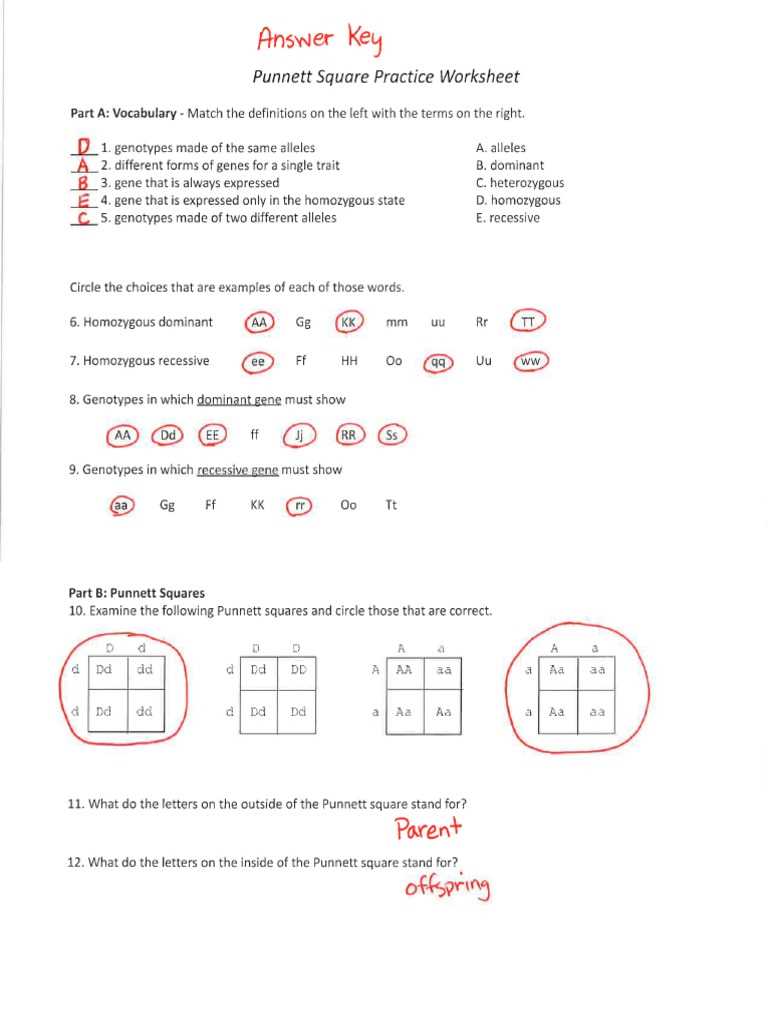
Check each grid by verifying that alleles from the top and side headers are transferred into every cell without skipping or swapping positions.
- Confirm that uppercase symbols are consistently used for dominant variants and lowercase for weaker variants; mixed or flipped cases indicate mistakes.
- Scan parental inputs for mismatched letters; crossed symbols (e.g., pairing B with a) disrupt trait predictions and must be corrected.
- Inspect every completed cell to ensure both inherited symbols appear; single-letter entries signal incomplete transfers.
- Compare all four cell outcomes to detect duplicate patterns caused by copying errors or misaligned headers.
- Review trait labels to ensure each allelic pair aligns with known dominance rules; mark any trait tag that contradicts allele hierarchy.
Use authoritative genetics resources such as https://www.ncbi.nlm.nih.gov to verify dominance conventions applied in each student grid.
Sample ratios applied to worksheet practice items
Assign ratios by comparing every outcome in the Punnett grid and grouping identical symbol pairs without omitting recessive combinations.
- Use a 1:2:1 pattern for single-trait crosses where one parent carries mixed symbols (e.g., Aa × Aa). Count each cell: one AA, two Aa, one aa.
- Apply a 3:1 trait ratio only after confirming that the dominant variant masks the recessive form in heterozygous results.
- For two-trait grids, sort each cell by paired outcomes and record the classic 9:3:3:1 distribution only if both parents carry mixed variants for both traits.
- Flag deviations if any row or column was copied incorrectly–imbalanced tallies such as 2:1:1 often signal header misalignment.
- Convert tallies into simplified fractions (e.g., 9/16 dominant–dominant, 3/16 dominant–recessive) to check whether your counts match expected proportions.
For reference on classical Mendelian ratios, consult Khan Academy Genetics.
Cross-checking multi-trait combinations in dihybrid tasks
Verify every cell by matching each gamete’s paired symbols without merging traits or shifting letter order.
- Generate all gametes explicitly by listing each parent’s two-trait symbol sets (e.g., AB, Ab, aB, ab) to avoid missing any combination.
- Confirm independence of traits by checking that each cell contains one symbol from each column header and one from each row header, preserving case exactly.
- Spot alignment errors by scanning rows for repeated patterns; identical sequences across an entire row often indicate a shifted header.
- Compare tallies with the 9:3:3:1 model only after ensuring both parents carry mixed alleles for both traits; any fixed symbol collapses expected ratios.
- Group outcomes by phenotype using explicit patterns such as A–B–, A–bb, aaB–, aabb to detect inconsistent dominance assignments.
- Mark improbable results such as four identical outcomes across diagonals, which often signal duplicated gamete lists.
Reliable explanations of dihybrid patterns can be reviewed at Khan Academy Genetics.
Verification approach for multi-step heredity calculations
Recheck each stage by isolating intermediate outputs and comparing them against fixed symbol rules before moving to the next operation.
Core checks:
| Stage | What to verify | Typical issue detected |
|---|---|---|
| Parental symbol sets | Confirm each trait pair contains one uppercase and one lowercase symbol only when heterozygosity is intended. | Accidental duplication (e.g., AA or aa used incorrectly) |
| Gamete listing | Check that each gamete includes exactly one symbol per trait. | Missing combinations or swapped positions |
| Grid assembly | Match every row–column merge without altering symbol order. | Reversed sequences or repeated cell entries |
| Trait grouping | Sort results by dominant vs. recessive expression using defined case rules. | Misclassified phenotypes |
| Ratio check | Compare final tallies with expected Mendelian proportions only if both parents supply mixed symbols. | Incorrect assumptions about trait segregation |
Cross-verify tallies by recalculating a small subset of cells; mismatches in these spot-checks usually indicate an earlier structural error.