Classkick guide for solving segment partition tasks with ratio methods
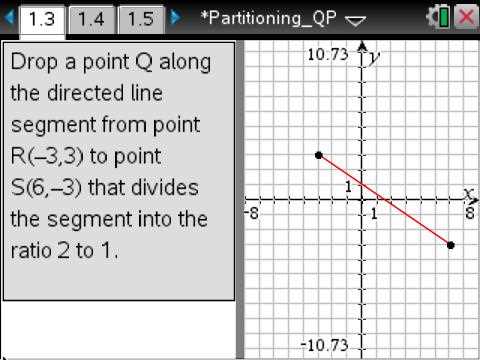
Verify ratio placement first by computing coordinates with the two-point weighted formula: ((1−r)·x₁ + r·x₂ , (1−r)·y₁ + r·y₂). This prevents mismatches between intended split values and plotted locations.
Use a written table of each r-value and its corresponding coordinate pair to avoid arithmetic slips. List entries as: weight, x-coordinate output, y-coordinate output, and confirmation through substitution.
Record each construction step directly inside the activity workspace so every plotted point, midpoint check, or ratio check remains traceable. This supports rechecking numeric choices without redoing all computations.
Workspace Guide on Dividing Line Portions
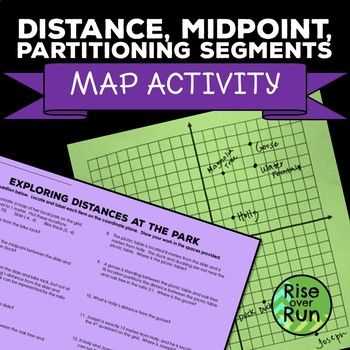
Verify each target point by applying the weighted pair formula ((1−r)·x₁ + r·x₂ , (1−r)·y₁ + r·y₂), ensuring all computed coordinates match the intended ratio.
- Insert both endpoints into a small numeric table to keep x- and y-values aligned.
- Check each ratio by substituting weights directly into the formula before plotting.
- Use consistent decimal precision, ideally to two places, to prevent drift in coordinate placement.
Organize your workspace entries so every computation remains visible while drawing. This reduces repeated calculations and highlights mismatches between calculated and drawn points.
- Note r-values in ascending order.
- Record coordinate outputs beside each r-value.
- Mark plotted points and label them to match table entries.
Ratio Selection Methods for Segment Division Tasks
Choose each proportion by aligning it with the coordinate gap between endpoints, ensuring the weight reflects the intended position along the line.
- Convert any integer-based split, such as 2:3 or 4:1, into fractional form r = a/(a+b) to streamline computations.
- Check whether the task requires an internal or external point; internal uses 0 < r < 1, external uses r < 0 or r > 1.
- For long horizontal or vertical spans, choose ratios that avoid unnecessary rounding–fractions like 1/4 or 3/5 minimize drift in plotted coordinates.
When multiple splits occur along a single line, structure all selected values in a clear progression to maintain consistent spacing.
- List chosen r-values in numeric order.
- Compute each coordinate using ((1−r)·x₁ + r·x₂ , (1−r)·y₁ + r·y₂).
- Label resulting points directly on your diagram to verify spacing alignment.
Stepwise Setup for Midpoint and Trisection Problems
Compute a midpoint by applying ((x₁ + x₂) / 2, (y₁ + y₂) / 2) directly to the coordinate pair you are given, ensuring both axes follow the same operation.
For any three-way split, convert the process into two ratios: r₁ = 1/3 and r₂ = 2/3. Use each value separately in the weighted formula ((1 − r)·x₁ + r·x₂ , (1 − r)·y₁ + r·y₂) to generate both interior points.
When verifying the locations, measure each horizontal and vertical difference: confirm that each interval equals one-third of the original span. If fractional coordinates appear, retain exact values until the diagram check is complete to avoid rounding drift.
Coordinate formulas for locating internal points
Apply a weighted interpolation rule using ((1 − r)·x₁ + r·x₂ , (1 − r)·y₁ + r·y₂), choosing r as the exact fractional placement between endpoints.
When determining placements such as quarter-points or three-fifths positions, substitute values like r = 0.25 or r = 0.6 to compute coordinates without rounding until the final stage.
Check correctness by confirming that the coordinate differences between your computed point and each endpoint match the intended ratio along both axes, ensuring the horizontal and vertical components scale consistently.
Error-checking strategies for ratio-based calculations
Confirm ratio accuracy by verifying that each computed difference scales proportionally, such as ensuring Δx and Δy follow the same multiplier derived from the intended comparison of parts.
Recalculate intermediary values–like fractional positions or weighted coefficients–using an alternate method (e.g., switching from fractions to decimals) to detect inconsistencies caused by arithmetic slips.
Cross-check results by reconstructing endpoint distances: add the computed partial distances and confirm that their sum reproduces the total length along both axes without deviation.
Using Classkick tools to verify each construction step
Use built-in grid overlays to compare plotted points against required fractional placement, ensuring coordinates align with intended ratio settings.
Activate distance markers to confirm each drawn segment matches computed values, checking both horizontal and vertical spans independently.
Apply snapshot annotations to track adjustments, allowing quick comparison between earlier drafts and updated constructions.
| Tool | Verification Target |
| Grid overlay | Coordinate consistency during multi-step setups |
| Distance markers | Length checks along x- and y-axes |
| Snapshot notes | Revision tracking across construction stages |
Common mistakes in segment splitting and how to fix them
Check ratio inputs before drawing any line portion, as wrong proportion values often shift midpoint or trisection markers away from intended coordinates.
Recalculate coordinate pairs when a line portion sits on a diagonal, since many learners overlook separate x- and y-differences, causing misplaced split points.
Confirm slope direction by comparing rise/run signs; incorrect sign usage pushes subdivision markers into opposite quadrants.
Cross-verify each computed point by substituting values into a distance formula, preventing drift caused by rounding shortcuts.
Consult reliable guidance at https://www.khanacademy.org/math/geometry to review ratio-based placement rules and coordinate procedures.
Frequent issues: incorrect ratio setup, misapplied slope sign, skipped coordinate recalculation.
Practical fix: use a small table tracking x/y changes, ratio components, and final coordinates.
Practice patterns in mixed coordinate-ratio exercises
Use paired coordinate shifts and proportional parts in a single row to build consistent numeric habits; record Δx, Δy, and each ratio component side by side.
Create short drills where x-values change while y-values remain fixed, then invert roles; this contrast strengthens attention to directional changes within ratio setups.
Integrate alternating integer and fractional proportions to improve precision, such as switching between 2:3, 5:4, and 1:6 within one worksheet.
Repeat placement of intermediate points on slanted paths, validating each result with a quick check that Δx·r₂ equals Δy·r₁ when r₁ and r₂ represent complementary parts.
Reference models within multi-step split-line solutions
Use a base ratio chart as anchor in each step, matching input pair parts with x-y span data.
Build a template grid showing x-shift, y-shift, part count, plus sum part count across all jumps.
Add a guide row linking ratio input with span jumps, aiding multi-step logic alignment.
Confirm each midpoint or split-point via quick calc using part-sum and axis span pairs.