Hardy Weinberg and Chi Square Answer Key with Explanations
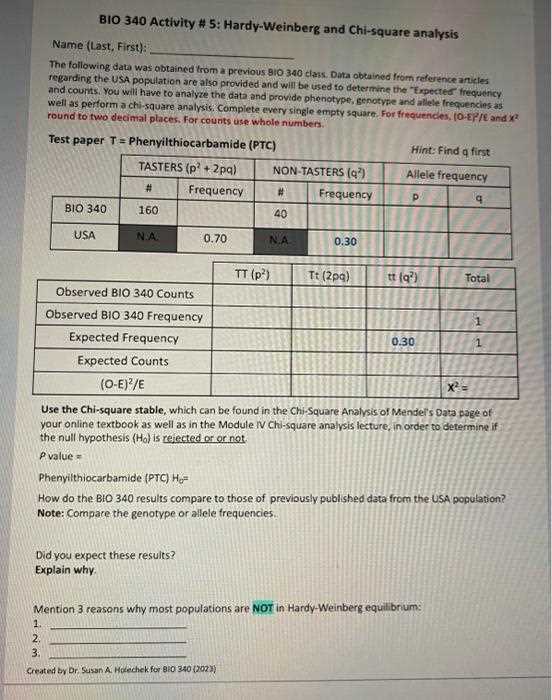
If you’re working with genetic data, applying population equilibrium principles and statistical methods is key to understanding genetic variations. When dealing with allele frequencies, use the equilibrium equation to calculate expected values and compare them with observed data. This helps determine if a population is in equilibrium or if evolutionary forces are at play.
To test the validity of your results, perform a statistical test that assesses the deviation between expected and observed frequencies. By calculating the test statistic, you can determine if the observed differences are due to chance or reflect significant evolutionary changes. Follow these steps carefully, ensuring accurate calculations for both allele frequencies and statistical tests.
When interpreting results, always consider the assumptions underlying your test, such as random mating, no mutations, and no migration. If any of these assumptions do not hold true, your test results may be skewed, and the population may not meet the criteria for genetic equilibrium.
Population Equilibrium and Statistical Testing: A Practical Guide
To begin solving problems related to genetic balance, first calculate allele frequencies in the population. Use the formula p² + 2pq + q² = 1, where p and q represent the frequencies of the dominant and recessive alleles. Ensure you square the dominant allele frequency and double the product of the two allele frequencies for the heterozygous genotype. This will give you the expected genotype frequencies under equilibrium conditions.
Once the expected frequencies are calculated, perform a statistical comparison using a test to assess if observed data fits the equilibrium model. The most common approach is the chi-squared test. First, calculate the difference between observed and expected values for each genotype. Then, square these differences, divide by the expected values, and sum the results to obtain the test statistic.
If the calculated test statistic exceeds the critical value from the chi-squared distribution table, reject the null hypothesis, indicating that the population is not in equilibrium. Otherwise, you fail to reject the hypothesis, meaning the population may be in equilibrium.
Always check your assumptions before concluding your analysis. Ensure that random mating, no mutations, no migration, and no natural selection are occurring. Violations of these assumptions can invalidate your statistical test, leading to incorrect conclusions about genetic equilibrium in the population.
Understanding Population Equilibrium Formula
To calculate allele frequencies in a population under equilibrium conditions, use the formula: p² + 2pq + q² = 1. In this formula, p represents the frequency of the dominant allele, and q represents the frequency of the recessive allele. The terms correspond to the genotypic frequencies: p² is the frequency of homozygous dominant individuals, 2pq is the frequency of heterozygous individuals, and q² is the frequency of homozygous recessive individuals.
First, determine the allele frequencies for p and q. If you know the frequency of homozygous recessive individuals (q²), take the square root of this value to find q. Then subtract q from 1 to find p. Once you have both p and q, you can calculate the expected genotype frequencies using the formula.
These calculations assume that the population is not affected by evolutionary forces such as migration, mutation, genetic drift, or natural selection. If the population does not meet these criteria, the results may not reflect true equilibrium.
How to Apply Population Equilibrium in Genetics
To apply population equilibrium in genetics, first calculate the allele frequencies within a population. Use the formula p + q = 1, where p represents the frequency of the dominant allele, and q is the frequency of the recessive allele. If you already know the frequency of the homozygous recessive individuals (q²), simply take the square root of this value to find q.
After determining q, calculate p by subtracting q from 1. Then, use these values to find the expected genotype frequencies: p² for homozygous dominant, 2pq for heterozygotes, and q² for homozygous recessive individuals. These frequencies should represent the genetic structure of a population under no evolutionary pressures.
If the observed genotype frequencies differ significantly from the expected frequencies, the population may not be in equilibrium. To assess whether the differences are statistically significant, perform a chi-squared test to compare observed and expected values. If the calculated statistic exceeds the critical value, this suggests that evolutionary forces may be acting on the population.
For accurate results, ensure the population meets the necessary assumptions, such as random mating, no mutations, and no migration. Any violation of these assumptions can lead to inaccurate conclusions about genetic stability.
Step-by-Step Guide to Solving Population Equilibrium Problems
1. Identify the given information: Typically, you will be provided with the number of individuals with different genotypes or allele frequencies. If you know the frequency of homozygous recessive individuals, calculate q².
2. Calculate the frequency of the recessive allele (q): Take the square root of q² to find q. This is the frequency of the recessive allele in the population.
3. Find the frequency of the dominant allele (p): Subtract the value of q from 1. This gives you the frequency of the dominant allele, p (p = 1 – q).
4. Calculate the expected genotype frequencies: Use the equilibrium formula: p² for homozygous dominant, 2pq for heterozygotes, and q² for homozygous recessive. These represent the expected proportions of each genotype in the population.
5. Compare observed and expected frequencies: If the observed frequencies of genotypes differ from the expected frequencies, statistical testing is required to determine if the differences are significant.
6. Perform the statistical test: Conduct a chi-squared test by calculating the sum of squared differences between observed and expected frequencies divided by the expected values. Compare the result to the critical value from the chi-squared table to assess the significance.
7. Interpret the results: If the test statistic is greater than the critical value, reject the null hypothesis, suggesting that the population is not in equilibrium. If the statistic is lower, the population may be in equilibrium.
Using Statistical Test for Population Equilibrium Data
To determine if a population is in equilibrium, perform a statistical test by comparing observed and expected genotype frequencies. Follow these steps:
- Calculate expected frequencies: Using the allele frequencies (p and q), compute the expected genotype frequencies under equilibrium conditions. Use the formula p² for homozygous dominant, 2pq for heterozygotes, and q² for homozygous recessive.
- Determine observed frequencies: Record the actual number of individuals with each genotype in the population.
- Compute the chi-squared statistic: Use the formula:
Χ² = Σ ( (O – E)² / E ), where O is the observed frequency, E is the expected frequency, and the sum (Σ) is taken across all genotypes. - Find the degrees of freedom: The degrees of freedom (df) is calculated as df = n – 1, where n is the number of genotype categories. For three categories (homozygous dominant, heterozygous, homozygous recessive), df = 2.
- Compare with critical value: Using the degrees of freedom and your chosen significance level (usually 0.05), find the critical value from a chi-squared distribution table. If the computed Χ² exceeds the critical value, reject the null hypothesis, suggesting that the population is not in equilibrium.
- Interpret the results: If the calculated value is less than the critical value, fail to reject the null hypothesis. This indicates the population is in equilibrium. A higher value suggests evolutionary forces may be acting on the population.
Ensure your data is accurate, and that the assumptions for the statistical test (e.g., random mating, no mutations) are met for valid results.
Interpreting Statistical Test Results in Genetics
To interpret the results of your statistical test, compare the calculated test statistic with the critical value from the distribution table. If the test statistic exceeds the critical value at a chosen significance level (usually 0.05), reject the null hypothesis. This indicates that the observed genetic frequencies are significantly different from what would be expected under no evolutionary forces, suggesting that the population may not be in equilibrium.
If the test statistic is less than the critical value, fail to reject the null hypothesis. This implies that any differences between observed and expected values could be due to random variation, and the population is likely in equilibrium.
A p-value smaller than 0.05 provides strong evidence against the null hypothesis, suggesting a significant difference between observed and expected frequencies. A p-value greater than 0.05 suggests the observed variation is due to chance, and the population may be in equilibrium.
Before making conclusions, ensure all assumptions for the test are met, such as random mating and large sample size. Violations of these assumptions can skew results and lead to incorrect interpretations.
Common Mistakes in Population Equilibrium and Statistical Calculations
One of the most common mistakes in equilibrium calculations is incorrectly assuming allele frequencies without first confirming that the population is in equilibrium. Always check the assumptions (e.g., no migration, no mutations, random mating) before applying the equilibrium model. Failing to account for these factors can lead to incorrect conclusions about genetic stability.
Another frequent error is miscalculating the allele frequencies, especially when determining the recessive allele frequency from the observed genotype frequencies. If the frequency of homozygous recessive individuals is known, remember to take the square root of this value to find q. Failing to do this step accurately skews the subsequent calculations of p and expected genotype frequencies.
In statistical testing, incorrect degrees of freedom are a common pitfall. The degrees of freedom should be the number of genotype categories minus one. For three genotype categories, the degrees of freedom is 2. Using incorrect degrees of freedom can lead to inaccurate critical values and result in wrong conclusions from the test.
Additionally, a common mistake is not checking whether the expected values in the statistical test are sufficiently large (typically at least 5). Small expected values can make the test unreliable, leading to inaccurate results. In such cases, a different statistical test may be necessary.
For more detailed information on avoiding these and other calculation errors, visit NCBI, a trusted resource for scientific information and guidelines.
How to Calculate Allele Frequencies from Population Data
To calculate allele frequencies, follow these steps:
- Determine the number of individuals with each genotype: You need the number of individuals with homozygous dominant, heterozygous, and homozygous recessive genotypes. This information is typically provided or can be calculated from the total population.
- Calculate the frequency of the homozygous recessive genotype: If the number of homozygous recessive individuals is known, divide this by the total population to get the frequency of the recessive genotype (q²).
- Calculate the recessive allele frequency (q): Take the square root of q² to find q, the frequency of the recessive allele.
- Calculate the dominant allele frequency (p): Since the sum of allele frequencies must equal 1, subtract q from 1 to find the frequency of the dominant allele: p = 1 – q.
- Check your results: The sum of p and q should equal 1. If it doesn’t, recheck your calculations.
Example Calculation:
| Genotype | Count | Frequency |
|---|---|---|
| Homozygous Dominant | 40 | p² = 0.4 |
| Heterozygous | 40 | 2pq = 0.4 |
| Homozygous Recessive | 20 | q² = 0.2 |
In this example, you would calculate the recessive allele frequency (q = √0.2 = 0.447) and then calculate the dominant allele frequency (p = 1 – 0.447 = 0.553).
Analyzing Results: Is the Population in Genetic Equilibrium?
To determine if a population is in genetic equilibrium, follow these steps:
- Compare observed and expected frequencies: Calculate the expected genotype frequencies under the assumption of no evolutionary forces. If the observed frequencies match the expected values, the population may be in equilibrium.
- Perform a statistical test: Use a statistical test (e.g., chi-squared) to assess whether the differences between observed and expected frequencies are statistically significant. If the test result shows a high p-value (typically >0.05), fail to reject the null hypothesis, suggesting equilibrium.
- Consider the assumptions: Ensure the conditions for equilibrium are met. This includes no migration, no mutations, no natural selection, large population size, and random mating. If any of these conditions are violated, equilibrium may not be present.
- Assess allele frequencies: If the allele frequencies remain constant across generations, this is another indicator that the population is in equilibrium. Fluctuating allele frequencies suggest the action of evolutionary forces.
- Reevaluate your data: Double-check for errors in the collection or calculation of genotype frequencies. Mistakes in counting or incorrect sample sizes can lead to false conclusions about equilibrium.
Only after carefully performing these checks can you conclude if a population is likely in genetic equilibrium or if evolutionary processes are at work.