Algebra 1 Chapter 2 Step by Step Solutions and Explanations
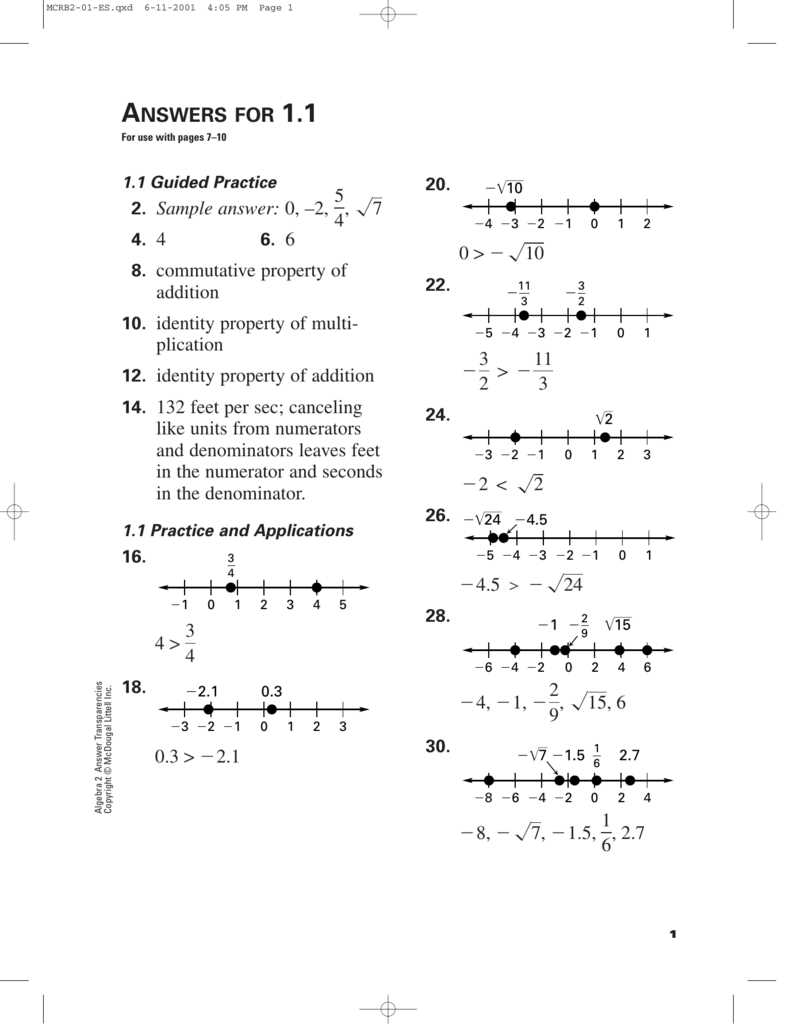
Start by carefully reviewing each equation type and method used to solve it. Focus on the step-by-step breakdown, particularly when handling linear relationships and systems of equations. Pay close attention to the rules for combining like terms and distributing variables.
While solving equations, ensure you are using the correct order of operations to avoid errors. Mistakes often arise when parentheses are not properly accounted for or when simplifying terms without considering their coefficients. Practice consistently to build confidence in applying these principles.
As you work through problems, consider checking your solutions by substituting values back into the original equation. This verification process helps catch any small calculation mistakes and ensures your understanding of the material is accurate.
Once you’ve completed several problems, review sample solutions to identify patterns in solving similar types of questions. This will enhance your ability to solve problems efficiently and confidently during exams or homework assignments.
Step by Step Solutions and Explanations for Chapter 2
When solving linear equations, start by isolating the variable on one side of the equation. Begin with the simplest operations, such as adding or subtracting terms from both sides.
For example, in the equation 2x + 5 = 15, subtract 5 from both sides: 2x = 10. Then, divide both sides by 2 to isolate the variable: x = 5.
When dealing with more complex expressions, follow the distributive property. For instance, in 3(x + 4) = 18, first distribute the 3 across the terms inside the parentheses: 3x + 12 = 18. Then, subtract 12 from both sides: 3x = 6. Finally, divide both sides by 3 to get x = 2.
Another common type of problem involves solving systems of equations. You can use substitution or elimination methods. In substitution, replace one variable with an expression from the other equation. In elimination, add or subtract equations to eliminate one of the variables, then solve for the remaining one.
For example, consider the system:
- x + y = 7
- 2x – y = 4
Using substitution, solve for y in the first equation: y = 7 – x, then substitute this into the second equation:
- 2x – (7 – x) = 4
Simplify and solve for x: 3x = 11, so x = 11/3. Substitute x = 11/3 back into y = 7 – x to find y = 7 – 11/3 = 10/3.
By following these methods, practice with various examples to improve your understanding and accuracy in solving similar problems.
Understanding the Key Concepts of Chapter 2
Focus on solving linear equations, a foundational skill in this section. The goal is to isolate the variable by applying inverse operations such as addition, subtraction, multiplication, and division.
For example, start with an equation like 3x + 4 = 19. First, subtract 4 from both sides: 3x = 15. Then, divide both sides by 3: x = 5.
Another important concept is working with expressions involving parentheses. The distributive property helps simplify such expressions. For instance, with 4(x + 2) = 24, distribute the 4 to both terms inside the parentheses: 4x + 8 = 24. Then, subtract 8 from both sides and divide by 4 to find x = 4.
Equally important is recognizing and solving systems of equations. These can be solved using substitution or elimination methods. For substitution, isolate one variable in one equation and substitute into the other equation. For elimination, add or subtract equations to eliminate one variable.
For example, consider the system:
- x + y = 10
- 2x – y = 4
Using substitution, solve for y in the first equation: y = 10 – x, and substitute into the second equation:
- 2x – (10 – x) = 4
Simplify: 3x = 14, so x = 14/3. Substitute this back to find y = 10 – 14/3 = 16/3.
Mastering these core principles will provide a solid foundation for tackling more complex topics.
How to Approach Word Problems in Algebra 1
Start by carefully reading the problem to identify the key information and what is being asked. Highlight or underline important numbers and words that indicate operations such as “sum,” “difference,” or “product.”
Next, define the variables. Assign a letter (like x) to represent the unknown quantity. For example, if a problem involves the total cost of apples, let x represent the number of apples.
Translate the word problem into a mathematical equation using the relationships described in the text. For example, if the cost of one apple is $2 and the total cost is $10, the equation would be 2x = 10, where x is the number of apples.
Once the equation is set up, solve for the variable. In the case of 2x = 10, divide both sides by 2 to find x = 5. This means there are 5 apples in the problem.
Finally, check the solution by substituting the value of the variable back into the original context to ensure it makes sense. If the solution doesn’t fit, re-examine the translation of the word problem into the equation.
For additional tips and resources on solving word problems, visit Khan Academy, which provides detailed examples and practice exercises.
Breaking Down Linear Equations and Their Solutions
To solve a linear equation, start by isolating the variable on one side of the equation. Begin by simplifying both sides if needed, combining like terms or distributing any constants.
For example, in the equation 2x + 5 = 15, subtract 5 from both sides to begin isolating x. This gives 2x = 10.
Next, divide both sides of the equation by the coefficient of the variable. In this case, divide both sides by 2 to solve for x: x = 5.
Check the solution by substituting the value of x back into the original equation. In this example, substituting x = 5 into 2x + 5 = 15 gives 2(5) + 5 = 15, which simplifies to 10 + 5 = 15, confirming the solution is correct.
Practice solving linear equations with various coefficients and constants to gain confidence. Use this same process to handle more complex equations such as 3(x + 4) = 18 or equations with variables on both sides.
Identifying Common Mistakes in Algebra 1 Chapter 2
One common mistake is failing to distribute correctly. For example, in an equation like 3(x + 2) = 18, it’s important to multiply both terms inside the parentheses by 3. Incorrectly simplifying this as 3x + 2 = 18 leads to the wrong result. Always apply the distributive property properly.
Another mistake is mishandling negative signs. For instance, in the equation -4x + 5 = 9, students often forget to subtract 5 from both sides first. Correct steps involve subtracting 5 from both sides to get -4x = 4 and then solving for x = -1.
Mixing up the operations when isolating the variable is also common. When working with equations like 2x + 6 = 12, subtracting 6 from both sides before dividing by 2 is crucial. Incorrectly dividing first will yield a wrong answer.
For problems with fractions, ensure to multiply both sides by the least common denominator (LCD) before simplifying. A common mistake is neglecting this step, leading to incorrect simplifications.
Lastly, always check solutions by substituting them back into the original equation. Not doing so often leads to overlooking minor errors, such as miscalculating simple steps or signs.
Using the Order of Operations in Chapter 2 Problems
When solving equations, always follow the correct sequence of operations: parentheses, exponents, multiplication and division (from left to right), and addition and subtraction (from left to right). This rule, often abbreviated as PEMDAS, ensures accuracy in your calculations.
For example, in an equation like 2 + 3 × (4 + 1), start by solving the expression inside the parentheses first, so you get 2 + 3 × 5. Then, multiply before adding, resulting in 2 + 15 = 17.
In cases where no parentheses are present, be sure to handle multiplication and division before addition and subtraction. For instance, in 5 + 2 × 3, multiply first to get 5 + 6 = 11.
Another common mistake is misapplying operations when negative signs are involved. If you have -3 + 4 × 2, follow PEMDAS by multiplying first, then adding the result to the negative sign, which gives -3 + 8 = 5.
Lastly, when working with fractions, ensure to apply the order of operations inside the numerator and denominator before performing division across the fraction bar. For example, for (2 + 3) ÷ (4 – 1), calculate each part separately to get 5 ÷ 3 = 1.67.
How to Check Your Work in Algebra 1 Chapter 2
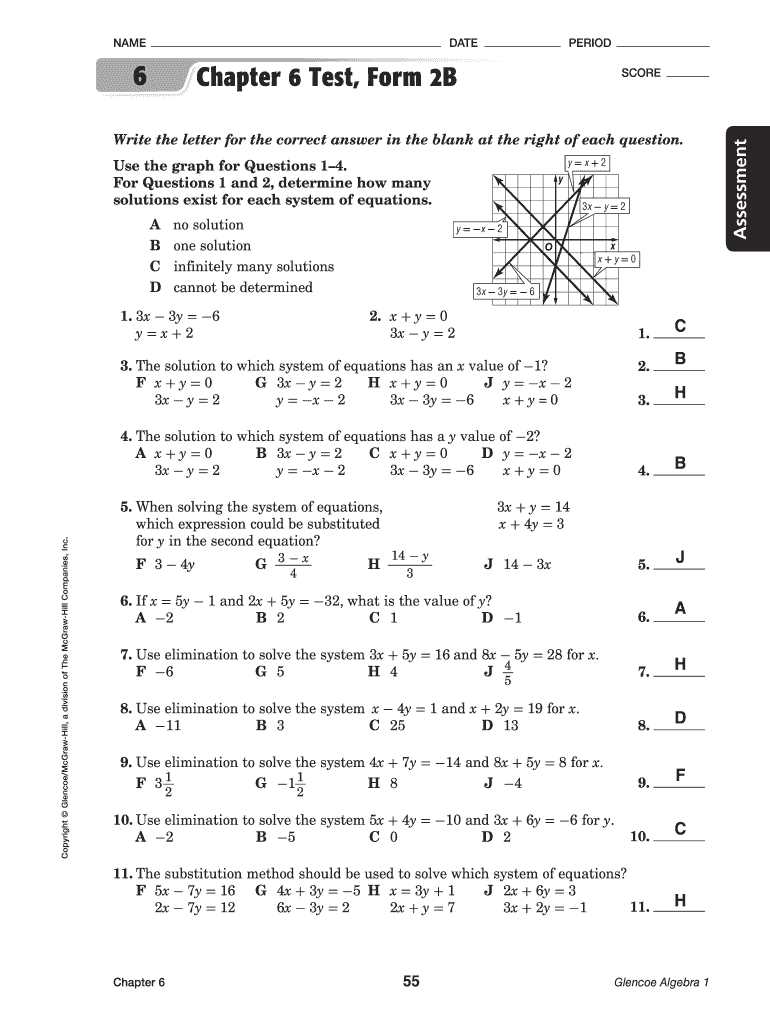
Start by revisiting each step to ensure the correct operations were applied. For example, if solving an equation, verify that you followed the correct order of operations. Double-check each arithmetic calculation, as simple mistakes often occur with signs or missing steps.
Next, substitute your solution back into the original equation to confirm it works. For instance, if you solved for x, plug it back into the equation and check if both sides are equal. This method helps to ensure your solution is valid.
If working with fractions, simplify each fraction and ensure all terms are reduced properly. For example, in a division problem with fractions, ensure that the numerator and denominator have been fully simplified before proceeding.
Cross-check each variable. If you solved for multiple unknowns, make sure you’ve solved all variables correctly by substituting them back into the equations. If needed, work backwards from the solution to verify the accuracy of your process.
Finally, if available, compare your solution with a reliable resource or a practice test solution. This can give you a quick reference point to confirm your work is correct.
Applying Graphing Techniques to Solve Algebraic Problems
To begin, always plot the given points or equations on a graph. For linear equations, identify the slope and y-intercept, then plot the line accordingly. This visual representation makes it easier to understand the relationship between variables.
Next, when dealing with systems of equations, graph both equations on the same set of axes. The point where the two lines intersect represents the solution. If the lines are parallel, the system has no solution. If the lines coincide, there are infinite solutions.
For quadratic equations, graph the parabola. Start by finding the vertex, axis of symmetry, and intercepts. Use these key points to plot the curve and identify where the graph crosses the x-axis, which indicates the roots of the equation.
Check your solutions by substituting the values you find from the graph back into the original equations to ensure accuracy. This process confirms that the graphical solution corresponds with the algebraic solution.
When working with inequalities, graph the boundary line and shade the appropriate region to represent the solution set. If the inequality is strict (e.g., y > mx + b), use a dashed line. If the inequality is inclusive (e.g., y ≥ mx + b), use a solid line.
Reviewing Practice Problems and Their Solutions in Chapter 2
Start by revisiting the practice problems from this section. Break down each problem into smaller steps, ensuring you follow the correct operations in the right order. Begin with identifying the given values and what the problem is asking for.
Next, examine the solutions carefully. If you encounter difficulties, retrace your steps and check for common errors, such as mistakes in signs, distributing terms, or solving for the wrong variable. Cross-check each step to make sure no step was skipped or rushed.
For linear equations, confirm that you properly isolate the variable and keep the equation balanced on both sides. When solving systems of equations, ensure that the substitution or elimination methods are applied correctly to reach the correct intersection point.
When dealing with quadratic equations, always check the discriminant to determine the number of real solutions. Review how to factor, complete the square, or apply the quadratic formula. After solving, verify that your solutions satisfy the original equation.
To further reinforce learning, work through a few extra problems that are similar in structure but with slight variations. This will help solidify the concepts and improve problem-solving skills.
| Problem | Steps | Solution |
|---|---|---|
| x + 3 = 7 | Isolate x: x = 7 – 3 | x = 4 |
| 2x – 5 = 9 | Isolate x: 2x = 9 + 5, x = 14 / 2 | x = 7 |
| x^2 – 4 = 0 | Factor: (x – 2)(x + 2) = 0, solve for x | x = 2, x = -2 |