Distance and Midpoint Calculation Solutions and Explanations
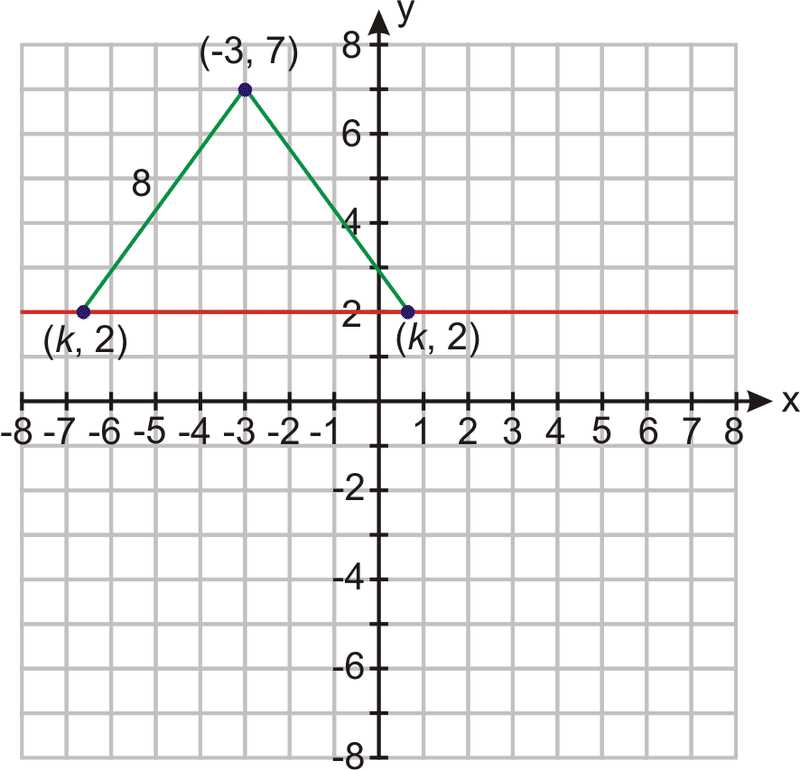
To calculate the length between two points in a coordinate plane, apply the distance formula: √((x₂ – x₁)² + (y₂ – y₁)²). This formula allows you to find the straight-line distance between any two points, using their coordinates (x₁, y₁) and (x₂, y₂).
For finding the central point between two coordinates, use the midpoint formula: ((x₁ + x₂)/2, (y₁ + y₂)/2). This will provide the point exactly halfway between the given two locations, useful for finding the center or dividing a segment equally.
In this guide, you will find detailed examples and step-by-step solutions to common problems related to these formulas. Whether you’re working through basic exercises or applying them to more complex geometry or algebra problems, this resource will clarify key concepts and provide accurate solutions.
Distance and Midpoint Calculation Solutions
To find the length between two points on a coordinate plane, use the formula √((x₂ – x₁)² + (y₂ – y₁)²). For example, given the points (3, 4) and (7, 1), calculate:
√((7 – 3)² + (1 – 4)²) = √(16 + 9) = √25 = 5
For determining the central point, apply ((x₁ + x₂)/2, (y₁ + y₂)/2). For the same points (3, 4) and (7, 1), the central point is:
((3 + 7)/2, (4 + 1)/2) = (5, 2.5)
These formulas are critical for geometry, navigation, and other fields where precise measurements are necessary. Apply these calculations to solve problems in various contexts with confidence.
How to Calculate Distance Between Two Points on a Coordinate Plane
To find the length between two points, use the formula:
√((x₂ – x₁)² + (y₂ – y₁)²)
Follow these steps:
- Identify the coordinates of the two points. For example, point A (x₁, y₁) = (3, 4) and point B (x₂, y₂) = (7, 1).
- Subtract the x-coordinates: (x₂ – x₁) = 7 – 3 = 4.
- Subtract the y-coordinates: (y₂ – y₁) = 1 – 4 = -3.
- Square both differences: (4)² = 16 and (-3)² = 9.
- Add the squares: 16 + 9 = 25.
- Take the square root: √25 = 5.
Therefore, the length between the points is 5 units.
Understanding the Midpoint Formula and Its Application
To locate the center point between two coordinates, apply the formula:
Midpoint = ((x₁ + x₂) / 2, (y₁ + y₂) / 2)
This formula finds the average of both the x and y coordinates of two points. Here’s how to apply it:
- Identify the coordinates of the two points. For example, A (x₁, y₁) = (2, 3) and B (x₂, y₂) = (8, 7).
- Add the x-coordinates: (x₁ + x₂) = 2 + 8 = 10. Then divide by 2: 10 / 2 = 5.
- Add the y-coordinates: (y₁ + y₂) = 3 + 7 = 10. Then divide by 2: 10 / 2 = 5.
- The midpoint is therefore (5, 5).
By using this method, you can easily find the center of any two points on a coordinate grid. This calculation is useful in geometry, navigation, and various other fields requiring coordinate-based analysis.
Step-by-Step Solution for Distance Calculation Examples
To compute the length between two points on a coordinate plane, follow these steps:
- Identify the Coordinates: Given two points A(x₁, y₁) and B(x₂, y₂), for example, A(1, 2) and B(4, 6), write down their coordinates.
- Substitute into the Formula: Use the formula: √((x₂ – x₁)² + (y₂ – y₁)²) to find the distance. In this case: √((4 – 1)² + (6 – 2)²).
- Simplify the Differences: Calculate the differences between the x and y coordinates: (4 – 1) = 3 and (6 – 2) = 4.
- Square the Differences: 3² = 9 and 4² = 16.
- Add the Squares: 9 + 16 = 25.
- Take the Square Root: √25 = 5.
- Final Result: The distance between points A(1, 2) and B(4, 6) is 5 units.
Repeat the steps for any other pair of points to find their length on the coordinate plane. This method is widely used in geometry, navigation, and physics for calculating spatial relationships.
How to Use the Midpoint Formula for Geometry Problems
To find the center point between two given coordinates, follow this simple procedure:
- Identify the Coordinates: Label the two points. Let the first point be A(x₁, y₁) and the second point B(x₂, y₂).
- Apply the Formula: The formula to find the center is: ((x₁ + x₂)/2, (y₁ + y₂)/2).
- Insert the Values: Plug the coordinates of the points into the formula. For example, if A(2, 4) and B(6, 8), the calculation would be: ((2 + 6)/2, (4 + 8)/2).
- Simplify the Expression: Solve for each component: (2 + 6) / 2 = 4 and (4 + 8) / 2 = 6.
- Result: The center point is (4, 6).
This method is useful in geometry for finding the center of line segments, triangles, and other geometric figures. It is particularly helpful for constructing bisectors, balancing shapes, or finding the center of symmetry.
Common Mistakes in Distance and Midpoint Calculations
Many students make frequent errors when calculating the separation between two points or the center point. Below are common mistakes to avoid:
- Forgetting to Square the Differences: In the distance formula, ensure to square the differences of the x and y coordinates. Many errors arise from skipping this step.
- Misapplying the Formula: Always remember that the distance formula is sqrt((x₂ – x₁)² + (y₂ – y₁)²). Confusing it with the midpoint formula, ((x₁ + x₂)/2, (y₁ + y₂)/2), can lead to incorrect results.
- Incorrect Order of Coordinates: When applying the formula, ensure that the coordinates are substituted in the correct order. Mistaking the x and y values can lead to a wrong result.
- Not Simplifying Correctly: After applying the formula, simplify each part of the equation carefully. Inaccurate simplifications can cause errors in the final result.
- Ignoring Negative Signs: Negative values can be critical. When subtracting coordinates, ensure the sign is properly accounted for in both the distance and center point calculations.
To avoid these mistakes, double-check each step and rework the problem if necessary. Practice is the best way to improve accuracy and speed.
For more information, refer to trusted math sources like Khan Academy.
Real-World Applications of Distance and Midpoint Formulas
These formulas have numerous practical applications across various fields. Here are a few examples:
- Urban Planning: City planners use these formulas to calculate the space between key locations, such as roads, utilities, or public amenities, ensuring efficient layouts.
- Navigation Systems: GPS systems rely on these calculations to determine the shortest path between two coordinates, helping drivers, pilots, and ships navigate accurately.
- Architecture: Architects use these formulas to assess distances between different points of a structure, ensuring proper design and spatial relationships between elements.
- Physics: In fields like astronomy and mechanics, these formulas help determine the relative positions and distances between celestial bodies or objects in motion.
- Geographic Information Systems (GIS): GIS applications rely on these principles to analyze geographical data, calculate distances between features, and create spatial models.
- Robotics: Engineers use these formulas in robotic pathfinding algorithms to calculate the shortest route for robots in warehouses, factories, or exploration missions.
In each of these cases, calculating accurate positions, separating two points, or finding central locations is critical for optimizing performance and minimizing errors. These applications demonstrate how mathematical concepts are integral to solving real-world challenges.
Using Distance and Midpoint in Algebra and Trigonometry
Both these concepts are integral to solving problems in algebra and trigonometry, offering precise ways to analyze relationships between points. Here’s how these formulas are applied in each subject:
- Algebra: In algebra, the formula for calculating separation between two points on a coordinate plane is used to solve problems involving the distance between variables. This is particularly useful in systems of equations or finding the length of line segments in geometry problems.
- Trigonometry: In trigonometry, these calculations help in analyzing angles and distances in right-angled triangles. The concepts are often used in conjunction with the Pythagorean theorem to calculate side lengths and angles. Additionally, they help find the center of circles or arcs, which is crucial for solving trigonometric equations.
- Graphing: Algebra students use these formulas to graph points and lines, understanding how far apart points are on a coordinate system. Trigonometric identities and distance formulas help graph curves, circles, and parabolas accurately.
- Vectors: In vector calculations, these methods are crucial in determining the magnitude of vectors and the angle between them. The relationship between vectors and points is frequently analyzed using these formulas, particularly in physics and engineering problems.
- Coordinate Geometry: These tools are foundational in solving problems that involve finding distances between points, determining the slope of a line, or finding perpendicular bisectors. The midpoint formula is frequently used to determine the center of a line segment.
By mastering these techniques, students can solve complex algebraic and trigonometric problems with ease, making them a fundamental part of mathematics education.
Practice Problems and Solutions for Distance and Midpoint
Here are a few practice problems that cover both separation between points and center calculations, along with their solutions to help reinforce your understanding:
| Problem | Solution |
|---|---|
| Find the length between points (3, 4) and (7, 1). |
Use the formula: √[(x₂ – x₁)² + (y₂ – y₁)²] √[(7 – 3)² + (1 – 4)²] = √[(4)² + (-3)²] = √[16 + 9] = √25 = 5 |
| Find the center of the line segment with endpoints (2, 3) and (8, 9). |
Use the formula: ((x₁ + x₂)/2, (y₁ + y₂)/2) ((2 + 8)/2, (3 + 9)/2) = (10/2, 12/2) = (5, 6) |
| What is the distance between points (-1, -2) and (4, 5)? |
√[(4 – (-1))² + (5 – (-2))²] = √[(5)² + (7)²] = √[25 + 49] = √74 ≈ 8.6 |
| Find the midpoint of (1, 2) and (-3, 6). |
Use the midpoint formula: ((x₁ + x₂)/2, (y₁ + y₂)/2) ((1 + (-3))/2, (2 + 6)/2) = (-2/2, 8/2) = (-1, 4) |
By practicing these problems, you’ll get a better understanding of applying these formulas in various scenarios. Make sure to check each step carefully to avoid common mistakes.