Step-by-Step Guide to Factoring Quadratic Equations
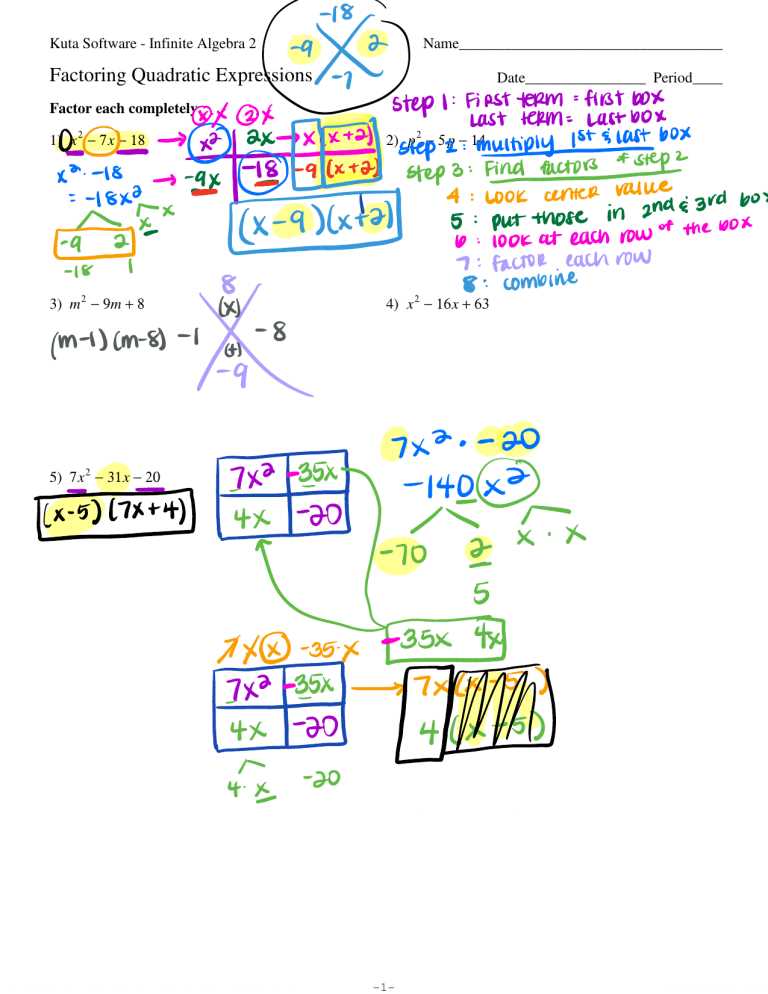
Begin by rewriting the equation in standard form, ensuring that the terms are properly ordered. Identifying the coefficients of the terms is key to simplifying the equation.
Next, use the method of splitting the middle term to break the polynomial into two binomials. Focus on finding two numbers that multiply to give the product of the first and last coefficients, and add up to the middle coefficient.
Once the equation is broken into two binomials, check your solution by expanding the factors. This will confirm that the factored form matches the original equation, providing a reliable method for solving these types of problems.
Solving Polynomial Equations: Step-by-Step Guide
Start by writing the equation in standard form, ensuring the terms are ordered from highest to lowest degree. Identify the leading coefficient (a), the middle term coefficient (b), and the constant (c).
Next, find two numbers that multiply to give the product of the leading coefficient (a) and the constant (c), while adding up to the middle term coefficient (b). This step is crucial for splitting the middle term.
After splitting the middle term, rewrite the equation as two binomial expressions. Factor out the greatest common factor (GCF) from each pair of terms, if possible.
Finally, check the solution by expanding the factored form. If the expansion matches the original equation, the solution is correct.
How to Identify the Type of Polynomial Equation
Start by examining the equation’s degree. If the highest exponent is 2, the equation is classified as a second-degree polynomial. Next, identify the coefficients of the equation: the leading term (highest degree), the middle term, and the constant.
Check if the equation can be rewritten as a perfect square trinomial. If it matches the pattern (x + p)^2 = 0 or (x – p)^2 = 0, it’s a perfect square.
If the equation contains three terms, and there’s no middle term, it may represent a difference of squares, which can be factored into two binomials. Lastly, if the equation includes both x and y terms, check if it’s a system of polynomials.
By identifying the degree and structure, you can quickly classify the equation into categories such as simple quadratic, perfect square trinomial, or difference of squares.
Understanding the Decomposition Method: A Clear Overview
To break down a second-degree polynomial, begin by identifying the terms. Focus on the first term (leading coefficient), the middle term, and the constant. The goal is to express the polynomial as a product of two binomials. Start by finding two numbers that multiply to give the product of the first and last coefficients and add up to the middle term’s coefficient.
If the polynomial has a coefficient of 1 in front of the squared term, look for two numbers that directly multiply to the constant. In more complex cases, the middle term must be split into two parts based on the factors of the product of the leading coefficient and constant. This process helps in creating factors that allow the equation to be split into binomials.
The decomposition method requires systematic trial and error to identify the correct numbers. Once found, group terms, factor out common factors, and factor the remaining polynomial into two binomials. This method is foundational for solving polynomials in higher-degree equations as well.
For further reading, you can explore detailed examples and resources at Khan Academy – Factoring Trinomials.
Breaking Down the Standard Form of a Quadratic Equation
The standard form of a second-degree equation is written as ax² + bx + c = 0, where a, b, and c are constants, and a cannot be zero. Understanding each component is crucial for solving or simplifying the equation.
The term ax² represents the squared term, where a is the coefficient that determines the parabola’s direction and width. The term bx is the linear term, where b affects the slope of the curve. The constant term c shifts the curve up or down.
To analyze or solve such an equation, focus on the relationship between the coefficients. Identifying the values of a, b, and c helps in determining how the equation behaves graphically and algebraically. This form is fundamental when solving using methods such as completing the square or using the quadratic formula.
For further resources on understanding and manipulating quadratic equations, check out this article on Khan Academy: Khan Academy – Quadratic Equations.
Using the Middle-Term Factorization Technique
To apply the middle-term factorization method, first identify the quadratic expression in the form ax² + bx + c. The goal is to break the middle term (bx) into two terms that simplify the expression for easy grouping.
Start by multiplying a and c (the coefficients of ax² and c, respectively). Next, find two numbers that multiply to give ac and add up to b (the coefficient of the linear term).
Once the two numbers are identified, rewrite the middle term bx as the sum of those two terms. This step creates a four-term polynomial that can be grouped into two binomials. Factor out the greatest common factor (GCF) from each group, and the equation will be factored into two binomials.
For example, in the expression x² + 5x + 6, multiply a = 1 and c = 6, resulting in ac = 6. The two numbers that multiply to 6 and add to 5 are 2 and 3. Rewriting the middle term gives x² + 2x + 3x + 6, which factors as (x + 2)(x + 3).
For additional practice and detailed explanations, refer to the following resource: Khan Academy – Factoring Expressions.
Common Mistakes When Factoring Quadratics and How to Avoid Them
A common mistake is failing to correctly identify the coefficients of the terms in the expression ax² + bx + c. Make sure you accurately determine the values of a, b, and c before proceeding with any steps.
Another frequent error is not checking if the quadratic expression can be simplified first. If there is a common factor among all the terms, factor it out before attempting to break down the middle term.
In the middle-term factorization method, it’s crucial to find two numbers that multiply to ac and add to b. Mistakes often happen when these numbers are incorrectly chosen. Double-check the numbers by multiplying them to ensure they match ac and adding them to confirm they total b.
Lastly, some overlook the need to group terms correctly. After splitting the middle term, grouping the terms is key to factoring them into binomials. Pay attention to the signs when factoring out the greatest common factor (GCF) from each group.
To minimize these errors, practice with various examples, ensuring to carefully verify each step. For additional guidance, refer to this reliable resource: Khan Academy – Factoring Expressions.
Solving Word Problems Involving Factoring Quadratic Equations
To approach word problems involving second-degree equations, first translate the problem into a mathematical expression. Identify key numbers and relationships in the problem to form the equation.
Once you have the equation, arrange it into standard form, ax² + bx + c = 0, before attempting to solve it. Ensure the terms are correctly aligned with the general quadratic structure.
Next, look for the most suitable method for solving the equation. If the equation is factorable, use the middle-term split technique. Carefully find two numbers that multiply to ac and add to b.
After splitting the middle term, group terms in pairs and factor out common factors. Solve for the unknowns by setting each factor equal to zero and solving for the variable.
If the equation is not easily factorable, consider using the quadratic formula or completing the square. These methods are helpful when the factors are not integers or the equation involves more complex terms.
Finally, check your solutions by substituting them back into the original word problem to ensure they satisfy the given conditions. This will confirm the accuracy of your results.
Checking Your Work: Verifying Factoring Solutions
After obtaining the factors of an equation, it is crucial to verify that your solutions are correct. To check your work, substitute your factored terms back into the original equation.
Start by expanding the factored form of the equation. Multiply the binomials or polynomials to ensure you get the same terms as in the original expression.
If the expanded form matches the original equation, your factorization is correct. If the terms do not align, revisit the factoring process and identify where the error occurred.
For clarity, here is an example of verification:
| Original Equation | Factored Form | Expanded Form | Verification |
|---|---|---|---|
| x² + 5x + 6 | (x + 2)(x + 3) | x² + 5x + 6 | Correct |
| x² + 7x + 12 | (x + 3)(x + 4) | x² + 7x + 12 | Correct |
| x² + 6x + 8 | (x + 2)(x + 4) | x² + 6x + 8 | Correct |
If the factorization and expansion do not match, recheck your middle-term splitting and factorization steps for mistakes.
Additional Practice Problems to Master Factoring Quadratics
To strengthen your skills in solving equations, try the following practice problems. Each problem is designed to reinforce different techniques and methods for breaking down equations into their simplest form.
- x² + 7x + 10
- x² – 8x + 12
- x² + 9x + 20
- 2x² + 5x – 3
- 3x² – 5x – 2
- x² – 4x – 12
- 4x² + 4x – 8
- 6x² – 7x + 2
- x² + 6x – 16
- 5x² – 9x + 4
After solving these, always verify your results by expanding the factored forms and checking if they match the original equation.