Percentage Composition Worksheet Answer Key with Detailed Solutions

If you’re struggling with calculating the mass percentages of elements in chemical compounds, start by understanding the fundamental relationship between mass and molar weight. To calculate the proportion of a particular element in a compound, divide the mass of that element by the total mass of the compound and multiply by 100. This method ensures that you accurately assess how much of each element contributes to the overall compound.
For example, in a water molecule (H₂O), hydrogen makes up 11.11% of the total mass, while oxygen contributes 88.89%. By mastering this calculation, you can apply the same principle to more complex substances, allowing you to break down any chemical formula into its elemental components and easily interpret the results.
It’s important to remember that proper molar mass calculation is key. Ensure you’re using the correct atomic weights for each element from the periodic table. A small mistake in these values can lead to significant errors in your final results.
For practice, try applying these steps to various formulas. Look up different compounds and calculate the weight percentages of each element. The more you practice, the easier it will become to visualize the distribution of mass in chemical compounds.
Solving Chemical Formula Breakdown Problems
To effectively solve chemical formula breakdown exercises, you need to follow a structured approach for each problem. Start by determining the molar mass of the entire compound. For example, if you have H₂O, calculate the molar mass of hydrogen (2 * 1.008 g/mol) and oxygen (16.00 g/mol), adding them together to get the total mass of the compound.
Next, focus on each individual element. For H₂O, calculate the total mass of hydrogen (2 * 1.008 = 2.016 g) and oxygen (16.00 g). Once you have these values, divide the mass of each element by the total molar mass of the compound, and multiply by 100 to find the weight percentage of each element.
Here is a step-by-step example for H₂O:
- Hydrogen: (2.016 g / 18.016 g) * 100 = 11.12%
- Oxygen: (16.00 g / 18.016 g) * 100 = 88.89%
Check your results for accuracy. The sum of the individual percentages should always add up to 100%. If not, recheck the molar masses and your calculations. Practice with different compounds, and soon the process will become second nature.
For more complex substances, break down each element’s contribution to the whole. Using the same technique for each component of the molecule ensures consistent and correct results.
How to Calculate Elemental Proportions in Simple Compounds
To find the mass proportion of each element in a simple compound, first calculate the molar mass of the entire substance. Add up the atomic masses of each atom in the compound, considering the number of atoms of each element present. For example, in water (H₂O), the molar mass of hydrogen is 1.008 g/mol, and oxygen is 16.00 g/mol. Multiply the atomic mass of hydrogen by 2 since there are two hydrogen atoms, and add it to the mass of oxygen.
In the case of water, the total molar mass is:
- Hydrogen: 2 * 1.008 g/mol = 2.016 g/mol
- Oxygen: 16.00 g/mol
- Total mass of H₂O: 2.016 g + 16.00 g = 18.016 g/mol
Once the total molar mass is determined, calculate the mass of each element as a percentage of the total. For hydrogen in water:
- (2.016 g / 18.016 g) * 100 = 11.12%
And for oxygen:
- (16.00 g / 18.016 g) * 100 = 88.89%
Always ensure the sum of all percentages equals 100%. If your results don’t add up, double-check the atomic weights and calculations. This method works for any simple compound and gives you an accurate breakdown of each element’s contribution to the compound’s mass.
Step-by-Step Guide to Solving Element Mass Proportion Problems
Start by identifying the chemical formula of the compound you’re working with. For example, if the compound is NaCl, note the elements involved–sodium (Na) and chlorine (Cl).
Next, find the molar mass of each element. Use the periodic table to get the atomic mass of sodium (22.99 g/mol) and chlorine (35.45 g/mol). Multiply the atomic mass by the number of atoms of each element in the formula. For NaCl, the total molar mass is:
- Sodium: 1 * 22.99 g/mol = 22.99 g/mol
- Chlorine: 1 * 35.45 g/mol = 35.45 g/mol
- Total mass: 22.99 g/mol + 35.45 g/mol = 58.44 g/mol
Now, calculate the mass of each element as a fraction of the total mass. For sodium in NaCl, divide the mass of sodium by the total molar mass:
- (22.99 g/mol / 58.44 g/mol) * 100 = 39.38%
Do the same for chlorine:
- (35.45 g/mol / 58.44 g/mol) * 100 = 60.62%
Check that the sum of the percentages equals 100%. If there are discrepancies, review the molar mass calculations or the number of atoms in the formula. This method works for any compound, whether simple or more complex.
Common Mistakes in Element Mass Proportion Calculations
One of the most frequent mistakes is using incorrect atomic masses. Always refer to the periodic table for the exact atomic weight of each element. Even small discrepancies can lead to significant errors. For example, using 16.0 g/mol for oxygen instead of 15.999 g/mol can slightly affect the results, especially in compounds with high oxygen content.
Another common error is neglecting to account for the number of atoms in each element. In a formula like H₂O, there are two hydrogen atoms and one oxygen atom. Mistaking this and assuming one hydrogen atom leads to inaccurate calculations. Always multiply the atomic mass by the number of atoms in the compound.
Some may also forget to add the total mass of all elements in the compound. The total mass is crucial for calculating the mass fractions. For example, in CO₂, the total molar mass is 12.01 g/mol (C) + 2 * 16.00 g/mol (O), which gives 44.01 g/mol. Omitting the total mass will cause incorrect proportions.
Lastly, failing to double-check the math after performing the calculations can result in errors. Always verify that the sum of the individual masses as a fraction of the total adds up to 100%. If the sum is off, retrace the steps and check for any miscalculations.
Understanding the Role of Molar Mass in Elemental Breakdown
The molar mass of a compound is the foundation for calculating how much each element contributes to the total mass. To begin, you need to know the atomic mass of each element in the compound. These values can be found on the periodic table. For example, the molar mass of carbon is 12.01 g/mol and oxygen is 16.00 g/mol.
For a compound like CO₂, the molar mass is determined by adding the atomic masses of all atoms in the formula. Since there are two oxygen atoms, the calculation would be:
- Carbon: 12.01 g/mol
- Oxygen: 2 * 16.00 g/mol = 32.00 g/mol
- Total mass of CO₂: 12.01 g/mol + 32.00 g/mol = 44.01 g/mol
Once you have the total molar mass, you can calculate the mass contribution of each element. For carbon in CO₂:
- (12.01 g/mol / 44.01 g/mol) * 100 = 27.3%
The molar mass plays a critical role in converting between grams and moles, making it necessary for determining the relative mass fractions of each element. Without it, accurate calculations are not possible.
Using the Solution Guide to Verify Calculations for Complex Compounds
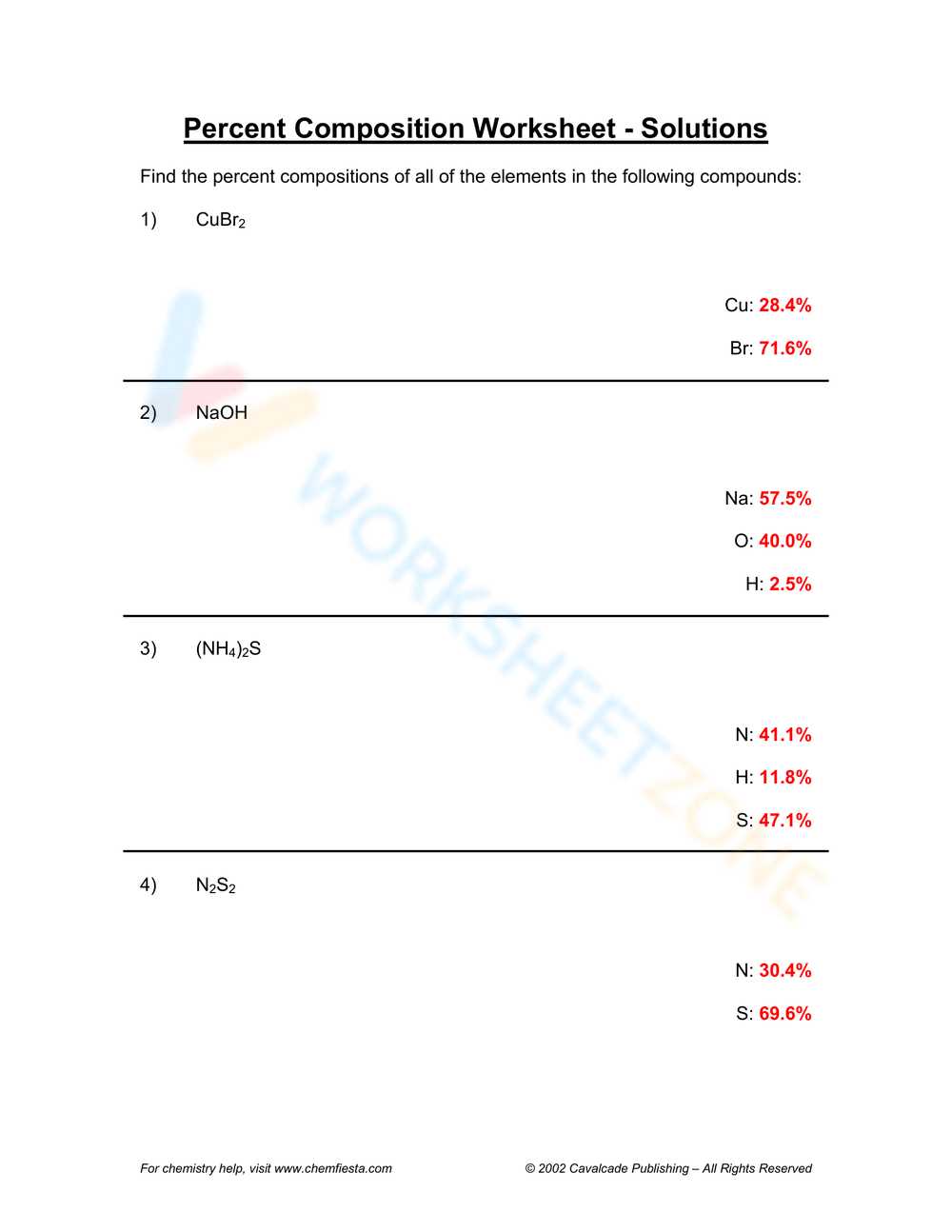
When dealing with more complicated formulas, use the solution guide to ensure that each step is correctly followed. Start by breaking down the compound into its individual elements. For instance, in a compound like C₆H₁₂O₆ (glucose), identify the molar masses of carbon, hydrogen, and oxygen from the periodic table.
Next, calculate the total molar mass of the compound:
| Element | Atoms | Atomic Mass (g/mol) | Total Mass (g) |
|---|---|---|---|
| Carbon (C) | 6 | 12.01 | 72.06 |
| Hydrogen (H) | 12 | 1.008 | 12.096 |
| Oxygen (O) | 6 | 16.00 | 96.00 |
| Total Mass | 180.156 |
Now that you have the total mass (180.156 g/mol), use the solution guide to check each element’s contribution. For carbon, calculate:
- (72.06 g / 180.156 g) * 100 = 40.0%
For hydrogen, the calculation is:
- (12.096 g / 180.156 g) * 100 = 6.7%
And for oxygen:
- (96.00 g / 180.156 g) * 100 = 53.3%
After completing your calculations, compare your results with the solution guide. If there’s a discrepancy, review your molar mass calculations or check if you miscounted the number of atoms in the formula. This method helps ensure accuracy, especially when dealing with more complex substances.
How to Handle Multi-Step Element Mass Fraction Problems
For complex calculations involving multiple elements, follow these steps systematically to avoid errors:
- Step 1: Identify the chemical formula and list all elements involved.
- Step 2: Calculate the molar mass of the entire compound. Add the atomic masses of all elements, considering the number of atoms of each type.
For example, in C₆H₁₂O₆ (glucose), you need to calculate the molar mass:
- Carbon: 6 * 12.01 g/mol = 72.06 g/mol
- Hydrogen: 12 * 1.008 g/mol = 12.096 g/mol
- Oxygen: 6 * 16.00 g/mol = 96.00 g/mol
- Total molar mass: 72.06 + 12.096 + 96.00 = 180.156 g/mol
Now you have the total mass of the compound. The next step is to calculate the mass of each element as a fraction of the total mass.
- Step 3: Calculate the mass fraction of each element:
- Carbon: (72.06 g / 180.156 g) * 100 = 40.0%
- Hydrogen: (12.096 g / 180.156 g) * 100 = 6.7%
- Oxygen: (96.00 g / 180.156 g) * 100 = 53.3%
For more complex compounds, repeat these steps for each element. If needed, break the problem down into smaller parts. Keep track of your calculations and cross-check the results to ensure the sum of all fractions equals 100%.
Why Some Mass Fractions in Formulas Don’t Add Up to 100%
If the calculated mass fractions of a compound do not add up to exactly 100%, it is often due to the rounding of atomic masses. Atomic weights are generally rounded to a few decimal places, which can cause slight discrepancies when performing multiple calculations. For example, the atomic mass of carbon is often rounded to 12.01 g/mol, but its true value is slightly different. These small rounding errors can accumulate, leading to a minor difference in the final total.
Another reason could be the presence of isotopes in the elements. Most atomic masses listed on the periodic table are averages of all the isotopes of that element, weighted by their abundance. If an element in the compound contains a mixture of isotopes, the calculated mass for that element will be slightly different than the value based on a single isotope, which could cause the sum of the percentages to be off by a small amount.
Lastly, impurities in the sample can lead to small errors. If a compound is not pure, the mass contribution from any impurities can skew the expected results. This is common in laboratory settings, where purity can vary slightly.
For more information on atomic weights and isotopic abundances, visit the ChemBlink database.
Practical Examples of Element Mass Fractions in Real-World Chemistry
Understanding the mass contribution of each element in compounds is key in many real-world applications, including pharmaceuticals, materials science, and environmental chemistry. Here are some practical examples:
Example 1: Sodium Chloride (NaCl) in Food Preservation
Sodium chloride, commonly known as table salt, is essential for preserving food. To calculate the contribution of each element, first determine the molar mass of NaCl:
| Element | Atoms | Atomic Mass (g/mol) | Total Mass (g) |
|---|---|---|---|
| Sodium (Na) | 1 | 22.99 | 22.99 |
| Chlorine (Cl) | 1 | 35.45 | 35.45 |
| Total Mass | 58.44 |
To find the contribution of sodium:
- (22.99 g / 58.44 g) * 100 = 39.4%
For chlorine:
- (35.45 g / 58.44 g) * 100 = 60.6%
This information is crucial for understanding the nutritional content of food and for regulating sodium intake in diets.
Example 2: Water in Hydration Solutions
In hydration solutions, such as in sports drinks, the mass contribution of water is a key factor. For example, in a solution containing NaCl and water, you can calculate the amount of water needed by subtracting the mass of NaCl from the total solution mass. This ensures that the solution maintains the desired concentration for effective hydration.
Example 3: Fuel Efficiency and Hydrocarbon Compounds
In fuels, such as gasoline, knowing the mass distribution between carbon and hydrogen helps in optimizing combustion efficiency. For example, gasoline’s chemical formula is typically C₈H₁₈. By calculating the mass fraction of carbon and hydrogen, we can better understand energy release during combustion:
| Element | Atoms | Atomic Mass (g/mol) | Total Mass (g) |
|---|---|---|---|
| Carbon (C) | 8 | 12.01 | 96.08 |
| Hydrogen (H) | 18 | 1.008 | 18.144 |
| Total Mass | 114.224 |
For carbon in gasoline:
- (96.08 g / 114.224 g) * 100 = 84.1%
For hydrogen:
- (18.144 g / 114.224 g) * 100 = 15.9%
This breakdown helps in determining the energy content of fuels and improving fuel efficiency in engines.