Cell Division Reinforcement and Answer Key for Biology Corner
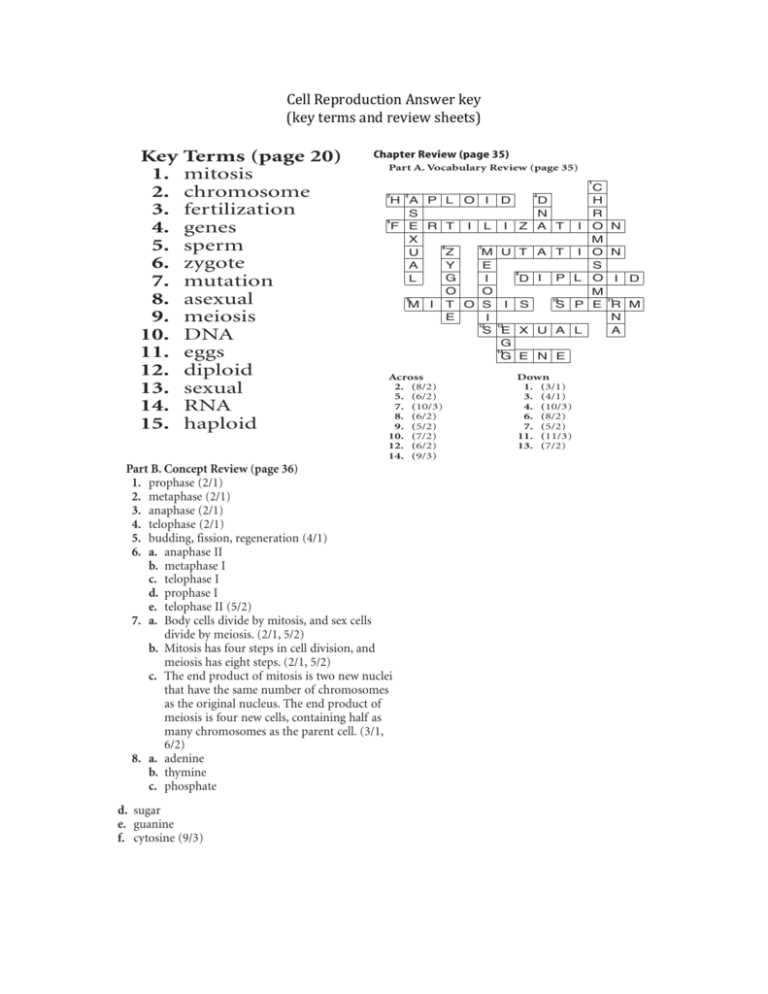
To fully grasp how organisms grow and reproduce, it’s crucial to understand the steps involved in cellular reproduction. Whether it’s a simple organism undergoing mitosis or a more complex one going through meiosis, knowing the phases and mechanics behind each process is foundational.
The first step in mastering this topic is recognizing the key stages of each process. For example, mitosis follows a predictable sequence of events, including prophase, metaphase, anaphase, and telophase, each characterized by specific cellular changes. Meiosis, on the other hand, introduces two rounds of division and is essential for sexual reproduction, creating genetic diversity.
When reviewing your understanding of these processes, pay close attention to the differences between mitosis and meiosis. Understanding these differences will help clarify why one process is used for growth and tissue repair, while the other is critical for producing gametes in sexually reproducing organisms.
By practicing with exercises and carefully analyzing diagrams, you can reinforce your knowledge and improve your ability to identify each stage correctly. This guide provides answers to common questions and highlights important concepts, ensuring a deeper comprehension of how life cycles progress at the cellular level.
Cellular Reproduction Process: Clarifying Key Concepts and Solutions
For a deeper understanding of how organisms reproduce at the cellular level, it is crucial to recognize the primary stages of both mitosis and meiosis. Review the key steps and mechanisms that occur in each process, and ensure you can identify and describe them accurately.
Here’s a breakdown of the steps and their key features:
- Mitosis: A single cell divides to form two identical daughter cells. Key stages include:
- Prophase: Chromosomes condense and the nuclear envelope breaks down.
- Metaphase: Chromosomes align at the cell’s equator.
- Anaphase: Chromatids are pulled toward opposite poles.
- Telophase: Nuclear membranes reform around each set of chromosomes.
- Meiosis: A form of cell division that reduces chromosome numbers by half, resulting in four genetically diverse gametes. Important steps include:
- Meiosis I: Homologous chromosomes are separated.
- Meiosis II: Sister chromatids are separated, similar to mitosis.
To correctly answer exercises or assessments on these topics, be sure to focus on:
- The specific differences between mitosis and meiosis.
- The role of genetic variation in meiosis.
- The significance of chromosomal behavior in each process.
Use diagrams to reinforce your understanding of the stages. Identifying key events in each phase will help you recognize them more easily in practice scenarios. By mastering these concepts, you will have a solid foundation for further study in cellular biology.
Overview of Cellular Reproduction: Key Concepts
Cellular reproduction is a fundamental process for growth, development, and repair. The two primary forms of cellular reproduction are mitosis and meiosis. Understanding these processes is vital for grasping how organisms maintain life through successive generations.
Mitosis is the process by which a single eukaryotic cell divides to produce two genetically identical daughter cells. The stages of mitosis include:
- Prophase: Chromosomes condense and become visible, the nuclear membrane begins to break down.
- Metaphase: Chromosomes align at the cell’s equator, preparing for separation.
- Anaphase: Sister chromatids are pulled to opposite ends of the cell.
- Telophase: The nuclear membrane reforms, and the chromosomes de-condense.
- Cytokinesis: The cytoplasm divides, resulting in two separate daughter cells.
Meiosis differs from mitosis in that it results in four non-identical gametes, each with half the number of chromosomes. It involves two rounds of division–Meiosis I and Meiosis II. Key steps include:
- Meiosis I: Homologous chromosomes are separated, reducing the chromosome number by half.
- Meiosis II: Similar to mitosis, but the result is four haploid cells, each genetically distinct from the others.
In both processes, DNA replication occurs before division, ensuring that each new cell receives the necessary genetic material. For mitosis, the end result is two genetically identical cells, while meiosis ensures genetic diversity through recombination and independent assortment.
Understanding these processes will help clarify how genetic information is passed from one generation to the next and how cellular functions are maintained throughout an organism’s life cycle.
Understanding Mitosis: Step-by-Step Process
The process of mitosis ensures that a single eukaryotic cell divides into two identical daughter cells. This mechanism is vital for growth, repair, and asexual reproduction. The stages of mitosis are distinct and involve precise changes in both the nucleus and cytoplasm of the cell. Below are the steps involved:
1. Interphase
Although not technically part of mitosis itself, interphase is essential for preparing the cell. It consists of three phases: G1 (growth), S (DNA synthesis), and G2 (preparation for mitosis). During interphase, the cell’s DNA is replicated, ensuring that each daughter cell receives a full set of chromosomes.
2. Prophase
In this phase, chromatin condenses into visible chromosomes. Each chromosome consists of two sister chromatids joined at the centromere. The nuclear membrane begins to break down, and the mitotic spindle, made up of microtubules, starts to form from the centrosomes at opposite ends of the cell.
3. Metaphase
Chromosomes align at the cell’s equator, known as the metaphase plate. The spindle fibers attach to the centromeres of each chromosome, securing them in place. This alignment ensures that each daughter cell will receive one copy of each chromosome.
4. Anaphase
In anaphase, the sister chromatids are pulled apart toward opposite poles of the cell. The centromere splits, and the spindle fibers shorten, separating the chromatids. This movement ensures that each future daughter cell will have an identical set of chromosomes.
5. Telophase
During telophase, the separated chromatids reach the poles of the cell, and the nuclear membrane begins to reform around each set of chromosomes. The chromosomes de-condense back into chromatin, and the cell prepares for division of the cytoplasm.
6. Cytokinesis
At this stage, the cytoplasm divides through a process called cytokinesis. In animal cells, a contractile ring forms and pinches the cell in two, while in plant cells, a new cell wall forms in the middle, resulting in two separate daughter cells.
By the end of mitosis, two genetically identical cells are formed, each with the same number of chromosomes as the original cell. This process is fundamental for maintaining genetic consistency in multicellular organisms.
Meiosis and Genetic Variation: A Detailed Explanation
Meiosis is a specialized form of cell division that reduces the chromosome number by half, resulting in four non-identical gametes. This process is vital for sexual reproduction and contributes significantly to genetic variation. It consists of two sequential divisions: meiosis I and meiosis II, each with distinct stages. The genetic diversity produced by meiosis is crucial for evolution and adaptation in populations.
1. Prophase I
During prophase I, homologous chromosomes pair up through synapsis. This pairing forms tetrads, and genetic material is exchanged between chromosomes in a process known as crossing-over. This exchange leads to the creation of new combinations of alleles on the chromosomes, a major contributor to genetic variation.
2. Metaphase I
The tetrads align at the metaphase plate, with each homologous chromosome facing opposite poles of the cell. The random alignment of chromosomes during metaphase I introduces another layer of genetic variation through independent assortment, meaning that the distribution of maternal and paternal chromosomes is random.
3. Anaphase I
Homologous chromosomes are pulled to opposite poles, reducing the chromosome number by half. This separation ensures that each gamete will contain only one set of chromosomes, contributing to genetic diversity through independent assortment.
4. Telophase I and Cytokinesis
The chromosomes arrive at the poles, and the nuclear membrane reforms around each set of chromosomes. The cell then undergoes cytokinesis, splitting into two haploid cells, each with half the original chromosome number.
5. Meiosis II
Meiosis II is similar to mitosis, where the two haploid cells divide again without DNA replication. The result is four non-identical daughter cells, each with half the original chromosome number. This step further contributes to genetic variation as the sister chromatids of each chromosome are separated and distributed randomly among the daughter cells.
6. Genetic Variation Through Meiosis
The two primary mechanisms through which meiosis promotes genetic variation are crossing-over and independent assortment. Crossing-over creates new allele combinations on chromosomes, while independent assortment ensures that each gamete contains a unique combination of chromosomes. These processes increase the genetic diversity in a population, which is crucial for evolution and adaptation to environmental changes.
For more detailed information on meiosis and its role in genetic variation, consult reliable scientific sources such as NCBI.
Common Mistakes in Identifying Phases of Cell Division
One common mistake is confusing prophase with telophase. In prophase, the chromosomes condense and become visible, while in telophase, they begin to de-condense and the nuclear envelope reforms. Focus on the state of the chromosomes and the nuclear envelope to differentiate the two stages.
Another error occurs when identifying metaphase and anaphase. In metaphase, chromosomes align at the center of the cell, while in anaphase, sister chromatids are pulled toward opposite poles. Pay attention to the position of the chromosomes along the equatorial plane during metaphase and their separation in anaphase.
A mistake often made in meiosis is overlooking the process of crossing-over during prophase I. This crucial event involves the exchange of genetic material between homologous chromosomes. Be sure to look for the formation of tetrads and the exchange of segments between chromatids.
It’s also common to confuse cytokinesis with telophase. Cytokinesis is the physical separation of the cytoplasm into two daughter cells, which occurs after telophase. While telophase focuses on nuclear division, cytokinesis is marked by the cleavage of the cell membrane.
Another frequent error is mistaking interphase for part of the active division process. Interphase is the preparatory stage that includes G1, S, and G2 phases. No visible chromosomal changes occur during this stage, and it’s important to recognize that cell division does not take place here.
Lastly, spindle fibers can be misidentified during metaphase and anaphase. These fibers play a vital role in chromosome movement. During metaphase, they attach to the centromeres, and during anaphase, they pull the chromatids toward the poles. Observing their function and position will help identify these stages correctly.
How to Differentiate Between Mitosis and Meiosis
To distinguish between mitosis and meiosis, focus on the number of divisions and the result:
- Mitosis results in two genetically identical daughter cells, each with the same number of chromosomes as the parent cell (diploid, 2n).
- Meiosis involves two rounds of division, producing four non-identical daughter cells, each with half the number of chromosomes (haploid, n).
Examine the stages:
- Mitosis has one division cycle, consisting of prophase, metaphase, anaphase, and telophase, followed by cytokinesis.
- Meiosis has two division cycles: meiosis I (with prophase I, metaphase I, anaphase I, telophase I) and meiosis II (with prophase II, metaphase II, anaphase II, telophase II), with no DNA replication between the two cycles.
Consider genetic variation:
- Mitosis results in daughter cells that are genetically identical to the parent cell, contributing to growth and tissue repair.
- Meiosis introduces genetic variation through processes like crossing over during prophase I and independent assortment during metaphase I.
Finally, remember the purpose:
- Mitosis is used for growth, repair, and asexual reproduction.
- Meiosis is involved in sexual reproduction, creating gametes (sperm and egg cells) for fertilization.
Practical Exercises on Cell Division: Answering Common Questions
Here are some common questions answered with practical exercises to better understand the stages of reproduction and genetic material transfer:
- What is the primary difference between mitosis and meiosis?
Mitosis results in two identical daughter cells, while meiosis produces four unique daughter cells with half the original chromosome count. Use diagrams to visually represent this difference.
- How can I identify the phases of mitosis under a microscope?
Look for key visual markers: in prophase, the chromatin condenses into visible chromosomes; metaphase shows chromosomes aligned at the center; anaphase features the splitting of chromatids; telophase shows the reformation of the nuclear membrane. Practice by comparing stained slides of mitotic stages.
- What happens during crossing over in meiosis?
During prophase I, homologous chromosomes exchange genetic material through crossing over. This increases genetic diversity. Review diagrams showing homologous chromosomes exchanging segments to better understand this process.
- Why is meiosis important for sexual reproduction?
Meiosis reduces chromosome numbers by half, ensuring that offspring receive one complete set from each parent. Use Punnett squares to predict genetic variation resulting from meiosis.
- How do I calculate the number of possible gamete combinations in meiosis?
Use the formula 2^n (where n is the number of homologous chromosome pairs) to calculate possible combinations. For example, in humans (n = 23), the number of possible gamete combinations is 2^23.
These exercises help solidify the understanding of key concepts in reproduction and genetic diversity. By practicing with diagrams, slides, and calculations, you can improve your grasp of these essential biological processes.
| Process | Outcome | Key Feature |
|---|---|---|
| Mitosis | Two identical daughter cells | One round of division |
| Meiosis | Four non-identical gametes | Two rounds of division and crossing over |
Visual Aids and Diagrams for Cell Division Reinforcement
To solidify the understanding of the stages of reproduction, utilizing visual aids is highly effective. Below are key recommendations for visual tools to aid in comprehension:
- Stage-by-Stage Diagrams: Create clear, labeled diagrams of each phase of mitosis and meiosis. These should include key features such as chromosome alignment, spindle formation, and chromatid separation. Label each stage with its name and relevant events for easy identification.
- Flowcharts: Use flowcharts to show the sequence of steps in both mitotic and meiotic processes. This will help visualize the flow of events and distinguish between the two types of cell reproduction.
- Comparative Tables: A table that outlines the differences between mitosis and meiosis can highlight crucial distinctions. Include columns for stages, outcomes, and unique features to easily contrast the two processes.
- 3D Models: Interactive 3D models can provide an immersive experience to better understand the three-dimensional structure of chromosomes during cell replication. These models can be explored from multiple angles to emphasize spatial relationships.
- Color-Coding: Use colors to highlight different elements in the diagrams. For instance, color chromosomes differently in each phase or highlight certain structures such as the centromere, spindle fibers, or nuclear membrane.
- Time-Lapse Videos: Incorporating animated or time-lapse videos that show real-time changes during cell replication can clarify dynamic processes like chromosome movement and cell separation. These videos help students understand the timing and coordination of each phase.
By integrating these visual tools, learners can gain a more tangible understanding of complex biological processes. Diagrams and models help connect theoretical knowledge with observable events, enhancing both comprehension and retention.
Real-Life Applications of Cell Reproduction Knowledge in Science
Understanding the processes involved in organism reproduction offers valuable insights with real-world implications. Here are several practical applications of this knowledge:
- Medical Treatments and Cancer Research: A deep understanding of how cells replicate is critical in cancer treatment. Targeting the uncontrolled cell growth that leads to tumors is a key focus of many therapies. By manipulating specific stages of reproduction, researchers can develop treatments that inhibit or promote cell reproduction as needed.
- Genetic Engineering: Cell reproduction knowledge is central to genetic modification techniques. By altering the genetic makeup of organisms, scientists can create crops with desirable traits, such as drought resistance or increased nutritional content, or even develop gene therapies for treating genetic disorders.
- Regenerative Medicine: Stem cell therapy relies on controlled cell proliferation to regenerate damaged tissues and organs. Understanding the mechanisms of mitosis and meiosis aids in the development of therapies aimed at repairing damaged tissues, such as spinal cord injuries or heart disease.
- Forensic Science: DNA analysis and cell replication play a significant role in forensic investigations. By examining cell samples and their replication patterns, forensic experts can trace genetic evidence and confirm identities, making it an essential tool in criminal justice.
- Agriculture: Crop breeding techniques use knowledge of genetic inheritance and cell reproduction to select desirable traits in plants. These advances help increase crop yield, resistance to disease, and overall sustainability, benefiting food production and environmental conservation.
- Vaccine Development: Understanding how cells replicate is fundamental to developing vaccines. The process of creating vaccines often involves stimulating an immune response through the replication of certain viruses or bacterial components, which prepares the body to fight infections.
These applications demonstrate the broad impact that understanding reproduction processes has across various scientific fields, from healthcare to agriculture. Recognizing these connections can help in the development of new solutions and innovations to address global challenges.