Using Angle Relationships to Solve for Angle Measures

To calculate unknown values in geometrical problems, apply key principles of geometric properties, such as complementary, supplementary, and vertical figures. These fundamental concepts help simplify calculations by providing clear relationships between different parts of shapes.
For example, complementary angles always add up to 90°, while supplementary angles sum to 180°. Recognizing these connections enables quick identification of missing values in various geometric setups, such as parallel lines cut by a transversal or within triangles.
Additionally, understanding theorems like the angle sum property of triangles or exterior angle theorem can help derive measures in more complex configurations. By recognizing these patterns, you can reduce problems to basic operations, making angle determination more straightforward and faster.
Solving for Unknowns in Geometric Figures
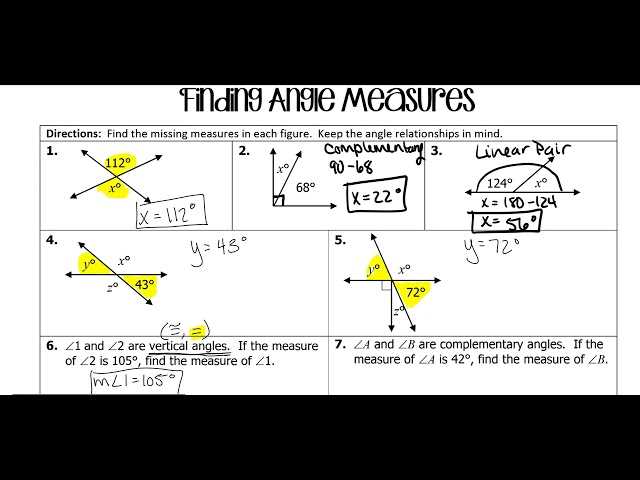
To solve for missing values in geometrical problems, identify the relationships between angles based on known properties. For instance, complementary angles always sum to 90°, while supplementary angles add up to 180°.
In situations involving parallel lines intersected by a transversal, alternate interior angles are congruent, and corresponding angles are equal. Recognizing these basic properties allows you to find missing values without complex calculations.
For triangles, remember that the sum of all interior angles equals 180°. If two angles are known, subtract their sum from 180° to determine the third. This rule applies to both acute and obtuse triangles, making it a reliable method for solving for unknown values in simple and composite shapes.
When working with exterior angles, the exterior angle theorem is useful: the exterior angle is equal to the sum of the two remote interior angles. This relationship can simplify the process of finding unknown angles in polygons.
Identifying Types of Angles in Geometrical Figures
Acute angles are those that measure less than 90°. Look for sharp corners or angles smaller than a right angle in figures like triangles or polygons.
Right angles measure exactly 90°. These can be identified by the presence of a square corner, typically seen in rectangles, squares, or any figure with perpendicular lines.
Obtuse angles are greater than 90° but less than 180°. In geometric shapes, they often appear in wide, open corners, such as in some types of triangles or polygons with larger internal angles.
Reflex angles are larger than 180° but less than 360°. These angles are common in rotated or extended shapes where the interior angle exceeds a straight line.
Straight angles are exactly 180°. They appear when two lines form a straight line, commonly seen in linear figures and angles formed by collinear points.
Complementary angles sum to 90°. If two angles together form a right angle, they are complementary, often found in rectangular shapes or when lines intersect at right angles.
Supplementary angles add up to 180°. Two angles that form a straight line are supplementary, commonly found in linear pairs when lines intersect.
Understanding Complementary and Supplementary Angles
Complementary angles are two angles that together form a right angle, meaning their sum equals 90°. For example, if one angle measures 40°, the other must be 50° to complete the 90° total.
These pairs of angles are frequently seen in geometric shapes where right angles are present, such as in rectangles or right triangles. Identifying complementary angles involves recognizing when two angles share a common vertex and are adjacent, or next to each other, forming a 90° total.
Supplementary angles are two angles whose sum equals 180°. These angles form a straight line when placed next to each other. For instance, an angle of 110° and 70° are supplementary because together they add up to 180°.
Supplementary angles are commonly encountered in linear pairs, especially in situations where two lines intersect, such as in the case of intersecting straight lines forming a linear angle pair. This concept is also critical in polygon angle calculations.
To solve problems involving complementary or supplementary angles, remember to subtract the given angle from 90° for complementary angles, or from 180° for supplementary angles, to find the missing angle.
Using Vertical Angles to Determine Unknown Measures
Vertical angles are always congruent, meaning they have the same measure. When two lines intersect, they create two pairs of opposite angles. For example, if one angle measures 40°, the vertically opposite angle also measures 40°.
To determine unknown values, look for intersecting lines that create vertical pairs. If one angle is known, the other opposite angle will have the same measure. This is crucial for solving geometric problems efficiently.
When solving for an unknown angle, simply identify the vertical pair and apply the principle that vertical angles are equal. If one angle in the pair is 60°, the other will automatically be 60° as well.
These principles can be applied to more complex problems, including polygons and triangles, where vertical angles are often used to simplify calculations. Always ensure that vertical angles are correctly identified before making assumptions or applying further geometric rules.
Applying the Concept of Corresponding Angles
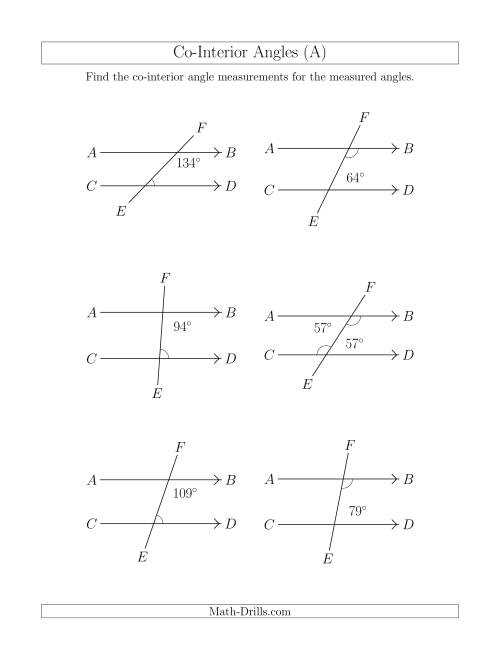
Corresponding angles occur when two parallel lines are intersected by a transversal. These angles are located in the same position relative to the parallel lines and transversal. When the lines are parallel, corresponding angles are congruent, meaning they have the same measure.
To solve for an unknown measure, first identify the pair of corresponding angles. If one angle is known, the corresponding angle will be equal. For instance, if one angle is 45°, the corresponding angle will also be 45°.
This concept is particularly useful when working with parallel lines and transversals. By recognizing corresponding angles, you can simplify problems by setting the angles equal to each other, thus eliminating the need for complex calculations.
In problems involving parallel lines, always verify that the lines are indeed parallel before applying the corresponding angle rule. Misidentifying the parallel lines could lead to incorrect conclusions.
Solving for Angles with Parallel Lines and Transversals
When two parallel lines are cut by a transversal, several types of angles are formed that can be used to solve for unknown values. These include alternate interior, alternate exterior, corresponding, and consecutive interior angles. Each type follows specific rules for calculating unknowns.
For corresponding angles, the rule is straightforward: if the lines are parallel, the corresponding angles are equal. For example, if one angle is 60°, the corresponding angle on the opposite side of the transversal will also be 60°.
Alternate interior angles, which are on opposite sides of the transversal and inside the parallel lines, are also congruent when the lines are parallel. If you know one angle, the alternate interior angle will share the same value.
For consecutive interior angles, the sum of these angles equals 180° when the lines are parallel. This property can be used to solve for missing angles by subtracting a known angle from 180°.
When working with problems, first identify the type of angle pair formed by the transversal and parallel lines. Then, apply the appropriate rule based on the type of angle and the given values to solve for unknown angles.
Using Triangle Angle Sum Theorem for Angle Measures
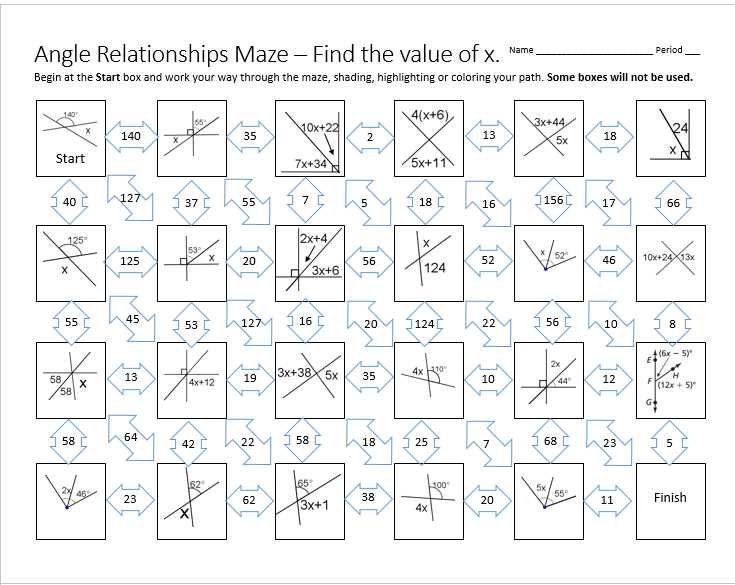
The Triangle Angle Sum Theorem states that the sum of the interior angles of any triangle is always 180°. This rule can be applied to solve for unknown values within a triangle.
To use this theorem effectively, follow these steps:
- Identify the known angles within the triangle.
- Subtract the sum of the known angles from 180° to determine the unknown angle.
For example, if two angles of a triangle are 50° and 60°, the third angle can be calculated as follows:
- 180° – (50° + 60°) = 70°.
This method is useful for solving problems where one or two angles are missing, as long as the sum of all angles within the triangle equals 180°.
Leveraging Exterior Angle Theorem to Find Unknown Angles
The Exterior Angle Theorem states that an exterior angle of a triangle is equal to the sum of the two non-adjacent interior angles. This can be applied to determine an unknown angle outside a triangle.
To solve for an exterior angle, follow these steps:
- Identify the two interior angles that are not adjacent to the exterior angle.
- Sum the values of the two interior angles.
- The sum will be equal to the exterior angle.
For example, if the two non-adjacent interior angles of a triangle are 40° and 60°, the exterior angle can be calculated as:
- 40° + 60° = 100°.
This method is effective when you are given an exterior angle and need to calculate unknown interior angles or other exterior angles.
Working with Angle Relationships in Polygons
In polygons, the sum of the interior angles can be calculated using the formula: (n – 2) × 180°, where “n” is the number of sides of the polygon. This formula helps to determine the total sum of all the interior angles, which is crucial for calculating individual angle values.
For regular polygons, where all angles are equal, the measure of each interior angle can be found by dividing the total sum by the number of sides (n). The formula for this is:
- Each interior angle = (n – 2) × 180° / n.
For example, in a regular hexagon (6 sides), the total interior angle sum is:
- (6 – 2) × 180° = 720°.
- Each interior angle = 720° / 6 = 120°.
Similarly, exterior angles of polygons can be determined by knowing that the sum of the exterior angles of any polygon is always 360°. For regular polygons, each exterior angle can be calculated by dividing 360° by the number of sides (n):
- Each exterior angle = 360° / n.
For more detailed formulas and examples, visit the Khan Academy Geometry section.