Comprehensive Guide to Solving Algebra 2 Problems for High School Students
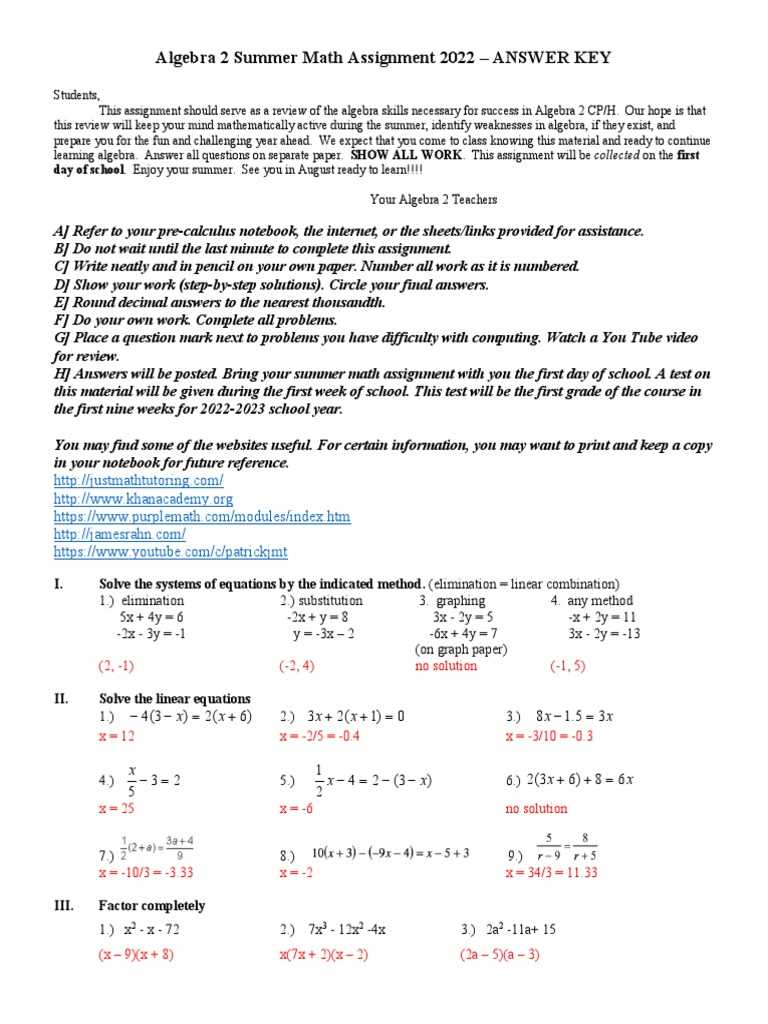
To tackle challenging equations, break each problem into smaller, manageable steps. Begin by identifying the variables and constants, then isolate the variable of interest. This method will help you focus on key aspects of the problem, ensuring that you can apply the correct operations at each stage.
Consult the provided solutions to check your work. Use them as a learning tool, comparing each step to your approach. This will help you identify any misunderstandings or missteps in your calculations. By reviewing the solution process in detail, you can reinforce your understanding of each concept and technique.
It’s also helpful to solve similar problems to strengthen your skills. The more practice you get, the more confident you’ll become in your problem-solving abilities. Apply the methods you’ve learned to different types of exercises to see how flexible the techniques can be across various scenarios.
Comprehensive Guide to Solving Algebra 2 Problems for High School Students
Begin by carefully reading the problem and identifying key variables and constants. Clearly define what you’re trying to solve for and look for relationships between different terms in the equation.
To solve equations with multiple steps, start by simplifying both sides. Combine like terms, distribute where necessary, and move constants to one side while isolating the variable. This step-by-step approach ensures you stay organized throughout the process.
For equations involving fractions or complex denominators, first eliminate fractions by multiplying through by the least common denominator (LCD). This will simplify the equation and make it easier to solve.
Check your work at each step by substituting your solution back into the original equation. This will verify that the solution satisfies the equation, helping to catch any potential errors early in the process.
Practice with a variety of problems. Solving different types of equations–whether they involve quadratics, systems of equations, or rational expressions–will enhance your problem-solving skills and build confidence in applying different strategies.
Understanding the Structure of Algebra 2 Problems

Each problem in advanced equation solving follows a predictable pattern. The first step is identifying the components: variables, constants, and operators. These are the building blocks you’ll manipulate through various mathematical procedures.
Start by categorizing the type of problem you’re facing. Is it a linear equation, quadratic, or rational expression? Knowing the structure allows you to select the appropriate method for solving, whether it’s factoring, completing the square, or using the quadratic formula.
Next, understand the operations involved. Problems often require multiple steps–simplification, distribution, isolating the variable, and checking solutions. Ensure that each operation aligns with algebraic rules, such as the distributive property or combining like terms.
The most challenging problems may involve combining different types of equations. For example, a system of equations may require both substitution and elimination methods. Identifying the best strategy depends on how the equations are structured and what the goal is–solving for one variable or multiple unknowns.
Review practice problems on reputable sites like Khan Academy, where each lesson explains problem structures in detail, offering step-by-step solutions that reinforce key concepts.
How to Use the Answer Key for Verifying Your Work
After solving a problem, use the provided solutions to double-check your results. This helps identify any errors or misconceptions in your approach. Follow these steps for effective verification:
- Compare Step-by-Step: Ensure your solution process matches the steps outlined in the solution. If any step is missing or incorrect, identify where the mistake occurred.
- Check Final Answer: Cross-reference your final result with the solution key. If they differ, retrace your calculations to spot the error.
- Understand the Method: If the answer key provides a different approach, analyze it to see if you missed an easier or more efficient method.
- Rework Complex Problems: For more complicated problems, try solving them from scratch after reviewing the solution. This reinforces learning and helps you catch any mistakes.
Regularly using the solution guide this way allows you to correct mistakes immediately and build stronger problem-solving habits over time.
Common Algebra 2 Mistakes and How to Avoid Them
Avoiding common errors in advanced equations is key to mastering problem-solving. Here are the most frequent mistakes and tips for preventing them:
- Sign Errors: One of the most common issues occurs when students forget to change the sign when multiplying or dividing by negative numbers. Always double-check your signs before finalizing the solution.
- Distributive Property Mistakes: Failing to correctly distribute terms in an expression can lead to incorrect results. Practice breaking down each step clearly, especially in expressions with parentheses.
- Incorrect Factorization: Factorization is a critical skill in solving quadratic equations. Ensure you’re using the correct method, whether factoring by grouping, using the quadratic formula, or completing the square.
- Ignoring Restrictions: In some problems, such as rational expressions or square roots, there are domain restrictions that students may overlook. Always check for conditions where variables can’t be zero or negative under a square root.
- Confusing Exponent Rules: Misapplying exponent laws can lead to major mistakes. Review the laws for multiplying, dividing, and raising powers to powers, especially when handling negative or fractional exponents.
- Overlooking Common Denominators: When working with fractions, especially in rational expressions, it’s important to find a common denominator. Failing to do so can prevent proper simplification of expressions.
By identifying these common pitfalls and actively working to avoid them, you can significantly improve accuracy and problem-solving efficiency in complex problems.
Step-by-Step Guide for Solving Algebra 2 Equations
Follow this structured approach to solve complex equations with confidence:
- Identify the Type of Equation: Determine if the equation is linear, quadratic, rational, or involves exponents. This will dictate the method you use for solving.
- Simplify Both Sides: Combine like terms on each side of the equation. Eliminate parentheses and simplify expressions where possible.
- Isolate the Variable: Use addition, subtraction, multiplication, or division to get the variable on one side of the equation. Move constant terms to the opposite side.
- Apply Appropriate Operations: If the equation involves fractions, find a common denominator. For exponentials, apply the power rule. When dealing with quadratic equations, use factoring or the quadratic formula as needed.
- Check for Special Conditions: In cases where you are solving for square roots or rational expressions, check for domain restrictions, such as avoiding negative values under square roots or denominators being zero.
- Verify the Solution: Substitute the value of the variable back into the original equation to ensure both sides are equal. This step confirms the correctness of your solution.
By breaking down the process into these steps, you can systematically approach any problem and solve it more efficiently.
Using the Answer Key to Improve Problem-Solving Strategies
Review the solutions provided to identify patterns in solving problems. Break down each step to understand the reasoning behind it, especially when working with complex equations.
Focus on the techniques used in each solution, such as factoring, applying the quadratic formula, or simplifying expressions. Pay attention to the order of operations and how each step contributes to reaching the final result.
Use the solutions to identify common mistakes. Compare your approach with the provided answer to spot where you may have gone wrong. This will help refine your strategy and avoid similar errors in the future.
Practice solving problems without looking at the solutions first. Afterward, compare your steps to the correct solutions to evaluate your understanding. This feedback loop will help strengthen your problem-solving abilities over time.
By using the solutions strategically, you can improve your approach to tackling challenging problems, refine your mathematical skills, and increase your confidence in problem-solving.
How to Approach Word Problems in Algebra 2
Read the problem carefully and identify the key information. Pay attention to any numbers, variables, or relationships mentioned in the text. Highlight or underline important details that will guide you through the solution.
Translate the problem into an equation or set of equations. Identify what each variable represents and how the terms in the word problem relate to one another. Breaking the problem into smaller, more manageable parts can simplify the process.
Look for clues that suggest which mathematical operations to use. Common indicators like “total,” “difference,” or “per” can help determine whether you need to add, subtract, multiply, or divide. These phrases often provide a direct link to the correct formula or method.
Once you’ve set up the equation, solve step by step, checking your work as you go. If the problem involves multiple steps, be sure to revisit the problem and verify that you haven’t missed any critical information along the way.
If you encounter difficulty, review the steps you’ve taken and make sure you haven’t misunderstood the word problem. Rewriting the problem in simpler terms can also help clarify the situation and reveal the solution.
Additional Resources to Support Algebra 2 Learning
Utilize online platforms such as Khan Academy for free video tutorials and practice exercises. The interactive lessons break down complex topics and allow you to test your understanding with immediate feedback.
Explore interactive problem-solving tools like Wolfram Alpha, which provides step-by-step solutions to a wide variety of problems. This tool can help clarify difficult concepts and offer alternative methods for solving equations.
Check out online forums and study groups on platforms like Reddit and Stack Exchange. These communities allow students to ask questions, share solutions, and collaborate with peers to understand difficult concepts.
Review textbooks and practice workbooks available at local libraries or through educational websites. These often provide additional problems with answers to help reinforce your understanding and improve problem-solving speed.
Consider enrolling in supplementary online courses or tutoring programs that specialize in high school subjects. These services can provide personalized attention and focused practice on areas where you may need extra help.
Tips for Practicing Algebra 2 Outside of Homework Assignments
Set aside time each week to work on additional practice problems from online resources or textbooks. Focus on areas where you struggle, and aim to solve problems without referring to solutions until you can consistently answer correctly.
Create your own set of problems based on the topics you are learning. This will help reinforce your understanding and give you a chance to explore different types of questions and approaches.
Use mobile apps like Photomath or Microsoft Math Solver to practice solving problems. These tools can provide step-by-step breakdowns of solutions, helping you understand the reasoning behind each step.
Form a study group with classmates. Sharing solutions and discussing different methods can lead to a deeper understanding of concepts and help you spot areas that need more focus.
Challenge yourself with timed quizzes to improve speed and accuracy. Set a timer for each problem to simulate test conditions and build confidence under pressure.
Incorporate real-world problems into your practice. Apply mathematical concepts to solve everyday problems such as budgeting, measuring, or even planning a trip, to see how these skills are used outside the classroom.