Complete Guide to Solving Special Right Triangle Problems in Delta Math
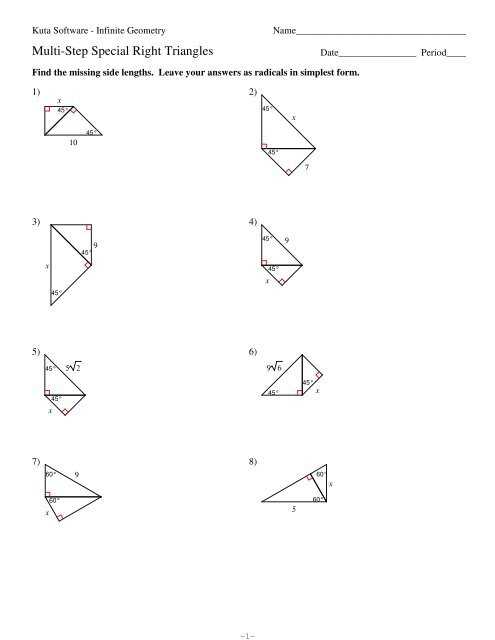
To solve problems involving 30-60-90 and 45-45-90 figures, start by memorizing the ratios for the side lengths. In a 30-60-90 shape, the shorter leg is half the length of the hypotenuse, and the longer leg is the shorter leg multiplied by √3. For 45-45-90 shapes, the two legs are equal, and the hypotenuse is √2 times the length of each leg. Familiarize yourself with these relationships before attempting any calculations.
For finding missing sides, ensure you understand the formulas derived from these ratios. It’s crucial to identify the angle measurements first and match them with the appropriate rule. For more complex problems, start by labeling each side of the figure correctly, then apply the ratios accordingly to avoid confusion.
Check your work by substituting the calculated side lengths back into the problem’s context. For example, if you’re asked to find the area of a figure using the side lengths, make sure the sides match the specified values. Double-checking calculations in this way can help ensure accuracy.
Solutions for Common Right Triangle Problems
To solve for the side lengths of a 30-60-90 triangle, remember the following ratios:
- The shorter leg is half the length of the hypotenuse.
- The longer leg is the shorter leg multiplied by √3.
For a 45-45-90 figure, the legs are congruent, and the hypotenuse is √2 times the length of each leg.
Let’s walk through an example for each case:
| Problem | Solution |
|---|---|
| 30-60-90 triangle: Hypotenuse = 10, find shorter leg. | Shorter leg = 10 / 2 = 5. |
| 45-45-90 triangle: Leg = 6, find hypotenuse. | Hypotenuse = 6√2 ≈ 8.49. |
For additional problems, follow these basic steps:
- Identify the angles and type of triangle.
- Use the corresponding ratio for the side lengths.
- Check the work by plugging values back into the problem.
Understanding the 30-60-90 Triangle Ratio
In a 30-60-90 figure, the side lengths follow a specific ratio that allows for quick calculations. The side lengths are proportional to the following:
- The shorter leg is half the length of the hypotenuse.
- The longer leg is the shorter leg multiplied by √3.
To apply this, start by identifying the hypotenuse. Then, use these rules to find the other two sides. Here’s a simple example:
| Problem | Solution |
|---|---|
| Hypotenuse = 12, find shorter leg and longer leg. | Shorter leg = 12 / 2 = 6. Longer leg = 6√3 ≈ 10.39. |
To verify the solution, check that the longer leg is √3 times the shorter leg and that the hypotenuse is twice the shorter leg. This method works consistently with all 30-60-90 figures.
Solving Problems with 45-45-90 Triangles

For a 45-45-90 figure, the side lengths are always proportional. The ratio between the two legs and the hypotenuse is straightforward:
- Both legs are equal in length.
- The hypotenuse is √2 times the length of either leg.
To find missing sides, simply use the following formula:
- If the leg length is known: Hypotenuse = leg × √2.
- If the hypotenuse is given: Leg = hypotenuse / √2.
Example:
| Problem | Solution |
|---|---|
| Leg = 7, find hypotenuse. | Hypotenuse = 7 × √2 ≈ 9.90. |
| Hypotenuse = 10, find leg. | Leg = 10 / √2 ≈ 7.07. |
By applying this simple ratio, you can easily solve for unknown sides in any 45-45-90 configuration.
Using the Pythagorean Theorem in Special Right Triangles
The Pythagorean Theorem applies to all right-angled figures and can help solve for missing sides in these shapes. The formula is:
- c² = a² + b²
- Where c is the hypotenuse, and a and b are the legs.
For special configurations like the 45-45-90 or 30-60-90 types, you can use this theorem to confirm the side ratios.
- In a 45-45-90 shape, the legs are equal, and the hypotenuse is √2 times the length of a leg.
- In a 30-60-90 shape, the hypotenuse is twice the shorter leg, and the longer leg is √3 times the shorter leg.
Example 1: In a 45-45-90 shape, if one leg is 5:
- Hypotenuse = 5 × √2 ≈ 7.07
Example 2: In a 30-60-90 shape, if the shorter leg is 4:
- Hypotenuse = 4 × 2 = 8
- Longer leg = 4 × √3 ≈ 6.93
Use the Pythagorean theorem to verify or calculate missing lengths and confirm the side ratios for both types of configurations.
How to Identify Special Right Triangles in Problems
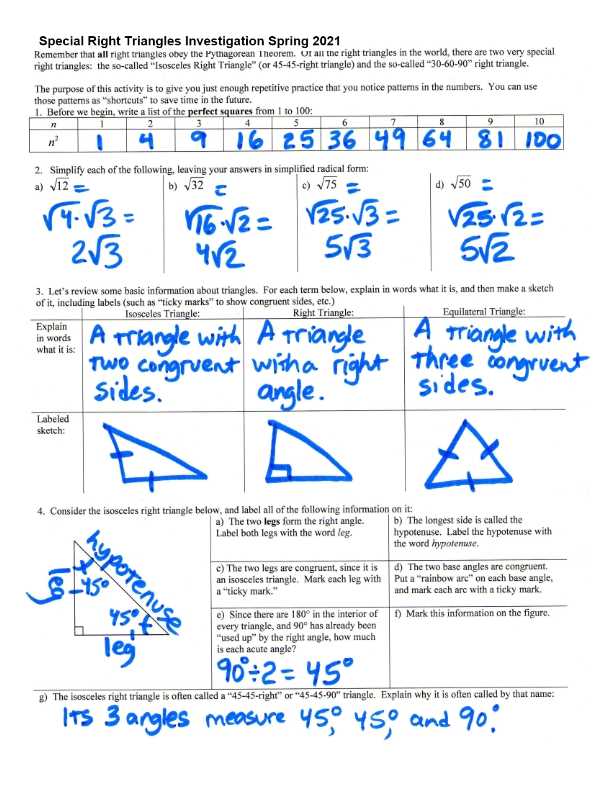
Look for specific angle measures: 45°, 45°, 90° or 30°, 60°, 90°. These are key indicators of the two main types of configurations.
For a 45-45-90 shape:
- Both legs are equal in length.
- The hypotenuse is √2 times the length of a leg.
For a 30-60-90 shape:
- The hypotenuse is twice the length of the shorter leg.
- The longer leg is √3 times the length of the shorter leg.
Check for specific side ratios. If the problem provides one leg, and the other two sides align with known ratios (like √2 or √3 multiples), it’s likely a special configuration.
Verify the angle measures. If the angles fit the standard 45°, 45°, 90° or 30°, 60°, 90° patterns, the triangle is special.
Use the given sides to calculate missing lengths. If the ratios match the known ones for these configurations, you’ve identified a special triangle.
Step-by-Step Method to Find Missing Sides in Right Triangles
1. Identify the given information: Check which sides or angles are provided in the problem.
2. Use the Pythagorean theorem: If two sides are known, apply the formula a² + b² = c² to find the third side. Here, a and b are the legs, and c is the hypotenuse.
3. Apply known ratios for specific triangles: For a 45-45-90 triangle, the legs are equal, and the hypotenuse is leg × √2. For a 30-60-90 triangle, the longer leg is short leg × √3 and the hypotenuse is 2 × short leg.
4. Rearrange the Pythagorean theorem if necessary: If the hypotenuse or one leg is missing, rearrange the formula to c = √(a² + b²) or a = √(c² – b²) to solve for the unknown side.
5. Check the solution: Verify the result by ensuring the side ratios or the Pythagorean theorem hold true.
Common Mistakes to Avoid When Working with Special Right Triangles
1. Confusing the leg ratios: In a 45-45-90 triangle, the legs are equal, and the hypotenuse is leg × √2. Ensure you don’t mix up the ratio with other triangle types.
2. Incorrectly using the 30-60-90 ratios: Remember that the shorter leg is half of the hypotenuse, and the longer leg is short leg × √3. Mistakes happen when the side lengths are confused or swapped.
3. Forgetting the Pythagorean theorem: While working with the given ratios, never ignore the Pythagorean theorem. It helps confirm the correctness of side lengths, especially if the triangle doesn’t fit typical ratios.
4. Misapplying the formula for the hypotenuse: In many cases, it’s easy to mistakenly multiply the wrong side by √2 or √3. Always double-check which side is the hypotenuse and which are the legs.
5. Not simplifying square roots: If you end up with an expression involving a square root, remember to simplify it. For example, √8 simplifies to 2√2, which may make it easier to work with.
6. Ignoring the unit of measurement: Ensure that all side lengths are in the same unit before performing calculations. Mixing up units can lead to significant errors.
How to Verify Your Solutions for Accuracy
1. Double-check your calculations: After finding the side lengths, quickly verify each step by reviewing your math. Pay close attention to square roots and ensure you’ve applied the correct ratio for the given triangle type.
2. Use the Pythagorean theorem: Verify your work by applying the theorem. For any triangle, the sum of the squares of the legs should equal the square of the hypotenuse. If this holds, your solution is likely correct.
3. Cross-check with known ratios: For common triangle types like 45-45-90 and 30-60-90, compare your results with standard ratios. For example, in a 45-45-90 triangle, both legs should be equal, and the hypotenuse should be leg × √2.
4. Compare with a calculator or reference: If possible, verify your final results using a calculator or online tool to check the side lengths. This helps confirm accuracy, especially with complex numbers or square roots.
5. Check unit consistency: Ensure that all units of measurement are consistent. If you use inches for one side, make sure all other sides are in inches, and you’re applying the correct conversion factors where necessary.
6. Rework key steps: If something doesn’t seem right, trace back to earlier steps. Often, errors occur due to misinterpreting a side length or incorrect application of a formula. Rerun the calculation from that point.
Applying Special Right Triangle Concepts to Real-World Problems
1. Construction and Architecture: When building structures like rooftops or ramps, the principles of 30-60-90 and 45-45-90 triangles are often used. For example, if you’re designing a roof with a 45-degree slope, the sides of the resulting triangle will have a predictable ratio, allowing for precise material estimation and stability calculations.
2. Navigation and Distance: In navigation, triangles are used to calculate distances between points when you have an angle and a side length. For example, using the 30-60-90 triangle ratio, you can quickly determine distances on a map when a straight path forms a triangle with a known angle.
3. Engineering and Design: In mechanical engineering, special triangles help in calculating the dimensions of gears, levers, or other tools. For instance, if you need to design a gear system that involves right-angle components, knowing the side relationships from a 45-45-90 triangle can streamline the design process.
4. Electronics and Signal Processing: In signal processing, triangle ratios help in the construction of various circuits, especially when working with waveforms and signals that involve right angles. Electrical engineers use these principles when determining phase shifts or setting up the components of a circuit to ensure proper functioning.
5. Art and Graphics: Special triangles also play a role in graphic design and artwork. Artists often use the properties of 30-60-90 triangles to create visually balanced compositions. Whether framing a piece or ensuring symmetry, the predictable nature of these triangles simplifies the process.
For further detailed applications of these concepts, see Khan Academy’s Trigonometry Section, where these real-world applications are explained in greater detail.