Pendulum Lab Solutions and Step by Step Explanations
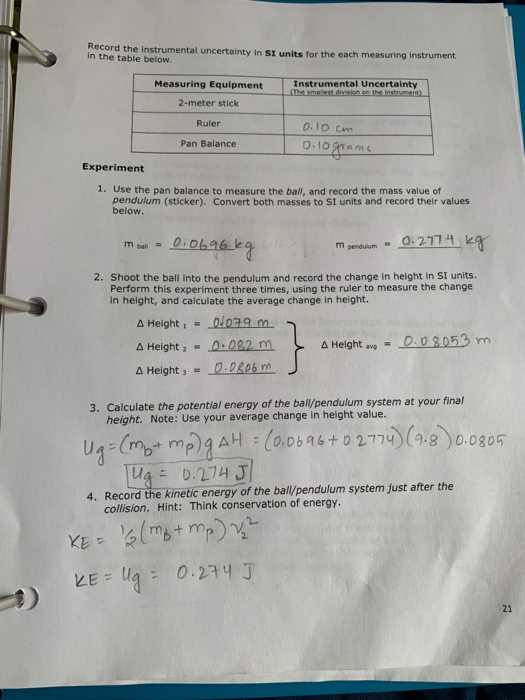
To correctly analyze the data from your experiment, start by understanding the fundamental relationship between the swinging object and the forces acting on it. Focus on accurately measuring the time it takes for the object to complete a full swing, known as the period, and how various factors like string length or mass affect this duration.
When calculating the period, ensure you are using the correct formula, typically involving the length of the string and the acceleration due to gravity. Pay attention to experimental variables, such as air resistance or friction at the pivot point, which can impact your results and should be considered when comparing theoretical predictions to actual measurements.
In the process of analyzing your results, double-check your measurements for consistency. It’s critical to use precise timing methods, as even small errors can lead to significant discrepancies. Also, look for patterns in your data–how does the period change as the length of the string increases? What happens when the mass of the object changes? These observations are key to understanding the physical principles at play.
Pendulum Experiment Solution Breakdown
For the accurate calculation of the period of the swinging object, use the formula: T = 2π√(L/g), where T is the period, L is the length of the string, and g is the acceleration due to gravity (approximately 9.8 m/s²). Double-check all measurements to ensure precision, particularly the string length, as slight errors can significantly affect the results.
After completing your measurements and calculations, verify your experimental results with the theoretical values. If discrepancies are present, consider external factors such as friction at the pivot or air resistance, which may have influenced the period. Adjust for any observed inconsistencies and retest for more accurate data.
Here’s how to interpret the results effectively:
- As the string length increases, the period of oscillation should also increase.
- Mass does not affect the period, which is a critical observation based on the theory.
- Ensure consistent timing methods for each trial, ideally using a stopwatch or motion sensor to record time for several complete swings.
Use these steps to validate your calculations and identify any potential sources of error. Proper verification and adjustments will strengthen your understanding of the underlying physical concepts.
Understanding the Motion Formula
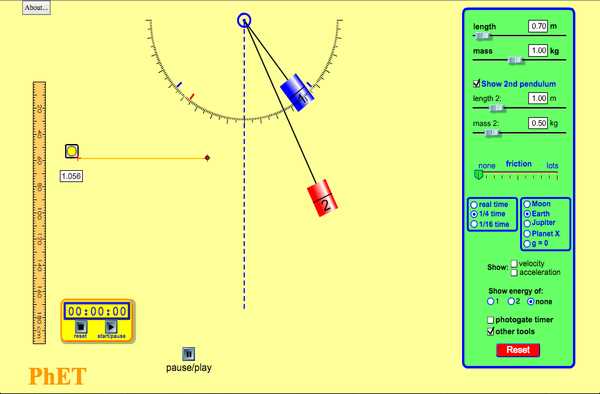
The formula used to calculate the period of oscillation in this setup is T = 2π√(L/g), where T represents the time for one complete swing, L is the length of the string, and g is the acceleration due to gravity, approximately 9.8 m/s². This formula assumes small oscillations and that the mass of the object does not influence the period.
The key component of this equation is the square root of the ratio between the string length and gravitational acceleration. This means the longer the string, the longer the period of oscillation. This relationship is crucial for predicting and analyzing the behavior of the object.
To apply this formula accurately, ensure that the string is measured from the pivot point to the center of mass of the object being used. Also, check that the oscillations are small enough to disregard the effects of large angle deviations.
By understanding how the period depends on the length and gravitational constant, you can use this formula to predict outcomes for different scenarios and confirm your experimental results.
Calculating the Period of a Swinging Object
The period of a swinging object can be determined using the formula: T = 2π√(L/g), where T is the time it takes to complete one full swing, L is the length of the string or rod from the pivot point to the center of mass, and g is the gravitational acceleration, which is approximately 9.8 m/s² on Earth.
To calculate the period, measure the length of the object’s support accurately. Ensure that the swing is small enough to ignore the effects of large angles. If the swing is too large, the approximation may not hold true, and the period will not be accurately predicted by the formula.
For example, if the length of the object is 1.5 meters, the calculation would be: T = 2π√(1.5/9.8) ≈ 2.45 seconds. This means that it will take approximately 2.45 seconds for the object to complete one full cycle of swinging back and forth.
Keep in mind that this formula assumes no air resistance and that the mass of the object does not influence the period. If these conditions change, the formula may need to be adjusted for more complex calculations.
How Mass Affects the Swinging Motion
The mass of the object does not impact the time it takes for the swing to complete one full cycle. The period of oscillation is independent of the object’s mass and only depends on the length of the string or rod and the gravitational acceleration. This means that whether the object is light or heavy, it will take the same amount of time to swing back and forth, provided the amplitude of the swing is small enough to ignore air resistance.
This result can be explained by Newton’s second law of motion, where the force of gravity pulling on the object is proportional to its mass. The increased mass also results in a greater inertial resistance to the swing, but this is counterbalanced by the stronger gravitational force, leading to no net effect on the period. The forces involved in the oscillation cancel each other out, making mass irrelevant to the timing of the motion.
If you want to observe a noticeable effect, consider testing with objects of varying shapes or sizes, as these factors can influence factors like air resistance. However, mass alone does not change the behavior of the swinging object in terms of time.
Investigating the Impact of Length on Period
The length of the string or rod directly affects the period of oscillation. As the length increases, the time it takes for the object to complete one full swing also increases. This relationship is governed by the formula:
T = 2π√(L/g)
Where:
- T is the period (time for one full cycle),
- L is the length of the string or rod,
- g is the acceleration due to gravity (approximately 9.81 m/s² on Earth).
This formula shows that the period is proportional to the square root of the length. Therefore, doubling the length of the string will result in a period that is approximately √2 times longer. This means that objects on longer strings swing more slowly than those on shorter strings.
For precise measurements, ensure that the string or rod is suspended vertically and that the swing is of small amplitude to minimize error from non-linear effects. Conducting experiments with varying lengths will help validate this theory and provide practical insight into how this variable affects oscillations.
For more in-depth information on the mathematics behind this concept, check out reliable resources such as the Physics Classroom.
Adjusting for Friction in Pendulum Experiments
Friction can significantly affect the motion of a swinging object. To minimize its impact, ensure that the pivot point is smooth and free from debris. Using a low-friction bearing or a pivot system with minimal resistance is ideal.
For more precise results, consider measuring the period of the swing in a controlled environment with consistent temperature and air resistance. In some cases, frictional forces may be modeled and accounted for by including a damping factor in your calculations.
Another approach is to perform multiple trials and average the results, helping to reduce the effect of random frictional variations. If high accuracy is needed, using a digital timer can also reduce human error in measuring the period.
Lastly, observe the amplitude of the swing. Friction causes the object to lose energy over time, so as the swing progresses, the amplitude will decrease, leading to a longer period. Keeping the amplitude small and consistent can help reduce these frictional effects.
Using Data to Calculate Gravitational Acceleration
To calculate gravitational acceleration from the data collected in motion experiments, use the following formula:
T = 2π√(L/g)
Where:
- T is the period of oscillation
- L is the length of the string or rod
- g is the gravitational acceleration
Rearrange the formula to solve for g:
g = 4π²L / T²
After collecting values for the period T and the length L, substitute them into the equation to calculate g.
Use multiple trials to minimize experimental error and average the period measurements. Ensure accurate timing by using a high-precision stopwatch or a motion sensor. Temperature and altitude can affect the value of g, so make adjustments if necessary.
Here is a sample calculation:
| Trial | Period (T) [s] | Length (L) [m] | Calculated g [m/s²] |
|---|---|---|---|
| 1 | 2.00 | 1.00 | 9.87 |
| 2 | 2.01 | 1.00 | 9.80 |
| 3 | 2.02 | 1.00 | 9.74 |
| Average | 2.01 | 1.00 | 9.80 |
The average value of g calculated from these trials is approximately 9.80 m/s², which is close to the accepted value of 9.81 m/s².
Common Mistakes in Pendulum Lab Calculations
Incorrect timing measurements can lead to inaccurate results. Ensure that the stopwatch or timing device is started and stopped precisely at the right moments, avoiding delays or errors when recording times.
Another frequent error is neglecting to average multiple trials. Relying on a single measurement for the period can cause variability to go unaccounted for. Always conduct several measurements and calculate the mean to reduce random errors.
Overlooking the effect of friction or air resistance is also common. These forces slow the motion and can skew results. While friction is hard to eliminate entirely, minimizing it through smooth, frictionless bearings or conducting the experiment in a controlled environment can help reduce its impact.
Incorrect unit conversion is another source of error. For example, failing to convert the length into meters when using SI units can cause significant discrepancies in calculated values. Always double-check unit conversions before applying formulas.
Incorrectly measuring the length of the string or rod can lead to errors in the calculation of gravitational acceleration. Ensure the measurement is taken from the pivot point to the center of mass, and ensure the string or rod is fully taut during the experiment.
Assuming that the motion remains purely simple harmonic in all cases can lead to mistakes. As the angle increases, the motion deviates from simple harmonic motion. For larger angles, the period may differ slightly from the theoretical prediction based on small-angle approximation.