How to Classify Polynomials and Understand Their Key Characteristics
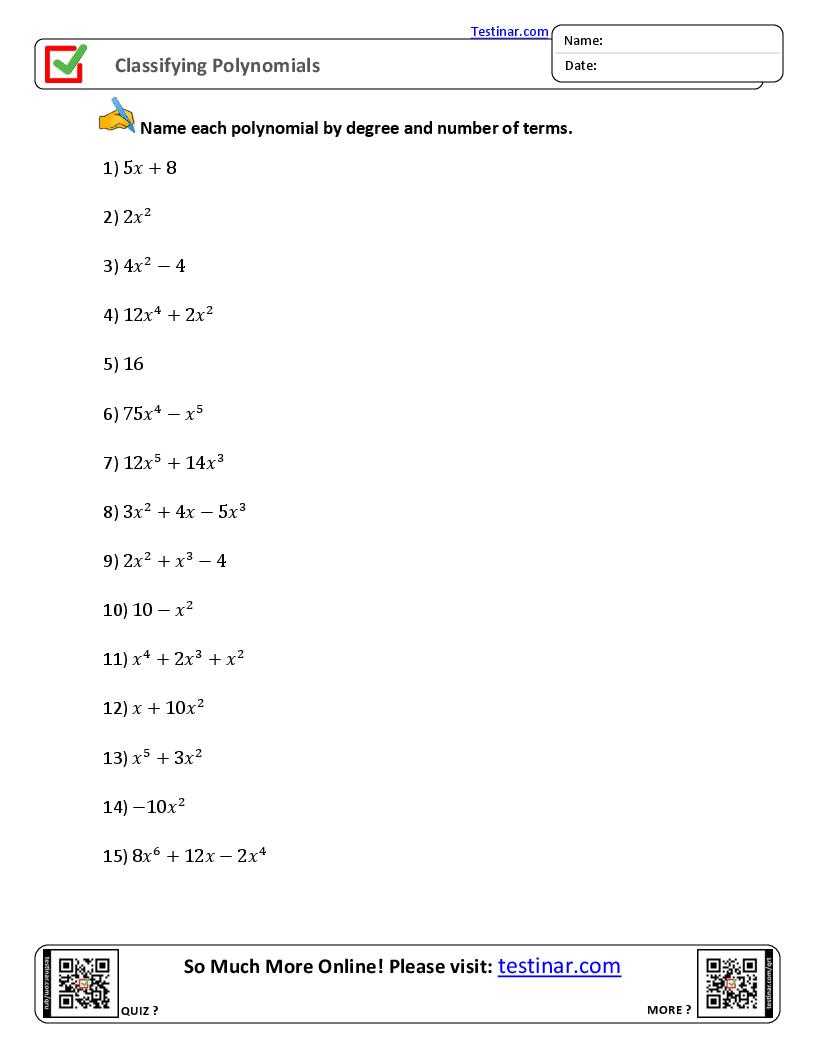
When working with algebraic expressions, it is critical to recognize the different forms these equations can take. The classification process helps organize expressions based on their degree and the number of terms involved, allowing for easier manipulation and problem solving. Understanding the structure of these equations enables more efficient handling of mathematical problems.
Each expression can be categorized as a monomial, binomial, or trinomial, depending on how many terms are present. Additionally, the degree of the expression is a key factor in identifying its characteristics. For example, expressions like x^2 + 3x + 2 are quadratic due to their degree of 2. Recognizing the degree and number of terms allows for better understanding and classification.
By the end of this guide, you will be able to identify and categorize various forms of algebraic expressions accurately. Through detailed examples and step-by-step instructions, the process becomes clearer, ensuring that you can confidently classify any given equation according to its structure and degree.
Classifying Algebraic Expressions: A Step-by-Step Guide
To correctly categorize algebraic expressions, focus on two primary factors: the number of terms and the highest degree of the variable. These characteristics define whether an expression is a monomial, binomial, trinomial, or higher. Here’s how to approach classification:
- Monomial: An expression with a single term, such as 3x or 5a^2.
- Binomial: An expression with two terms, like x + 2 or 4y^2 – 3y.
- Trinomial: An expression with three terms, for example, 2x^2 + 3x – 5 or y^3 + y^2 – 4.
- Higher-order polynomials: These have four or more terms, such as x^4 + 3x^3 – x^2 + 2x + 7.
Next, examine the degree of the expression. The degree refers to the highest power of the variable in the expression. For example, 3x^2 + 4x + 7 has a degree of 2 (quadratic), while 2x^3 – 5x^2 + x is cubic because the highest exponent is 3.
By identifying both the number of terms and the degree, you can categorize any given algebraic expression. Practice by sorting different expressions into these categories to improve your skills in classifying algebraic forms.
Identifying Terms and Degrees in Algebraic Expressions
To identify terms and degrees in an algebraic expression, begin by recognizing individual terms. A term is a product of a constant and one or more variables raised to exponents. For example, in the expression 3x^2 + 2x – 4, the terms are 3x^2, 2x, and -4.
Next, determine the degree of each term. The degree is the highest exponent of the variable in each term. In 3x^2 + 2x – 4, the degree of the term 3x^2 is 2, as the exponent of x is 2. The degree of 2x is 1, and the degree of the constant term -4 is 0, as it does not contain a variable.
Once you identify the terms and their respective degrees, you can determine the degree of the entire expression. This is done by looking at the term with the highest degree. For 3x^2 + 2x – 4, the highest degree is 2, so the degree of the entire expression is 2.
When practicing, break down each algebraic expression into individual terms, identify the degree of each, and then determine the degree of the entire expression. This method helps in both understanding and categorizing algebraic forms accurately.
Classifying Expressions by Their Degree
To categorize an algebraic expression by its degree, identify the highest exponent of the variable in the expression. The degree represents the highest power of the variable and determines the type of expression.
For an expression such as 5x^3 + 2x^2 + 3x + 1, the degree is 3 because the highest exponent is 3 (from 5x^3). The degree helps categorize the expression as a cubic expression.
The following classifications are common based on the degree:
- Degree 0: Constant, e.g., 5
- Degree 1: Linear, e.g., 3x + 2
- Degree 2: Quadratic, e.g., x^2 + 2x + 1
- Degree 3: Cubic, e.g., x^3 – 3x^2 + 2x – 1
- Degree 4: Quartic, e.g., 2x^4 + x^3 – x + 7
Identifying the degree allows you to properly classify the expression and helps in solving or manipulating algebraic problems effectively. Always look for the term with the highest exponent to determine the degree.
For further details and examples, refer to authoritative algebra resources like Khan Academy Algebra.
Classifying Expressions by the Number of Terms
To classify an expression based on the number of terms, examine each distinct part of the expression separated by plus or minus signs. Each part is a term, and the classification depends on the total count of terms.
Common classifications based on the number of terms include:
- Monomial: An expression with only one term, e.g., 3x or 7.
- Binomial: An expression with two terms, e.g., x + 5 or 3x^2 – 2x.
- Trinomial: An expression with three terms, e.g., x^2 + 4x + 3 or 2x^3 – x + 1.
- Multinomial: An expression with more than three terms, e.g., 2x^4 – x^3 + 3x^2 + 4x – 5.
Identifying the number of terms helps determine the structure of the expression, which is crucial for simplifying, solving, or factoring the expression. Always break down the expression into its components to count the terms accurately.
For more practice on this topic, visit Khan Academy’s Algebra Section for tutorials and exercises.
Recognizing Monomials and Binomials
To identify a monomial, look for an expression with only one term. This term can involve a constant, a variable, or a product of constants and variables. The key characteristic of a monomial is that it is not separated by any addition or subtraction signs. For example, expressions like 5x, 3y^2, or 7 are monomials.
On the other hand, a binomial consists of exactly two terms. These terms are separated by a plus or minus sign. The terms can be constants, variables, or combinations of both. For example, x + 2, 3x – 5y, and 4a^2 – 7a are binomials.
- Monomial Examples: 5x, -2, 3x^2y
- Binomial Examples: x + 3, 2y – 4, 4a^2 + b
Recognizing whether an expression is a monomial or binomial simplifies the process of simplifying and solving algebraic equations. Look for the number of terms to classify the expression correctly.
Standard Form for Polynomials
To write an expression in standard form, ensure the terms are ordered from the highest degree to the lowest. The terms should be written in descending order of the exponent of the variable. Each term must be separated by a plus or minus sign. Additionally, no terms should be combined or simplified unless necessary.
The general structure of a polynomial in standard form is as follows:
- The term with the highest degree is placed first.
- All terms with descending powers of the variable follow, separated by plus or minus signs.
- Constant terms are written last, with no variable component.
For example, the standard form of 3x^2 + 5x – 7 has the terms ordered by degree: the term with degree 2 (3x^2), the term with degree 1 (5x), and the constant (-7).
Example of standard form:
- 5x^3 + 2x^2 – 4x + 3 is in standard form because the exponents of the variable are ordered from highest to lowest.
- 2 – 3x + x^2 is not in standard form because the terms are not ordered by degree. The correct form would be x^2 – 3x + 2.
Always ensure that terms are ordered properly and no like terms are omitted in the process of writing the polynomial in standard form.
Identifying Leading Coefficients and Their Role
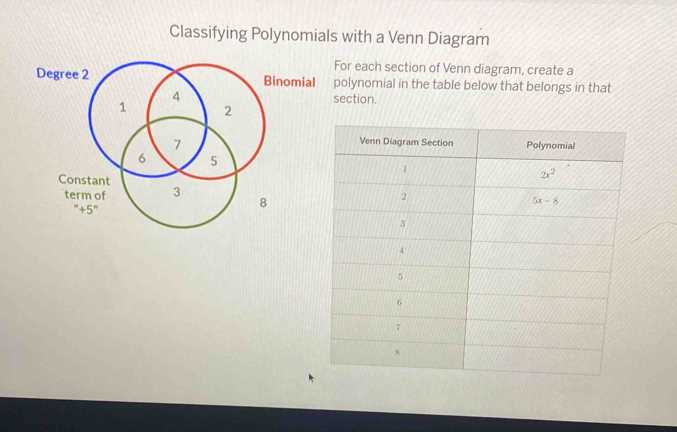
The leading coefficient is the coefficient of the term with the highest degree in a given expression. Identifying this coefficient is crucial for understanding the behavior of the expression, particularly its graph and overall properties.
To find the leading coefficient, first identify the term with the largest exponent. The coefficient of that term is the leading coefficient. For example, in the expression 5x^3 + 2x^2 – 4x + 7, the leading coefficient is 5 because the term with the highest degree is 5x^3.
The leading coefficient plays a key role in determining the direction of the graph of the expression. For example:
- If the leading coefficient is positive and the degree is odd, the graph will rise to the right and fall to the left.
- If the leading coefficient is negative and the degree is odd, the graph will fall to the right and rise to the left.
- If the leading coefficient is positive and the degree is even, the graph will rise on both sides.
- If the leading coefficient is negative and the degree is even, the graph will fall on both sides.
In addition to its graphical implications, the leading coefficient is also important for simplifying expressions and determining end behavior in mathematical analysis. Always focus on the term with the highest degree to determine the leading coefficient.
Common Mistakes When Identifying and Grouping Expressions
A common mistake is failing to identify the correct degree of a term. Ensure you are accurately identifying the term with the highest exponent. For instance, in the expression 3x^2 + 2x^3 – x + 5, the highest degree is 3, not 2. The degree of the expression is determined by the highest exponent, not just the first term you see.
Another frequent error is misidentifying the number of terms. Be careful not to confuse terms separated by addition or subtraction. For example, in 4x^2 – 3x + 7, there are three distinct terms: 4x^2, -3x, and 7.
Additionally, it’s important to avoid overlooking negative signs in the coefficients. A negative sign in front of a term affects the classification, especially when determining the direction of the graph. For example, -2x^3 + x – 1 has a degree of 3, but the negative sign on the leading term indicates a different graph behavior compared to a positive leading coefficient.
Finally, don’t confuse terms involving exponents with other operations. For example, x^2 + x/2 is not the same as 2x or x^2 + 1. Division should be handled with caution to avoid classifying expressions incorrectly.
Practical Examples for Identifying Expressions
Example 1: 3x^4 – 5x^2 + 7x – 2
In this expression, the highest degree is 4 (from the term 3x^4). It has four terms, so the degree is 4, and since there are more than two terms, it is a four-term expression.
Example 2: 7x^3 + 2x – 1
Here, the highest degree is 3 (from 7x^3). The expression has three terms, so it’s a cubic expression with three terms.
Example 3: 2x^2 – 5x + 3
This is a quadratic expression with a degree of 2 (from 2x^2) and three terms. Quadratics always have a degree of 2 and typically consist of three terms.
Example 4: 5x – 6
This expression has two terms and the degree of 1 (from 5x), which makes it a linear expression. Linear expressions have a degree of 1 and typically consist of two terms.
Example 5: 4
In this case, the degree is 0 because the expression is just a constant term. A constant term has no variable, so its degree is always 0, and it has only one term.
By identifying the highest degree and the number of terms, you can quickly classify expressions into their appropriate categories.