Understanding Changes of State and Phase Transitions in Physics
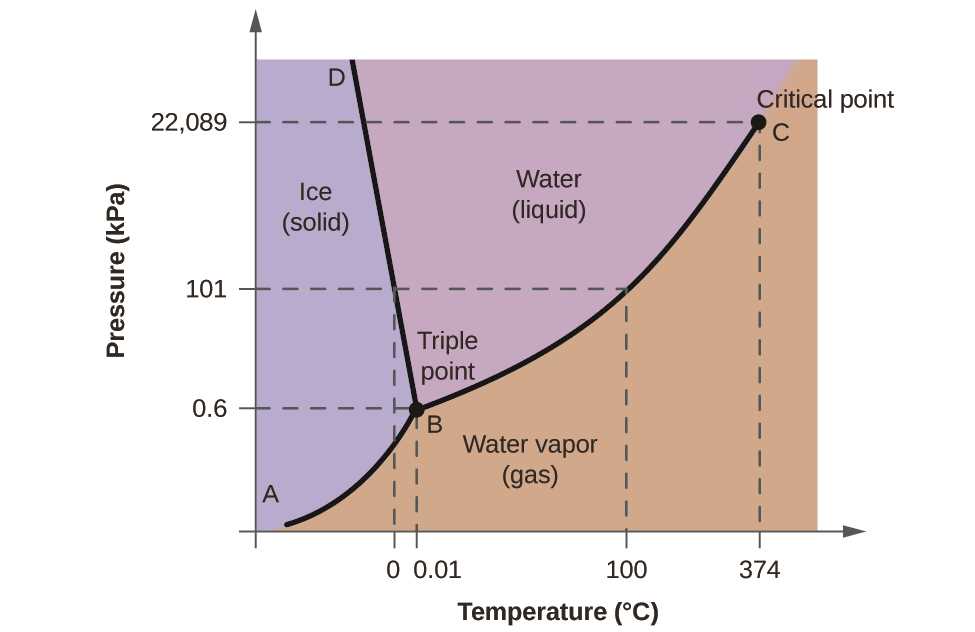
To understand how matter behaves under different conditions, it’s crucial to examine the transition between its various forms: solid, liquid, and gas. Recognizing how temperature and pressure influence these transformations will help in solving related problems. Whether it’s ice melting into water or water vapor condensing into a liquid, the underlying processes follow predictable patterns that can be quantified using specific principles.
The transfer of energy plays a key role during these phase shifts. When substances change from one form to another, energy is either absorbed or released, influencing temperature, pressure, and volume. Grasping how energy interacts with matter during these transitions is essential for understanding the physical world around us. For instance, when ice melts, it absorbs heat, while the condensation of water vapor releases energy.
In this section, we will review the main principles of these transitions, how they can be calculated, and their real-world applications. By breaking down complex ideas into simpler steps, it becomes easier to solve problems related to these processes and apply them effectively in scientific and everyday contexts.
Understanding Phase Transitions and Their Principles
To solve problems related to phase transitions, focus on identifying the type of transition involved–whether it’s from solid to liquid, liquid to gas, or vice versa. Recognize that these shifts involve either heat absorption or heat release, depending on the direction of the transition.
Start by calculating the amount of heat required for a phase transition using the formula:
Q = m * L, where Q is the heat energy, m is the mass of the substance, and L is the latent heat of fusion or vaporization, depending on the transition.
Next, understand the impact of pressure on the transitions. For example, the boiling point of a liquid increases with pressure. This is why water boils at a higher temperature in a pressure cooker than at standard atmospheric pressure.
Use diagrams like phase change graphs to visualize how temperature and heat flow during a phase transition. These graphs show how heat is absorbed or released at constant temperatures during the transition. For example, during the melting or boiling process, temperature remains constant as the substance changes form, even though heat is still being added.
In real-world applications, phase changes occur regularly. From boiling water to ice forming on a winter day, understanding the principles behind these processes allows for accurate predictions and calculations, which are used in engineering, meteorology, and industrial processes.
Identifying Different Phases of Matter
To identify the various phases of matter, first examine the key characteristics that distinguish each phase: solid, liquid, gas, and plasma. Each phase is defined by the arrangement and movement of its molecules.
- Solid: Molecules are tightly packed and only vibrate in place. This structure gives solids a fixed shape and volume. For example, ice and metal are solid at room temperature.
- Liquid: Molecules are loosely connected, allowing them to flow and take the shape of their container while maintaining a fixed volume. Water is a typical liquid at room temperature.
- Gas: Molecules are widely spaced and move freely. Gases expand to fill any container and have neither a fixed shape nor volume. Air and oxygen are examples of gases under normal conditions.
- Plasma: This phase occurs at very high temperatures. Molecules are broken apart into charged particles, creating a substance that conducts electricity. Examples include lightning and the sun’s core.
Understanding the behavior of molecules in each phase is key to predicting how a substance will react to changes in temperature or pressure. For instance, increasing temperature generally causes solids to melt into liquids, and liquids to evaporate into gases.
Recognizing these phases and the transitions between them is essential for various applications, from industrial processes to scientific research, where controlling or exploiting these properties is crucial.
Understanding the Process of Melting and Freezing
The processes of melting and freezing are the result of energy transfer that causes the rearrangement of molecules in a substance. These processes occur when temperature changes influence the energy within a material, leading to phase transitions between solid and liquid states.
Melting occurs when a solid absorbs enough heat energy to overcome the forces holding its molecules in place. As the temperature increases, the molecules vibrate more intensely until they break free from their fixed positions, turning the substance into a liquid. A common example is ice turning into water when heated.
Freezing is the reverse process, where a liquid loses energy, typically by releasing heat into the surrounding environment. As the temperature decreases, the molecules slow down and come closer together, forming a solid. For example, water turning into ice when cooled below its freezing point.
The temperature at which these transitions occur is known as the melting point or freezing point, and it is specific to each substance. The melting point of ice is 0°C (32°F), while water freezes at the same temperature but in reverse. External factors, such as pressure, can also affect these points, with higher pressure generally raising the melting point and lowering the freezing point.
Understanding these processes is critical in various scientific fields, such as materials science, meteorology, and chemistry, where controlling phase changes is often necessary for experiments or practical applications.
For more detailed explanations on the physical properties and phase transitions, you can refer to reliable educational sources like the Chemistry Explained website.
Explaining Vaporization and Condensation
Vaporization is the process by which a liquid turns into a gas. This can happen in two ways: evaporation and boiling. In evaporation, molecules at the surface of the liquid gain enough energy to escape into the air, even at temperatures below the boiling point. In boiling, the entire liquid reaches a specific temperature, and bubbles form within the liquid as the molecules gain sufficient energy to turn into gas. This process requires heat energy, which is absorbed by the liquid.
Condensation is the opposite process, where a gas turns into a liquid. This occurs when gas molecules lose energy, typically by cooling down. As the temperature drops, the gas molecules slow down and come closer together, forming liquid droplets. An example of condensation is the formation of water droplets on a cold glass when water vapor in the air cools down.
The temperature at which vaporization occurs is the boiling point, and the temperature at which condensation happens is usually the dew point. These points can be influenced by external factors such as pressure, with higher pressures generally raising the boiling point and lowering the dew point.
These processes are important in numerous applications, such as in the water cycle, refrigeration, and various industrial processes, where controlling temperature and phase transitions is crucial for efficiency and safety.
The Role of Energy in Phase Changes
Energy plays a crucial role in the transformation of matter from one phase to another. During these transitions, the energy added or removed determines whether a substance will move from solid to liquid, liquid to gas, or any other phase change.
Heating a substance provides the energy required for molecules to overcome intermolecular forces, causing a transition to a higher-energy state. For example, when heat is applied to a solid, it causes the molecules to vibrate more vigorously. If enough energy is provided, the solid will melt into a liquid. Similarly, heating a liquid provides enough energy for its molecules to escape into the gas phase, a process known as vaporization.
Cooling a substance removes energy from the system. As molecules lose energy, their movement slows down, and they can bond more tightly together. In this way, a gas condenses into a liquid, and a liquid freezes into a solid. The energy released during condensation and freezing is often referred to as latent heat, as it is not used to change temperature but rather to change the substance’s phase.
The amount of energy required for a phase transition depends on the substance and its specific properties, such as the strength of the intermolecular forces. For example, water has a high latent heat of vaporization, meaning it requires a significant amount of energy to transition from liquid to gas.
Understanding how energy affects phase changes is important for processes like heating, refrigeration, and even in nature, such as the water cycle, where energy drives the transitions of water between liquid, gas, and solid forms.
Key Concepts in Sublimation and Deposition

Sublimation occurs when a solid transitions directly into a gas without passing through the liquid phase. This process requires the addition of energy to overcome the intermolecular forces holding the solid together. An example of sublimation is the transformation of dry ice (solid carbon dioxide) into gas at room temperature. The energy input is sufficient to break the bonds in the solid, allowing the molecules to disperse into the gaseous phase without first becoming a liquid.
Deposition, on the other hand, is the reverse of sublimation. It is the direct transition of a gas into a solid. During this process, energy is released as the gas molecules lose kinetic energy and bond together to form a solid. A common example of deposition is the formation of frost on a cold surface, where water vapor in the air turns directly into solid ice without first becoming liquid water.
Both sublimation and deposition are phase transitions that occur without passing through the liquid phase. The key difference between the two is whether energy is absorbed (sublimation) or released (deposition). These transitions occur under specific temperature and pressure conditions, and they are influenced by the substance’s physical properties.
Understanding these processes is useful in areas such as material science, refrigeration, and meteorology, where the manipulation of phase changes plays a critical role in the behavior of materials and systems.
Calculating Heat Energy During Phase Transitions
To calculate the heat energy involved during phase transitions, use the formula:
Q = m * L
Where:
- Q is the heat energy (in joules),
- m is the mass of the substance (in kilograms),
- L is the latent heat, which is the amount of heat required to change the phase of 1 kg of the substance at constant temperature (in joules per kilogram).
There are two primary types of latent heat:
- Latent heat of fusion occurs when a substance changes from solid to liquid (or vice versa),
- Latent heat of vaporization happens when a substance transitions between liquid and gas.
For example, to calculate the energy needed to melt 2 kg of ice at 0°C, use the latent heat of fusion for water, which is 334,000 J/kg. The calculation would be:
Q = 2 kg * 334,000 J/kg = 668,000 J
This means 668,000 joules of energy are required to melt 2 kg of ice at 0°C.
For a phase transition involving vaporization, such as boiling water, use the latent heat of vaporization, which for water is approximately 2,260,000 J/kg. The heat energy required to vaporize 1 kg of water at 100°C would be:
Q = 1 kg * 2,260,000 J/kg = 2,260,000 J
These calculations are fundamental in understanding energy transfer during phase transitions and are widely applied in various fields such as thermodynamics, engineering, and environmental science.
Factors Affecting Phase Change: Pressure and Temperature
The two primary factors influencing the transition between phases are pressure and temperature. These variables directly affect the energy required for phase changes and determine the conditions under which a substance can shift between solid, liquid, and gas phases.
Temperature: A substance undergoes a phase transition when the temperature reaches a specific value, called the phase transition temperature. For example:
- At 0°C, water melts from solid ice to liquid.
- At 100°C, liquid water boils into steam at standard atmospheric pressure.
Raising the temperature generally causes molecules to move faster, potentially overcoming intermolecular forces and resulting in a phase change. In the case of heating a solid, it may transition to a liquid (melting), and heating a liquid may cause it to vaporize into a gas.
Pressure: Pressure also plays a critical role in determining the phase of a substance. Increasing pressure can force molecules closer together, making it harder for a substance to change from liquid to gas, for example. Conversely, decreasing pressure can allow a substance to boil at lower temperatures. A few examples include:
- At high altitudes, where atmospheric pressure is lower, water boils at temperatures below 100°C.
- In a pressure cooker, increased pressure raises the boiling point, allowing food to cook faster.
The phase diagram of a substance is a useful tool to visualize how temperature and pressure affect its phases. These diagrams show the regions where a substance exists as a solid, liquid, or gas under varying conditions.
For practical applications, understanding the interplay between pressure and temperature is essential in fields such as cooking, refrigeration, and engineering. In some cases, phase changes are manipulated by adjusting one or both of these factors to optimize processes or achieve desired results.
Real-Life Applications of Changes in State
Understanding how substances transition between different forms is fundamental in a wide range of industries. Here are several real-world examples where the manipulation of phase transitions plays a key role:
- Refrigeration and Air Conditioning: These systems rely on the evaporation and condensation of refrigerants. When a liquid refrigerant evaporates in the evaporator coil, it absorbs heat, cooling the air. The refrigerant is then compressed and condensed back into a liquid, releasing heat in the process.
- Cooking: The process of boiling and freezing is a common example of phase transitions used in cooking. For example, water changes from liquid to gas at 100°C, boiling pasta or cooking vegetables. Freezing is used to preserve food by turning water in food into ice, halting microbial growth.
- Weather Phenomena: The water cycle demonstrates the importance of phase changes in nature. Evaporation, condensation, and precipitation work together to move water through the atmosphere, creating clouds, rain, and snow.
- Pressure Cookers: Pressure cookers make use of elevated pressure to raise the boiling point of water, allowing food to cook faster at higher temperatures without losing moisture.
- Ice and Snow Management: In winter, substances like salt or sand are used to speed up the melting of ice on roads, aiding in traffic safety. This relies on the principles of freezing point depression.
In each of these applications, the transition of matter from one phase to another–whether it’s the evaporation of water or the freezing of food–optimizes processes for efficiency, safety, and practicality.
| Application | Phase Change Involved | Key Benefit |
|---|---|---|
| Refrigeration | Evaporation and condensation of refrigerants | Cools air efficiently |
| Cooking | Boiling and freezing | Helps cook and preserve food |
| Weather | Evaporation, condensation, precipitation | Regulates water cycle |
| Pressure Cookers | Boiling under high pressure | Cooks food faster |
| Ice Management | Melting ice with salt or sand | Ensures safe travel conditions |
In industries ranging from food preservation to climate control, understanding and utilizing the transition of matter between phases allows for significant advancements in both practicality and innovation.