Percent Composition Worksheet with Detailed Solutions
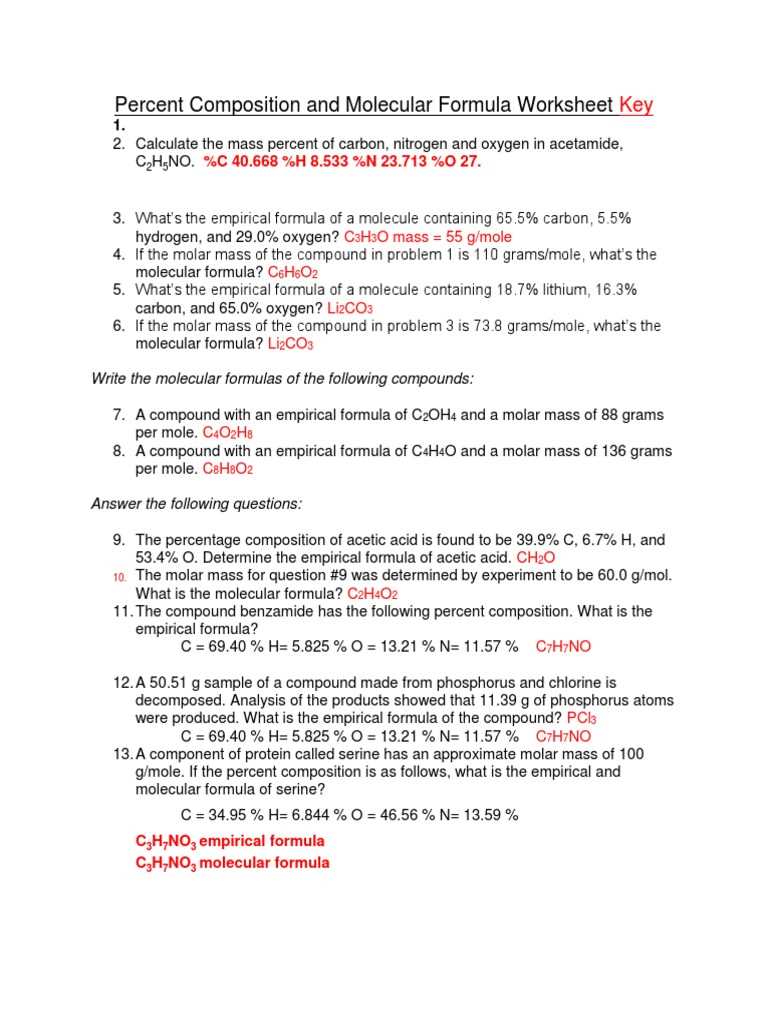
To determine the proportion of each element in a compound, begin by calculating the molar mass of each element involved. Once you have the molar masses, use them to find the individual mass percentages within the compound.
For each question, carefully break down the molecular formula into its elemental components. Then, divide the mass of each element by the total molar mass of the compound and multiply by 100 to get the percentage composition. This method ensures accuracy and helps in understanding how the elements contribute to the overall substance.
In addition, practice is crucial. By solving multiple problems and verifying results with the provided solutions, you’ll improve your grasp of the technique. The solutions not only confirm your calculations but also provide insight into any mistakes made, enabling you to refine your approach.
Calculating Mass Percentages in Chemical Compounds
To calculate the proportion of each element in a compound, first find the molar mass of each element in the formula. Then, determine the total mass of the compound by summing the molar masses of all the elements present.
For example, for a compound like H₂O, calculate the molar mass of hydrogen and oxygen. Multiply the atomic mass of each element by the number of atoms in the formula and add them together to get the total molar mass of the compound. Then, divide the mass of each element by the total mass and multiply by 100 to obtain the percentage contribution of each element.
To check your work, use the provided solutions to verify your calculations. Comparing your results with the correct values helps in identifying mistakes and understanding where adjustments are needed.
How to Calculate Mass Fractions in Chemical Formulas
Begin by determining the atomic mass of each element in the compound. For example, in water (H₂O), hydrogen has an atomic mass of approximately 1.008 g/mol, and oxygen is about 16.00 g/mol.
Next, calculate the total molar mass of the compound. Multiply the atomic mass of each element by the number of atoms in the formula. For water, this would be: (2 × 1.008) + 16.00 = 18.016 g/mol.
Now, divide the mass of each element by the total molar mass of the compound, then multiply the result by 100 to find the mass fraction for each element. For hydrogen in H₂O, it would be: ((2 × 1.008) ÷ 18.016) × 100 ≈ 11.2%.
Repeat the same process for oxygen, which will give you approximately 88.8% for H₂O. This method can be applied to any compound by using the same steps for all elements in the formula.
Understanding the Formula for Mass Fraction in Compounds
To calculate the mass fraction of an element in a compound, use the formula:
Mass fraction of an element = (Mass of element in 1 mole of compound / Molar mass of the compound) × 100
For example, consider water (H₂O). First, find the molar mass of each element: hydrogen (H) has an atomic mass of 1.008 g/mol, and oxygen (O) has an atomic mass of 16.00 g/mol. The total molar mass of water is:
(2 × 1.008) + 16.00 = 18.016 g/mol
Next, calculate the mass fraction of hydrogen:
Mass fraction of hydrogen = (2 × 1.008) / 18.016 × 100 ≈ 11.2%
For oxygen, the calculation is:
Mass fraction of oxygen = 16.00 / 18.016 × 100 ≈ 88.8%
This formula applies to any compound by following the same steps for each element present.
Step-by-Step Guide to Solving Mass Fraction Problems
Follow these steps to calculate the mass fraction of each element in a compound:
- Determine the formula of the compound: Write down the chemical formula of the substance you are working with. For example, H₂O for water.
- Calculate the molar mass of each element: Find the atomic mass of each element involved using the periodic table. Multiply it by the number of atoms of that element in the formula. For example, in H₂O, hydrogen (H) has a mass of 1.008 g/mol, and oxygen (O) has a mass of 16.00 g/mol.
- Sum the molar masses: Add up the total molar mass of the compound. For H₂O, the total molar mass is (2 × 1.008) + (1 × 16.00) = 18.016 g/mol.
- Find the mass of each element in the compound: Multiply the number of atoms of each element by its atomic mass. For H₂O, the mass of hydrogen is (2 × 1.008) = 2.016 g, and the mass of oxygen is 16.00 g.
- Calculate the mass fraction for each element: Divide the mass of each element by the total molar mass of the compound and multiply by 100 to get the percentage. For hydrogen in H₂O, the calculation is (2.016 g / 18.016 g) × 100 ≈ 11.2%. For oxygen, the calculation is (16.00 g / 18.016 g) × 100 ≈ 88.8%.
Repeat these steps for any compound, ensuring you account for each element’s contribution to the total molar mass and apply the formula for each one.
Common Mistakes to Avoid in Mass Fraction Calculations
1. Incorrect molar mass calculation: Always ensure you correctly calculate the molar mass of each element in the compound. Multiplying by the number of atoms of each element is crucial.
2. Ignoring subscripts in formulas: Be careful with formulas that include subscripts. Each subscript represents the number of atoms of that element, which must be multiplied by the element’s atomic mass.
3. Failing to account for all elements: When calculating the total molar mass, make sure to include every element present in the compound, even if it’s just one atom.
4. Using incorrect atomic masses: Refer to the periodic table for accurate atomic masses. Rounding too early or using outdated values can result in inaccurate results.
5. Forgetting to convert to percentage: After finding the mass fraction, always multiply by 100 to express the result as a percentage.
6. Overlooking significant figures: Ensure you maintain proper significant figures throughout the calculation, especially when adding or multiplying values with varying precision.
7. Not checking the final sum: After calculating the mass fractions for each element, double-check that they add up to approximately 100%. A discrepancy indicates an error in the calculations.
Using Molar Mass to Determine Elemental Fractions
To calculate the mass fraction of each element in a compound, first determine the molar mass of the entire compound by adding the individual atomic masses of all elements. Then, for each element in the compound, multiply its atomic mass by the number of atoms present in the molecular formula.
Follow these steps:
- Step 1: Find the molar mass of the compound by summing the atomic masses of all its elements, accounting for subscripts in the molecular formula.
- Step 2: Multiply the atomic mass of each element by the number of atoms of that element in the formula.
- Step 3: Divide the total mass of each element by the molar mass of the entire compound.
- Step 4: Multiply the result by 100 to convert the fraction into a percentage.
For example, in a compound like H2O, the molar mass of the compound is 18.02 g/mol (2 × 1.008 for hydrogen + 1 × 16.00 for oxygen). The mass fraction of hydrogen is:
- Hydrogen: (2 × 1.008) / 18.02 × 100 = 11.2%
- Oxygen: 16.00 / 18.02 × 100 = 88.8%
This method ensures you accurately determine the mass contribution of each element in a compound.
How to Use the Answer Sheet for Verifying Your Results
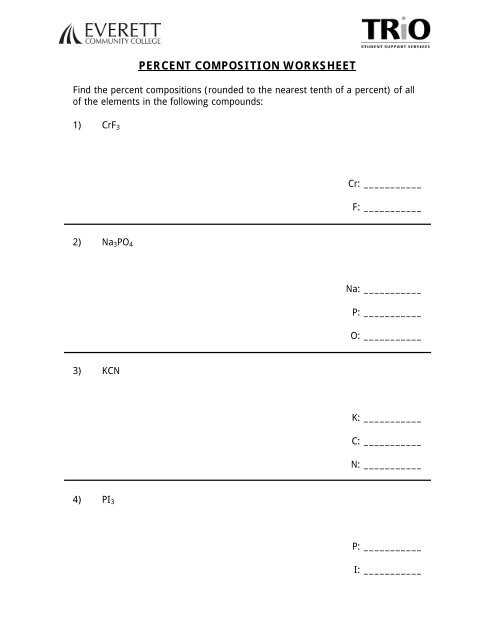
To verify your results, compare each step of your calculations with the provided solutions. Start by checking the molecular formulas for accuracy. Ensure you’ve included the correct number of atoms for each element in the compound.
Next, verify the molar masses you’ve used by referring to the atomic weights provided in the answer sheet. Cross-check your additions for the total molar mass. For example, if you are working with water (H2O), confirm that you’ve added hydrogen and oxygen’s atomic masses correctly.
Once you have verified your total mass, move to the individual element calculations. Double-check each element’s mass fraction using the formula provided in the guide. Compare your result to the one shown in the answer sheet to ensure there are no discrepancies.
If your results differ, recheck each calculation step carefully. Pay close attention to details like rounding errors, incorrect atomic masses, or misplaced decimal points.
By following these steps, the provided solutions will serve as a reliable reference to identify any mistakes and validate your work.
Applying Percent Composition to Real-Life Chemistry Problems
To apply the concept to practical chemistry, calculate the mass of each element in a compound and determine the proportion it contributes to the total mass. For example, when analyzing a sample of magnesium chloride (MgCl2), calculate the mass of magnesium and chlorine and then find their contributions to the overall mass.
Consider how this method is used in industrial chemistry. In pharmaceutical manufacturing, understanding the exact ratio of elements in a drug compound ensures proper dosage and consistency. By knowing the exact makeup, chemists can ensure that the final product has the correct concentration of active ingredients.
Another application is in environmental chemistry. When analyzing pollutants in water, chemists use similar calculations to determine the concentration of contaminants like lead or mercury. The ability to determine how much of a substance is present in a solution is crucial for assessing safety standards.
To solve these problems, follow these steps:
- Write the chemical formula of the substance you are analyzing.
- Find the molar masses of the elements involved.
- Calculate the total mass of the compound.
- Determine the mass of each element and divide by the total mass to find the proportion.
By applying these steps, you can accurately measure and analyze real-life chemical mixtures, whether in manufacturing, environmental science, or other fields of chemistry.
Additional Practice Problems and Resources for Percent Composition
For extra practice, use online resources that provide various examples and problems to solve. Websites like Khan Academy offer clear explanations and practice problems on stoichiometry and chemical analysis. These resources can help reinforce the skills needed for accurate calculations in real-world scenarios.
Visit the following reliable source for more practice and detailed lessons: Khan Academy – Chemistry.
Additionally, check out interactive tools like ChemCollective, which provides virtual labs and scenario-based learning to practice determining element ratios in compounds.
Books such as “Chemistry: The Central Science” by Brown, LeMay, and Bursten also include practice problems and detailed explanations for mastering these calculations.
By working through a variety of problems from these trusted sources, you will improve your understanding and ability to apply this knowledge in more complex chemical situations.