Step-by-Step Guide to Finding the Measure of Each Numbered Angle
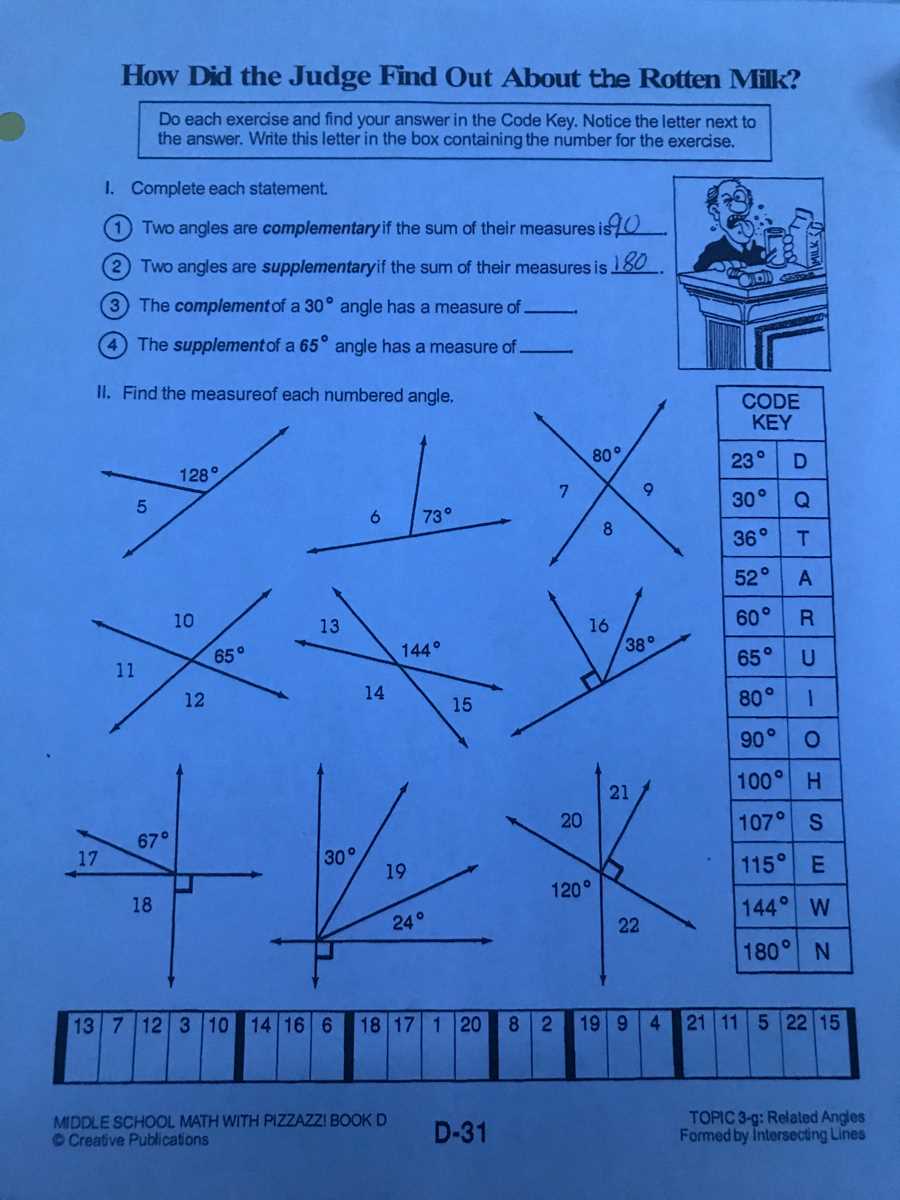
Begin by identifying the relationships between various geometric elements, such as intersecting lines, triangles, and polygons. These connections are the foundation for calculating unknown values in any diagram. Use the properties of parallel and perpendicular lines to quickly determine missing figures. The sum of interior angles in polygons and the rules governing supplementary and complementary angles can significantly narrow down possible solutions.
When solving for unknowns, employ algebraic methods to set up equations based on angle relationships. For example, if two angles are complementary, their sum equals 90 degrees. Similarly, if two angles are supplementary, their sum equals 180 degrees. Recognize these patterns and utilize them to simplify complex problems into manageable steps.
Consider utilizing visual aids like diagrams or drawing auxiliary lines to clarify relationships and facilitate more accurate measurements. By focusing on well-established geometric principles, you can reliably determine the values for any given angle in a sequence of problems.
Detailed Guide to Finding the Measure of Each Numbered Angle
Start by analyzing the diagram and identifying key relationships between the lines and figures. If parallel lines are involved, recall that corresponding angles are equal, alternate interior angles are equal, and supplementary angles add up to 180 degrees.
If a transversal intersects two parallel lines, use these relationships to set up equations for the unknown values. For instance, if two angles form a linear pair, their sum will be 180 degrees. Use this principle to solve for the unknown angle.
For polygons, remember that the sum of interior angles in any polygon can be calculated using the formula (n – 2) * 180, where n is the number of sides. This will help you find the sum of all interior angles, and you can then calculate individual angles if the problem provides enough information.
When working with triangles, use the fact that the sum of the three interior angles equals 180 degrees. If one or two angles are given, subtract their sum from 180 to find the remaining angle(s).
For problems involving adjacent angles, pay attention to whether they form a straight line or if they share a vertex, as these relationships can provide the necessary information to determine the missing values.
By applying these geometric principles systematically, you can confidently calculate the unknown values in various problems involving intersecting lines, polygons, and triangles.
Understanding Basic Angle Relationships
Recognizing how different types of angles relate to each other is crucial in solving geometric problems. These relationships include:
- Complementary angles: Two angles whose sum is exactly 90 degrees.
- Supplementary angles: Two angles that add up to 180 degrees.
- Vertical angles: Angles formed when two lines intersect; these angles are always congruent (equal in measure).
- Adjacent angles: Two angles that share a common side and vertex but do not overlap.
- Corresponding angles: When a transversal crosses two parallel lines, these angles are in the same relative position and are congruent.
- Alternate interior angles: Angles on opposite sides of a transversal, inside two parallel lines, that are congruent.
- Alternate exterior angles: Angles on opposite sides of the transversal, outside two parallel lines, and congruent.
Using these relationships helps simplify problems involving intersecting lines and parallel lines. For example, if you know that two angles are complementary, their sum will be 90 degrees, making it easy to determine an unknown value. Similarly, vertical angles are always equal, which can be applied to solve various geometric equations.
Mastering these basic relationships enables you to approach geometry problems with confidence and accuracy, streamlining the process of finding unknown values in a figure.
How to Use Vertical and Adjacent Angles
To solve problems involving intersecting lines, understanding how vertical and adjacent pairs work can simplify the process. Here’s how to apply these concepts:
- Vertical pairs: When two lines intersect, they form two pairs of opposite angles. These angles are always congruent. If you know the measure of one angle, you automatically know the measure of its vertical counterpart. For instance, if one angle measures 40°, the opposite angle will also measure 40°.
- Adjacent pairs: These angles share a common side and vertex. The sum of adjacent angles is always 180°, provided the angles form a linear pair. To find the unknown angle in such a pair, subtract the known angle from 180°. For example, if one angle is 70°, the other will be 180° – 70° = 110°.
Using these relationships allows you to quickly determine unknown values by applying basic principles of geometry. Vertical angles always match, and adjacent angles can be easily solved using the supplementary angle rule.
Applying the Sum of Angles in a Triangle
The sum of the internal angles in any triangle is always 180°. To find an unknown angle in a triangle, simply subtract the known angles from 180°.
- Example 1: If two angles in a triangle measure 50° and 60°, subtract their sum from 180°: 180° – (50° + 60°) = 70°. Therefore, the third angle is 70°.
- Example 2: If one angle is unknown and the other two are 80° and 40°, subtract their sum from 180°: 180° – (80° + 40°) = 60°. The missing angle is 60°.
Use this rule whenever you are given two angles in a triangle, and you need to calculate the third. This approach applies to all types of triangles, whether they are acute, obtuse, or right triangles.
Using Linear Pair Theorem for Angle Calculations
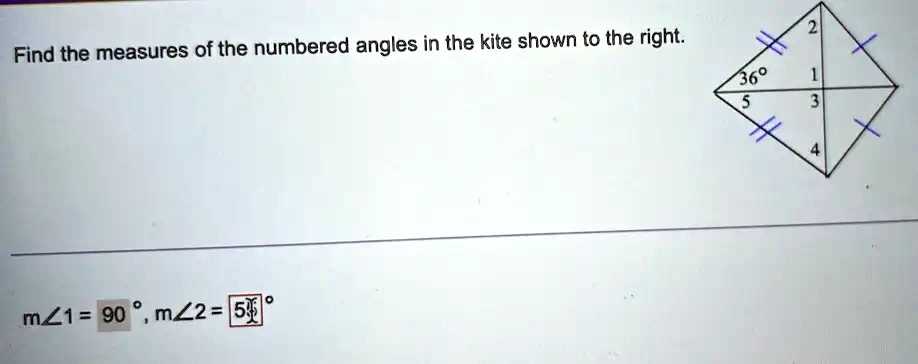
A linear pair consists of two adjacent angles formed when two lines intersect. These angles are always supplementary, meaning their sum is 180°.
- Example 1: If one of the adjacent angles is 120°, subtract it from 180°: 180° – 120° = 60°. The other angle is 60°.
- Example 2: If one angle is 75°, the other angle in the linear pair is 180° – 75° = 105°.
To apply this theorem, identify the two adjacent angles that form a straight line, then subtract the known angle from 180° to calculate the unknown one.
Exploring Corresponding and Alternate Angles
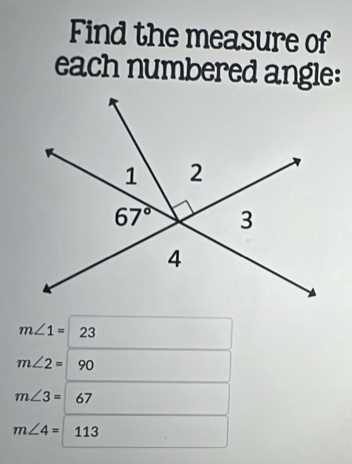
Corresponding angles are formed when a transversal crosses two parallel lines. These angles occupy the same position at each intersection and are congruent. If one corresponding angle is 50°, the other must also be 50°.
Alternate interior angles are located on opposite sides of the transversal and between the two parallel lines. These angles are also congruent. For example, if one alternate interior angle is 70°, the other is also 70°.
Alternate exterior angles, positioned outside the parallel lines, also share congruency. Knowing one alternate exterior angle allows you to determine the other. For instance, if an alternate exterior angle is 110°, the opposite angle is also 110°.
Use these relationships to calculate unknown angles by recognizing parallel lines and identifying the corresponding, alternate interior, or alternate exterior angles. If any of these angles are known, their counterparts can be found using congruency rules.
Solving for Unknown Angles with Algebraic Equations
To determine an unknown value in a geometric figure, algebraic equations can be used when relationships between angles are known. These relationships often involve supplementary or complementary angles, vertical angles, or parallel line theorems.
1. Supplementary Angles: If two angles are supplementary (sum to 180°), use the equation:
angle1 + angle2 = 180°
For example, if one angle is represented as 2x + 30 and the other is 3x – 20, set up the equation:
(2x + 30) + (3x – 20) = 180
Solve for x to find the value of the unknown angle.
2. Complementary Angles: If two angles are complementary (sum to 90°), use the equation:
angle1 + angle2 = 90°
For example, if one angle is 4x and the other is 5x + 10, set up the equation:
4x + (5x + 10) = 90
Solve for x to find the unknown angle.
3. Vertical Angles: When two lines intersect, vertical angles are congruent. If you are given one angle as 5x + 10 and its vertical angle is 3x + 50, set up the equation:
5x + 10 = 3x + 50
Solve for x to find the unknown angle.
4. Angles with Parallel Lines: When a transversal intersects parallel lines, use properties of corresponding, alternate interior, and alternate exterior angles. For example, if an alternate interior angle is expressed as 2x + 40 and the corresponding angle is x + 60, set up the equation:
2x + 40 = x + 60
Solve for x to find the unknown angle.
For further information and more examples, consult authoritative resources like the Khan Academy Geometry Section.
Using the Angle Sum Property of Polygons
To calculate the sum of all interior angles of any polygon, use the formula:
Sum of interior angles = (n – 2) × 180°
Where n is the number of sides of the polygon. This formula provides the total sum of the angles inside a polygon.
For example, for a quadrilateral (4 sides), the sum is:
| Sum = (4 – 2) × 180° | Sum = 2 × 180° = 360° |
If one of the angles in a quadrilateral is known, you can subtract it from 360° to find the sum of the remaining angles. For instance, if one angle is 90°, the remaining sum is:
| 360° – 90° = 270° |
For a hexagon (6 sides), the sum of the interior angles is:
| Sum = (6 – 2) × 180° = 4 × 180° = 720° |
This method allows for solving unknowns in polygons by subtracting known angles from the total sum. With algebraic equations, this approach simplifies complex geometric problems and helps in determining other missing values in various polygons.
Step-by-Step Examples for Accurate Angle Measurement
To solve for unknown angles, follow these clear steps:
Step 1: Identify the type of geometric figure you are working with (e.g., triangle, quadrilateral, or polygon) and the known values.
Step 2: Apply relevant angle relationships. For example, if two lines are intersecting, use vertical angle properties or linear pair theorem.
Step 3: Use the angle sum property. In a triangle, the sum of the internal angles equals 180°. In a quadrilateral, the sum is 360°.
Example 1: Solving for an unknown angle in a triangle:
If two angles are given as 50° and 60° in a triangle, the third angle can be found by subtracting the sum of the known angles from 180°:
| 180° – (50° + 60°) = 70° |
Example 2: Solving for an unknown angle in a linear pair:
If one angle is 120° and is part of a linear pair, the other angle can be found by subtracting 120° from 180°:
| 180° – 120° = 60° |
Step 4: Double-check your calculations to ensure accuracy, particularly when multiple angle relationships are involved. If necessary, work through the problem again to verify the result.
By following these steps, you can solve for any unknown in simple geometric figures using basic angle rules and properties.