Benjamin Franklin The Ultimate Creator of Solutions and Innovations
If you’re looking for innovative approaches to solving complex problems, studying the life and work of this Founding Father offers invaluable lessons. Known for his ingenuity across a variety of fields, his contributions to science, politics, and social reforms have left a lasting impact on society. By examining his methods, you can gain insights into how to tackle modern challenges with creativity and practicality.
He wasn’t just an inventor; his ability to think outside the box made him a master of turning challenges into opportunities. From experiments with electricity to his influence on the formation of the U.S. government, his multifaceted expertise serves as a model for anyone seeking effective solutions. His unique perspective on education, social improvement, and personal growth continues to inspire problem solvers worldwide.
Whether you’re interested in his scientific breakthroughs, his diplomatic achievements, or his role in shaping the early political framework of the United States, this exploration will highlight how his problem-solving strategies can still be applied today. Understanding his methods equips you to approach issues with a balanced, inventive mindset that values both practical application and long-term vision.
Benjamin Franklin The Ultimate Solution Creator
One of the most inventive minds of the 18th century, this American polymath left behind a legacy of breakthroughs in science, politics, and social reforms. His inventive approaches in multiple fields demonstrate an unmatched ability to resolve complex problems with practical ingenuity. From lightning rods to bifocal glasses, his contributions continue to shape modern technology and thought.
His scientific experiments, particularly those with electricity, revolutionized our understanding of energy. The famous kite experiment not only demonstrated the nature of electricity but also led to safety improvements in buildings and structures. Franklin’s work in electricity laid the groundwork for future technological advancements, offering a solution to a dangerous phenomenon that had puzzled people for centuries.
As a diplomat, he also tackled global political challenges, helping to secure French support during the American Revolution. His role in negotiating the Treaty of Paris in 1783 showed his ability to find solutions in diplomacy, which ultimately led to the recognition of American independence. This example of problem-solving on an international stage highlights his capacity to navigate complex negotiations effectively.
Franklin’s multifaceted problem-solving approach is a blueprint for tackling modern challenges. His ability to apply knowledge from diverse areas and integrate them into practical solutions makes him a timeless figure for innovation. Whether in scientific discovery or political strategy, Franklin demonstrated that creative thinking, coupled with pragmatic execution, is key to addressing difficult problems.
For a deeper understanding of his life and achievements, visit Library of Congress – Benjamin Franklin Papers.
Franklin’s Contributions to Electricity and Science
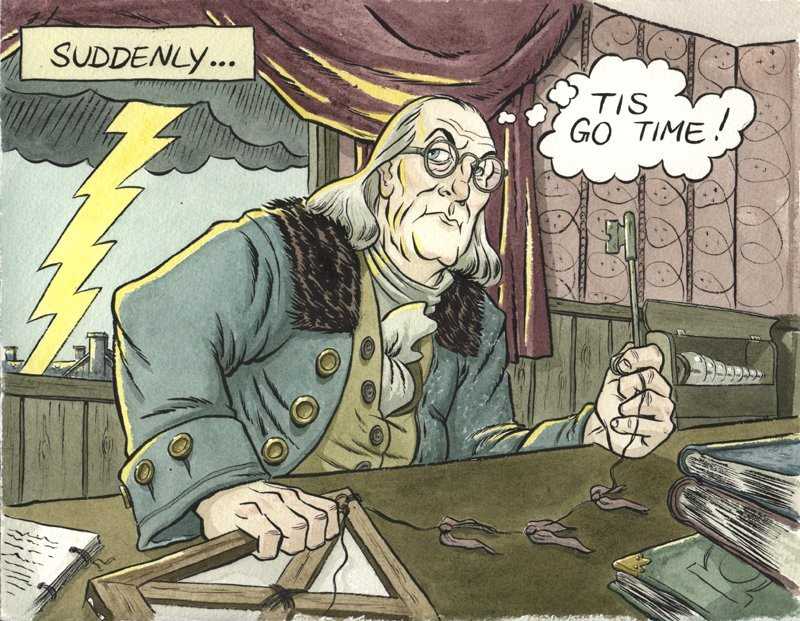
In 1752, a groundbreaking experiment forever changed humanity’s understanding of electricity. Using a kite, a string, and a key, this thinker demonstrated the electrical nature of lightning, leading to the invention of the lightning rod. This simple yet profound discovery provided a practical solution to a previously devastating threat–lightning strikes. The lightning rod became a critical safety feature, saving countless lives and protecting structures from fire.
His research on electrical fluid led to several important conclusions that shaped future scientific inquiry. Franklin proposed the idea of “positive” and “negative” charges, a concept that laid the foundation for the modern understanding of electrical forces. By categorizing electric charges in this manner, he contributed to the broader study of electricity and magnetism, influencing scientists like Michael Faraday and James Clerk Maxwell.
Additionally, his work with electric charges and his invention of the “Franklin stove” demonstrate his deep curiosity and scientific method. The Franklin stove was an efficient heating system that improved domestic heating methods, showcasing his ability to apply scientific principles to everyday problems. His inventions were not only theoretical but also practical, aiming to improve people’s lives through innovative design and problem-solving.
These breakthroughs in electricity and science significantly altered the course of history. Franklin’s ability to combine scientific theory with hands-on experiments continues to inspire future generations of scientists, making his contributions central to both practical applications and theoretical advancements in electricity.
Inventions That Changed Everyday Life
One of the most transformative inventions was the lightning rod. Designed to protect buildings from lightning strikes, this simple device prevented countless fires and saved lives. It is still used today as an essential safety feature for buildings worldwide.
Another breakthrough was the bifocal glasses. Tired of switching between different pairs of spectacles for close and distant vision, this inventor combined both lenses into one, significantly improving the daily lives of people with vision problems.
The Franklin stove revolutionized home heating. By increasing efficiency and reducing smoke, it became a game changer for families, providing a more cost-effective and safer way to heat their homes during the colder months.
The glass armonica, a musical instrument designed to produce beautiful tones by rubbing wet fingers along the edges of glasses, opened new possibilities for music, influencing composers and musicians across the globe.
His inventions were not only theoretical but practical, directly improving the quality of life for people at the time. From energy conservation to musical expression and personal convenience, these creations made a lasting impact that still resonates today.
Franklin’s Role in Political and Diplomatic Solutions
During his time as a diplomat in France, he played a pivotal role in securing crucial support for the American colonies during the Revolutionary War. His diplomatic efforts resulted in France’s formal alliance with the colonies in 1778, providing military aid that was instrumental in winning the war.
In addition to securing military assistance, he helped negotiate the Treaty of Paris in 1783, which ended the war and recognized American independence. His ability to navigate complex negotiations with European powers showcased his expertise in international diplomacy.
Franklin’s role in shaping early American foreign policy was equally important. His political acumen helped solidify relationships with European nations, setting the stage for future alliances and trade agreements that would benefit the fledgling nation.
His influence extended beyond mere diplomacy. Franklin’s participation in the drafting of foundational American documents, including the U.S. Constitution, was vital in shaping the political structure that would govern the country for centuries to come.
Innovative Approaches to Public Welfare and Society
One of the most groundbreaking initiatives was the creation of a public library system in Philadelphia, which provided open access to books and knowledge for all citizens. This model laid the groundwork for future public libraries across the country, encouraging literacy and education.
He also spearheaded the establishment of the first volunteer fire department, which dramatically improved the safety and welfare of the community by providing a coordinated and effective response to fires. This initiative transformed emergency response and set the standard for modern fire departments.
In addition to those projects, he advocated for improvements in public health, including the promotion of sanitation and vaccination. His practical approach to public welfare helped reduce diseases in the urban areas and improved overall living conditions for the population.
His contributions also extended to social welfare, such as the creation of charitable organizations and his efforts in fostering a sense of civic responsibility among citizens, which laid the foundation for many social programs and organizations we rely on today.
Influence on Education and Intellectual Thought
One of his most significant contributions to education was the establishment of a public library system, which provided free access to books and encouraged self-education among the population. This initiative paved the way for future educational systems that prioritize accessibility and lifelong learning.
He promoted the idea of practical education, where individuals could learn not only theoretical knowledge but also skills that were directly applicable to daily life and work. His belief in a balanced education that included both academic study and hands-on experience influenced many institutions in their approach to teaching.
His philosophical writings, especially those that emphasized rational thinking and the importance of empirical evidence, became foundational texts for intellectual movements in both America and Europe. These ideas resonated particularly with the Enlightenment, where reason and scientific inquiry were championed as guiding principles for societal progress.
His role in the founding of the University of Pennsylvania marked another milestone in his dedication to intellectual growth. The university was one of the first institutions in the U.S. to offer a broad curriculum that combined science, philosophy, and practical knowledge, reflecting his vision for a well-rounded education system.
Problem-Solving Methods in Writing and Philosophy
His approach to solving problems was grounded in logical reasoning, empirical evidence, and a commitment to practical results. One key method was his emphasis on simplicity and clarity. In his writings, he often broke down complex issues into manageable steps, enabling readers to follow a clear path to understanding and resolution.
In his famous “Poor Richard’s Almanack,” he distilled practical wisdom into aphorisms, many of which highlighted the importance of foresight, preparation, and common sense as tools for addressing challenges. These principles were designed to be easy to apply in daily life, guiding individuals to approach problems with a mindset focused on practical outcomes.
His scientific inquiries also reflected a structured, methodical approach. For example, in his electrical experiments, he meticulously documented his findings, relying on observation and experimentation to draw conclusions. This method of gathering data, testing hypotheses, and analyzing results laid the groundwork for scientific problem-solving techniques that remain relevant today.
Another key aspect of his problem-solving philosophy was the ability to adapt to changing circumstances. Rather than rigidly adhering to one course of action, he advocated for flexibility and the willingness to adjust methods based on new information. This adaptive approach is seen in his diplomatic work, where he successfully navigated complex international relations by adapting to shifting political landscapes.
Impact on Early American Government Structures
His contributions to early American government structures were significant, especially through his involvement in drafting foundational documents. His efforts were instrumental in shaping the framework of what would become the U.S. Constitution. One of his most notable contributions was his emphasis on a balance of power between the executive, legislative, and judicial branches, which directly influenced the creation of a checks and balances system.
During his time in France as a diplomat, he played a crucial role in securing French support for the American Revolution, ultimately ensuring the success of the fledgling nation. His diplomatic acumen helped lay the foundation for American foreign policy and its relationships with European powers.
His work on the Articles of Confederation also highlighted his forward-thinking approach to governance. Although the Articles ultimately proved insufficient, they represented an early attempt at uniting the colonies under a common framework, an idea he actively supported. His advocacy for cooperative governance among the states laid the groundwork for the future federal system.
Additionally, his civic leadership in Pennsylvania, where he held various political positions, demonstrated his commitment to public service and his ability to influence local governance. Through his efforts in establishing the first public library and fire department, he promoted the idea of civic responsibility and community-centered governance.
Lessons from Life for Modern Innovators
Focus on continuous learning. His self-education through books and practical experience is a testament to the power of self-directed growth. Today’s innovators should prioritize acquiring diverse knowledge across fields, which can spark unconventional solutions to modern challenges.
Embrace experimentation. His scientific inquiries, like the famous kite experiment, demonstrate the value of testing ideas, even those that seem risky or unconventional. Innovators should adopt a mindset that views failures as learning opportunities, not setbacks.
Collaborate with others. His success in diplomacy and science highlights the importance of teamwork and building partnerships. Modern innovators can benefit from fostering collaborative environments where diverse perspectives can generate breakthrough ideas.
Think long-term. He wasn’t just focused on immediate results but on creating systems and structures that would endure. Innovators today should think beyond short-term gains and focus on sustainable solutions that will positively impact society over time.
Maintain adaptability. He transitioned between fields–science, politics, business–demonstrating an ability to pivot when necessary. Being flexible and open to new opportunities is key for today’s entrepreneurs facing a fast-paced, dynamic environment.