Complete Solutions for Permutations and Combinations Worksheet
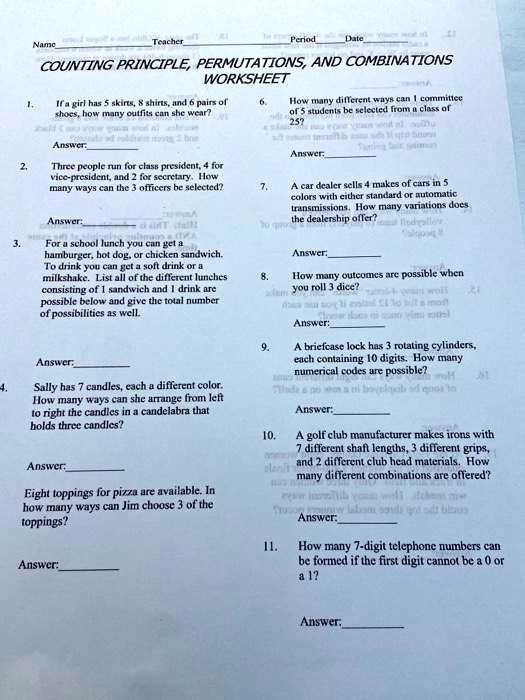
If you want to master the techniques for arranging or selecting items from a set, start by practicing through targeted exercises. Understanding how to calculate possible outcomes based on specific rules is key to solving these problems effectively. With a reliable set of solutions at hand, you can quickly identify patterns in your approach and make adjustments where needed.
Use the provided answers to verify your calculations, focusing on any discrepancies you encounter. Pay close attention to how each problem is structured and whether you followed the correct sequence of steps. Common errors include misapplying factorials or overlooking constraints in the problem. Correcting these mistakes early helps reinforce a deeper understanding of the material.
For further improvement, attempt different variations of similar problems to test your grasp on both arrangements and selections. By reviewing your mistakes and comparing your reasoning with the given answers, you’ll improve your ability to identify subtle differences between different types of exercises and apply the right formulas efficiently.
Counting Principle Permutations and Combinations Worksheet Answer Key
When reviewing solutions for arranging and selecting items, it’s crucial to carefully analyze each calculation. Start by checking if you’ve applied the correct formulas for each type of problem. For example, when determining the number of ways to arrange a set of objects, ensure that you’ve considered whether repetition is allowed and whether the order of the items matters.
Verify your answers by comparing them with the provided solution guide. Below is a breakdown of common methods used for solving these problems:
| Problem Type | Formula | Example |
|---|---|---|
| Arrangements without repetition | n! (Factorial) | How many ways can 3 books be arranged on a shelf? |
| Arrangements with repetition | n^r (n raised to the power of r) | How many ways can 4 digits be chosen from a set of 10 digits? |
| Selections without repetition | C(n, r) = n! / (r!(n – r)!) (Combination formula) | How many ways can 2 students be selected from a group of 5? |
| Selections with repetition | H(n, r) = (n + r – 1)! / (r!(n – 1)!) (Combination with repetition) | How many ways can 3 apples be selected from a set of 4 types of apples? |
After comparing your work with the solution guide, take note of any areas where you made errors or misapplied a formula. This will help you identify knowledge gaps and improve your understanding of each type of problem. Practice with additional problems and verify your work regularly to track your progress and build confidence in your skills.
How to Solve Permutation Problems Using the Counting Method
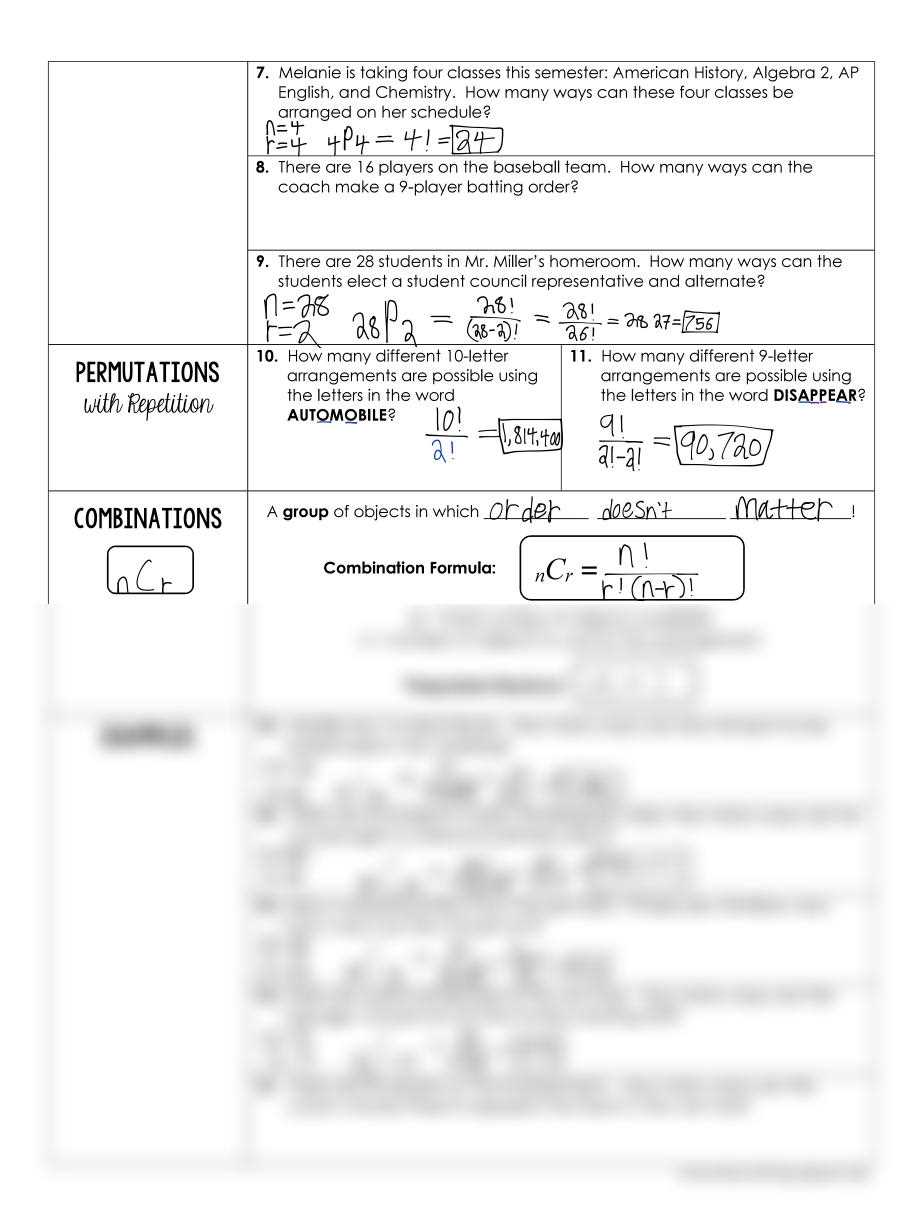
To solve problems related to arranging a set of objects where order matters, use the factorial formula. The number of ways to arrange n objects is simply n! (n factorial). For example, arranging 3 objects would be calculated as 3! = 3 × 2 × 1 = 6 ways.
If there is a specific number of objects selected from a larger set, calculate the number of arrangements by multiplying the number of choices for each object. For instance, if selecting 2 objects from 4, first there are 4 options for the first selection, and 3 remaining options for the second selection, resulting in 4 × 3 = 12 arrangements.
For cases where some objects are repeated, adjust the formula accordingly by dividing by the factorial of the number of repetitions. For example, for arranging the letters in “AAB”, you divide by 2! because “A” repeats twice: 3! / 2! = 6 / 2 = 3 possible arrangements.
Verify your answer by checking the steps and confirming the logic behind each multiplication. Practice with different examples to solidify your understanding of arranging objects where order matters. You can also refer to the solution guide for common mistakes and ensure you’re applying the correct method for each scenario.
Step-by-Step Guide for Understanding Combinations in Selection Problems
To find the number of ways to select a subset of items from a larger set, use the formula:
[ C(n, r) = frac{n!}{r!(n-r)!} ]
where (n) is the total number of items and (r) is the number of items to select. This expression calculates how many distinct groups of (r) can be formed from a set of (n) elements, disregarding the order of selection.
1. Identify total elements: First, determine the total number of items available for selection. For example, if you have a set of 10 different books and you want to select 3, (n = 10).
2. Determine subset size: Decide how many items will be selected from the total. In this example, (r = 3).
3. Apply the formula: Plug the values of (n) and (r) into the formula. For (n = 10) and (r = 3), calculate:
[ C(10, 3) = frac{10!}{3!(10-3)!} = frac{10!}{3!7!} ]
Cancel out the common terms in the factorials, simplifying the equation:
4. Simplify the factorials:
[ frac{10 times 9 times 8}{3 times 2 times 1} = 120 ]
This means there are 120 unique ways to select 3 books from a set of 10.
5. Double-check for repetition: Ensure that order doesn’t matter. If the arrangement of selected items were important, a different formula would apply. Here, no attention is given to order, which is why combinations are used instead of permutations.
By following these steps, you can easily calculate the number of ways to choose a specific number of items from any given set without worrying about their arrangement.
Identifying Key Differences Between Permutations and Combinations
The primary distinction between these two concepts lies in whether the order of selection matters. If the sequence of items is important, the calculation involves arrangements; if the sequence doesn’t matter, the focus is on groupings.
Arrangements (Order Matters): For problems where the order of items affects the outcome, use the formula for arrangements. In this case, the number of possible selections is larger because different orders of the same elements count as distinct. The formula is:
[ P(n, r) = frac{n!}{(n-r)!} ]
For example, selecting 3 positions from 5 people where the order of selection is critical leads to more possibilities than if the order didn’t matter.
Groupings (Order Doesn’t Matter): When the arrangement of selected items doesn’t matter, use the formula for groupings. This counts only distinct combinations where the same items in different orders are considered identical. The formula is:
[ C(n, r) = frac{n!}{r!(n-r)!} ]
This is often used when forming teams or selecting groups where the internal order doesn’t change the outcome.
In short, use arrangements when order is crucial and groupings when it is not. Both formulas rely on factorials but differ in how they handle the arrangement of elements. An arrangement will always result in more possibilities than a grouping because order is considered.
For more detailed examples and exercises, refer to the official resource on these topics: Khan Academy.
Common Mistakes in Selection Problems and How to Avoid Them
1. Misunderstanding when order matters: One common error is assuming that order doesn’t matter when it actually does. Always check the problem carefully to determine if the sequence of choices affects the outcome. For example, when selecting a leader and a deputy from a group, the roles are different, so the arrangement matters.
2. Confusing factorial simplifications: Incorrectly simplifying factorials can lead to mistakes. For instance, in problems involving large numbers, ensure to cancel out terms properly before performing the calculation. For example, when calculating ( frac{10!}{7!} ), only ( 10 times 9 times 8 ) remains, not the entire 10 factorial.
3. Not accounting for repeated elements: If the set has repeated items, don’t forget to adjust the formula. This is especially common when selecting items from a group that includes duplicates. In such cases, use the appropriate adjustments (like dividing by the factorial of the number of repeated items) to avoid overcounting.
4. Forgetting the difference between selection with or without replacement: Some problems involve selecting elements without returning them to the set (without replacement), while others allow repeated selections (with replacement). If you mistakenly treat selections as if they were with replacement when they’re not, it will lead to incorrect results.
5. Incorrect use of formulas: Mixing up formulas for different types of problems can lead to errors. For example, applying a formula for groupings (where order doesn’t matter) to a problem where the arrangement is crucial will provide the wrong result. Always make sure you’re using the correct formula based on the problem’s requirements.
To minimize mistakes, carefully review each problem’s conditions and clearly identify whether the order of selection matters, check for repeated items, and verify which formula applies to the situation. Practice with different scenarios helps solidify understanding and avoid these common pitfalls.
Using the Factorial Formula in Selection Problems
The factorial formula is a fundamental tool for calculating the total number of possible arrangements or selections. Here’s how to apply it effectively:
1. Identifying the total number of items: First, determine the total number of items available for selection. For example, in a problem involving 8 different books, ( n = 8 ).
2. Factorial calculation for total arrangements: When order matters, the number of possible sequences is determined by calculating the factorial of the total items, ( n! ). For instance, if all 8 books are to be arranged, the calculation is ( 8! = 8 times 7 times 6 times 5 times 4 times 3 times 2 times 1 = 40,320 ).
3. Adjusting for selection size: If you’re selecting fewer than all items, use the adjusted factorial formula. For example, if you’re choosing 3 books from 8, calculate:
[ P(8, 3) = frac{8!}{(8-3)!} = frac{8!}{5!} = 8 times 7 times 6 = 336. ]
4. Applying for groupings without order: When order doesn’t matter, the formula changes. Use the factorial formula for selections of fewer than the total number, but divide by the factorial of the selection size:
[ C(8, 3) = frac{8!}{3!(8-3)!} = frac{8!}{3!5!} = frac{8 times 7 times 6}{3 times 2 times 1} = 56. ]
5. Adjusting for repetition: If there are repeated elements, adjust the formula to account for the overcounting of identical selections. For example, if there are two identical books among 8, divide by the factorial of the repeated items, ( 2! ), to correct for duplicates.
By following these steps and ensuring you apply the correct factorial adjustments, you can efficiently solve problems involving arrangements or selections, whether order matters or not.
How to Cross-Check Solutions with the Provided Answer Key
To effectively verify your solutions, follow these steps:
- Revisit the problem’s conditions: Ensure that you clearly understand the problem’s requirements. Identify whether the order of selection matters or if repetitions are allowed. This will help you confirm which formula to use.
- Double-check your formula: Make sure that you applied the correct mathematical formula based on the scenario. For example, check if you used the formula for sequences when order matters or for groups when it doesn’t.
- Recalculate your steps: Break down your solution step-by-step and recalculate key parts. Compare intermediate steps, like factorial simplifications, to identify any calculation errors.
- Compare results: Look at the provided solution and compare it with your final result. If they match, your process is likely correct. If they differ, analyze where your approach diverged from the answer key.
- Identify any discrepancies: If there is a difference, check for possible mistakes in assumptions, such as overlooking repetitions or applying the wrong formula. Review the problem again to ensure every condition is accounted for.
- Seek clarification if needed: If you cannot spot the mistake, refer to example problems in textbooks or online resources to help clarify the concept. Asking for assistance from peers or instructors can also be helpful.
By following these steps, you can confidently cross-check your solutions and identify where any errors might have occurred. This process helps build a stronger understanding of the topic and improves accuracy over time.
Tips for Mastering Selection Exercises
1. Understand the problem setup: Before attempting any calculation, carefully analyze the scenario. Identify whether the problem involves selecting a group of items where the order matters, or if it’s about grouping without regard to sequence. This distinction determines which formula to use.
2. Focus on the formula: Always choose the correct mathematical approach. If you’re dealing with an ordered arrangement, apply the formula for sequences. If the order is irrelevant, use the grouping formula. Ensure you’re not mixing them up based on the problem’s conditions.
3. Break down complex calculations: For larger numbers or more complex situations, break the calculations into smaller, manageable parts. Simplify factorial expressions early to avoid errors, such as canceling out common terms in both the numerator and denominator.
4. Check for repetitions: In problems involving repeated elements, adjust your formula to account for overcounting. If items are identical, divide by the factorial of their repetition count to ensure you don’t double-count identical selections.
5. Practice with varied problems: Mastery comes from repeated exposure to different scenarios. Practice problems with various set sizes, selection counts, and conditions (with or without repetition) to get comfortable with the underlying concepts.
6. Review solutions step-by-step: After solving, always revisit your steps and solutions. Comparing your work with provided solutions or answer guides helps identify any misinterpretations or calculation mistakes.
7. Stay organized: Keep your work neat and methodical. Clearly list all terms in factorial expressions and keep track of intermediate steps to prevent simple arithmetic errors.
By following these strategies, you can improve your accuracy and confidence in solving selection problems and tackle more advanced exercises with ease.
How to Use the Answer Key for Self-Assessment and Review
To make the most of the provided solution guide, follow these steps:
- Verify your results: Compare each of your solutions with the ones in the solution guide. Check if your final answers match and identify any discrepancies.
- Analyze step-by-step: Go through each solution in the guide carefully. Focus on the steps taken to reach the final answer. This helps you understand the reasoning behind each formula application and calculation.
- Identify mistakes: If your answer is incorrect, identify where the error occurred. Check for common mistakes, such as incorrect use of formulas, arithmetic errors, or misinterpretation of the problem. Understanding where you went wrong helps avoid repeating similar errors in future problems.
- Rework the problem: Once you find the mistake, attempt to solve the problem again, making sure to follow the correct approach. Reworking the problem reinforces the concepts and improves your problem-solving process.
- Track common errors: Keep a list of recurring mistakes or areas where you struggle. This helps focus your review on these specific areas and track your progress over time.
Here is a simple table example of how to use the guide effectively:
| Your Solution | Provided Solution | Mistake Identified | Correct Approach |
|---|---|---|---|
| 120 | 120 | None | Correct formula used |
| 180 | 150 | Misapplied formula | Recheck formula for selection without order |
By using the solution guide in this manner, you can effectively identify areas for improvement and reinforce your understanding of key concepts.