Complete Guide to Capitalization Worksheet Solutions
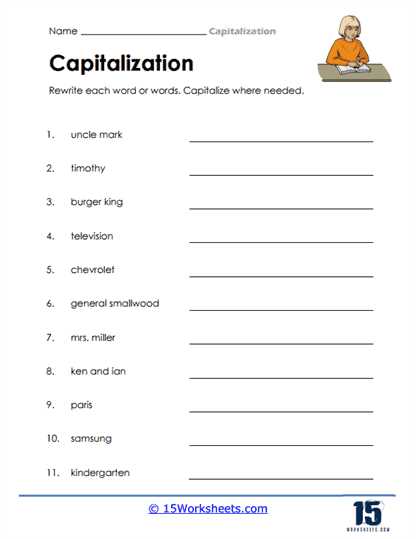
To improve your writing, it’s important to follow proper letter-case conventions. Recognizing when to use uppercase letters in sentences is a fundamental skill in producing polished, error-free text. This guide will walk you through the most common scenarios where capitalization is required, offering practical solutions to help you apply these rules correctly every time.
Start by focusing on specific words that must always be capitalized: proper nouns, the beginning of sentences, and important titles. Practicing these will help you avoid the common pitfalls of using lowercase when an uppercase letter is needed.
Whether you’re working on academic assignments, professional documents, or just improving your writing skills, mastering letter-case usage will significantly enhance your clarity and attention to detail. Let’s explore the key areas where capitalization is critical and how to approach them effectively.
Capitalization Worksheet Solutions Guide
To successfully complete exercises on proper letter-case usage, it’s vital to follow the rules regarding which words should begin with uppercase letters. Here are the key areas to focus on when correcting the sentences:
| Rule | Example | Correction |
|---|---|---|
| First word in a sentence | the dog barked loudly. | The dog barked loudly. |
| Proper nouns (names of people, places, organizations) | we went to london last summer. | We went to London last summer. |
| Days of the week, months, and holidays | i love christmas time. | I love Christmas time. |
| Titles of books, movies, and artworks | i am reading harry potter. | I am reading Harry Potter. |
By correcting these common mistakes and understanding when to apply uppercase letters, your writing will become more polished and professional. Always check for proper capitalization of names, locations, and the start of sentences to avoid errors. Practice these rules and apply them consistently for greater accuracy in your writing.
Understanding Basic Capitalization Rules
To improve clarity and readability, it’s important to apply the correct letter-case usage in writing. Below are the basic rules for using uppercase letters:
| Rule | Example | Correct Usage |
|---|---|---|
| First word in a sentence | the cat is sleeping. | The cat is sleeping. |
| Proper nouns (names of people, places, brands) | john went to new york. | John went to New York. |
| Days of the week and months | we meet every monday in april. | We meet every Monday in April. |
| Titles of books, movies, and works of art | i watched the godfather. | I watched The Godfather. |
| First and last words of titles | the great gatsby is a classic. | The Great Gatsby is a classic. |
| Pronoun “I” | i am learning new things. | I am learning new things. |
By applying these basic rules, writing will be clearer and more professional. Check for uppercase at the start of each sentence, with proper nouns, and when referring to specific titles or days to avoid mistakes.
Common Mistakes in Capitalization Exercises
One frequent mistake is failing to capitalize proper nouns, such as names of people, places, and brands. For instance, “john went to paris” should be corrected to “John went to Paris.”
Another common error involves neglecting to capitalize the first letter of a sentence. For example, “she likes to read books” should start with an uppercase letter: “She likes to read books.”
Many people forget to capitalize days of the week, months, and holidays. In “we are meeting on monday in december,” “Monday” and “December” should be capitalized to “We are meeting on Monday in December.”
Titles of books, movies, and songs are often written in lowercase. An example of a mistake is “i watched the godfather,” which should be “I watched The Godfather.”
Some exercises also see the misapplication of capital letters in smaller words of a title, such as “a,” “and,” “the,” unless they are the first or last word. For example, “the hunger games” should be written as “The Hunger Games.”
Incorrectly capitalizing common nouns, like “city” in “I visited New York City,” is another mistake. The word “city” should not be capitalized unless it is part of the official name or a title.
By paying attention to these mistakes, learners can improve their understanding of letter-case usage and apply it more accurately in writing.
Step-by-Step Approach to Completing a Capitalization Exercise
Start by carefully reading each sentence or phrase provided in the exercise. Identify all the words that require an uppercase letter according to grammar rules.
First, look for proper nouns like names of people, cities, countries, or brands. These always need to begin with a capital letter. For example, “michael visited london” should become “Michael visited London.”
Next, check the beginning of each sentence. Ensure that the first letter of every sentence is capitalized. If you encounter a sentence like “she enjoys painting,” it should be corrected to “She enjoys painting.”
Review days of the week, months, and holidays. These are always capitalized. “We plan to travel in september” should be revised to “We plan to travel in September.”
Examine titles of books, movies, and songs. Capitalize the first and last words, as well as important words in between. For example, “harry potter and the prisoner of azkaban” should be “Harry Potter and the Prisoner of Azkaban.”
Look for common errors like unnecessary capitalization of small words, such as “the,” “and,” or “a,” within titles. These words should only be capitalized if they are the first or last word. Correct “the great gatsby” to “The Great Gatsby.”
Once you’ve completed the task, double-check for any missed words that should be capitalized, and ensure there are no accidental capitalizations in common nouns.
By following these steps systematically, you can effectively complete the exercise while reinforcing your understanding of proper letter-case usage.
Examples of Correct Letter-Case for Different Contexts
For proper nouns, always capitalize the name of a person, place, or specific entity. For instance, “john smith went to paris” should be “John Smith went to Paris.”
In sentences, ensure the first word of every sentence is capitalized. For example, “it was a sunny day” should be corrected to “It was a sunny day.”
Days of the week and months should be capitalized. For example, “we will meet on monday in april” becomes “We will meet on Monday in April.”
Titles of books, movies, and articles require capitalization of significant words. “the hunger games: catching fire” should be changed to “The Hunger Games: Catching Fire.”
For holidays, use uppercase letters, such as “christmas is my favorite holiday” turning into “Christmas is my favorite holiday.”
In addresses and locations, capitalize all parts: “he lives in new york city” becomes “He lives in New York City.”
In brand names and trademarks, capital letters are necessary. For instance, “iPhone is the latest model” should be corrected to “iPhone is the latest model.”
After colons, if the following phrase is a complete sentence, capitalize the first word. “he had one goal: to win the race” should be “He had one goal: To win the race.”
How to Identify Proper Nouns in Sentences
Proper nouns are names of specific people, places, or things and are always capitalized. To identify them, look for names that refer to unique entities. Here are some guidelines:
- Names of people: Any specific person’s name should be capitalized. For example, “mary went to the park” should be “Mary went to the park.”
- Geographical locations: Names of cities, countries, states, and landmarks are proper nouns. “he visited paris” should be “He visited Paris.”
- Organizations: The names of companies, institutions, and clubs require capital letters. “she works at microsoft” becomes “She works at Microsoft.”
- Days, months, and holidays: These should always be capitalized. “we met on monday in december” should be “We met on Monday in December.”
- Titles of books, movies, and works of art: These names are treated as proper nouns. “i watched a new movie yesterday” should be “I watched a new movie yesterday.”
Remember that generic terms like “city,” “country,” or “book” are not capitalized unless part of a specific name. For instance, “new york city” should be “New York City,” while “the city” does not need to be capitalized.
For more information on identifying proper nouns, visit Grammarly.
Tips for Reviewing Your Capitalization Answers
Carefully check each word for proper usage of uppercase letters. Ensure names, places, and specific titles are correctly capitalized. If in doubt, verify the rule for the context of the word.
- Double-check names: Verify all personal names, geographical locations, and brand names are capitalized. For example, “john” should be “John,” and “paris” should be “Paris.”
- Look for the beginning of sentences: The first word in every sentence should always start with a capital letter, like “this is a test” should be “This is a test.”
- Pay attention to days and months: These should be capitalized. “monday” becomes “Monday,” and “january” becomes “January.”
- Titles and holidays: Titles of books, movies, and holidays should also be capitalized. “the great gatsby” should be “The Great Gatsby” and “christmas” should be “Christmas.”
- Watch out for common mistakes: Avoid capitalizing common nouns unless part of a proper name. For instance, “new york city” should be “New York City,” but “the city” is not capitalized.
Reviewing your responses with these tips can help you spot errors and ensure accuracy. When in doubt, consult a style guide or trusted grammar resource for clarification.
How to Correct Capitalization Errors in Your Work
To fix mistakes in letter usage, first identify the type of error. Common errors include improper use of uppercase letters for common nouns, names, and places. Carefully review the context in which the word is used.
- Check for proper nouns: Ensure that all names of people, places, and specific things are capitalized. For instance, “john” should be corrected to “John,” and “paris” to “Paris.”
- Review sentence beginnings: Every sentence should start with an uppercase letter. For example, “this is a mistake” should become “This is a mistake.”
- Look for days and months: These should always be capitalized, such as “february” becoming “February” and “wednesday” changing to “Wednesday.”
- Titles and holidays: Be sure to capitalize the names of holidays and specific works. “thanksgiving” should be “Thanksgiving” and “the great gatsby” should be “The Great Gatsby.”
- Avoid unnecessary capitalization: Common nouns like “city” and “school” should not be capitalized unless part of a specific name (e.g., “New York City” but “the city”).
Make these corrections systematically, checking each word and adjusting according to these rules. After reviewing your work, consider using a grammar tool for an extra layer of verification.
Additional Resources for Practicing Capitalization Skills
To reinforce your understanding of correct letter usage, consider exploring these helpful tools and materials:
- Interactive Online Quizzes: Websites like GrammarBook offer quizzes that test your knowledge in real-time.
- Grammar Apps: Download apps like Grammarly or Purdue OWL for grammar checking and exercises.
- Practice Books: Books like “English Grammar in Use” by Raymond Murphy provide structured exercises and explanations on correct letter usage.
- Educational YouTube Channels: Channels like EnglishGrammar offer video tutorials that break down rules and examples in easy-to-understand formats.
- Printable PDF Exercises: Websites like Education.com offer printable exercises that allow for practice without screen time.
Utilize these resources to practice regularly and improve your skills. Repetition and consistency will ensure you master the rules and make fewer mistakes in your writing.