Complete Guide to Ionic Bond Practice Problems and Solutions
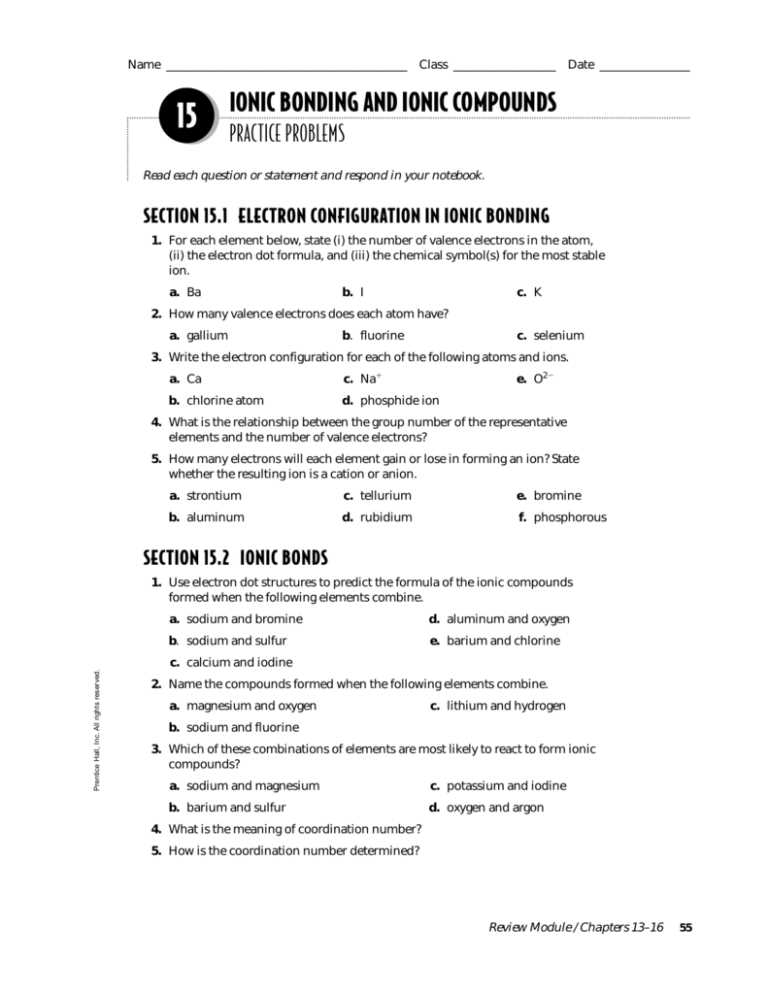
To tackle challenges involving charged particles, focus on the process of electron transfer. Begin by identifying the elements involved and determine their respective charges. This will guide you in constructing the correct compounds. Review the periodic table for each element’s tendency to either lose or gain electrons, forming a positive or negative charge accordingly.
Next, practice combining elements with opposite charges. The positive charge of one atom will be attracted to the negative charge of another, resulting in a stable structure. Always ensure the total charge in the compound is neutral by balancing the charges of each component.
As you work through examples, pay close attention to the number of atoms needed to maintain this balance. Double-check your calculations for any discrepancies, especially when dealing with polyatomic ions or when more than two elements are involved in a compound.
Solving Compound Formation: Step-by-Step Solutions
Begin by identifying the charges of the involved elements. For example, sodium (Na) typically forms a +1 ion, and chlorine (Cl) forms a -1 ion. These charges indicate the number of electrons that will be transferred to create a neutral compound.
Next, match the elements based on their charges. In this case, one sodium ion will pair with one chlorine ion to balance the charges, forming NaCl. This is a 1:1 ratio because the charges of the ions cancel each other out.
For more complex compounds, such as magnesium (Mg) and oxygen (O), magnesium typically forms a +2 ion, while oxygen forms a -2 ion. In this case, a 1:1 ratio will suffice to balance the charges, resulting in MgO.
Ensure that the total charge in each compound equals zero. For example, if magnesium and chlorine are combined, magnesium’s +2 charge requires two chlorine ions to balance the charges, creating MgCl2.
Always check that the ratio of ions in the compound reflects the charge balance. For polyatomic ions, such as sulfate (SO4) with a -2 charge, ensure the proper number of cations (positive ions) are included to maintain neutrality.
Understanding the Basics of Ionic Bond Formation
To form a stable compound, atoms must exchange electrons to achieve a full outer electron shell. This process typically occurs between atoms with significantly different electronegativities. One atom loses electrons to become positively charged, while the other gains electrons to become negatively charged.
The first step is identifying the atoms involved. For example, sodium (Na) has one electron in its outer shell, while chlorine (Cl) has seven. Sodium will give up its single electron, and chlorine will accept it, leading to the formation of Na+ and Cl- ions.
Once the electrons are transferred, the positive and negative charges attract each other, creating a stable electrostatic force. This attraction between the oppositely charged ions is what holds the compound together. In this case, NaCl is the resulting compound.
For compounds with more complex structures, such as magnesium (Mg) and oxygen (O), magnesium loses two electrons to form Mg2+, while oxygen gains two electrons to form O2-. The resulting compound is MgO, with a 1:1 ratio of ions.
Make sure to check that the charges of the ions balance out in each compound. The total charge in the compound should always be neutral. If needed, adjust the number of ions to ensure the charges cancel each other out, like in the case of calcium (Ca) and sulfur (S), where Ca2+ pairs with two S2- ions to form CaS.
Step-by-Step Guide to Writing Ionic Bond Equations
Follow these steps to write correct equations for the formation of compounds between charged atoms:
- Step 1: Identify the Reacting Elements – Start by identifying the elements that will form the compound. Look at the periodic table to determine their charge when they ionize. For example, sodium (Na) will form Na+ and chlorine (Cl) will form Cl-.
- Step 2: Write the Chemical Symbols and Charges – Use the chemical symbols for the elements involved. Include the charges of the ions formed by the loss or gain of electrons. Example: Na+ and Cl-.
- Step 3: Balance the Charges – Ensure that the total positive and negative charges balance out. If one element forms a 2+ charge (like Ca2+), it will need to bond with two ions of an element that forms a 2- charge (like S2-). The charges must neutralize each other.
- Step 4: Write the Chemical Formula – Combine the ions to form a neutral compound. For example, Na+ and Cl- will form NaCl, while Ca2+ and S2- will form CaS. The number of each ion should balance the charges.
- Step 5: Check the Final Equation – Review the equation to make sure that it represents a neutral compound. The sum of the positive charges should equal the sum of the negative charges.
Example 1: Sodium (Na) and Chlorine (Cl)
| Reactants | Products |
|---|---|
| Na (sodium) + Cl (chlorine) | Na+ + Cl- → NaCl |
Example 2: Calcium (Ca) and Sulfur (S)
| Reactants | Products |
|---|---|
| Ca (calcium) + S (sulfur) | Ca2+ + S2- → CaS |
By following these steps, you can correctly write equations for any pair of elements that form compounds through electron transfer.
Common Mistakes in Ionic Bond Calculations and How to Avoid Them
Here are some of the most common errors made when calculating ionic compound formulas, and how to prevent them:
- Incorrectly Balancing Charges: One of the most frequent mistakes is failing to balance the positive and negative charges of the ions. Ensure that the total positive charge equals the total negative charge. For example, when combining Ca2+ and Cl-, the resulting formula is CaCl2, as two Cl- ions are needed to balance one Ca2+ ion.
- Misunderstanding the Ratio of Ions: Sometimes, students incorrectly assume that the number of atoms involved in a compound is simply based on the element’s atomic number. In reality, it is the ion’s charge that determines the ratio. Always focus on the ion charges, not the atomic numbers.
- Forgetting the Charges of Polyatomic Ions: Polyatomic ions like sulfate (SO4^2-) and nitrate (NO3-) have specific charges that need to be considered when writing formulas. A common mistake is leaving out the charge or using the wrong charge when forming compounds.
- Assuming the Same Charge for Similar Elements: Not all elements in the same group of the periodic table form ions with the same charge. For example, magnesium forms Mg2+, while calcium forms Ca2+. Make sure to check the specific charge of each ion before combining them.
- Incorrect Use of Subscripts: Subscripts in formulas indicate how many ions of each type are needed to balance the charges. Misplacing subscripts can lead to incorrect formulas, such as writing NaCl instead of Na2S when balancing sodium and sulfur.
To avoid these mistakes, always double-check the charges of the ions involved and ensure that the total positive and negative charges balance. Practice regularly with different combinations of ions to build a solid understanding of the process.
For more in-depth information and examples, check trusted sources like Chemistry.com.
How to Identify Ionic Compounds in Practice Problems
To identify compounds formed through the attraction between positively and negatively charged particles, follow these key steps:
- Check the Components: Ionic compounds are formed between metals and nonmetals. If the compound includes a metal from the left side of the periodic table (e.g., sodium, calcium) and a nonmetal from the right side (e.g., chlorine, oxygen), it is most likely ionic.
- Look for Charge Transfer: In these compounds, electrons are transferred from the metal atom to the nonmetal atom. Metals tend to lose electrons and form positive ions, while nonmetals gain electrons and form negative ions.
- Examine the Physical Properties: Ionic compounds usually have high melting and boiling points and conduct electricity when dissolved in water or melted. This is due to the strong electrostatic forces between the ions in the solid state.
- Check for Polyatomic Ions: Some compounds include polyatomic ions like sulfate (SO4^2-) or nitrate (NO3-) along with a metal. If these ions are present, the compound is still considered ionic.
- Test the Formula Balance: Ensure that the positive and negative charges in the compound are balanced. For example, calcium (Ca2+) will combine with two chloride ions (Cl-) to form CaCl2, balancing the charges to zero.
By analyzing these factors, you can confidently identify whether a compound is ionic in practice problems.
Using Electron Configuration to Predict Ionic Bonding
Electron configuration is a powerful tool to predict how atoms will form charged particles and interact with one another. Follow these steps to understand how electron configuration influences bonding:
- Identify the Electron Configuration: Start by determining the electron configuration of each element involved. Look at the number of valence electrons, as these are the key electrons involved in bond formation. Elements in the same group of the periodic table have similar configurations.
- Determine the Likely Ion Formation: Elements with fewer than 4 valence electrons (e.g., alkali metals) tend to lose electrons to achieve a stable electron configuration, forming positive ions. Elements with more than 4 valence electrons (e.g., halogens) tend to gain electrons to complete their outer shell, forming negative ions.
- Consider the Octet Rule: Most atoms aim to achieve 8 valence electrons (except hydrogen, which seeks 2). For example, sodium (1s² 2s² 2p⁶ 3s¹) will lose its single 3s electron to become Na⁺, while chlorine (1s² 2s² 2p⁶ 3s² 3p⁵) will gain an electron to form Cl⁻.
- Predict the Resulting Compound: After ion formation, the oppositely charged ions attract each other due to electrostatic forces. Use the charge of the ions to balance the equation. For example, Na⁺ and Cl⁻ will combine in a 1:1 ratio to form NaCl.
- Verify the Stability: Check if the resulting compound satisfies the octet rule for both atoms. If the electron configuration of the resulting ions leads to a stable, low-energy configuration, the compound will form naturally.
By analyzing the electron configurations and understanding how atoms achieve stable configurations, you can predict the formation of stable compounds formed through charge interactions.
Understanding the Role of Electronegativity in Ionic Bonding
Electronegativity plays a key role in determining how atoms interact to form stable compounds. To predict whether an atom will lose or gain electrons, look at the difference in electronegativity between the atoms involved.
- Identify Electronegativity Values: Electronegativity is a measure of an atom’s ability to attract electrons in a bond. Higher values indicate a stronger pull on electrons. Elements like fluorine and oxygen have high electronegativity, while metals like sodium and potassium have lower values.
- Determine the Electron Transfer: When two atoms with a large difference in electronegativity come together, the more electronegative atom will attract electrons from the less electronegative atom. For example, in sodium chloride (NaCl), sodium (with low electronegativity) loses an electron, while chlorine (with higher electronegativity) gains that electron.
- Predict Charge Formation: The atom with lower electronegativity (e.g., sodium) forms a positive ion (cation) after losing an electron, while the atom with higher electronegativity (e.g., chlorine) forms a negative ion (anion) after gaining an electron. These oppositely charged ions attract each other, forming a stable compound.
- Assess the Bonding Nature: If the electronegativity difference between two atoms is greater than 1.7, the interaction is typically ionic, resulting in electron transfer. If the difference is smaller, the bond is more likely to be covalent, where electrons are shared rather than transferred.
In summary, understanding electronegativity helps predict how atoms will interact and form charged particles, leading to the creation of stable compounds. Use electronegativity values to assess the type of bond that will form and whether electron transfer will occur.
Examples of Ionic Bond Problems with Solutions
Here are some examples of problems involving electron transfer and formation of charged particles, along with their solutions:
- Problem 1: Sodium and Chlorine Reaction
What happens when sodium (Na) reacts with chlorine (Cl)?
- Sodium has one electron in its outer shell, and chlorine has seven.
- To achieve a stable electron configuration, sodium will lose its outer electron, becoming Na+ (cation).
- Chlorine will gain that electron, becoming Cl– (anion).
- The result is the formation of NaCl, a stable compound held together by the electrostatic attraction between Na+ and Cl–.
- Problem 2: Magnesium and Oxygen Reaction
What happens when magnesium (Mg) reacts with oxygen (O)?
- Magnesium has two electrons in its outer shell, and oxygen has six.
- Magnesium will lose two electrons to form Mg2+, while oxygen will gain those two electrons to form O2-.
- These ions attract each other, and the result is the formation of magnesium oxide (MgO), a stable compound.
- Problem 3: Calcium and Fluorine Reaction
What happens when calcium (Ca) reacts with fluorine (F)?
- Calcium has two electrons in its outer shell, while fluorine has seven.
- Calcium will lose two electrons, forming Ca2+, while fluorine will gain one electron, forming F–.
- For every calcium ion, two fluorine ions are required to balance the charges, resulting in CaF2.
These examples demonstrate the process of electron transfer, resulting in the formation of charged ions and the creation of stable compounds through electrostatic attraction.
Advanced Tips for Mastering Ionic Bond Practice Questions
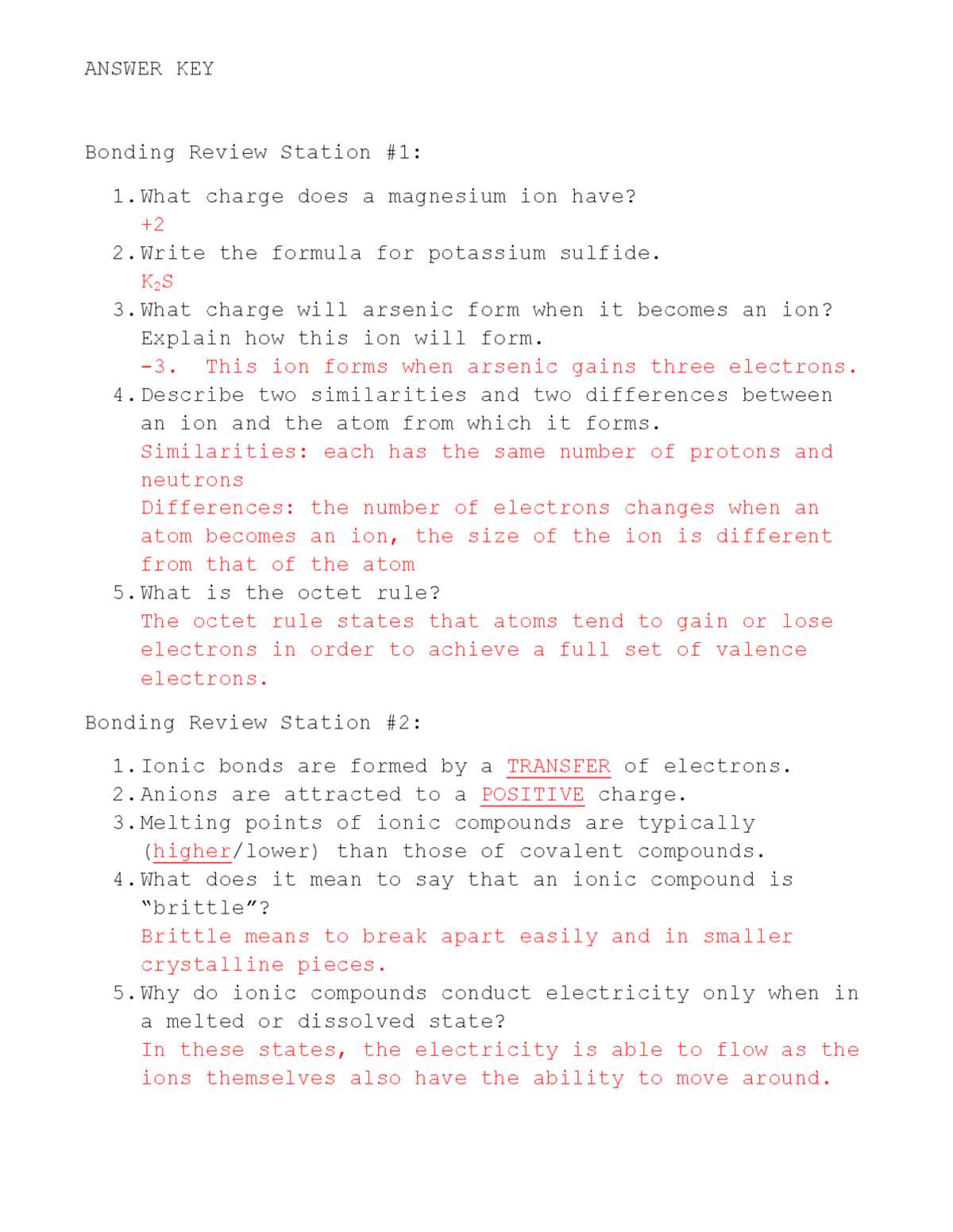
Focus on understanding electron configuration before attempting problems. By knowing how atoms gain or lose electrons, you’ll be able to predict the formation of ions with greater accuracy.
Work through various examples involving elements from different groups of the periodic table. This will help you identify patterns and become familiar with how atoms of different sizes and electronegativity values interact.
Practice writing the electron configuration for each atom before determining the charges of the ions. This step is crucial in identifying how many electrons are transferred during reactions.
Ensure you understand the role of electronegativity in the formation of charged particles. Elements with high electronegativity tend to gain electrons, while those with lower electronegativity will lose them.
When dealing with more complex compounds, pay attention to charge balance. For example, if one ion carries a +2 charge, you’ll need two -1 ions to balance the charges. Practice writing the chemical formula based on this principle.
Check your work by reviewing how the atoms and ions are arranged in the final compound. The total charge should always be neutral, so verify the ratio of ions to ensure charge neutrality.
Use diagrams to visualize electron transfer. This will help reinforce the concept of how atoms gain and lose electrons to form stable structures.
Finally, regularly review the trends in the periodic table, as these can give you insight into how elements interact and form compounds based on their position and properties.