How to Find Unknown Measures in Similar Triangles with Solutions
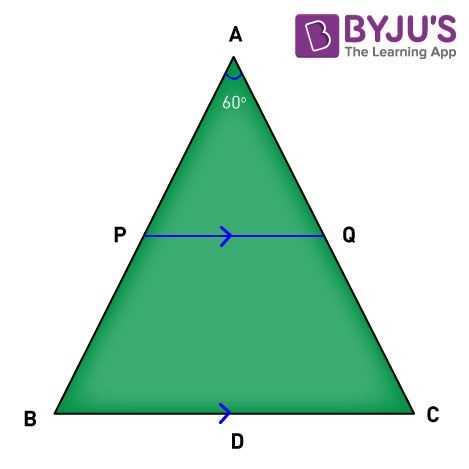
To solve for missing side lengths in proportional figures, begin by recognizing the relationship between the corresponding sides. When two figures are proportional, the ratio of their corresponding sides remains constant. This is the foundation for calculating any unknown lengths. Set up a proportion based on these known ratios to find the missing value.
For example, if two objects are similar, their corresponding sides will have the same ratio. By writing this ratio as a fraction, you can then solve for the unknown quantity using basic algebraic techniques. Whether you’re given one unknown side or multiple, this method applies consistently to all cases, making it a powerful tool for geometric analysis.
Pay attention to the specific properties of each figure. Sometimes, additional geometric principles such as angle congruence or parallel lines may be involved. If you identify these relationships, you can further narrow down your solution. Be sure to check for consistency in the ratios and ensure all corresponding sides align before finalizing your answer.
Finding Unknown Side Lengths in Proportional Figures
To solve for missing side lengths in proportional figures, first establish the relationship between the known and unknown sides. In proportional figures, the ratios of corresponding sides are equal. This allows you to create a proportion equation to find the missing value.
Follow these steps to solve for the missing side:
- Identify the corresponding sides of the two figures that are proportional.
- Write the proportion: (known side 1 / known side 2) = (unknown side 1 / unknown side 2).
- Cross-multiply and solve for the unknown side using basic algebra.
For example, if you know the side lengths of one triangle and need to find the missing side of another triangle that is proportional to the first, set up a proportion. If triangle A has side lengths 6 cm and 9 cm, and triangle B has a known side length of 4 cm and an unknown side, you can write the proportion:
6/9 = 4/x
Now, solve for x:
- Cross-multiply: 6 * x = 9 * 4.
- Simplify: 6x = 36.
- Divide both sides by 6: x = 6 cm.
This method can be applied to solve for any unknown side, as long as the two figures are proportional. For more detailed examples and explanations, you can refer to authoritative resources like the Khan Academy’s Geometry section.
Understanding the Properties of Proportional Figures
Proportional figures share specific properties that make it possible to solve for missing lengths. The key properties include:
- Corresponding Angles are Equal: In proportional figures, each pair of corresponding angles is congruent. This means that the shape of the figures remains the same, and only their size changes.
- Corresponding Sides are Proportional: The ratios of corresponding side lengths are equal. For example, if one side of a figure is twice as long as a corresponding side in another figure, all corresponding sides will follow this ratio.
- Scale Factor: The ratio between the lengths of corresponding sides is called the scale factor. This factor describes how much larger or smaller one figure is compared to the other.
- Ratio of Areas: The ratio of the areas of two proportional figures is the square of the scale factor. For example, if the scale factor is 2, the ratio of the areas will be 4 (2²).
To solve problems involving proportional figures, use these properties to set up a proportion. When you know some sides and angles, you can use the properties to calculate the missing sides or angles by maintaining the constant proportional relationships.
For more information and practice problems, visit Khan Academy’s Geometry Section.
Setting Up Proportions to Solve for Missing Values
To solve for missing values in proportional figures, set up a proportion by comparing corresponding side lengths. Follow these steps:
- Identify the corresponding sides: Look for pairs of sides that correspond to each other. These sides should have the same relative position in the two figures.
- Set up the proportion: Write a proportion where the ratio of one pair of corresponding sides is equal to the ratio of the other pair. For example, if one side of the first figure is 6 and the corresponding side in the second figure is 9, and you know one side in the second figure is 12, set up the equation as 6/9 = x/12, where x represents the missing side.
- Cross-multiply and solve: After setting up the proportion, cross-multiply the terms. This means multiplying the numerator of one fraction by the denominator of the other fraction, and solving for the unknown. In the example 6/9 = x/12, cross-multiply to get 6 * 12 = 9 * x, then solve for x.
- Check your answer: Make sure that the solution makes sense by checking the proportion. The ratios of corresponding sides should remain equal.
This method can be applied to any proportionate figures, allowing you to calculate missing side lengths or angles with accuracy. Remember to double-check the ratios and ensure you’re comparing the correct sides.
Identifying Corresponding Sides in Proportional Figures
To identify corresponding sides in proportional figures, focus on the following steps:
- Label the vertices: Assign labels to the vertices of the shapes. For example, if you have two triangles, label the vertices as A, B, and C for the first figure, and A’, B’, and C’ for the second figure.
- Observe the shape and angle relationships: In proportional figures, corresponding sides are those that are in the same relative position. For instance, side AB in the first shape corresponds to side A’B’ in the second shape.
- Compare angles: Corresponding sides are always opposite equal angles. If two figures have matching angles, the sides opposite those angles correspond with each other.
- Use the proportionality rule: The ratio of the corresponding sides should be constant. For example, if side AB corresponds to side A’B’, then the ratio of AB to A’B’ will be equal to the ratio of other corresponding sides, such as AC to A’C’.
By identifying the correct corresponding sides, you can set up accurate proportions to calculate unknown side lengths or solve for missing values. Always double-check that the angles and sides are correctly matched before applying any further calculations.
| First Figure | Second Figure |
|---|---|
| AB | A’B’ |
| BC | B’C’ |
| CA | C’A’ |
Using the Side-Angle-Side (SAS) Similarity Criterion
The Side-Angle-Side (SAS) similarity criterion allows you to determine if two figures are proportional by comparing one pair of corresponding sides and the included angle between them. Follow these steps:
- Identify the corresponding sides: Select one pair of sides from each figure that are known to be proportional. These sides should have the same relative position in each shape.
- Check the included angle: Verify that the angle between the selected sides in both figures is congruent. The angle must be exactly the same in both shapes for the SAS criterion to apply.
- Apply the criterion: If one pair of sides is proportional and the included angle is equal, then the figures are proportional by the SAS similarity criterion. This means the figures are similar, and the corresponding sides have a consistent ratio.
Once you confirm the similarity based on SAS, you can use the proportionality of the corresponding sides to calculate missing lengths or solve for other variables in the figures.
| First Figure | Second Figure |
|---|---|
| Side 1 | Side 1′ |
| Side 2 | Side 2′ |
| Included Angle | Included Angle’ |
Applying the Angle-Angle (AA) Similarity Postulate
The Angle-Angle (AA) similarity postulate states that if two angles of one figure are congruent to two angles of another figure, the figures are proportional. To apply this rule:
- Identify the corresponding angles: Locate two angles in one figure and find the corresponding angles in the other figure. These angles must match exactly for the postulate to apply.
- Verify congruency: Check if the corresponding angles are congruent (equal in measure). If they are, the figures are similar based on the AA postulate.
- Use proportionality: Once the similarity is established, you can apply the proportional relationship between the corresponding sides to calculate missing values.
This postulate works well when you are given angle measures and need to determine the similarity between two figures. It provides a simple and quick way to solve for various properties such as side lengths without needing to know all the dimensions of the figures.
Solving for Missing Sides Using Cross Multiplication
Cross multiplication is an effective technique for solving for missing sides when proportionality is established between two figures. Here’s how to apply this method:
- Set up the proportion: Write the ratio of corresponding sides as a fraction. For example, if you know the ratio of the sides of two figures, it might look like this: a/b = c/d, where a and b are the sides of the first figure and c and d are the sides of the second.
- Cross multiply: Multiply the numerator of one fraction by the denominator of the other. In this case, cross multiplying gives you a * d = b * c.
- Solve for the missing value: Rearrange the equation to isolate the missing side. For example, if a and b are known, and you are solving for c, rearrange to c = (a * d) / b.
This method works because the ratios of corresponding sides in proportional figures are equal. Cross multiplication allows you to quickly and accurately solve for the missing side without needing additional complex calculations.
Common Mistakes to Avoid in Similar Triangle Problems
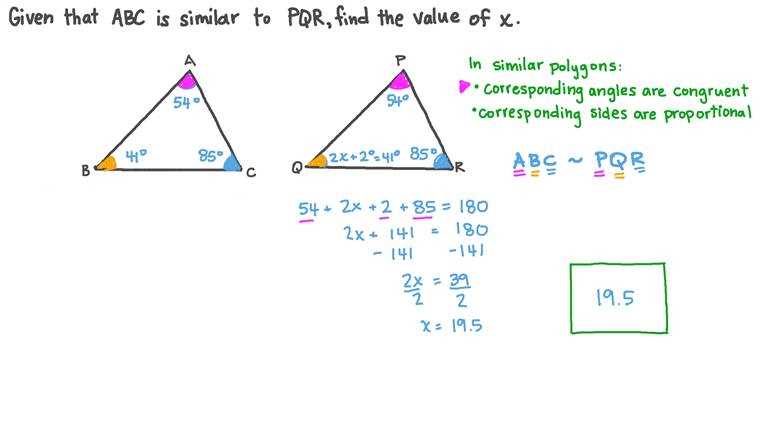
When working with proportional figures, avoid these common mistakes:
- Misidentifying corresponding sides: Ensure that the sides are matched correctly. For example, the longest side in one figure should correspond to the longest side in the other.
- Incorrectly setting up proportions: Double-check that the ratios of corresponding sides are written in the right order. A common mistake is swapping the numerator and denominator.
- Forgetting to square the scale factor in area problems: When calculating areas, use the square of the scale factor, not just the factor itself.
- Assuming figures are proportional without verifying: Always confirm that the figures meet the criteria for proportionality (e.g., equal angles and corresponding sides proportional) before solving.
- Not simplifying ratios: After setting up the proportion, simplify the ratios before proceeding with calculations for clarity and ease.
By avoiding these errors, you can solve problems more accurately and with greater confidence.
Practice Problems and Solutions for Reinforcement
To strengthen your skills, solve the following exercises:
- Problem 1: If two figures are proportional and one figure has sides of 8 cm, 6 cm, and 4 cm, and the second figure has sides of 16 cm, 12 cm, and an unknown side, find the missing side length.
- Problem 2: In two proportional shapes, the lengths of corresponding sides are 3 cm, 9 cm, and 12 cm. The larger shape has a side length of 18 cm. Determine the corresponding side in the larger shape.
- Problem 3: A small figure has side lengths of 7 cm, 5 cm, and 4 cm. The larger figure’s corresponding side lengths are 21 cm, 15 cm, and an unknown length. Find the missing side length.
Solution: Set up the proportion: 8/16 = 6/12. The missing side is 4 cm.
Solution: Set up the proportion: 3/18 = 9/x. Solve for x to get 27 cm.
Solution: Set up the proportion: 7/21 = 5/x. The missing side is 15 cm.
Continue practicing with additional problems to ensure full understanding and accuracy.