Pedigree Worksheet Solutions and Analysis Guide
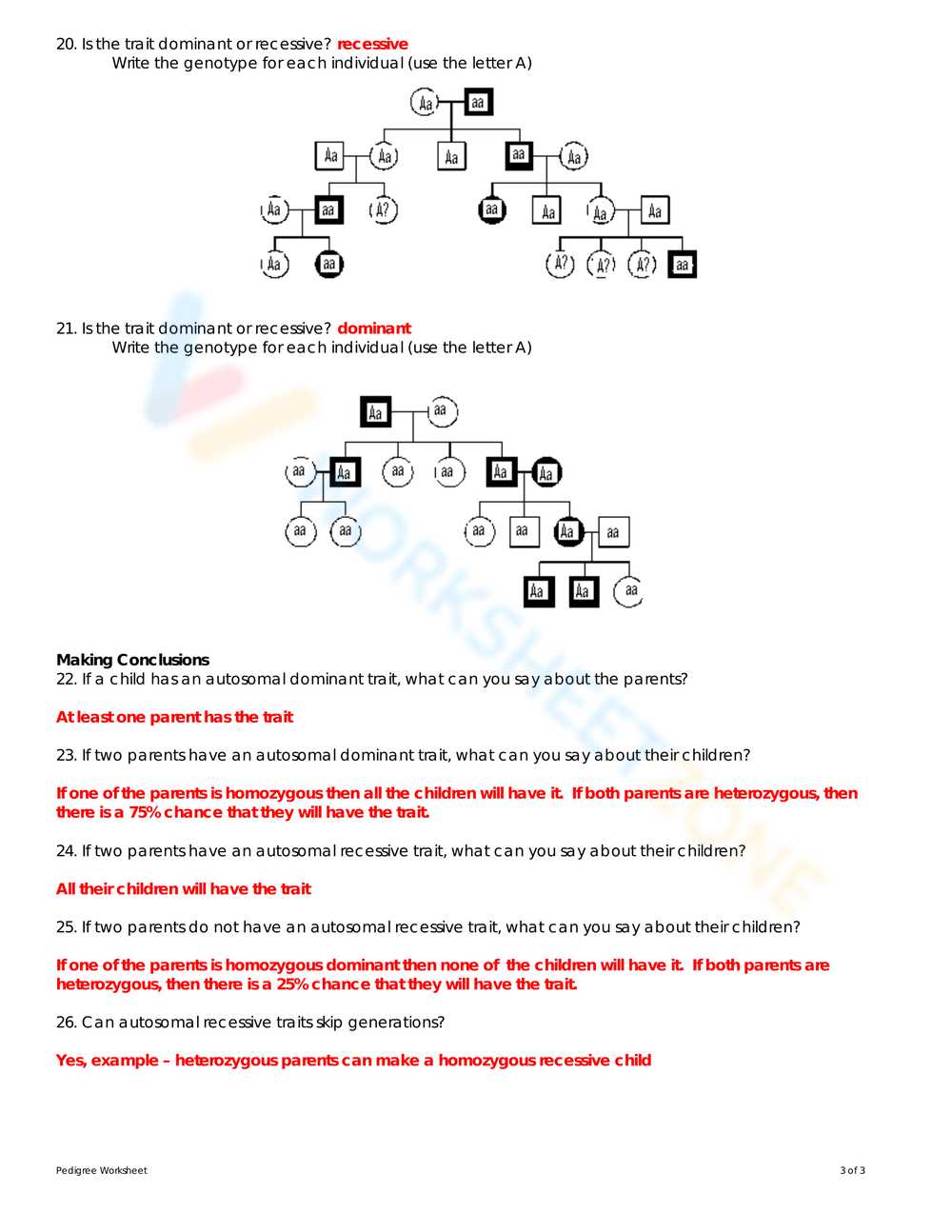
Begin by focusing on the symbols used in genetic family diagrams. Each shape, line, and color represents specific genetic traits and familial relationships. Understanding these markers is the first step toward accurate analysis. For example, squares typically represent males, while circles represent females. Lines connecting these shapes show relationships, and filled symbols indicate the presence of a genetic condition.
Next, recognize inheritance patterns such as autosomal dominant, autosomal recessive, and X-linked traits. Knowing how traits are passed down through generations will help you make correct assumptions about family members and their genetic conditions. For instance, autosomal dominant traits often appear in every generation, while recessive traits may skip generations, only showing up when both parents carry the recessive allele.
When analyzing a family chart, make sure to trace the family tree backward to identify potential carriers of genetic conditions. Marking family members correctly and observing the genetic inheritance pattern will give you a clear understanding of the family’s genetic history. This method will guide you in filling out and interpreting these diagrams effectively, ensuring accurate conclusions.
Genetic Chart Solutions and Analysis Guide
Begin by identifying the key relationships in the genetic diagram. Squares represent males, and circles represent females. If a symbol is filled, it indicates that the individual exhibits the genetic trait being studied. Unfilled symbols show the absence of the trait. Lines connecting individuals demonstrate their familial connections, with horizontal lines showing marriages and vertical lines indicating offspring.
Next, determine the inheritance pattern based on the trait’s appearance across generations. In autosomal dominant inheritance, the condition typically appears in every generation, even if one parent does not show symptoms. For recessive traits, individuals must inherit two copies of the recessive allele, one from each parent, which can skip generations. This pattern is crucial when analyzing how the condition might be passed down.
For X-linked traits, pay attention to the gender distribution of the condition. Males are more likely to express X-linked recessive conditions because they have only one X chromosome. Females, with two X chromosomes, typically need to inherit the condition from both parents to express it. Analyzing gender-specific inheritance patterns is key to interpreting X-linked conditions.
After identifying the inheritance pattern, trace each individual’s potential genotype, considering the genetic information passed from one generation to the next. Mark the genotypes of the family members where possible, keeping in mind that heterozygous carriers for recessive traits are often unaffected but can pass the condition to their offspring.
Finally, summarize your analysis by providing a clear interpretation of the results. Identify the risk for future generations based on the observed inheritance pattern and the genotypes of the family members. This process will guide your understanding of how genetic traits are passed through the family tree and help predict the likelihood of the condition occurring in future generations.
How to Interpret Genetic Charts
To begin interpreting a genetic chart, identify the key symbols: squares represent males, and circles represent females. Filled symbols indicate the presence of a trait, while unfilled ones suggest its absence. These symbols are connected by lines: horizontal lines denote marriages, and vertical lines represent offspring.
Next, analyze the inheritance pattern. In autosomal dominant inheritance, the trait is present in every generation, and only one parent needs to pass on the allele. For autosomal recessive traits, both parents must pass on a recessive allele for the offspring to express the trait. If only one allele is inherited, the individual becomes a carrier without expressing the condition.
For X-linked traits, pay close attention to gender distribution. Males, with one X chromosome, are more likely to show X-linked conditions, especially recessive ones. Females, with two X chromosomes, generally need both to carry the mutation for it to be expressed. Affected males will pass the mutation to all of their daughters but not to their sons.
It’s important to identify any carriers in the chart, especially when dealing with recessive or X-linked traits. Carriers typically do not show symptoms but can pass the trait to their offspring. Understanding who the carriers are helps predict the likelihood of the trait being passed to the next generation.
To further verify your interpretation, compare the chart to known inheritance patterns and genetic principles. If available, consult additional resources or databases to ensure accuracy. A thorough understanding of inheritance types–dominant, recessive, X-linked–is crucial in interpreting genetic relationships.
For more detailed information on genetic chart interpretation, you can refer to resources from the National Institutes of Health (NIH) at https://www.nih.gov.
Common Symbols Used in Genetic Charts
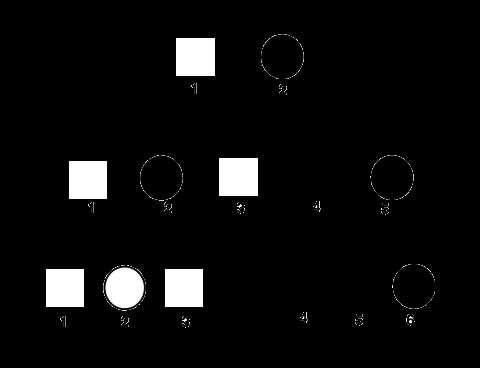
Genetic charts utilize specific symbols to represent individuals and their traits. Here are the most common symbols:
| Symbol | Description |
|---|---|
| Circle | Represents a female individual |
| Square | Represents a male individual |
| Filled Circle/Square | Indicates that the individual expresses a particular trait or condition |
| Unfilled Circle/Square | Represents an individual who does not express the trait |
| Horizontal Line | Connects two individuals in a marriage or partnership |
| Vertical Line | Connects parents to their offspring |
| Diagonal Line | Used to indicate deceased individuals |
| Double Line | Represents consanguineous marriage (marriage between relatives) |
| Half-filled Circle/Square | Represents a carrier of a recessive trait, who does not express it but can pass it on |
Understanding these symbols is critical for accurately interpreting the chart. These symbols help track the inheritance of specific traits or genetic conditions across generations, allowing for an easy analysis of genetic relationships and patterns.
Steps to Solve Genetic Charts
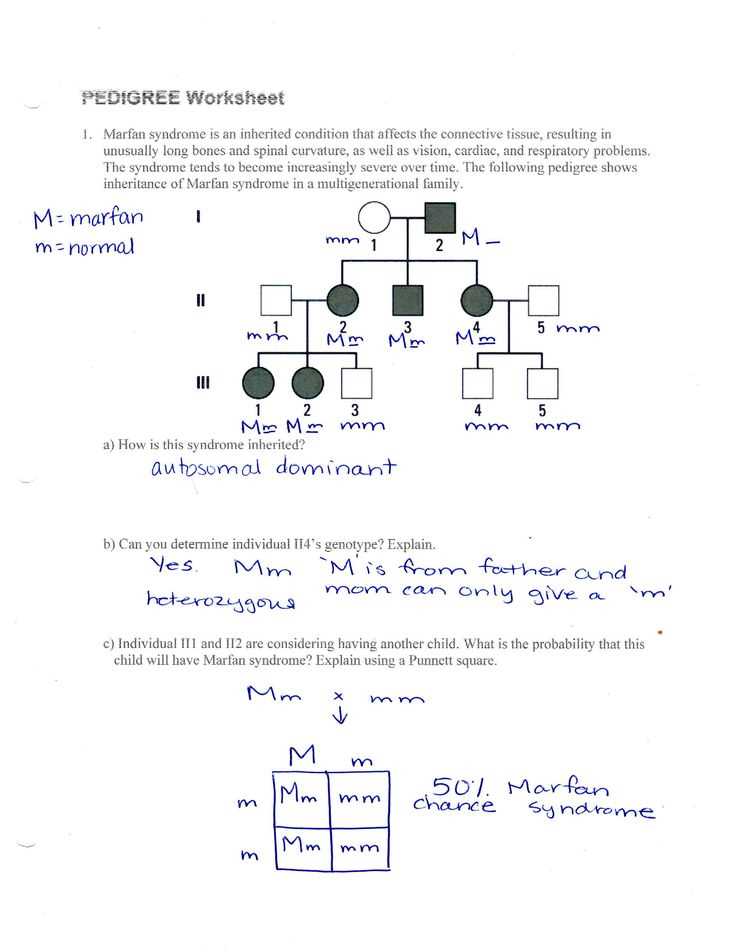
Follow these steps to effectively interpret and solve genetic charts:
- Review the Chart Structure: Begin by examining the structure of the chart. Identify the generations, relationships, and symbols used for males, females, and specific traits.
- Identify Parents and Offspring: Trace the vertical lines connecting parents to children. Ensure you understand which individuals belong to each family line.
- Note Affected Individuals: Look for filled squares or circles to determine who expresses the given trait or genetic condition. These individuals will help guide your analysis.
- Understand the Mode of Inheritance: Identify whether the trait follows a dominant or recessive inheritance pattern. This will influence how you analyze family members and their potential carriers.
- Track Carrier Status: If an individual is a carrier, it will typically be represented by half-filled squares or circles. Keep track of potential carriers in each generation.
- Analyze Patterns Across Generations: Pay close attention to how the trait is passed from one generation to the next. Look for patterns that suggest dominant or recessive inheritance.
- Consider Genetic Probabilities: Use the family tree to calculate the likelihood of offspring inheriting the trait. This step is crucial in predicting future generations.
- Double-Check for Accuracy: After filling in the chart, review all entries for consistency. Make sure the inheritance patterns align with the genetic principles you’ve applied.
By following these steps, you’ll be able to accurately interpret and solve genetic charts, helping you understand inheritance patterns and relationships across generations.
Understanding Inheritance Patterns in Genetic Diagrams
Inheritance patterns can be understood by identifying how traits are passed from one generation to the next. There are several key patterns to recognize:
- Autosomal Dominant Inheritance: A dominant allele causes the trait. It appears in every generation, with affected individuals passing the trait to approximately 50% of their offspring, regardless of gender.
- Autosomal Recessive Inheritance: A recessive allele must be inherited from both parents to express the trait. It may skip generations and often shows up when both parents are carriers.
- X-linked Inheritance: Traits carried on the X chromosome may be passed from mother to son or daughter. Males are more frequently affected as they only have one X chromosome, while females require two copies of the mutant allele to express the trait.
- Y-linked Inheritance: Y-linked traits are passed from father to son only, as only males have a Y chromosome. These traits do not appear in females.
- Codominance: Both alleles contribute equally to the phenotype. For example, in blood type inheritance, both A and B alleles are expressed equally in individuals with AB blood type.
- Incomplete Dominance: The heterozygote expresses a phenotype that is intermediate between the two homozygous phenotypes. For instance, a red flower crossed with a white flower may produce pink flowers.
Recognizing these patterns allows you to predict the likelihood of traits appearing in future generations. By studying the inheritance of traits in family trees, you can better understand genetic links and probabilities.
How to Identify Genetic Disorders Using Family Diagrams
To identify genetic disorders, first observe the inheritance pattern displayed in the family chart. Start by examining the affected individuals and their relationships to others in the diagram.
- Examine the gender distribution: In X-linked disorders, males are more commonly affected because they only have one X chromosome. If the disorder appears predominantly in males, it may indicate an X-linked inheritance pattern.
- Look for autosomal inheritance: If the disorder affects both males and females equally and can skip generations, it is likely autosomal recessive. If it appears in every generation, it suggests autosomal dominant inheritance.
- Identify carrier parents: For recessive disorders, individuals with one copy of the mutant gene (carriers) do not show symptoms but can pass the allele to offspring. If both parents are carriers, there is a 25% chance the offspring will be affected.
- Track the generation gaps: Autosomal dominant disorders typically appear in each generation, while recessive disorders may skip generations. If the disorder skips one or more generations, it suggests a recessive pattern.
- Check for consanguinity: In some cases, consanguinity (marriage between close relatives) increases the likelihood of recessive genetic disorders due to the increased chance of inheriting the same recessive allele from both parents.
By identifying these patterns, it becomes easier to predict the likelihood of passing on genetic disorders in future generations.
Tips for Analyzing X-linked Traits in Family Charts
When analyzing X-linked traits, keep these points in mind:
- Focus on gender distribution: X-linked disorders affect males more often than females because males have only one X chromosome. If a disorder is more prevalent in males, it suggests an X-linked inheritance pattern.
- Track inheritance patterns: If the trait is X-linked recessive, the disorder will appear mostly in males, with females acting as carriers. Affected males inherit the trait from their mother, while females must inherit two copies of the mutated gene to be affected.
- Look for female carriers: Female carriers of an X-linked recessive trait show no symptoms but can pass the mutated gene to their sons. Male offspring of carriers have a 50% chance of being affected.
- Check for maternal inheritance: In X-linked inheritance, the father cannot pass the trait to his sons, only to his daughters. This means an affected father will have all daughters who are carriers but will not pass the trait to his sons.
- Identify skipped generations: In X-linked recessive inheritance, the disorder may skip generations, especially in females. Affected males will pass the gene to all of their daughters, but none of their sons.
Understanding these points will help in accurately identifying and predicting the inheritance of X-linked traits in future generations.
How to Draw and Complete a Family Tree Chart
To create and complete a family chart, follow these steps:
- Start with the oldest known generation: Begin by placing the earliest known ancestors at the top of the chart. Use squares to represent males and circles for females.
- Connect family members: Draw lines between parents and children. A horizontal line connects the parents, and vertical lines lead to their children, indicating direct family relationships.
- Include all relevant details: For each family member, include key information such as birth and death dates, and any specific traits or conditions relevant to the chart.
- Mark affected individuals: Use shading or different colors to indicate individuals with specific traits, such as genetic conditions. This helps to visually track the inheritance pattern.
- Use standard symbols: Remember that males are represented by squares and females by circles. A filled-in square or circle indicates an affected individual, while an empty shape represents an unaffected individual.
- Follow the correct inheritance pattern: As you add generations, make sure to correctly represent the inheritance pattern, whether autosomal dominant, autosomal recessive, or X-linked.
- Check for consistency: Review the chart to ensure all connections, symbols, and family relationships are accurate. Double-check for missing individuals or inconsistencies.
By following these steps, you can create a clear and informative family tree chart that accurately displays hereditary traits or conditions across generations.
Common Mistakes in Family Tree Analysis and How to Avoid Them
To avoid errors in analyzing family relationships and traits, focus on the following points:
- Misidentifying gender: Ensure the correct use of symbols: squares for males and circles for females. Double-check each individual’s gender before making connections.
- Incorrectly linking family members: Always verify that lines connecting parents and children are accurate. Misplaced lines can lead to confusion about generational relationships.
- Overlooking incomplete data: If certain information is missing, such as birth or death dates, it’s important to fill in those gaps or indicate that the data is unknown to avoid inaccuracies in the analysis.
- Failing to show inheritance patterns: Clearly indicate whether a condition is dominant, recessive, or X-linked. Inaccurate representation of inheritance can lead to incorrect conclusions.
- Ignoring multiple generations: Sometimes, analysis focuses only on a few generations. Be sure to trace the lineage through all relevant generations to get a full picture of the inheritance pattern.
- Confusing carriers with affected individuals: For recessive conditions, carriers (heterozygotes) should be marked with half-shaded circles or squares. Ensure you distinguish between carriers and those with the condition.
- Misunderstanding consanguinity: In cases of marriages between relatives, make sure to mark the relationship correctly. Consanguinity (inbreeding) can influence the expression of traits.
By carefully avoiding these common mistakes, the analysis of genetic patterns in family trees will be more accurate and reliable.