Comprehensive Guide to Gas Law Review and Solution Breakdown
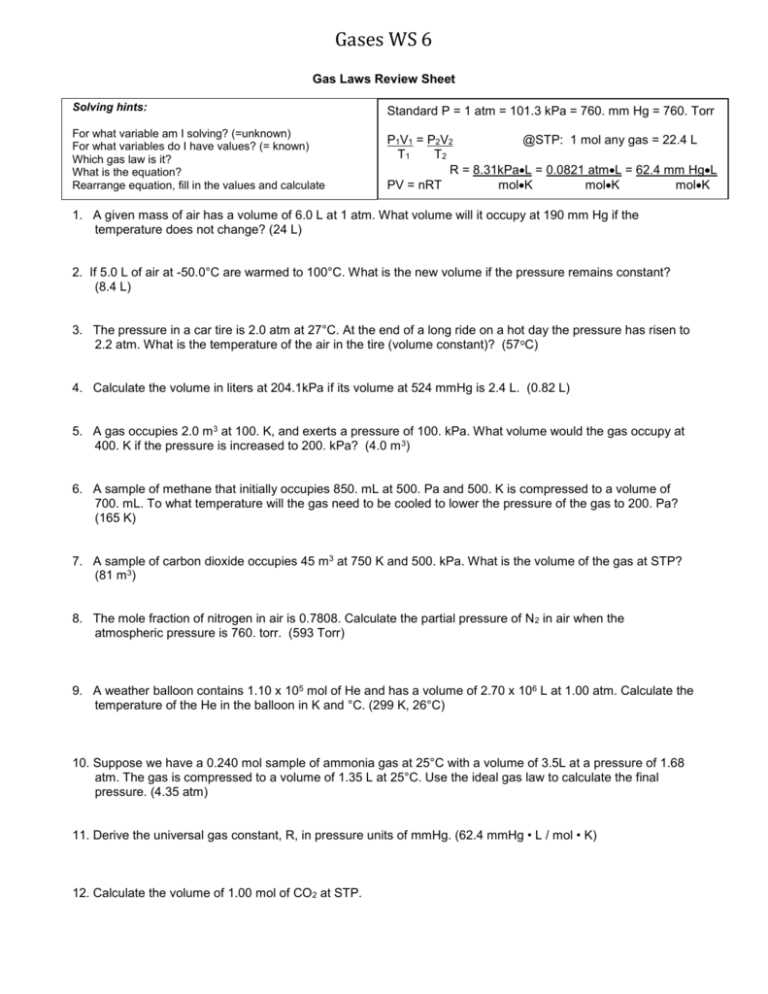
To master the relationship between pressure, volume, temperature, and quantity of gases, you must first understand the mathematical principles behind these connections. Begin by recognizing that the behavior of gases is predictable and can be explained using simple equations that link each of these properties. By breaking down these formulas, you will be able to determine the unknowns in various problems, such as how volume changes with temperature or how pressure is affected by gas quantity.
Start solving problems by focusing on the correct equation based on the variables provided. For instance, Boyle’s equation can be used when pressure and volume are inversely related, while Charles’ law comes into play when dealing with temperature and volume. Similarly, Avogadro’s principle links the number of gas molecules with volume at constant pressure and temperature. It’s critical to identify which properties remain constant in each situation, as this will guide your approach to solving each problem.
Once you are familiar with the core principles, ensure that you carefully plug in known values and consistently check your units for accuracy. By practicing with multiple examples, you can refine your problem-solving skills and gain confidence in applying these formulas to real-world scenarios.
Solving Problems with Ideal Gas Equations
Start by applying the ideal gas equation, PV = nRT, where P represents pressure, V is volume, n is the amount of gas in moles, R is the universal gas constant, and T is temperature in Kelvin. Use this equation when the problem provides values for pressure, volume, and temperature, and you need to solve for any one of the unknown variables. Ensure that units are consistent, especially for temperature (in Kelvin) and pressure (usually in atmospheres or Pascals).
Boyle’s Law: Understanding Pressure-Volume Relationship
Boyle’s Law, P1V1 = P2V2, describes the inverse relationship between pressure and volume at constant temperature. If pressure increases, volume decreases proportionally, and vice versa. When solving problems, identify which variables remain constant (in this case, temperature) and apply the equation to solve for the unknown quantity. Always verify that the units for pressure and volume are compatible before solving.
Charles’ Law: Exploring Volume-Temperature Relations
Use Charles’ Law, V1/T1 = V2/T2, when temperature and volume are directly related at constant pressure. An increase in temperature will cause the volume to expand. Ensure that temperature is converted to Kelvin, as the law applies only to absolute temperatures. Identify the known values for initial and final volumes and temperatures, then rearrange the equation to solve for the unknown.
Avogadro’s Law: Relating Volume and Mole Quantity
Avogadro’s Law states that at constant pressure and temperature, the volume of a gas is directly proportional to the number of moles of gas present: V1/n1 = V2/n2. If you are provided with the number of moles and volume at different conditions, use this relationship to determine how volume will change as the number of moles increases or decreases. Again, ensure consistency in units before calculating.
Combined Gas Law: Linking All Variables
The combined gas law is a consolidation of Boyle’s, Charles’ and Avogadro’s laws and is expressed as P1V1/T1 = P2V2/T2. Use this equation when multiple variables change simultaneously (pressure, volume, and temperature). It is particularly useful when comparing two different sets of conditions. Carefully isolate the unknown variable and solve by cross-multiplying the known values.
Dalton’s Law of Partial Pressures
Dalton’s Law states that the total pressure of a gas mixture is the sum of the partial pressures of individual gases: Ptotal = P1 + P2 + P3 + …. Use this law when dealing with a mixture of gases. If given the individual partial pressures of gases in a mixture, simply add them up to find the total pressure. Be mindful of the units used for pressure in the problem.
Graham’s Law of Effusion: Comparing Gas Rates
Graham’s Law provides a way to compare the rates of effusion (the movement of gas particles through a small hole) for two gases: r1/r2 = √(M2/M1), where r1 and r2 are the rates of effusion and M1 and M2 are the molar masses of the gases. Use this equation to determine which gas will effuse faster based on their molar masses. The lighter the gas, the faster it will effuse.
Practical Tips for Using Gas Equations
When solving gas problems, always start by carefully analyzing the given information and choosing the correct equation. Ensure that all units are consistent, particularly for temperature (Kelvin) and pressure. Double-check your work by verifying if the results make logical sense given the physical behavior of gases. If you’re unsure about a step, recheck the equation and its application before proceeding. Consistent practice with various problems will help reinforce your understanding and improve problem-solving skills.
Understanding the Ideal Gas Equation and Its Applications
The ideal gas equation is a foundational principle in understanding the behavior of gases under various conditions. The equation, PV = nRT, relates pressure (P), volume (V), the number of moles (n), temperature (T), and the gas constant (R). This relationship is crucial for solving problems involving gases when the conditions (pressure, temperature, volume) change, and one of the variables needs to be calculated.
Start by ensuring all units are consistent before applying the equation. For temperature, convert to Kelvin. For pressure and volume, choose compatible units, such as atm for pressure and liters for volume, with the gas constant R = 0.0821 L·atm/(mol·K). Using the ideal gas equation is straightforward when you have values for at least four of the variables. If any variable is unknown, solve for it algebraically by rearranging the equation.
Common applications of this equation include calculating the volume of a gas at a specific temperature and pressure, determining the number of moles in a given volume, or finding the temperature when the pressure and volume are known. The ideal gas equation is particularly useful in laboratory settings, engineering, and when working with gases in thermodynamic processes.
In practical scenarios, such as in a chemistry experiment, you may encounter changes in conditions. For example, if a gas undergoes expansion or compression, you can apply the equation to predict how its volume will change with a given change in pressure or temperature. For reactions involving gases, the ideal gas law helps in determining the amount of reactant or product involved in the reaction.
Although the ideal gas equation provides an excellent approximation for many gases, it has limitations. It assumes the gas particles do not interact and occupy no volume themselves, which is not always true for real gases, especially under high pressure and low temperature. In such cases, more complex equations, like the Van der Waals equation, might be required to account for these interactions.
For reliable results, carefully examine the conditions of the gas in the problem. Ensure that the ideal gas law is applicable, meaning the gas behaves ideally under the given circumstances. If the gas is likely to exhibit significant intermolecular forces or occupy a significant volume, consider using adjustments or alternative models.
How to Solve Problems Using Boyle’s Equation
To solve problems using Boyle’s equation, begin by identifying the two conditions of pressure and volume at different stages. Boyle’s equation, P1 × V1 = P2 × V2, expresses the inverse relationship between pressure and volume. This means that when the pressure of a gas increases, its volume decreases, provided the temperature remains constant.
Start with rearranging the equation if you’re solving for a specific variable. For instance, to find the final pressure P2, use P2 = (P1 × V1) / V2. Ensure that the pressure and volume are in compatible units, such as atmospheres (atm) for pressure and liters (L) for volume.
Step-by-step, plug in the known values for P1, V1, and V2 into the equation. After solving, check the unit consistency and ensure the result aligns with the expected change in pressure and volume. If you have the final pressure, you can use the same method to find the volume at the new pressure.
For example, if a balloon’s volume decreases from 4.0 L to 2.0 L as the pressure increases from 1.0 atm to the unknown value, substitute the values into the equation: (1.0 atm × 4.0 L) = (P2 × 2.0 L). After simplifying, solve for P2 to find that P2 = 2.0 atm.
In problems involving real-world scenarios, make sure that the temperature remains constant, as Boyle’s equation assumes this condition. If temperature changes are involved, you may need to consider other equations that account for thermal effects, such as the combined gas law.
Applying Charles’ Equation for Volume-Temperature Relationships
To solve problems based on Charles’ equation, use the formula V1/T1 = V2/T2, which represents the direct relationship between the volume and temperature of a gas. This equation states that the volume of a gas is directly proportional to its temperature (in Kelvin), provided pressure remains constant.
When solving a problem, start by ensuring that temperature is measured in Kelvin. Convert Celsius to Kelvin by adding 273.15 to the Celsius temperature. For example, if the temperature is 25°C, convert it to 298.15 K (25 + 273.15).
After converting temperatures, substitute the known values into the equation. For example, if a gas has an initial volume of 3.0 L at 300 K and the final temperature is 350 K, substitute these values into the equation: 3.0 L / 300 K = V2 / 350 K. Solve for V2 to find the new volume: V2 = (3.0 L × 350 K) / 300 K = 3.5 L.
If you encounter a problem where only the final temperature and volume are given, rearrange the equation to solve for the unknown value. For example, V2 = V1 × (T2 / T1).
Remember that temperature must always be in Kelvin for consistency and to ensure correct results. If the temperature is given in Celsius, always convert it before applying the formula. For practical use, this equation helps in understanding how heating or cooling a gas impacts its volume under constant pressure.
Using Avogadro’s Equation to Determine Molar Volume
To calculate molar volume using Avogadro’s relationship, apply the formula: V = (n × Vm), where V is the volume, n is the amount of substance in moles, and Vm is the molar volume (22.4 L at STP for ideal gases).
For example, if you have 2 moles of a gas at standard temperature and pressure (STP), you can find the volume by multiplying the number of moles by the molar volume:
- V = 2 mol × 22.4 L/mol = 44.8 L
Ensure that the conditions are at STP for this direct calculation. If the temperature or pressure deviates from STP, use the ideal gas equation to adjust accordingly. For conditions not at STP, the formula becomes:
- V = (n × R × T) / P, where R is the ideal gas constant, T is the temperature in Kelvin, and P is the pressure.
This equation allows you to determine the molar volume for gases under varying conditions by substituting known values for temperature and pressure. It is a useful tool in both theoretical and applied chemistry settings, providing a straightforward way to calculate how much space a certain number of gas molecules will occupy.
For more detailed information on the subject, you can refer to trusted chemistry sources like Chegg or check reputable textbooks on thermodynamics and gas properties.
Real vs Ideal Gases: Key Differences Explained
Ideal gases are theoretical models used to simplify the behavior of gases. They follow the ideal gas equation perfectly, with no interactions between particles and no volume occupied by the molecules themselves. In contrast, real gases do not behave according to this equation, especially under conditions of high pressure and low temperature.
The key differences between real and ideal gases include:
- Particle Interactions: Ideal gases assume no intermolecular forces, while real gases experience attractive and repulsive forces between molecules.
- Volume of Gas Molecules: Ideal gases are assumed to have no volume, but real gas molecules do occupy space and their volume can become significant under certain conditions.
- Deviations at High Pressure and Low Temperature: Ideal gas behavior is most accurate at high temperatures and low pressures, where the interactions between molecules are minimal. Real gases deviate more from ideal behavior at high pressure and low temperature, as intermolecular forces become more significant.
- Compression and Expansion: Real gases compress and expand less predictably than ideal gases, especially near their condensation point, where their behavior becomes more complex due to molecular attractions.
To calculate the behavior of real gases, the van der Waals equation is often used, which accounts for intermolecular forces and the finite volume of molecules. This equation is more accurate for gases under extreme conditions compared to the ideal gas law.
Understanding these differences is important for accurately predicting the behavior of gases in real-world applications, such as in industrial processes, meteorology, and the study of chemical reactions.
Common Mistakes in Gas Law Problems and How to Avoid Them
One of the most frequent mistakes in solving gas-related problems is forgetting to convert units. Ensure that all measurements, such as pressure, volume, and temperature, are in the correct units before applying any formulas. For example, pressure should be in atmospheres (atm), volume in liters (L), and temperature in Kelvin (K). Failing to convert can lead to incorrect results.
Another common error is not using the correct formula for the specific situation. For instance, using the ideal gas equation when the gas exhibits non-ideal behavior can yield inaccurate results. In such cases, the van der Waals equation should be used instead of the ideal gas law.
Be mindful of temperature scales. Many students mistakenly use Celsius instead of Kelvin, which can lead to errors in calculations. Always convert Celsius to Kelvin by adding 273.15 before using the temperature in gas equations.
Additionally, misunderstanding the relationship between variables can lead to errors. For example, when pressure increases, volume decreases in accordance with Boyle’s law, but failing to recognize this inverse relationship can lead to incorrect predictions. Double-check the expected trends in the problem and ensure that the equation reflects those trends.
Lastly, neglecting significant figures can affect the precision of your answers. Always carry the correct number of significant figures through calculations and round off only at the final step to avoid loss of accuracy.
Step-by-Step Guide for Solving Combined Gas Law Problems
To solve problems using the combined equation, follow these steps:
- Identify known variables: Carefully read the problem and identify all given values, including initial and final pressure, volume, and temperature.
- Convert units: Ensure that all units are consistent. Convert temperature to Kelvin (K), volume to liters (L), and pressure to atmospheres (atm), if necessary.
- Write the combined equation: Use the combined form of the gas equation:
P1 * V1 / T1 = P2 * V2 / T2
- Substitute known values: Plug the given values into the equation, ensuring that each variable corresponds to the correct parameter (initial or final state).
- Solve for the unknown: Rearrange the equation to solve for the unknown variable. For example, if you need to find volume, rearrange the equation as:
V2 = P1 * V1 * T2 / (P2 * T1)
- Check your units: Verify that your answer has the correct units. If necessary, convert back to the desired unit (e.g., from liters to milliliters or atmospheres to pascals).
- Verify the result: Consider whether the result makes sense based on the relationships between pressure, volume, and temperature. For example, if temperature increases, volume should increase, assuming pressure remains constant.
How to Interpret Gas Law Graphs and Data Tables
To accurately interpret graphs and data tables in relation to gas behavior, follow these key steps:
- Identify the variables: Review the axes of the graph or the columns in the data table. Typically, pressure, volume, and temperature are the variables plotted or listed. Ensure you know which variable corresponds to each axis or column.
- Understand the relationship: Determine how the variables relate to one another. For example, in a volume vs. temperature graph, the relationship should be direct, meaning as temperature increases, volume also increases (Charles’ Law).
- Examine the trend: Analyze the shape of the graph. If the graph is a straight line, it indicates a linear relationship (such as Boyle’s Law where pressure is inversely proportional to volume). If the graph is curved, it may indicate a more complex relationship like a direct or inverse square relationship.
- Check for anomalies: Look for any inconsistencies in the data or unusual patterns. These could indicate experimental errors or conditions outside the expected range for the gas.
- Interpret the slope or area: In many graphs, the slope (change in y over change in x) represents the rate of change between the variables. For example, in a pressure-volume graph, the slope may reveal how pressure changes with volume.
- Use the table for exact values: In data tables, extract the exact numerical values for each variable at different conditions. Use these values to perform calculations or to compare with theoretical predictions.
- Apply the correct equation: Once the trend is understood, use the appropriate gas equation to calculate unknown variables or predict behavior under different conditions.